A 203-lap race decided by a green-white-checkered restart, a red flag for spilled oil and a pole sitter caught in the final-lap crash.
The 2015 Daytona 500 was won by Joey Logano for Team Penske after a green-white-checkered finish. Kevin Harvick was second, and the race ended with a final-lap pileup that involved pole sitter Jeff Gordon, who finished 33rd.
Joey Logano won the 2015 Daytona 500 for Team Penske, the second Daytona 500 victory for Roger Penske's organisation and the ninth Cup win of Logano's career. The race ran 203 laps after a green-white-checkered finish extended it from 200, and it was settled on the final restart.
Who won the 2015 Daytona 500?
The race was decided at the end of a 203-lap run, and Logano crossed first after the final caution. Harvick was runner-up, and the top five was filled out by Earnhardt, Hamlin and Johnson.
Logano took the lead with ten laps remaining in the original distance and was ahead of Harvick when the final caution ended the race in his favour. He crossed the line to celebrate a win that gave him the lead in the points standings by five over Harvick.
x
Why did Logano's win matter?
The victory was the ninth of Logano's Cup career and the second Daytona 500 for Team Penske. At 24 years of age he became the second-youngest winner in the history of the race, behind Trevor Bayne, who was 20 when he won in 2011.
The victory also helped Ford in the manufacturer race, where the marque now led Chevrolet by a narrow margin.
How did the absence of the Busch brothers change the race?
The Xfinity race the previous day had put Kyle Busch in hospital with serious leg injuries, which ruled him out. Kurt Busch was suspended by NASCAR while facing a domestic violence trial, so the Busch brothers were absent together for the first time since 2001.
Crafton took Kyle Busch's place in the field. Regan Smith replaced Kurt Busch, and because of NASCAR's rule for changes after qualifying, Smith had to start from the rear.
What changed on track and in the rules?
Pit road was now watched by Forty-five cameras, a system that let NASCAR cut the number of officials on the lanes from 24 to 10. Eight officials watched the feed from a truck outside the track.
Because lug nut violations were no longer penalised, the teams took full responsibility for making sure the wheels stayed on.
Who changed teams for the 2015 season?
Fifty drivers were entered for the race, and the entry list was released on 12 February at 9:22 a.m. Eastern. Joe Nemechek's team withdrew before qualifying after problems preparing the car.
Thirteen drivers were racing for a different team from the one they had used in 2014. Trevor Bayne moved to Roush Fenway Racing after five part-time seasons with Wood Brothers Racing, and Ryan Blaney took his place in the No. 21 Ford on a part-time basis. Sam Hornish Jr. returned to full-time Cup racing for the first time since 2010, driving the No. 9 Richard Petty Motorsports Ford.
Carl Edwards left Roush after eleven seasons to join Joe Gibbs Racing in the No. 19 Toyota, while Marcos Ambrose went home to Australia to race in the V8 Supercars series. Other changes included Alex Bowman's move to Tommy Baldwin Racing and Cole Whitt's arrival at Front Row Motorsports.
How did practice go?
Stenhouse set the fastest time in the opening practice at 44.413 seconds, or 326.122 km/h (202.643 mph). McDowell was quickest in the second session at 45.153 seconds.
Newman's engine failed half an hour into the second session, which sent him to the back for one of the Duels. Truex had a cracked oil pan but kept the same engine.
Busch was fastest in the third session at 44.826 seconds, or 323.118 km/h (200.776 mph). Bowman set the pace in the fourth, and Larson was quickest in the fifth at 46.705 seconds.
A four-car crash also happened during that third session. Hamlin's move out of line led Patrick into the wall, Annett and Burton tangled as well, and all four needed their spare cars.
How did knockout qualifying work?
Qualifying for the pole was held on Sunday, 15 February, at 1:35 p.m. Eastern. It was the first year NASCAR had used a knockout format for the pole, in place of the single-car runs of the past, and drivers were split into two groups of 25 and 24 cars for the first session.
The 24 fastest cars moved on to the second session, and the top twelve from there went into the final five-minute session. The top two times in that final session were locked onto the front row, and the remaining 41 places were set by the Budweiser Duels on Thursday.
How did Jeff Gordon win his final pole?
Jeff Gordon won the pole with a lap of 44.711 seconds, which was 323.950 km/h (201.293 mph). It was his last Daytona 500 start, and he described the pole as one of the most gratifying he had earned. His Hendrick teammate Johnson started alongside him in second.
The first round of qualifying saw Clint Bowyer try to pass Reed Sorenson while Jeb Burton hit Bowyer from behind. Both cars hit the wall, and the session was red-flagged with a minute and 22 seconds left, which prevented the final drivers from getting another lap in.
Two front-runners were caught out after inspection. Earnhardt's car sat too low on the left front, and Hamlin's panhard rod was outside the limit, so both began their Duel races at the back.
What happened in the Budweiser Duels?
The Duels were held on Thursday, 19 February, and each was 240 km (150 miles). The first race began at 7:19 p.m. Eastern when Gordon led the field to the green. Gordon and Matt Kenseth swapped the lead on pit road, and the first caution came on lap 17 when Casey Mears blew an engine.
Earnhardt Jr. took the lead on lap 35 with a push from the bottom lane, and Kenseth regained it before Earnhardt's slingshot move on lap 43 put him in front for good. A third caution on lap 51 followed a crash by Trevor Bayne, and Earnhardt held off Jeff Gordon over the final five laps to win the first race.
Race two was delayed by 18 minutes before it began. Johnson led the field to the green, but Kyle Busch took over at once and was later sent to the back for speeding on pit road.
A green-white-checkered finish decided the second race. Johnson held off a last-lap charge from Kyle Busch and Carl Edwards to win, and he defined the Speedweeks as awesome for his team. After the race, Patrick challenged Hamlin on pit road and said he was in the wrong.
Who made the field from the Duels?
Nine drivers earned their places through the Duels, among them Annett, Blaney and Cassill. Bobby Labonte also qualified through the provisional for past champions.
Alex Bowman, Jeb Burton, Ron Hornaday Jr., Justin Marks, Brian Scott and Josh Wise did not make the field, and Wise had been eliminated after stalling at the entrance to pit road before the second race.
What did the pre-race ceremonies include?
The pre-race program opened with an invocation from Ronnie Barton, then Phillips sang the anthem and the Thunderbirds made a flyover. Vaughn called on the drivers to start their engines.
A group from the US women's national soccer team waved the green flag under clear skies.
How did the first half of the race unfold?
Gordon led the opening lap of his final Daytona 500, but Johnson passed him on the second lap. Johnson kept the front until a shuffle on lap 14 let Gordon back through.
An early caution on lap 19 followed an engine failure for Cassill as he left turn two, and the stops that came with it shaped the first half.
The yellow came out again on lap 41 after Stewart and Kenseth ended up in the wall, and Kenseth lost two laps in the pits.
Logano used the high line to pass Gordon for the lead on lap 47, but Gordon took it back on lap 53. Gordon, Earnhardt Jr., Martin Truex Jr. and Kasey Kahne then broke away in single file for the next 15 laps.
How did the middle stint play out?
Green-flag stops began at lap 85. Gordon surrendered the lead to pit, Carl Edwards took over, and Denny Hamlin passed his teammate on pit road the next lap. Several cars took drive-through penalties for speeding, while Jimmie Johnson was penalised for a crew over the wall too soon.
Gordon regained the lead on lap 90. Debris on the track brought out the third caution on lap 105, and Gordon continued to lead after the pit stops. Hamlin took the lead with 88 laps to go before Logano drove underneath him one lap later.
Earnhardt briefly led, but Logano passed him with 55 laps to go. Green-flag stops then began with 49 laps remaining.
What happened in the fourth quarter of the race?
Johnson regained the lead with 42 laps to go, but Keselowski's engine failure with 40 laps to go drew McMurray and Newman together and brought out the fourth caution.
Edwards passed Johnson on the restart, but Johnson retook the lead two laps later. A fifth caution came with 25 laps left after Blaney's engine went on the back straight.
Restarting with 19 laps left, the field ran three-wide. Logano took the lead and held it for seven laps before Allgaier and Ty Dillon crashed in the tri-oval for the sixth caution.
How did the green-white-checkered finish come about?
The sixth caution forced a green-white-checkered finish. A red flag lasted 6 minutes and 42 seconds because Allgaier's car had spilled oil on the track. The field went back to green for two laps with Logano in front.
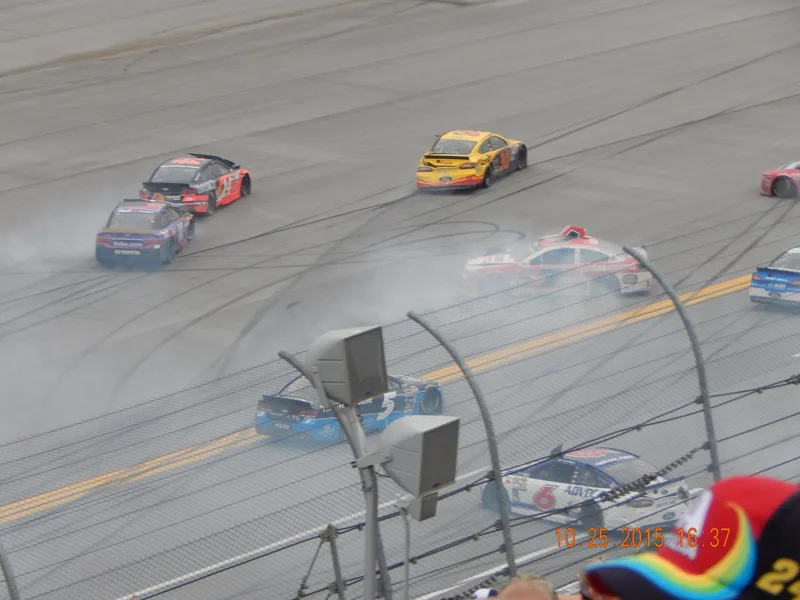
On the last lap a large wreck on the back straight involved Gordon, Larson, Stenhouse, Allmendinger, Bayne and Sorenson. The caution came out as the leaders reached turn three, and Logano coasted to the flag.
What do the final results show?
| Position | Driver | Note |
|---|---|---|
| First | Joey Logano | Team Penske; first Daytona 500 win, ninth Cup win |
| Second | Kevin Harvick | Finished second after a late battle for the lead |
| Third | Dale Earnhardt Jr. | Top five finish in the race |
| Fourth | Denny Hamlin | Top five finish in the race |
| Fifth | Jimmie Johnson | Top five finish in the race |
| 33rd | Jeff Gordon | Pole sitter; led a race-high 87 laps before the final-lap crash |
What were the race statistics?
The race produced 27 lead changes, and seven cautions covered 26 laps. Race time was 3 hours, 8 minutes and 2 seconds.
The fastest lap went to Carl Edwards, who posted 44.399 seconds on lap 133, which was 326.225 km/h (202.707 mph). Michael Annett earned the Ingersoll Rand Power Move award for gaining 16 positions during the race.
What awards were handed out?
Gordon took the pole award and the most laps led, with 87 laps, as well as the brake award. Sam Hornish Jr. earned the restart award for green-flag restarts, and Casey Mears was the Moog problem solver, with crew chief Robert Barker.
Roush-Yates Engines, with the No. 22 engine, was named the MAHLE engine builder of the race. The NASCAR leader bonus was not won by anyone, so the $20,000 rolled over to the next event.
What did the result mean for the season?
Logano led Harvick by five points in the standings after the race. Ford led Chevrolet by the same margin among manufacturers.
The opening race left the points tight, with Logano and Harvick separated by five points.
Who covered the race?
Fox has broadcast the race since 2001, apart from 2002, 2004 and 2006. Mike Joy, Larry McReynolds and Darrell Waltrip called the action, and Matt Yocum, Vince Welch, Jamie Little and Chris Neville worked the pits.
The Motor Racing Network carried the race on radio, a service it has provided since 1970, with Joe Moore, Jeff Striegle and Rusty Wallace in the booth. Dave Moody was the lead turn announcer, and Winston Kelley led the pit-road reporting team.