One green-white-checkered attempt, a failed restart and a crash on the second try handed Joey Logano a win that drew boos and debris from the stands.
The CampingWorld.com 500 ended on a failed green-white-checkered finish, with the win going to Joey Logano after a crash on the restart. It was his sixth victory of the season and it completed a sweep of the Contender Round, the third win at the track for Team Penske.
Joey Logano won the 2015 CampingWorld.com 500 at Talladega Superspeedway on 25 October 2015, his sixth win of the season and his third in a row. The race was the 32nd of the Sprint Cup Series season and the final event of the Contender Round, and the win completed a sweep of that round for Logano.
From 1969 to 1989 the Talladega venue was called Alabama International Motor Speedway. Today it is a 4.281 km (2.660 mi) tri-oval in Lincoln, Alabama.
Why did the finish allow only one green-white-checker attempt?
NASCAR announced on Tuesday, 20 October, that only one green-white-checkered attempt would be used if a caution pushed the race past its advertised distance. The change was made after extensive dialogue with the industry, and the series said it wanted to balance exciting finishes with safety.
Steve O'Donnell, the series' top racing development executive, called the decision a positive step toward both aims. The race was scheduled for 188 laps and was contested over 196 laps once the finish was run.
NASCAR ruled that Logano had been ahead of Earnhardt when the caution flew, and that decision gave him the win.
What was at stake in the Contender Round?
Logano began the day with a 13-point cushion on Denny Hamlin. Kyle Busch and Dale Earnhardt Jr. needed a victory, as did Matt Kenseth and Ryan Newman, to control their own fates. Regardless of who won, Hamlin needed a finish of 14th or better to reach the Eliminator Round. He would have needed 15th with a lap led, or 16th with the most laps led.
Kurt Busch needed eighth or better, and Carl Edwards needed seventh or better. Kevin Harvick, Jeff Gordon and Brad Keselowski could clinch with a second-place finish, or with a lower spot if one of them led laps, while Martin Truex Jr. needed a top-two finish, or a third if he led the most laps.
Going into the race Kurt Busch sat third, 18 points back, and Carl Edwards was fourth, 19 points back. Harvick, Gordon and Keselowski were tied for fifth, 24 points back, and Martin Truex Jr. was eighth, 25 points behind. Kyle Busch was ninth, 31 back, Newman tenth, 33 back, and Kenseth twelfth, 60 points back.
How fast were the cars in qualifying and practice?
The weekend's entry list included several changes. Labonte was back in the No. 32 Go FAS Racing Ford, Kvapil in the No. 33 Hillman-Circle Sport Chevrolet, Josh Wise in the No. 34 Front Row Motorsports Ford, and Michael Waltrip in the No. 98 Toyota.
Jeff Gordon won the pole at 49.234 seconds, a speed of 313.017 km/h (194.500 mph). Greg Biffle was fastest in first practice at 47.597 seconds, a speed of 323.782 km/h (201.189 mph), and Brad Keselowski topped the final session at 48.752 seconds.
Gordon said he had a fast car but had not been sure until his first run, and he credited the crew for the pole. He said this car differed from the one the team had run earlier in the year, and that the crew had done what it does. Truex's qualifying time was thrown out for dipping below the yellow line, a rule that applies on superspeedways. Allgaier was made to start at the rear because his car had been damaged on pit road during qualifying.
Annett and Burton did not make the field in qualifying. The field numbered forty-five cars, and all but Michael McDowell had also run the previous week at Kansas.
How did the first half of the race unfold?
Under overcast skies the field went green at 2:34 pm Eastern. Gordon led the opening nine laps, until Dale Earnhardt Jr. went around him on the middle lane on lap 10, and Denny Hamlin used a push on the high side to take the lead on lap 12.
Earnhardt jumped back in front on lap 16 and again on lap 20 as the leaders traded places. Five laps on, the leading seven cars pulled clear of the pack, and Matt Kenseth tried to get past teammate Hamlin but was shuffled out of line and dropped back.
Green-flag pit stops began on lap 38, and Earnhardt pitted on lap 40, handing the lead to Michael Waltrip. Austin Dillon and Aric Almirola each drove through penalties for pit road infractions during this phase.
Hamlin's car also suffered a loose roof hatch on lap 84, forcing him into an unscheduled stop to tape it down.
What changed in the second half?
Before the leaders returned to pit road, the No. 48 car had led the field single file for about 20 laps. Earnhardt retook the lead on lap 65, and Clint Bowyer took it on lap 96, Kevin Harvick on lap 98 and Kasey Kahne on lap 102.
Joey Logano took the lead from Paul Menard at the start-finish line on lap 84, and Michael McDowell and Travis Kvapil were both penalised for pit road infractions in the same phase.
Kahne handed the lead to Ricky Stenhouse Jr. on the next lap, and it cycled to Earnhardt Jr. before going to his teammate Jimmie Johnson. Casey Mears ran through the grass while pitting on lap 118, and Earnhardt and Justin Allgaier both took drive-through penalties for their crews going over the wall too soon.
Kyle Busch got in front of his teammate with 48 laps to go, and Earnhardt went back to the front soon afterwards.
| Item | Detail |
|---|---|
| Lead changes | 30 among 18 drivers |
| Cautions | 3 for 18 laps in total |
| Race time | 3 hours, 6 minutes and 56 seconds |
| Average speed | 269.261 km/h (167.311 mph) |
| Fastest lap | Ricky Stenhouse Jr., lap 87, 46.927 seconds, 328.406 km/h (204.062 mph) |
| Most laps led | Dale Earnhardt Jr., 61 laps |
How did the closing laps play out under caution?
The first caution, with 57 laps to go, followed an engine failure for Justin Allgaier. When the field restarted with 49 laps left, Earnhardt went underneath Kyle Busch on the back straight and regained the front with 37 laps to go.
When the first caution came out, Ryan Newman stayed out and took the lead. Newman came in the following lap and gave the front to Kurt Busch, who also pitted and passed it to David Gilliland, and the lead then cycled to Matt Kenseth.
Greg Biffle then built a lead of nearly a full lap over Joey Logano, and as the field bunched up he caught the back of the leading pack. With 10 laps to go Earnhardt and others broke up the single-file train, and the line became double file and then triple file.
With 19 laps left Earnhardt pitted and gave the lead to Paul Menard, who stopped the next lap and passed it to David Gilliland. The lead then went to Greg Biffle, who was on a separate pit cycle.
McMurray's engine failed on the backstretch with five laps left, which brought out the second caution.
What went wrong on the green-white-checkered attempts?
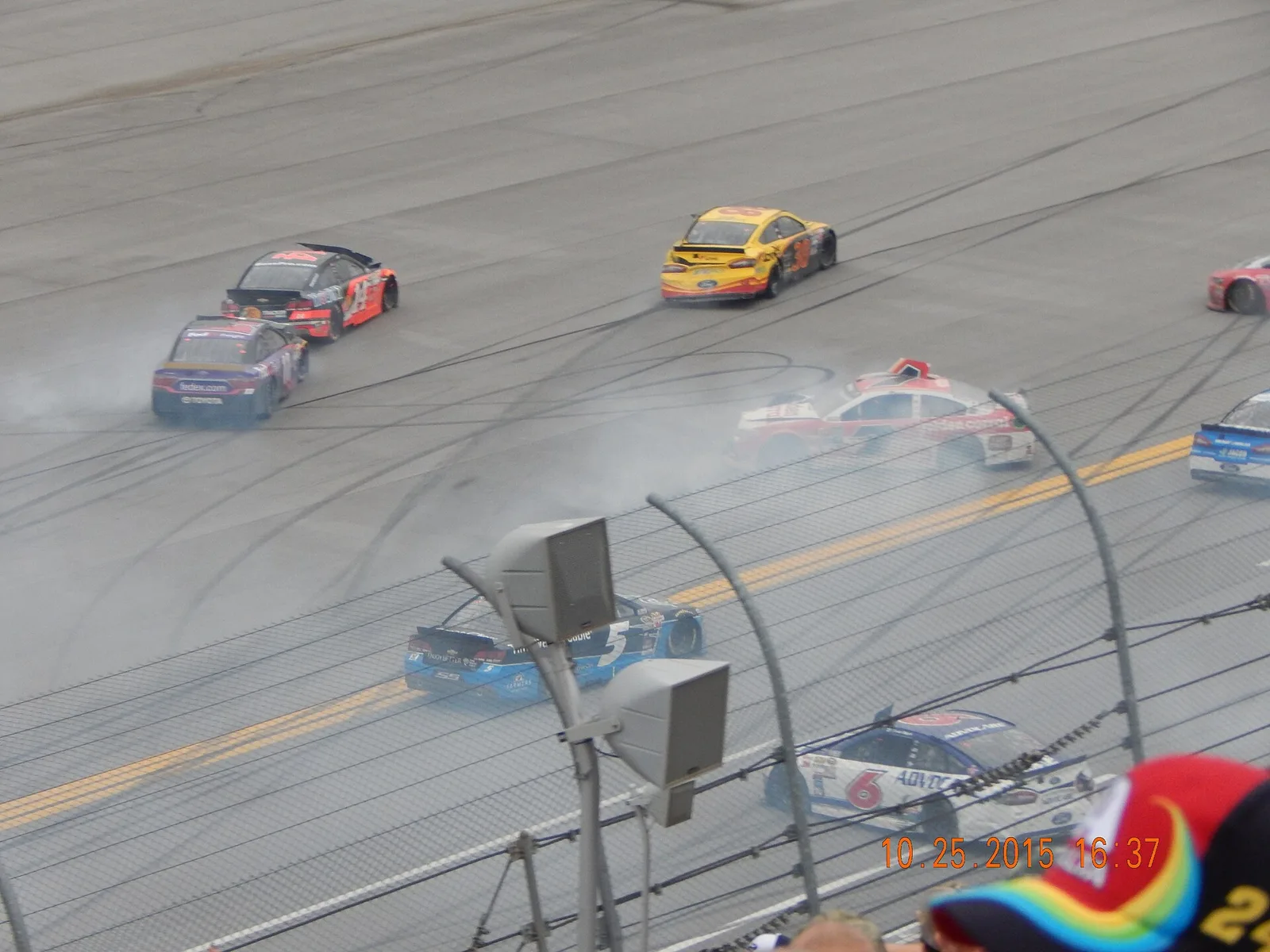
The first restart attempt failed after Jimmie Johnson spun, having been tapped from behind by Kyle Larson. A second try produced a huge crash exiting pit road, which brought out the third caution, after Kevin Harvick's car could not accelerate and hit Trevor Bayne just before the line.
Ten cars took part in the wreck: Hamlin, McDowell, Stewart, Kenseth, Gilliland, Harvick, Patrick, Hornish, Bayne and Dillon. Harvick's car had developed its problem well before the first attempt, and he had already moved clear of the failed restart.
Why did the crowd boo Logano in victory lane?
NASCAR ruled that Logano had been ahead of Earnhardt when the caution flew, and that decision gave him the win. Fans hurled debris, including beer cans, during his burnout and booed him loudly in victory lane, protesting the green-white-checkered rule and the instant yellow flag.
The reaction recalled the 2004 spring race at the same track, which Jeff Gordon won. In that race Earnhardt had also been ahead on the track but was second at the timing line when the caution came out, and the timing line decides races.
What was the controversy over Harvick's restart?
Trevor Bayne accused Kevin Harvick of deliberately wrecking him to protect his position for the Eliminator Round. Harvick said he had been trying to get out of the way and that his car had not got going, while crew chief Rodney Childers said the motor was blowing up.
The series did not sanction Harvick, which kept him in the next round of the Chase. The series did change the overtime rules for the following season, allowing unlimited restart attempts.
Which drivers collected the awards?
Aric Almirola took the American Ethanol Green Flag Restart award, and he also earned the Ingersoll Rand Power Move award for gaining 14 positions. Jimmie Johnson won the Duralast Brakes Bake In The Race award, while Joey Logano took the Freescale Wide Open award.
Hendrick Engines, with engine number 88, won the MAHLE Clevite Engine Builder of the Race award. Dale Earnhardt Jr. took the Mobil 1 Driver of the Race award with a 114.0 driver rating, Paul Menard won the Moog Steering and Suspension problem solver award with crew chief Justin Alexander, and Matt DiBenedetto was named Sunoco Rookie of the Race.
How did the drivers and the broadcast describe the day?
Logano said the team was going on all eight cylinders, but he stressed that they were back to zero and needed to keep going. He said the team had momentum and was relaxed, and had a lot of confidence heading into the next round.
Earnhardt said he would have been in the lead had the race gone another 100 yards, but he accepted the calls of the governing body. He admitted the team had not done well enough in the first two races of the round, and said the team could sit and pout about the day but needed another win before the year ended.
Gordon finished third in his final restrictor-plate race, and he regretted not having Earnhardt ahead of him on the last restart. Gordon also said his 3M Chevrolet had been awesome, and that he would have liked a shot at the leaders in the finish. He called restarts crucial, with everyone trying to gain all they could and banging into one another.
NBCSN televised the race with Rick Allen, Jeff Burton and Steve Letarte in the booth. Motor Racing Network carried the radio call, which was simulcast on Sirius XM NASCAR Radio, with Rusty Wallace calling the action from the booth.
Logano earned $289,573 in winnings and took the points lead, while Earnhardt led a race-high 61 laps. For Logano, the 14th victory of his career was also his first at Talladega and the third triumph there for the Penske organisation. He also collected the NASCAR Sprint Cup Leader Bonus of $10,000, and Ford trailed Chevrolet by 63 points in the manufacturers' standings after the race.