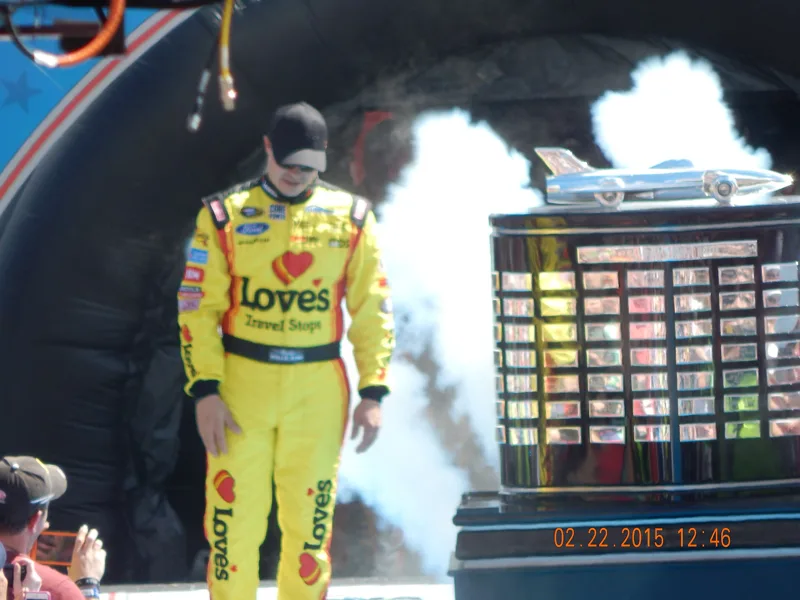
Founded from Jack Roush's engineering business, the Ford-only team won back-to-back Cup titles in 2003 and 2004 and ran some of NASCAR's largest multi-car operations.
RFK Racing is a Ford-only NASCAR Cup team that grew out of Jack Roush's engineering business. It won back-to-back Cup titles in 2003 and 2004 and ran five full-time teams at its peak, and it now races under the RFK name with Brad Keselowski as co-owner.
Roush Fenway Keselowski Racing, trading as RFK Racing, is an American stock car organisation that competes in the NASCAR Cup Series. It was one of NASCAR's largest racing teams in the 2000s and early 2010s, and it has always run Ford cars.
What is RFK Racing?
RFK Racing currently fields the No. 6 Ford Mustang Dark Horse for driver and co-owner Brad Keselowski, the No. 17 Mustang for Chris Buescher, the No. 60 for Ryan Preece and the No. 99 for Corey LaJoie on a part-time basis. Its name has changed with its ownership, from Roush Racing to Roush Fenway Racing in 2007 and to RFK Racing in 2022.
The team also formerly ran entries in the NASCAR O'Reilly Auto Parts Series, the NASCAR Craftsman Truck Series, the ARCA Menards Series, the Trans-Am Series and IMSA Camel GT. Its Roush-Yates Engines unit supplies engines to most Ford teams in NASCAR and ARCA.
A Ford-only team born in Jack Roush's engineering business that won back-to-back Cup titles and ran five full-time teams at its peak.
Who was Jack Roush?
Roush Racing was founded by Jack Roush, a former Ford Motor Company employee who went on to found Roush Performance. Before entering NASCAR, Roush had won championships in drag racing and sportscar racing since the mid-1960s, including the NHRA, the SCCA Trans-Am Series, the IMSA GT Championship and the 24 Hours of Daytona.
The racing business began as a small branch of Roush's engineering and road-racing equipment company, based in Livonia, Michigan. Tommy Kendall, Scott Pruett and Willy T. Ribbs were among the first drivers to race for the outfit, which helped build its early reputation.
How did the NASCAR operation grow?
The NASCAR operation was founded in 1988 in Concord, North Carolina, and it became the cornerstone of the company. The team won back-to-back Cup championships in 2003 and 2004, the first with Matt Kenseth, the last Winston Cup title, and the second with Kurt Busch, the first Nextel Cup title.
The team also amassed many wins and championships in the Nationwide, now Xfinity, and Craftsman Truck Series. Its multi-car model was central to that success, because teams shared information and resources across the enterprise.
From 1998 to 2000 and from 2003 to 2009 Roush ran five full-time Cup teams, more than any other organisation, including Hendrick Motorsports and Richard Childress Racing, which at most ran four. In 2001 the teams moved into a single shop in Concord, to improve performance and communication.
Why was 2005 a record year?
In 2005 all five of Roush's race teams made the Chase for the Nextel Cup, a first in the sport. It was the peak of a model built on several full-time teams sharing engineering and information.
After 2009 NASCAR ordered Roush Fenway to shrink its operation to four Sprint Cup teams, which meant ceding the No. 26 team. The team later shrank to three after 2011, and to two after 2016. For 2025 RFK returned to a three-car operation for the first time since 2016.
How did the Fenway deal change the team?
John W. Henry, who owns the Fenway Sports Group and its Boston Red Sox, took half of the team in 2007, and the operation became Roush Fenway Racing. On 14 February 2007 Fenway Sports Group purchased half of Roush Racing to create the new company.
Jack Roush continued to head day-to-day operations after the deal. The partnership was notable because the owner of a major sports franchise had moved into NASCAR, a first for owners of a professional team in one of the four major North American leagues.
What did the O'Reilly and truck teams achieve?
The O'Reilly operation began in 1992 with the No. 60 driven by Mark Martin. That car won many races and three driver's titles, won by Greg Biffle (2002), Carl Edwards (2007) and Chris Buescher (2015), as well as an owner's championship with Edwards in 2011.
Ricky Stenhouse Jr. gave the No. 6 team back-to-back driver's titles in 2011 and 2012. From 2008 to 2010 the team strung together 79 straight top 10 finishes, a record. The O'Reilly programme was closed after the 2018 season, when Ryan Reed, Chase Briscoe and Austin Cindric had left.
From 1995 until 2009 Roush fielded Truck Series teams with drivers including Kurt Busch, Greg Biffle, Kyle Busch, Carl Edwards, Ricky Craven, David Ragan and Mark Martin. Its trucks won fifty races and the 2000 series championship, with Biffle at the wheel.
Who drove the truck programme's key cars?
In 2006 Mark Martin won five races in the No. 6 truck, and the team finished second in the owner's points. Travis Kvapil won four races in 2007 on his way to sixth in points, and Colin Braun won Rookie of the Year in 2008.
The No. 50 truck produced big results in the late 1990s. Greg Biffle won nine times in 1999, losing the title to Jack Sprague, before winning five races in 2000 and taking the championship by 230 points over teammate Kurt Busch.
The No. 99 truck was home to Kurt Busch, who won four times in 2000 and finished second to Biffle. Carl Edwards won three races and Rookie of the Year in 2003, and Erik Darnell won at Kansas in 2007 and at Michigan in 2008 by .005 seconds.
How did the Gong Show find drivers?
For many years Roush recruited its developmental drivers through an elimination-style test called The Gong Show. The first competition was held in 1985 for the road racing programme, and the first stock car combine took place in 1999.
The process started with applications from thousands of drivers, followed by tests of driving skill, public relations talent and personality. The final group raced Roush vehicles, often in Truck Series cars, and the fastest became contract drivers. In 2005 the Discovery Channel series Roush Racing: Driver X followed the 2005 Gong Show, and winners include Kurt Busch, Carl Edwards and David Ragan.
What happened with partnerships and engines?
Roush's most famous partnership was with Yates Racing, a longtime rival Ford team. In 2004 the two teams combined their engine divisions as Roush-Yates Engines, which greatly improved the power of both organisations' engines. By 2006 most Ford teams used the Roush-Yates engines.
Roush also had a technical alliance with Wood Brothers Racing from mid-2000, the oldest active team in the sport, and it supplied engines and chassis to Front Row Motorsports. As of 2017 Roush supplied engines and chassis to 13 Cup teams.
What did Keselowski bring?
On 20 July 2021 the organisation announced that Brad Keselowski, the 2010 Nationwide and 2012 Sprint Cup champion, would leave Team Penske after the 2021 season to join the team as a driver, replacing Ryan Newman in the No. 6, and as a co-owner.
The team's name changed to RFK Racing in 2022 when Keselowski became a co-owner. On 29 September 2026 he announced he would leave the team as a co-owner and driver.
What are the key results?
| Series | Result | Year |
|---|---|---|
| NASCAR Cup Series | Champion, Matt Kenseth | 2003 |
| NASCAR Cup Series | Champion, Kurt Busch | 2004 |
| NASCAR Cup Series | All five full-time teams in the Chase | 2005 |
| O'Reilly Auto Parts Series | Driver's title, Greg Biffle | 2002 |
| O'Reilly Auto Parts Series | Driver's title, Carl Edwards | 2007 |
| O'Reilly Auto Parts Series | Driver's title, Ricky Stenhouse Jr., back-to-back | 2011 and 2012 |
| O'Reilly Auto Parts Series | Driver's title, Chris Buescher | 2015 |
| Craftsman Truck Series | Series title, Greg Biffle | 2000 |
| ARCA Menards Series | Title, Justin Allgaier, with Stenhouse fourth | 2008 |
What is the legacy of RFK Racing?
RFK Racing's legacy is a Ford-only identity built on engineering, multi-car depth and a long run of championships across several series. Its Cup titles in 2003 and 2004 and its record five-car Chase in 2005 remain the peaks of the Roush era.
The team's future rests on a leaner operation, with three full-time cars in 2025 and a changed leadership group. Its history shows how a manufacturer-focused engineering company can build a NASCAR team that outlasts many of its rivals.
What were the road racing and smaller programmes?
Roush restarted its road racing programme in 2006 under the name Roush Road Racing, previously Roush Performance Racing. The team ran a No. 61 Ford Mustang in IMSA sports car series, with Billy Johnson and Roush's son Jack Roush Jr. among its drivers. Since 2014 a No. 60 Mustang has run in the Pirelli World Challenge, driven by Roush Jr. Since 2015 the team has worked in partnership with Capaldi Racing and moved its base to Michigan, near Roush Performance headquarters.
Roush also explored outside partnerships. In 2005 NFL wide receiver Tim Brown announced plans for his own NASCAR team, most likely the No. 81, with equipment from Roush Racing. In 2006 SoBe No Fear announced a team for 2007 with the road racing specialist Boris Said, affiliated with Roush, which let Roush sell No Fear cars and equipment while Said tutored younger drivers on road courses.
Robby Gordon moved from Chevrolet to Ford from 2007 under a Ford Racing deal, and he leased engines from the Roush-Yates programme until he moved to Gillett Evernham engines and a Dodge Charger.
How did the truck teams change over time?
The No. 6 truck was shared in 2006 by Mark Martin and rookie David Ragan. Martin won the first two races of that season and went on to win five races, while Ragan had six top-tens and a pole. In 2008 rookie Colin Braun took over the ride from Travis Kvapil, collecting three top-fives and finishing thirteenth in points to win Rookie of the Year.
In 2009 Braun won at Michigan and finished fifth in points. When he moved to the Nationwide Series for 2010, Roush shut the team down and ended its Truck Series programme, and the remaining trucks were sold to Kyle Busch.
In 2008 Joey Clanton drove the No. 09 full-time, but he was released after the season-opening race. Travis Kvapil shared that ride with Bobby East and John Wes Townley, and Kvapil managed two top-five finishes at Dover and New Hampshire before Roush closed the No. 09 team after the season.
The No. 33 truck was a Ford development entry from 2005. Bobby East tried three races and missed the field in two of them, while Mark Martin drove in the Ford 200 and finished eighth after starting fourteenth.
Chuck Hossfeld took the wheel of the No. 49 truck for the last race of 2000 at California Speedway, a third Roush entry that season. Jon Wood then earned a full-time run in 2002, posting twelve top-ten finishes and finishing twelfth in points, and he won twice the following year. Todd Kluever won the Rookie of the Year award in 2005 after six top-five and twelve top-ten finishes.
The No. 80 truck was driven by Joe Ruttman, who posted sixteen top-tens and finished fourth in points in 1996. In 1997 he won five times and finished third in points. The original No. 61 truck debuted in 1995 at Heartland Park Topeka, where Todd Bodine finished fourth.
The No. 99 truck debuted at Heartland Park Topeka in 1996, with Jeff Burton finishing eighth. In 1997 Chuck Bown posted thirteen top-tens and finished ninth in points. Mike Bliss later won at Heartland Park Topeka but finished ninth in points before leaving for Winston Cup, and Kurt Busch was named for the 2000 season.
The ARCA programme had smaller entries of its own. Todd Kluever drove the No. 60 car at Daytona in 2005 and crashed out, and Danny O'Quinn Jr. drove the No. 39 car in 2006, finishing 37th after completing less than half the laps. Darnell's 2007 programme was three races long: second at Kansas, then wins at Kentucky and Michigan.