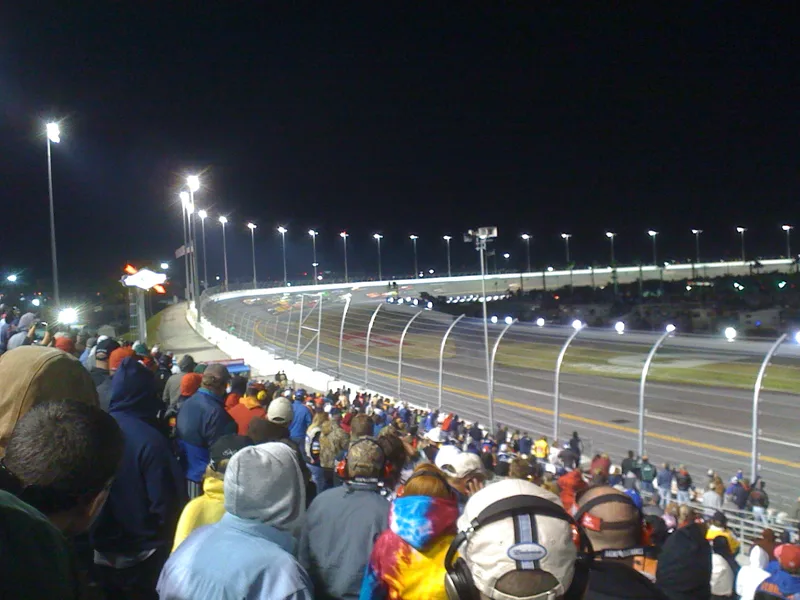
Roush Racing's Ford stable ran five Cup teams at its peak; today RFK builds on the No. 6, No. 17 and No. 60 with Brad Keselowski and Ryan Preece.
RFK Racing's Cup operation grew from Roush Racing's Ford stable, founded in 1988. It ran five full-time teams at its peak, later shrank to a few cars, and today races the No. 6, No. 17 and No. 60 cars.
RFK Racing is the Cup Series operation that grew out of Roush Racing, the Ford-based stable founded in 1988 that also builds engines, engineering and race car services for other Ford teams. At its peak the organisation ran five full-time Cup teams, more than any other operation of its time. Today the team races under the RFK name and runs its cars from a single shop in Concord, North Carolina.
How did the Roush operation become a multi-car team?
The multi-team structure was built on sharing information and resources across the enterprise, which was meant to lift the performance of every car. Since 2004 the cars have run engines from Roush-Yates Engines, a partnership between Roush Fenway Racing and the former Yates Racing. Doug Yates is the head engine builder, and the same partnership supplies Wood Brothers Racing, Team Penske and Front Row Motorsports.
Between 1998 and 2000 and again from 2003 to 2009, Roush ran five full-time Cup teams, the 6, 16, 17, 26 and 99. From 2001 the teams moved into a single shop in Concord to improve performance and communication. In 2005 all five Roush teams made the Chase for the Nextel Cup, a NASCAR record.
A Ford stable that once ran five Cup cars now races a handful of drivers and a driver-owner, with a Daytona 500 and a title along the way.
Why did the team shrink after 2009?
Following the 2009 season NASCAR ordered Roush Fenway to shrink to four Cup teams, which meant giving up the No. 26. The operation later dropped to three teams after 2011 and to two after 2016. Those cuts reshaped the organisation, which had long relied on several cars to share risk and resources.
How did the No. 6 begin with Mark Martin?
The No. 6 was the Roush organisation's original NASCAR entry, debuting in the 1988 Daytona 500 with Mark Martin as the Stroh's Light-sponsored Ford driver. Robin Pemberton was the crew chief, and the team finished 41st after an engine failure after 19 laps. Results improved quickly, and Martin won a pole later that season and recorded ten top-10 finishes.
In 1989 Martin won six poles, earned eighteen top tens and won for the first time at Rockingham. The team finished third in points. In 1990 Folgers came on as sponsor, and Martin won three races and three poles. He lost the championship to Dale Earnhardt by 26 points, and he would have won it had he not been docked 46 points for a rules violation early in the season.
Martin's record in the car was strong through the 1990s. He won five races in 1993 and finished third in points. He finished runner-up to Earnhardt in points in 1994, and in 1998 he won seven times but finished second to Jeff Gordon. His father, Julian, died in an aviation accident that year.
By the 2000s the car's results had slipped, but it was still the team's flagship. Martin earned 35 of his 40 career wins in the No. 6, and his final year for Roush in 2006 ended with a ninth-place points finish.
Who drove the No. 6 after Martin?
David Ragan took over the No. 6 full-time in 2007, after Todd Kluever had been slated for the seat. Ragan had three top tens and 23rd in points as a rookie, with several crashes. The next year he improved dramatically, posting fourteen top-10 finishes and finishing 13th in points.
In 2011 the team nearly won the Daytona 500 before a penalty for an early lane change, and then it won at Daytona in July, its first win there since 2005. Ragan moved to Front Row Motorsports after the team was reduced to part-time in 2012.
In 2012 Ricky Stenhouse Jr. drove the car at the Daytona 500, qualifying eighth and finishing 21st. Without sponsorship, the team planned to close after that race, and Jack Roush sold its top-35 owner points to Frank Stoddard's FAS Lane Racing team.
Trevor Bayne was named the full-time driver for 2015, with AdvoCare as the season sponsor. He failed to qualify for the 2014 Bank of America 500 in the car, which was the organisation's first Cup DNQ since 2006. Bayne finished 22nd in points in 2016 and again in 2017.
In 2018 Matt Kenseth returned to share the No. 6 with Bayne on a part-time basis, with Wyndham Rewards as primary sponsor. Bayne left after the 2018 season, and Kenseth scored the car's highest finish that year with a sixth in his final race for the team.
How did Ryan Newman and Brad Keselowski change the No. 6?
Ryan Newman took over the No. 6 for 2019, and Oscar Mayer became the main sponsor in January of that year. Newman was injured in a crash at the end of the 2020 Daytona 500, and Ross Chastain replaced him for a race while he recovered. Newman was cleared to return in April 2020, and NASCAR granted him a waiver for the playoffs.
On 20 July 2021 Brad Keselowski was announced as a co-owner of Roush Fenway Racing and as Newman's replacement. He had won the 2012 Sprint Cup championship, and he began 2022 as driver and co-owner of RFK Racing with a ninth-place finish at the Daytona 500.
The 2022 season was hard. Keselowski went 14 races without a top-10 finish. In March the crew chief, Matt McCall, was suspended for four races and fined US$100,000 after an L2 penalty tied to a modified single-source part, and the team was docked 100 driver and owner points and 10 playoff points. Keselowski missed the playoffs for the first time since 2013, and the No. 6 finished 25th in points.
In 2023 Keselowski finished eighth in points, the first top-10 final standing for the No. 6 since Martin's ninth in 2006. He reached the Round of 12 and went out at the Charlotte Roval. In 2024 he won at Darlington, holding off Ty Gibbs after Chris Buescher and Tyler Reddick collided, and that win ended a 110-race winless streak for him. He was eliminated in the Round of 16, and McCall did not return for 2025.
Keselowski finished 20th in points in 2025 and missed the playoffs. For the 2026 Cook Out Clash Corey LaJoie drove the No. 6, and Keselowski returned at Daytona, where he finished in the top five.
What was the story of the No. 16?
The No. 16 was the first car that made Roush a multi-car stable. It debuted at the 1992 Daytona 500 with Keystone Beer as sponsor, and Wally Dallenbach Jr. drove it to 15th. Dallenbach earned only one top ten that year and finished 24th in points, and he posted four top tens in 1993.
For 1994 Ted Musgrave took over, with The Family Channel as the new sponsor. The car improved sharply, and Musgrave won three poles and finished 13th in points. He moved up six spots to seventh in 1995, but he never won a race in the car.
In 1998 Kevin Lepage replaced Musgrave for the final stretch of the season, and he finished runner-up to Kenny Irwin Jr. for Rookie of the Year. The car ran in 1999 with Lepage and PrimeStar and later TV Guide, and then disbanded in 2000 when FamilyClick left the team.
The car returned in 2003 with Greg Biffle as a full-time rookie. He won the Pepsi 400 at Daytona, and McMurray edged him for Rookie of the Year. In 2005 the car was sponsored by the National Guard and won six races, finishing runner-up in the Chase for the Nextel Cup.
Biffle signed a contract extension in 2008 with 3M as his major sponsor. Red Cross joined as secondary sponsor in 2010, and Biffle won at Pocono and Kansas that year. In 2013 he won at Michigan, the 1,000th win for Ford, and he made the Chase. Biffle's final season with the team was 2016, when he finished 23rd in points. The car's charter was leased to JTG Daugherty Racing afterwards.
How did the No. 17 build its record?
The No. 17 debuted in 1999 with Matt Kenseth at the wheel, DeWalt Tools as sponsor, and Robbie Reiser as crew chief. Kenseth finished 14th at Michigan on his debut and then placed fourth at Dover a month later. In 2000 he started every race, won the Coca-Cola 600, and beat Dale Earnhardt Jr. for Rookie of the Year.
In 2003 Kenseth won only once, at Las Vegas, yet he was consistent enough to take the final Winston Cup championship by 90 points. That gave Jack Roush his first Cup title. The team won two races in 2004 and made the Chase, and in 2006 Kenseth won four races and finished second to Jimmie Johnson.
Kenseth won the first two races of 2009, including the Daytona 500, the first Daytona 500 for Roush. Economic pressure then cost the team its DeWalt sponsorship, and Crown Royal moved in for 35 races in 2010. In 2011 Kenseth won at Texas, Dover and Charlotte and finished fourth in points.
In 2012 Kenseth won the Gatorade Duel and the Daytona 500, which was Jack Roush's 300th NASCAR win and his second Daytona 500 victory. He announced he was leaving after the season, and he joined Joe Gibbs Racing in 2013.
Ricky Stenhouse Jr. took over in 2013 and inherited much of Kenseth's sponsorship. He finished 12th at that year's Daytona 500, and his best finish of the season was third at Talladega. In 2017 he won the spring Talladega race and then the Coke Zero 400 at Daytona, and he made the Playoffs. He left after 2019.
Chris Buescher replaced Stenhouse for 2020. In 2021 he stayed in the top 20 in points and finished second at the Daytona Coke Zero Sugar 400, but he was disqualified after a rear sub-frame violation. In 2022 he won at Bristol's night race, ending a long winless run for the No. 17.
Buescher finished second to Kyle Larson by 0.001 seconds at Kansas in 2024, the closest finish in Cup history. He also won at Watkins Glen that year. In 2025 the car was docked 60 owner and driver points after an L1 penalty for a bumper reinforcement that exceeded the allowed size.
What did the No. 26 and No. 97 contribute?
The No. 26 debuted in 1998 as Roush's first attempt at a fifth Cup team. It signed Johnny Benson, bought out of his contract with Bahari Racing, with Cheerios sponsoring. Benson finished 20th in points that year, but in 1999 the car had a disappointing season and then ceased operations when General Mills and Cheerios left.
From 2006 the team ran Jamie McMurray in the car, with Crown Royal and Smirnoff Ice as sponsors. He won the 2007 Pepsi 400 by 0.005 seconds over Kyle Busch. In 2008 he climbed to 16th in points. NASCAR then limited teams to four full-time cars, which ended the No. 26 after 2009.
In January 2010 Vermont businessman Bill Jenkins bought the team and its owner points and renamed it Latitude 43 Motorsports, with a services contract with Roush to provide equipment.
The No. 97 raced for the first time in 1993 with Chad Little, and Roush bought the team partway through 1997. Little finished second at the 1998 Texas 500 and 15th in points that year. Kurt Busch then drove the No. 97 from 2000, and he won four times in 2002. In 2004 Busch won three times and the first Chase for the Cup. He left after 2005, and the car was renumbered No. 26 for 2006.
How did Jeff Burton and Carl Edwards shape the No. 99?
The No. 99 first raced at the 1996 Daytona 500, with Jeff Burton driving and Exide Batteries sponsoring. He finished fifth there, and in 1997 he took three wins, one of them the inaugural Cup race at Texas. He finished fifth in points in 1998 and 1999 and was fourth in 1997.
In 2004 Burton left for Richard Childress Racing, and Carl Edwards was promoted from the Truck Series. He won four races in 2005 and finished second in points, behind Greg Biffle on the tiebreaker. In 2008 Edwards won a series-best nine races, but he was runner-up to Jimmie Johnson by 69 points.
Edwards won the 2010 Kobalt Tools 500 at Phoenix, ending a 70-race winless streak, and he won at Homestead a week later. In 2011 he won his only race of the season at Las Vegas and finished second in points on a tiebreaker with Tony Stewart. He left after 2014 when Fastenal moved to the No. 17, which left the No. 99 without a driver or sponsor for 2015.
Ryan Reed made his Cup debut in the No. 99 at Talladega in October 2016, finishing 26th. The car later moved to StarCom Racing and then to Trackhouse Racing Team in 2021. On 20 January 2026 Corey LaJoie was announced to attempt the Daytona 500 in the No. 99, the first use of the number by the team since 2016.
What is the No. 60 and why does it matter now?
The No. 60 had a brief history before RFK revived it. Roush tried it once in 1998 with Matt Kenseth at Talladega, but the team failed to make the race. In 2024 RFK ran the No. 60 at the Daytona 500 with David Ragan, and the team fielded it in select races under its Stage60 programme.
On 19 November 2024 RFK arranged a charter lease from Rick Ware Racing, putting Ryan Preece in the No. 60 full-time for 2025 with Kroger as primary sponsor. At Talladega Preece finished second to Austin Cindric by 0.022 seconds, but he was disqualified after post-race inspection found the spoiler had three shims instead of two.
Preece won the 2026 Cook Out Clash. He later won his first Cup race at the summer Daytona race, but he was penalised 25 points and fined US$50,000 after wrecking Ty Gibbs at Texas.
What does the team's history show?
RFK's history is a story of a multi-car stable that shrank, then rebuilt around a few strong cars and a driver-owner. Its numbers, from the No. 6 and the No. 17 to the No. 16 and No. 99, have each carried championship-level results, and the operation has kept a steady place in the Ford garage.