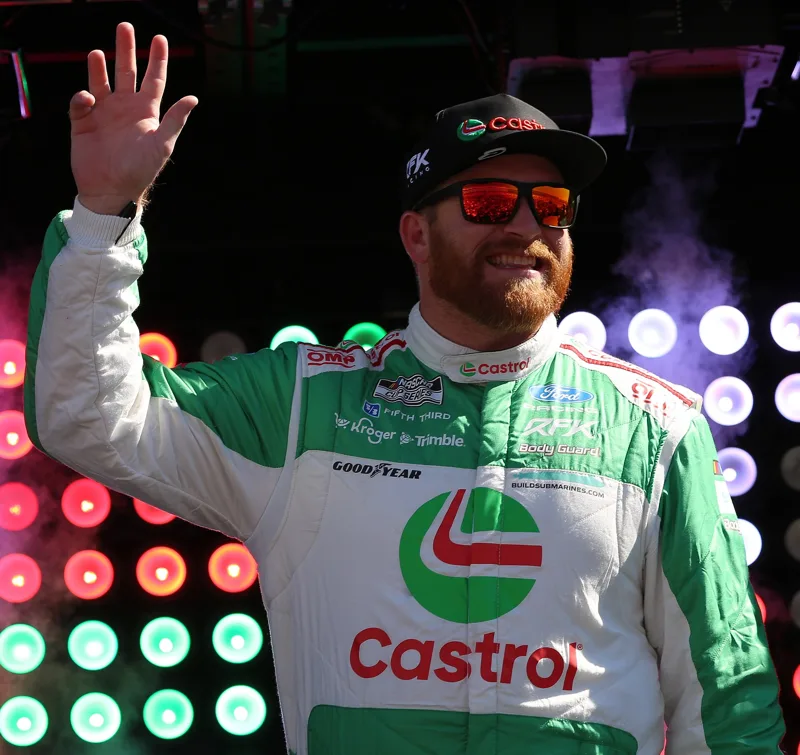
From Mark Martin's 1992 No. 60 to Chris Buescher's 2015 title, Roush's Xfinity operation won championships and trained drivers until it closed after 2018.
RFK Racing's Xfinity operation began in 1992 with Mark Martin in the No. 60. It won three driver's titles with Biffle, Edwards and Buescher, back-to-back driver's titles with Stenhouse, and closed after the 2018 season.
RFK Racing's Xfinity Series operation began in 1992 as Roush Fenway Racing's Busch Series effort, with the No. 60 driven by Mark Martin. Over the next two decades the Roush cars won three driver's championships, with Greg Biffle in 2002, Carl Edwards in 2007 and Chris Buescher in 2015. The organisation also won an owner's title with Edwards in 2011 and back-to-back driver's titles with Ricky Stenhouse Jr. in 2011 and 2012.
How did the Xfinity program begin with Mark Martin?
The centrepiece of Roush Racing's Busch operation was the No. 60, which debuted at the opening race of the 1992 season at Daytona with Winn-Dixie as sponsor. Martin finished seventh in that race. For the next several years it was Martin's personal Busch car, and he won enough races to pass Jack Ingram as the Busch Series' all-time leader in wins.
During that period Martin and several other Winston Cup drivers faced criticism for running both Cup and Busch races. They became known as the Buschwackers, a nickname that followed the series through the decade.
A Roush Xfinity operation that won titles with Biffle, Edwards, Stenhouse and Buescher, then closed after a 2018 season spent developing drivers.
Why did the No. 60 change hands so often?
After the 2000 season Martin cut back his Busch schedule, and Winn-Dixie left NASCAR as a sponsor. Greg Biffle, one of Roush's Truck Series drivers, took over and brought W. W. Grainger with him. He had a phenomenal rookie season, winning five times and briefly leading the standings before falling to Kevin Harvick.
Biffle returned in 2002, won four more races and took the championship by a wide margin before moving up to the Cup Series. In 2003 Roush hired Stanton Barrett to drive the No. 60 with OdoBan sponsorship. The car won two consecutive poles, but it lost its sponsor and folded before the end of the season.
Charter Communications sponsored the car in 2004, and Biffle returned to drive it full-time. He won five times and finished third in the series points.
How did Carl Edwards build his Xfinity record?
In 2005 Carl Edwards moved into the No. 60 as a Busch Series rookie who also ran Cup races. He won five races, finished third in points and earned Rookie of the Year honours. He returned in 2006 for a full-time Xfinity schedule in the Ameriquest-sponsored Ford, winning four more times and finishing runner-up for the championship.
Edwards continued in the car in 2007, with rotating sponsors including Scotts and World Financial Group. He and the No. 60 team took the 2007 Busch Grand National title with a wide gap over David Reutimann. In 2008, the first season under the Nationwide Series name, he won five races and ended second to Clint Bowyer.
Edwards finished second in points again in 2009, behind Kyle Busch. In 2010 he ran for the championship with co-sponsorship from Fastenal and Copart. He won at Road America, Gateway and Texas, but he finished runner-up to Brad Keselowski.
In 2011 Edwards drove the No. 60 with Fastenal sponsoring only half of the season. Despite missing Road America and being unable to compete for the drivers' title, he scored a career-high eight wins and won the owner's championship for Jack Roush. He then announced he would not contest the owners' championship the following year, after crew chief Mike Beam left for Kyle Busch Motorsports.
Who drove the No. 60 after Edwards?
In 2012 Trevor Bayne's crew moved across to the No. 60 and ran the first five races with the aim of a full season, but a lack of sponsorship sidelined them. Later in 2012 the car returned with Edwards at Watkins Glen, where he went on to win. Billy Johnson, the team's road course driver, finished eighth at Montreal, and Bayne came back at Bristol with backing from the Pat Summit Foundation.
Travis Pastrana drove the No. 60 for the full 2013 season, his first full year of NASCAR competition. He often showed speed, including a pole at Talladega, but he struggled to adjust from rally cars to heavier stock cars and crashed several times. He announced in November 2013 that he would leave full-time racing for 2014, and he finished the season 14th in points with four top tens.
How did Chris Buescher's championship come about?
Chris Buescher, the 2012 ARCA champion, started driving the No. 60 in 2014 and competed for Rookie of the Year against a strong class. He failed to qualify at Daytona but then had a solid rookie year, with finishes of second at Talladega, seventh at Richmond and ninth at Las Vegas and Charlotte.
In 2014 Buescher won the Nationwide Children's Hospital 200 at Mid-Ohio, his first career victory and the only Xfinity win for Roush that year. He finished seventh in points with 14 top tens, and the No. 60 finished 11th in owner points.
Buescher returned to the No. 60 in 2015 with a broader list of sponsors, including Fastenal, Cheez-It, Safety-Kleen and AdvoCare. He finished second to teammate Ryan Reed in the Daytona season opener, won at Iowa in May on a green-white-checkered finish, and then won at Dover after a strategy call and contact with Bubba Wallace. After 24 consecutive weeks as the points leader, he won the 2015 Xfinity title. It was the eighth championship for the Roush organisation, and he had 11 top fives, 20 top tens and an average finish of 8.4.
What happened to the No. 6 in the Xfinity years?
The No. 6 Ford Fusion first raced at the Hershey's Kissables 300 at Daytona on 18 February 2006, with Todd Kluever driving for 3M. Kluever earned four top tens and one pole that season. Mark Martin drove the car in two races in 2007 for Dish Network, and the team did not return in 2008.
David Ragan drove the No. 6 full-time in 2007 with Discount Tire sponsorship. He recorded four top fives and nine top tens, with a fifth-place points finish and Rookie of the Year honours. In 2008 he improved dramatically, with seven top fives and 21 top tens and fourth in the standings.
In 2009 Ragan ran 19 races, winning the Aaron's 312 for his first Nationwide victory and a win at Bristol. Erik Darnell ran the rest of the schedule, but he was not retained for 2010.
In 2010 Ricky Stenhouse Jr. drove the No. 6 with Citigroup as primary sponsor, with teammate Colin Braun also in the stable. Stenhouse was benched after failing to qualify at Nashville, and Mike Kelley took over the pit box. Stenhouse responded with a third at the fall Daytona race and finished 16th in points, and the team won Rookie of the Year honours.
The next year Stenhouse swept both Iowa races for his first two Nationwide wins, and he held off Elliott Sadler for the 2011 Nationwide championship. He won six races and a second straight title in 2012, when he again beat Sadler. Stenhouse later moved on, and Trevor Bayne drove the No. 6 full-time in 2013, earning seven top fives, 21 top tens and sixth in points.
In 2015 Bubba Wallace drove the No. 6 after leaving Joe Gibbs Racing. With Ford EcoBoost and Roush Performance often on the car as placeholders, he scored three top fives and fourteen top tens and finished seventh. In 2016 he had three top fives and nine top tens, finishing 11th. The team ran only part of 2017 before shutting down for lack of sponsorship.
How did the No. 16 and No. 17 contribute?
The No. 16 first ran in the Busch Series at Daytona in 2006. Greg Biffle piloted the Ameriquest car in 20 races and won once, at California. In 2008 the car went winless again, but Colin Braun won two poles at Mexico City and O'Reilly Raceway Park. In 2009 Biffle won at Las Vegas and Phoenix, while Matt Kenseth won once at Darlington.
Colin Braun drove the No. 16 full-time in 2010 with Con-way Freight, but struggled and was released after the season. Trevor Bayne replaced him in 2011, and he won once at Texas, finishing 11th in points. The team shut down for 2012, and it returned in 2013 with several drivers.
Ryan Reed drove the No. 16 full-time from 2014, running for Rookie of the Year with Lilly and the ADA. He won the 2015 season-opener at Daytona, his first career win. He finished sixth in points in 2016 and eighth in 2017, when he won the Daytona opener again. After the 2018 season Roush shut down its Xfinity operation.
The No. 17 debuted in 1994 at Darlington with Robbie Reiser at the wheel, and it was unsponsored at first. Reiser hired Matt Kenseth after Tim Bender was injured in 1997. Kenseth won his first race at North Carolina in 1998, and with Lycos on the car he took three wins and ended second in points to Dale Earnhardt Jr.
DeWalt became the sponsor in 1999, and Kenseth added four wins and a third-place finish. The No. 17 was not part of Roush Racing until 2002, when it joined the stable. Kenseth won three races in 2006 and two at California and Texas in 2007, and he finished 10th in points while running only 23 races.
What about the No. 26, No. 9 and No. 98 entries?
The No. 9 debuted at Daytona in 1997 with Jeff Burton driving a Track Gear-sponsored Ford Taurus. Burton won twice that year, at Bristol and Darlington, and from 1997 to 2003 he collected 16 wins with a series of sponsors.
The No. 26 Ford debuted as the No. 50 at Daytona in 2006. Danny O'Quinn Jr. drove it with World Financial Group and Stonebridge Life Insurance sponsoring, and he had five top tens and won Rookie of the Year honours. The car was numbered 26 for 2007, with Jamie McMurray driving most of the season for Dish Network. It did not return in 2008.
The No. 98 team was bought by Roush when the Yates Racing operation broke up after 2009. Paul Menard drove it briefly with Menards sponsorship, and the team ceased operation when Menard moved to Richard Childress Racing for 2011.
How did the 2018 season end the program?
In 2018 development drivers Austin Cindric, Chase Briscoe and Ty Majeski shared the No. 60, and Mike Kelley ran the pit box. It was the weakest year of full-time running the team had. The car was involved in 28 spins or crashes in 33 races, finished 22nd in points, and recorded only five top-10 finishes. Majeski's seventh at Iowa was the best of them.
Roush Fenway Racing closed its Xfinity effort at season's end. The three drivers' careers still advanced. Cindric moved to Team Penske's No. 2 Cup team and won the 2022 Daytona 500. Briscoe later drove for Stewart-Haas Racing and, from 2025, the No. 19 for Joe Gibbs Racing. Majeski drives the No. 88 Ford for ThorSport Racing in the Truck Series and won the 2024 Truck championship.