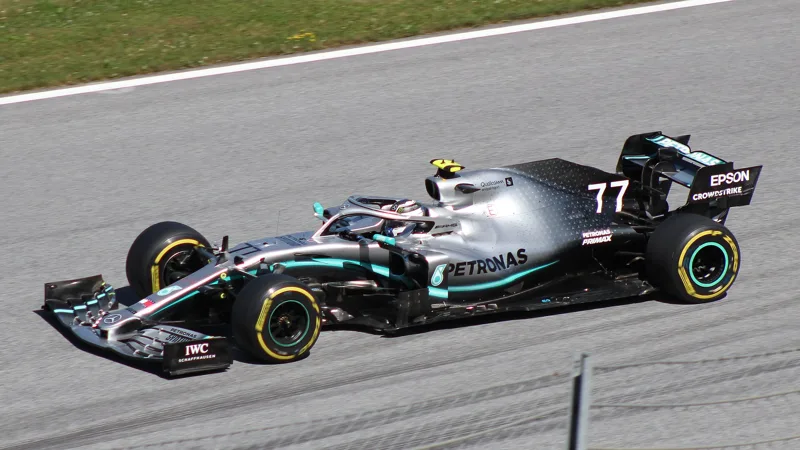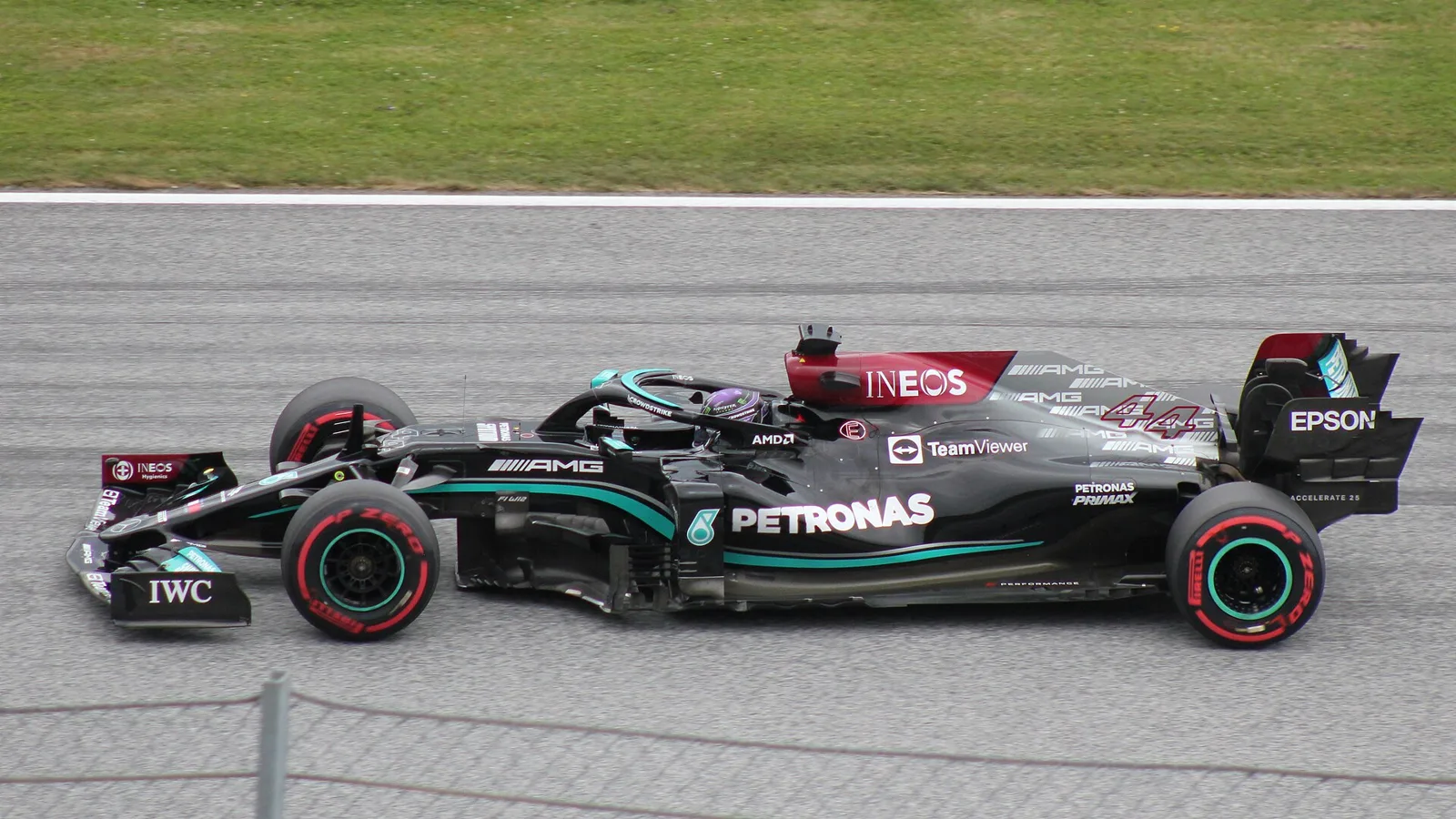
A car built from a champion, a season that swung on weather, safety cars and penalties, and a title decider that ended with a controversial final lap.
Built by Mercedes-AMG Petronas for 2021, the W12 carried Lewis Hamilton and Valtteri Bottas. It delivered the team's eighth straight constructors' title, but Hamilton finished second in the drivers' standings after a controversial title decider in Abu Dhabi. The car was based on the W11 that had won both championships in 2020.
The Mercedes W12 was the Formula One car Mercedes-AMG Petronas ran in the 2021 world championship, and it delivered the team's eighth consecutive constructors' title. It was built from the W11 that had won both championships the year before, and it was driven by Lewis Hamilton and Valtteri Bottas. Yet it was the first Mercedes car since the V6 turbo-hybrid era began in 2014 to fail to win the drivers' title, with Hamilton finishing second in the standings.
What was the Mercedes W12?
The W12 was Mercedes' Formula One car for 2021, designed under James Allison and raced by Lewis Hamilton and Valtteri Bottas. Its full name was Mercedes-AMG F1 W12 E Performance. It earned the team a constructors' title, although neither of its drivers won the drivers' championship.
The team had taken the constructors' championship every year since the V6 turbo-hybrid rules began in 2014, and the W12 extended that run. The car was not as dominant as its predecessor, but it kept Mercedes competitive at the front for much of the year.
A car built from a champion and a season decided by the final lap, with the constructors' crown secured and the drivers' title slipping away.
Where did the W12 come from?
The W12 was based on the Mercedes-AMG F1 W11 EQ Performance, which won both championships in 2020. For 2021 the rules were changed to reduce the downforce produced by the floor, and those changes were said to hurt low-rake designs such as the W12 more than high-rake ones like the Red Bull RB16B.
The banning of the DAS system added to the challenge. Pre-season testing and the opening race showed a car that was still highly competitive, though not as dominant as the W11. Several pundits made Red Bull the favourites for the opener after a stronger showing in testing.
Doubts also came from a Mercedes protege. George Russell, who had driven the W11 at the 2020 Sakhir Grand Prix and was then racing for Williams, suggested that the W12 and the Williams FW43B could have had problems with wind sensitivity. He said this could explain Mercedes' struggles against Red Bull in Bahrain.
How did the W12 start the 2021 season?
The season opened in Bahrain, where Max Verstappen took pole ahead of Hamilton and Bottas. Mercedes pitted Hamilton for hard tyres at the end of lap 14 to undercut the Red Bull, and he went on to win from Verstappen, with Bottas on the podium. The W12 started with a win after Red Bull had been widely tipped to lead.
Emilia Romagna was a more mixed weekend. Hamilton took his 99th pole position, but Verstappen took the lead early and kept it. A red flag followed a crash between Bottas and Russell, and after a rolling restart Hamilton fought his way through the field to finish second, more than 20 seconds behind the winner. He had earlier run wide on lap 31 and rejoined in eighth.
Portugal produced a clear result for Mercedes. Bottas started from pole, but Hamilton took the lead, and he won by over 29 seconds from Verstappen. At the Spanish Grand Prix Hamilton took his 100th pole position, and Verstappen led from the start only until his first pit stop, which was slower than planned. Hamilton passed him on lap 59 to win.
Monaco was a poor weekend. Hamilton qualified seventh after a tyre temperature problem, his worst qualifying session since the 2018 German Grand Prix. He could not make an overtake in the race and finished seventh, while Bottas retired when the team could not remove a wheel during a routine pit stop.
How did the W12 fare in the middle of the season?
Mercedes brought a major upgrade package to the British Grand Prix, and Hamilton recovered from a first-lap collision to win his record-equalling eighth British Grand Prix. In Hungary, his pole led to an unusual restart in which he was the only car left on the grid. Those two weekends set the tone for the summer.
At the British Grand Prix weekend, Hamilton took pole for the first sprint, but Verstappen got the better start, led every lap and won, with Hamilton second and Bottas third. That put Verstappen on pole for the Grand Prix. In the race, Hamilton made the better start, and the two contested the lead during the first half of the opening lap before a collision at Copse corner. Verstappen hit the wall and the race was red flagged.
Hamilton was given a ten-second time penalty for his part in the incident, which the stewards judged to be mostly, though not fully, his fault. The race resumed after fifteen minutes. Hamilton served the penalty, rejoined in fourth and passed Norris and Bottas to regain second. He took the lead on lap 50, when Charles Leclerc was struggling with an engine problem, and held it to the flag.
The Hungarian Grand Prix began on a damp track. Bottas was caught in a multi-car collision at turn 1, and after two laps behind the safety car the race was red flagged so marshals could clear debris. The rest of the grid pitted for slick tyres and started from the pit lane, leaving Hamilton as the only car on the grid. That set a record for the fewest cars on a grid, beating the six cars at the 2005 United States Grand Prix and the 2015 Australian Grand Prix.
Hamilton finished behind Ocon and Vettel, but he was promoted to second after Vettel's disqualification. That result gave Hamilton and Mercedes the championship lead, which had been held by Verstappen and Red Bull.
What happened at Belgium and in the Dutch and Italian races?
The Belgian Grand Prix was heavily affected by rain and became the shortest race in Formula One history. It was red flagged again after three laps and never restarted. A two-lap countback gave Verstappen the win and cut Hamilton's championship lead to three points.
Verstappen had taken pole ahead of Russell and Hamilton, and the start had been delayed by 25 minutes, followed by a three-hour wait before the race resumed. Russell finished second for his first Formula One podium, while Hamilton was third.
The race was awarded half points because less than 75% of the race distance had been completed.In the Dutch Grand Prix Hamilton qualified second, just 0.038 seconds behind Verstappen. He set the fastest lap but could not catch Verstappen, who was winning his first home race in the Netherlands. The result cost Hamilton the championship lead he had regained. Bottas came third, while Norris dropped back to tenth.
At Monza, Hamilton qualified second for the sprint, 0.096 seconds behind Bottas, and he finished fifth in the sprint after losing four positions by the second corner. In the Grand Prix, Hamilton and Verstappen collided on lap 24, and both retired. It was Hamilton's first retirement since the 2018 Austrian Grand Prix, and Bottas recovered to third behind the McLarens of Daniel Ricciardo and Lando Norris.
How did the closing races unfold?
Hamilton won in Russia, Sao Paulo, Qatar and Saudi Arabia during the closing stretch, while Bottas took his first win of the season in Turkey. The run was shaped by penalties, a poor start in Russia and a late pit stop in Turkey, and Verstappen kept the title fight alive until Abu Dhabi.
At the Russian Grand Prix, Hamilton was quickest in Q1 and Q2 but made contact with the pit wall on the way to change tyres in Q3. The damage left him fourth on the grid. In the race he had a bad start, dropped six positions, and then pitted for intermediate tyres when rain arrived on lap 48. Norris ran wide at turn 5 on lap 51, which gave Hamilton the lead, and that victory was his 100th in Formula One.
Hamilton was the fastest in Turkey but was penalised for a power unit component change and started further back. Bottas took pole and won the race, his first win of the season. Hamilton made a late pit stop that cost him places, and he finished fifth.
In the United States Grand Prix Hamilton qualified second, just behind Verstappen, and he set the fastest lap in the race. He finished second, 1.3 seconds behind Verstappen. Bottas started ninth after an engine penalty and climbed to sixth, passing Carlos Sainz on the final lap.
Mexico City was another weekend in which Verstappen took the lead from pole-sitter Bottas. Hamilton stayed behind Verstappen for the full race and kept second place, ahead of Sergio Perez.
In Sao Paulo Hamilton took pole, but he was disqualified after qualifying because his DRS slot was larger than the permitted 85 millimetres. He started the sprint from the back and finished fifth after making up fifteen places, with Bottas winning. He was dropped to tenth on the grid after taking another new engine, but he caught Verstappen by lap 48 and passed him on lap 59 to win.
The Qatar Grand Prix made its debut on the Formula One calendar. Hamilton took pole and led every lap, winning 25 seconds ahead of Verstappen. It was his 30th different circuit where he had won a Grand Prix.
The Saudi Arabian Grand Prix was also a first for the calendar. Hamilton set pole and held it after Verstappen aborted a flying lap. On lap 37 Hamilton tried to pass at turn 1, and contact followed. Verstappen was given a ten-second time penalty, and he let Hamilton through on lap 42 before passing him again. On lap 43 Hamilton passed Verstappen for good and won, also setting the fastest lap of the race.
How did the title fight end in Abu Dhabi?
The Abu Dhabi Grand Prix decided the title, with both drivers level on points after Saudi Arabia. Hamilton led by 11 seconds until Sergio Perez held him up, and Verstappen cut the gap to 1.3 seconds before Hamilton pulled clear. A safety car on lap 53 changed the race.
The safety car allowed Verstappen to pit for fresh soft tyres, while Hamilton could not pit for new tyres without risking his lead. Race director Michael Masi let the lapped cars unlap themselves for one final lap, and Verstappen overtook Hamilton into turn 5.
Hamilton finished second in the drivers' standings, with Bottas third. Mercedes won its eighth consecutive World Constructors' Championship, a new record. The team's title was secured, but the drivers' crown went to Verstappen after the final lap.
Where did the W12 appear after 2021?
After its racing career the W12 was used for a series of promotional and exhibition runs. It made an appearance at the launch of the Las Vegas Grand Prix strip wearing the W13 livery from 2022. In 2023 it ran at the Goodwood Festival of Speed in the W14 livery, driven by Esteban Gutierrez.
In 2024 Hamilton drove the car down Fifth Avenue ahead of the Miami Grand Prix in the W15 livery, as a promotion with WhatsApp. In April 2026 Doriane Pin drove it for 76 laps during a private test at Silverstone. Pin was a Mercedes development driver and the 2025 F1 Academy champion.
What were the W12's key results?
| Event | Result for Mercedes | Notable point |
|---|---|---|
| Bahrain | Hamilton won, Verstappen second, Bottas third | Hard tyres on lap 14 for Hamilton |
| Emilia Romagna | Hamilton second | 99th pole position for Hamilton |
| Portugal | Hamilton won by over 29 seconds | Bottas started from pole |
| Spain | Hamilton won | 100th pole position for Hamilton |
| British Grand Prix | Hamilton won | Record-equalling eighth British win |
| Hungary | Hamilton promoted to second | Only car on the grid at the restart |
| Belgium | Russell second, Hamilton third | Shortest race in Formula One history |
| Dutch Grand Prix | Hamilton second | Fastest lap for Hamilton |
| Russia | Hamilton won | 100th Formula One victory |
| Turkey | Bottas won | First win of the season for Bottas |
| Qatar | Hamilton won by 25 seconds | Led every lap |
| Saudi Arabia | Hamilton won | First Saudi Arabian Grand Prix |
| Abu Dhabi | Hamilton second, Bottas third | Eighth consecutive constructors' title |