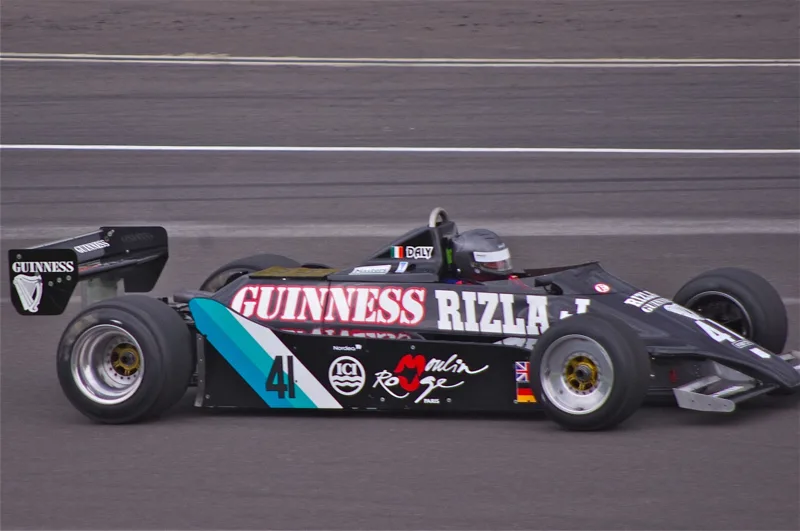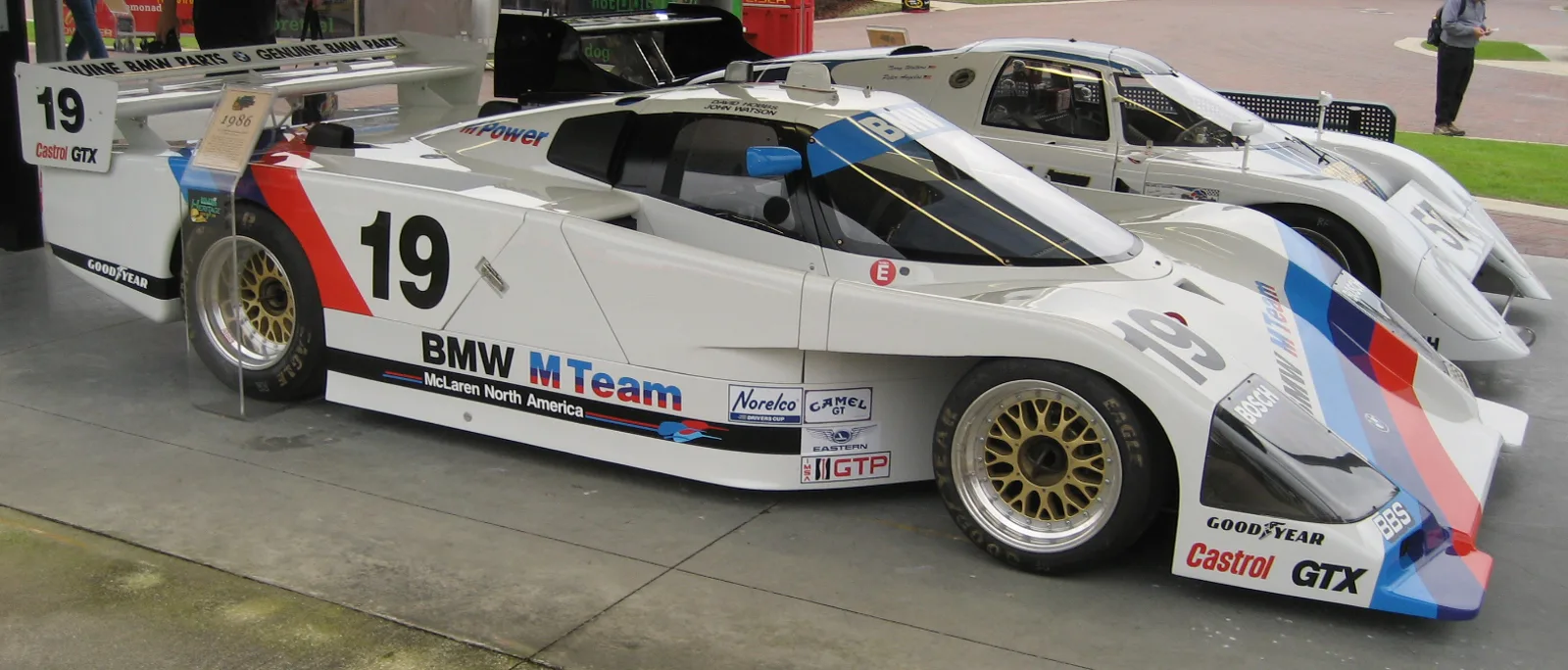
A Group C and IMSA GTP sports racer that carried three different identities, scored a BMW win in 1986 and gave Nissan five pole positions.
Built by March Engineering as a bare platform, the 86G raced as a BMW GTP, Nissan R86V and Buick Hawk. It won one race for BMW in 1986 and took five poles for Nissan, and it stayed in use until early 1989.
March Engineering built the 86G as a Group C and IMSA GTP racer, supplied as a chassis with no engine, and the engine that went into it decided which badge it raced under as a BMW GTP, a Nissan R86V or a Buick Hawk.
Eleven chassis were built, and the car raced from 1986 until early 1989. It scored one race victory, for the BMW team in 1986, and its Nissan-run examples took five pole positions, so it left a mixed but memorable record in the IMSA and Japanese sports car series.
What made the March 86G unusual?
The 86G was sold as a bare chassis, and the manufacturer that bought it chose the engine and the name. Bodywork was altered to reflect the company running the car, so one design appeared in three quite different forms, depending on who campaigned it.
The chassis went to three groups of buyers. Chassis 86G-1 to 86G-4 went to BMW, 86G-5 to 86G-8 went to Nissan, and later examples went to private teams linked to Buick.
The 86G was not retired when a newer design arrived. It kept racing long after the 87G had appeared, which shows how a sound design could keep working for teams without a newer car.
One chassis, three names: the March 86G raced as a BMW, a Nissan and a Buick Hawk, and each badge changed the car's story.
How did the BMW GTP perform in 1986?
BMW's four cars were numbered 86G-1 to 86G-4 and entered as the BMW GTP for the 1986 IMSA GTP season. Davey Jones and John Andretti shared car 18, while John Watson and David Hobbs drove car 19 for most of the year.
The programme began badly. BMW North America hoped to debut the car at the 24 Hours of Daytona, but a fire during a test at Road Atlanta left the only completed car too damaged to race. The car made its first appearance at the Grand Prix of Miami instead.
At Miami the Jones and Andretti car crashed out after 41 laps and was classified 25th. Watson and Hobbs finished ninth after 122 laps, which was the first sign that the chassis could go the distance.
At Watkins Glen the team's form improved. Jones and Andretti finished fifth, a lap ahead of Watson and Hobbs in sixth.
Chassis 86G-1 earned the car's only race victory, and chassis 86G-2 had its best finish, fourth at Portland. Those results were the high points of a difficult year.
BMW finished the year with a series of mechanical failures and reliability problems. BMW pulled out of IMSA GTP at the season's end, which nearly ended the car's career.
BMW did enter two cars for the 1987 ADAC Wurth Supercup season opener at the Nurburgring, yet neither car lined up for the race, so the BMW GTP's career ended there.
What did Nissan do with the R86V?
Nissan bought chassis 86G-5 to 86G-8 and ran them as the R86V. The first race for the car came at the 500 km of Suzuka, where chassis 86G-5 caught fire and never started. The team's early results were patchy, but the car quickly showed speed in qualifying.
Person Racing qualified tenth and finished fifth in its first race, the 1000 km of Fuji, which was the only Nissan entry at the event. Later in 1986 the Hoshino team took back-to-back pole positions at Suzuka, and the Nissan factory car claimed a pole at the Fuji 500.
The Le Mans trip was less successful. Chassis 86G-5, run by Nissan Motorsport for the 1986 race, qualified 24th and failed to finish with gearbox failure, and the rest of the 1986 season was dogged by retirements.
By the end of the 1986 season the works Nismo team had abandoned its R86V chassis, selling 86G-7 to Hasemi Motorsport. In 1987 the March-Nissan partnership finished fourth in the manufacturers' points with 22, behind Mazda, Toyota and Porsche.
Across the whole run, the car earned five pole positions. Its best finish as a Nissan R86V was fourth at the Fuji 500 Kilometers that closed the 1987 season.
How was the 86G turned into a March 88S?
From 1988 the Person Racing Team began converting its Nissan R86V into a March 88S, changing the aerodynamics at both ends of the car. The Nissan VG30ET V6 was enlarged from 2.9 litres to 3.2 litres, and a second 87G was converted in the same way later in the season.
The 88S made its debut at the 1988 500 Kilometers, where it qualified third but dropped out with a suspension failure. The next race at Suzuka ended in a transmission failure after a 10th-place start, but the car finished ninth at the Fuji 1000 km.
The chassis also went to Le Mans in 1988. It started 25th and retired with engine failure, a result that matched much of the rest of the car's career. Late in the season the older 86G-based 88S ran alongside a second 88S, which had been assembled from a March 88G built from a March 87G.
The March 88S continued to race through 1989, although by then the cars were built on the 88G chassis. That change shows how a single design could be rebuilt around new hardware as the seasons passed.
What were the R88C conversions?
Nissan upgraded its 87G cars to R88C specification in 1988. In 1989 the company bought back chassis 86G-5 from the Hoshino Racing Team and 86G-7 from Hasemi Motorsport, and both were rebranded as R88C cars for the 1989 season.
The two 86G-based R88C cars used a twin-turbo version of the VRH30 V8, which set them apart from the 87G-based cars. Their power unit made them a useful stopgap while Nissan finished work on a new car.
R88C-7 finished third at the 1989 Fuji 1000 km, the best result achieved by any Nissan 86G-based car. R88C-5 finished sixth in the same race after starting second on the grid, which put the two cars on the front row.
Both cars were retired after that race, and Nissan used a new car for the rest of the season. The R88C programme was the last major use of the 86G chassis, and Nissan's attention had already moved on to the R89C, which it was building with Lola.
How did the Buick Hawk variant race?
The Buick Hawk was the 86G fitted with a three-litre Buick V6 turbo. Conte Racing bought chassis 86G-11 in 1987 and ran it with that engine, but the team's season was short, and its best result was fourth at Lime Rock, where the car finished in the points.
Conte's car had missed the 1987 Daytona 24 Hours and started its first race at the 1987 3 hours of Miami, where it qualified second and then crashed. After repairs it ran at Laguna Seca, where it failed to finish, and then at Lime Rock, where it took fourth. After that the car was sold to Gianpiero Moretti, whose Momo team ran it for the rest of 1987.
For 1988 the Momo Course team bought two BMW chassis, 86G-9 and 86G-10, and entered them as a pair of Buick Hawks. Both cars started the Daytona 24 Hours, with 86G-10 retiring after an oil system failure.
At the 1988 Sebring 12 Hours three Buick Hawks lined up. The best finish was 39th for the HP Racing car, which had previously run as a BMW. None of the three reached the finish, and the Momo cars failed with engine and oil pressure problems. Bob Copeman died during the preliminary sessions in a Porsche entered by HP Racing.
What were the main March 86G specifications?
| Specification | Detail |
|---|---|
| Constructor | March Engineering |
| Categories | Group C and IMSA GTP |
| Chassis built | 11 in total |
| BMW GTP | Four chassis, 86G-1 to 86G-4 |
| Nissan R86V | Chassis 86G-5 to 86G-8 at first |
| Buick Hawk | Run by private teams including Conte Racing and Momo Course |
| Race wins | 1 (BMW, 1986) |
| Pole positions | 5 (Nissan) |
| Years active | 1986 to early 1989 |
| Nissan engine | VG30ET V6, enlarged from 2.9 to 3.2 litres for the March 88S |
| Buick engine | Three-litre Buick V6 turbo |
| R88C engine | Twin-turbo version of the VRH30 V8 |
How did the Person and Hasemi teams keep the 86G running?
Person Racing and Hasemi Motorsport kept the older chassis in service through 1987. Person qualified fourth at the season opener and retired with an oil leak, while Hasemi's 86G-7 qualified seventh and finished eighth before the team retired the car.
Hoshino returned for the Fuji 1000 km, joined by the Pearson team. Its car started from a deep qualifying position but came back to finish eighth, while the Person car retired with suspension problems.
The Person team went back to Japan for the final three races of 1987 and finished all three. Its best result was fourth at the Fuji 500 Kilometers, which closed the season and gave the R86V family one last strong finish.
Chassis 86G-8 went to Le Mans in 1987 as an Italya Sports entry. It was fifth fastest in practice testing, qualified 24th and retired with accident damage, which ended its Le Mans appearance for that year.