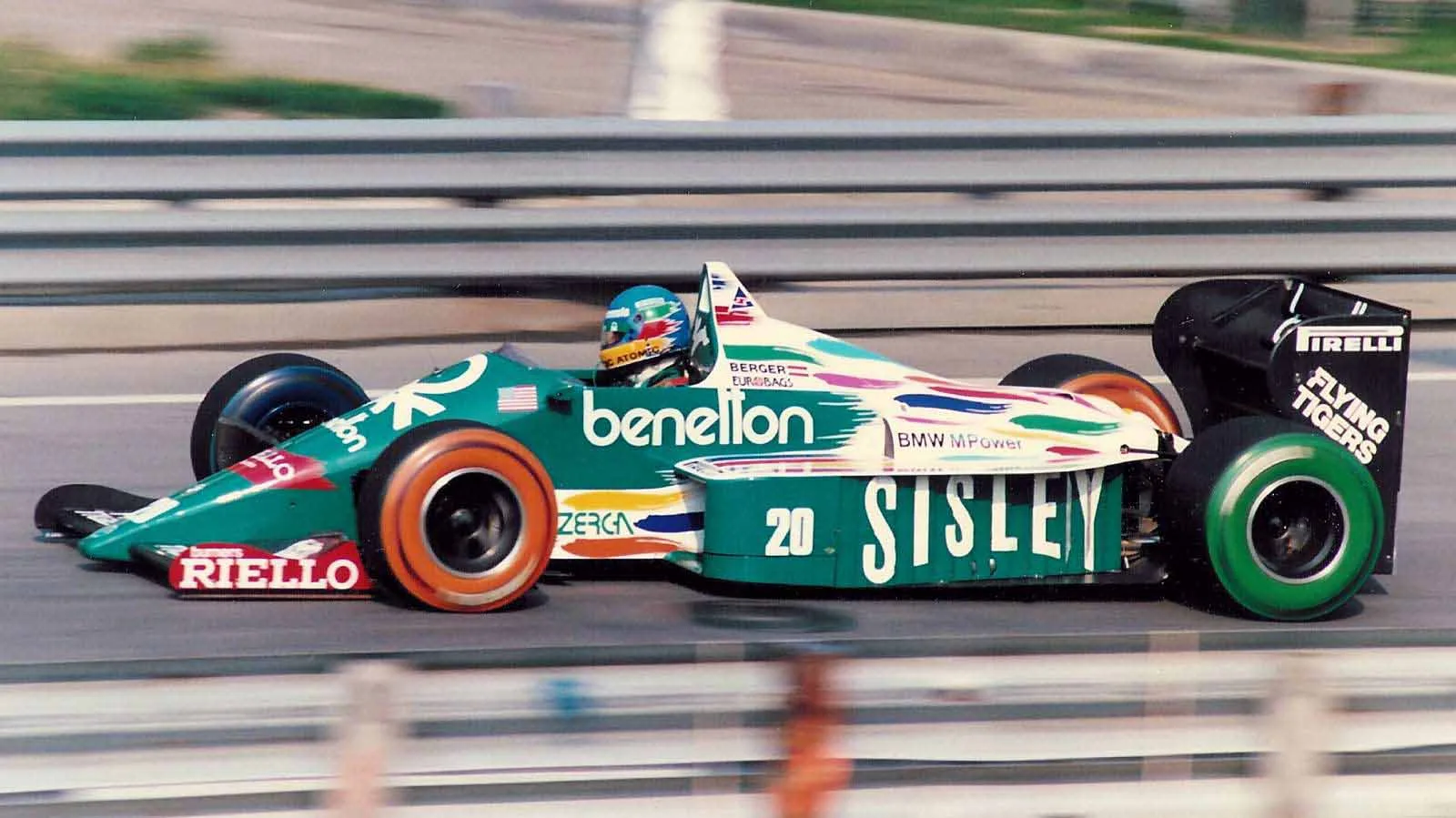
Benetton's first Formula One car as a constructor, built on a BMW turbo four with huge qualifying power, which won in Mexico in 1986.
The Benetton B186 was the Formula One car Benetton built and raced in the 1986 World Championship, after buying the Toleman team. Its BMW M12/13 turbo engine was among the most powerful units in the field, and the car gave Gerhard Berger a first win in Mexico. It was replaced by the Ford-powered B187 for 1987.
Benetton entered its own Formula One car for 1986, the B186, after acquiring Toleman late in 1985. Powered by a BMW turbo four with enormous qualifying power, it scored points in its first races, gave Gerhard Berger a podium at San Marino, and delivered Benetton its first Grand Prix win in Mexico.
Why did Benetton build its own car in 1986?
Benetton bought the small Toleman outfit at the end of 1985, after years of sponsoring it and other teams. The structure barely changed, and the planned Toleman TG186 was simply renamed the B186. Peter Collins stayed on as team manager, and Rory Byrne remained chief engineer.
Benetton was an Italian group, yet the team kept its base at Witney in England. The biggest change was the engine. The privately run Hart 415T units that had powered Toleman since 1981 gave way to BMW's turbocharged four-cylinder, a unit that only a large manufacturer could supply. Byrne began drawing the B186 once the BMW deal was signed in late October 1985, which left only about five months before the opening race in Brazil.
Three B186s were ready for Brazil on 23 March 1986, and four more chassis followed during the season, giving seven in all. The monocoques were carbon fibre, as was normal by then. Much of the first part of the year went into producing spare parts for the existing cars rather than developing the chassis.
A BMW turbo four with huge qualifying power, which gave Benetton its first win in Mexico in 1986.
What was the BMW engine like?
The BMW M12/13 was a turbocharged four-cylinder that produced around 1,400 bhp in qualifying trim and roughly 900 bhp in race trim. On paper that made it the most powerful unit in the field, but its on-off delivery and turbo lag left the car slow out of slow corners compared with the V6 rivals.
The lay-down version of the M12/13 went to Brabham's BT55, while Benetton and Arrows received the upright version. The BMW delivered about 600 bhp more than the Hart in qualifying and roughly 200 bhp more in the race. That extra strain meant the B186 was built to be structurally stronger than its predecessor, the TG185.
A dispute came to a head in Austria over the engine management chips. The team's chips gave roughly 50 bhp over the factory-spec units Brabham received. BMW engineer Paul Rosche asked to inspect them, but the team had kept the originals and was able to produce them, which avoided a breach of contract.
How did the B186 perform in 1986?
The B186 scored points in its first three races, including Berger's podium at San Marino. It set two poles, three fastest laps and one win, but it retired nineteen times in 32 starts, which tells its own story. It was strongest at the fast tracks and weakest on the tight street circuits.
Early on the car was difficult to sort. Spare parts were in short supply, the chassis was stressed by the BMW's power, and the handling took time to settle. The team also ran Pirelli tyres when most front-runners used Goodyears, and neither Benetton nor Brabham had completed many laps in pre-season testing. Pirelli's compounds later improved, and their durability often played to the B186's advantage.
By mid-season the spares problem had eased, and the cars received a fresh set of aerodynamic parts, revised suspension and a stronger chassis. A new rear wing arrived for the Austrian Grand Prix, where the car became the quickest in the field, with Fabi taking pole and Berger alongside him on the front row.
Speed on the power circuits
Its best venues were the fast ones: Imola, Spa, Hockenheim, Monza and the Osterreichring. Berger set a top speed of 352 km/h (219 mph) at Monza, and BMW-powered cars held the top five places on the speed traps there.
In qualifying at Monza, Berger's speed trap reading of 351.22 km/h (218.24 mph) was the second fastest of the original turbo era from 1977 to 1988. Only Nelson Piquet's Williams-Honda, at 352.135 km/h (218.807 mph) in 1987, was quicker. Fabi was next quickest on the straight and took pole, but problems on the warm-up lap forced him to start from the pit lane.
The engine's peak speed was not always matched by the chassis early on. The B186 struggled on slower circuits, where the four-cylinder's turbo lag mattered more than peak power.
What went wrong in Austria?
At the Austrian Grand Prix the B186s looked set for a dominant 1-2 finish. Fabi over-revved his engine after lifting its rear wheels over a kerb, and the engine failed several laps later. Berger's battery then failed as well, and he lost five laps in the pits while a new one was fitted.
The car's race pace was clear at Brands Hatch too, where Berger and Fabi were both running well during the British Grand Prix. The results rarely reflected that speed, because reliability remained a worry all year.
Where did Benetton win its first race?
Benetton's first Grand Prix win came in Mexico, the penultimate round of 1986. Berger did not have the outright fastest package, but his Pirelli tyres lasted without a stop while rivals such as Piquet, Prost and Mansell lost time to pit stops or mechanical trouble. It also marked the final victory for that BMW M12 unit.
It was Berger's first of ten career wins, and many observers saw the result as a fitting end to Benetton's first season as a constructor. The team comfortably beat fellow BMW users Brabham and Arrows, and it was usually the quickest team on Pirelli tyres. The more reliable Ligier still scored more points with its Renault V6 turbos.
Gordon Murray's low-line Brabham BT55 had been expected to be the strongest customer car for BMW and Pirelli alike, so the B186's results surprised both companies. Ford's turbo B187 took over from it for 1987.
Livery, drivers and surviving chassis
The livery reflected the new owner. Benetton green covered the front and sidepods, with sponsors Sisley and Riello. The engine cover carried multi-coloured streaks on white, a nod to the United Colors of Benetton brand. At Detroit the team ran tyres with multi-coloured sidewalls, and each car carried the flag of the host country beside its mirrors, except at San Marino, where the flag of San Marino was shown even though Imola is in Italy.
Gerhard Berger and Teo Fabi drove the car. The cockpit had to suit two very different builds, with Fabi about 1.68 metres (5.5 ft) tall and Berger about 1.83 metres (6.0 ft). Seven chassis were built, and all of them raced in the hands of Fabi or Berger.
Fabi wrote off chassis 4 in Canadian Grand Prix practice. Chassis 2 is on display at the Mondello Park museum in Ireland, and chassis 6 sits in the BMW Museum in Munich. Chassis 5 was rebuilt in Sydney for historic racing, then sold to a collector in Adelaide in late 2015.
Specification and results at a glance
| Item | Detail |
|---|---|
| Team | Benetton, formerly Toleman |
| Season | 1986 Formula One World Championship |
| Engine | BMW M12/13 turbocharged four-cylinder |
| Qualifying power | About 1,400 bhp |
| Race power | About 900 bhp (671 kW; 912 PS) |
| Tyres | Pirelli |
| Chassis built | Seven, carbon fibre monocoques |
| Pole positions | Two, both taken by Teo Fabi |
| Fastest laps | Three |
| Wins | One, Gerhard Berger in Mexico |
| Retirements | Nineteen from 32 starts |