
Max Verstappen passed Lewis Hamilton on the final lap to take the 2021 world title, in a race that left the FIA reviewing its safety car rules and race control.
The 2021 Abu Dhabi Grand Prix was settled when Red Bull's Verstappen passed Lewis Hamilton on the last lap at Yas Marina. The race, held on 12 December, gave him the drivers' title by eight points, while Mercedes took its eighth straight Constructors' title.
Max Verstappen won the 2021 Abu Dhabi Grand Prix on 12 December 2021, passing Lewis Hamilton on the final lap to take his first world championship. The race was the 22nd and last round of the season at the Yas Marina Circuit, and it finished under a safety car restart that set off a wide argument about how race control had handled the closing laps. Mercedes won its eighth consecutive Constructors' title.
Who won the 2021 Abu Dhabi Grand Prix?
Max Verstappen won for Red Bull, taking the lead on the final lap and holding it to the chequered flag. Lewis Hamilton finished second for Mercedes, and Carlos Sainz Jr. took third for Ferrari. Verstappen finished the season eight points clear, which made him the drivers' champion.
The race was held on 12 December after its original date of 5 December was moved. The Australian Grand Prix had been postponed because of the COVID-19 pandemic, and the Saudi Arabian Grand Prix took the original date in the calendar. It was the 13th edition of the Abu Dhabi race and the last round of the 2021 season.
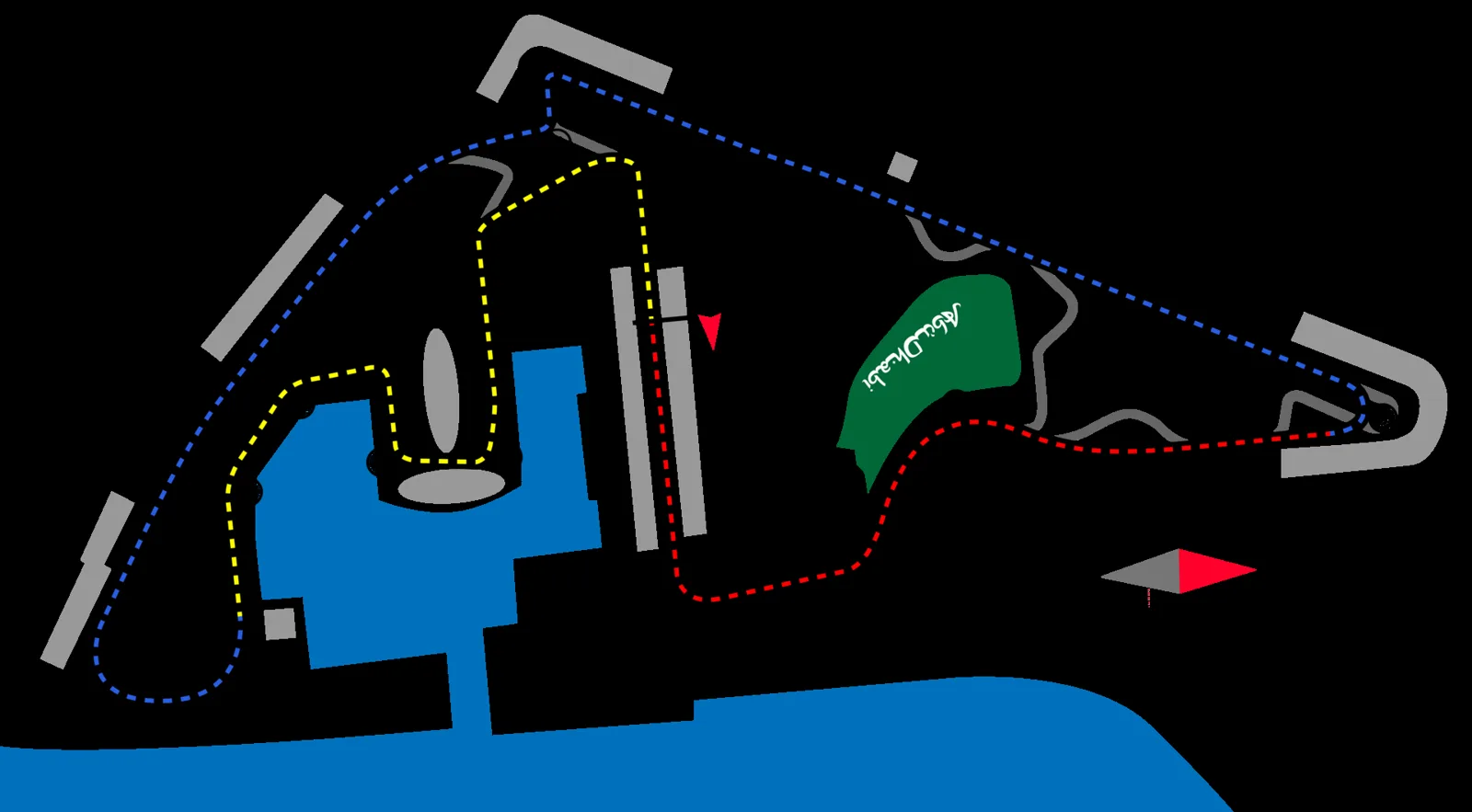
The Yas Marina layout had been altered to create more overtaking. The chicane after turn four was removed, the turn five hairpin was widened, and the four-corner sequence of turns 11 to 14 became one banked turn nine. Pirelli supplied its softest dry compounds, the C3, C4 and C5, for the race.
A last-lap pass, a disputed safety car restart and a title decided by eight points.
What was at stake before the race?
Verstappen and Hamilton both entered the round on 369.5 points, which left the title level on the eve of the last round, a situation not seen since 1974. Verstappen had won nine races to Hamilton's eight, so he would have taken a tie on that count. The race was the first final round to decide the drivers' title since 2016.
Mercedes topped the Constructors' table with 587.5 points, while Red Bull had 559.5, a gap of 28. Not since 2008 had the final round settled the constructors' title, and Ferrari led McLaren by 38.5 points in the fight for third.
The rivalry had been bitter all season, and history offered warnings. Ayrton Senna and Alain Prost collided at the 1989 Japanese Grand Prix, and their 1990 rematch ended in another deliberate contact at Suzuka. Michael Schumacher's clashes with Damon Hill in 1994 and Jacques Villeneuve in 1997 also decided title fights, and the 1997 contact led to his disqualification from that season.
Race director Michael Masi warned both title rivals that the FIA could impose sanctions, up to championship disqualification or race bans, if either driver attempted a deliberate collision to win the title.
How did practice and qualifying go?
Verstappen was fastest in the opening practice session, and Hamilton led the second before Verstappen's Red Bull team fought back on pace. Qualifying saw Verstappen take pole from Hamilton, using the slipstream of his teammate Sergio Perez in the final session.
The first practice session passed without incident. It ended with Verstappen fastest, then Valtteri Bottas and Hamilton. In the second session Hamilton was fastest, 0.3 seconds ahead of Esteban Ocon, with Bottas third and Verstappen fourth, 0.6 seconds behind Hamilton. Kimi Raikkonen crashed at turn 14 as that session ended, but he was unhurt.
Saturday qualifying got under way at 17:00 local time. Mick Schumacher hit a bollard in the first session, which was briefly suspended before resuming without further trouble, and Hamilton and Bottas set the fastest early times. In the second session Hamilton held a four-millisecond advantage over Verstappen after the first flying laps.
Verstappen then locked up on his second flying lap and returned to the pits for soft tyres. Hamilton, by contrast, was locked into the medium compound for the race. Verstappen improved to the top of the timesheets on the softer tyres, which meant he would start the race on them.
In the final session Verstappen used the slipstream of Perez to take pole, with Hamilton second on the grid. Nikita Mazepin, who had qualified 20th, then tested positive for COVID-19 and withdrew before the race. His place was left vacant and not filled.
What happened in the race?
Hamilton led most of the race. Verstappen's soft tyres degraded faster than Hamilton's mediums, and the finish was shaped by a late safety car.
The Sunday start came at 17:00 local time, in front of about 153,000 spectators. Hamilton grabbed the lead on the main straight from his rival. Verstappen then tried an overtake on the inside of the turn six-seven chicane, ran wide, and Hamilton stayed on the track, cut turn seven and rejoined well ahead.
Red Bull protested and argued that Hamilton should have given the place back. Red Bull were told by radio that Hamilton had given back any advantage, and the stewards decided no further investigation was needed. Horner called the decision a total lack of consistency during the race.
Verstappen pitted at the end of lap 13 and Hamilton followed a lap later, both on hard tyres. That elevated Perez to the lead, and he was told to hold Hamilton up so that Verstappen could close. The gap fell from about 11 seconds to 1.3 seconds by lap 21, but Hamilton had stretched it back to four seconds by the middle of the race.
On lap 26 Raikkonen collided with the barriers at turn six after brake problems, ending his 349th and final Grand Prix. George Russell's final race for Williams also ended that lap, with gearbox trouble. On lap 35 Antonio Giovinazzi retired with the same problem, which triggered a brief virtual safety car.
Red Bull used the virtual safety car to pit Verstappen for hard tyres without losing track position. Mercedes did not pit Hamilton, because it did not want to give up the position. Verstappen cut the deficit from 17 seconds to 11, but he could not reach Hamilton before the flag.
On lap 53 Latifi, who had dirty tyres after going off the track at turn nine, crashed at turn 14 while fighting Mick Schumacher for 15th. The safety car came out. Hamilton again did not pit, since he did not have enough of a gap to Verstappen, and the team may have expected the race to finish under the safety car. Verstappen pitted for soft tyres and kept second, while Perez retired into the pits.
Why was the final safety car restart so controversial?
Race director Michael Masi let only the cars between Hamilton and Verstappen pass the safety car, then brought the safety car period to an end a lap earlier than the usual procedure implied. That gave Verstappen a final lap of green-flag racing and a chance to pass Hamilton, and critics said the handling was inconsistent with usual procedure.
On lap 57, Christian Horner pressed Masi by radio to clear the lapped traffic. Masi responded by letting five lapped cars pass the safety car in the gap between the two title rivals, while those behind Verstappen stayed put. That had never happened before in one race, because either none or all of the lapped cars had normally been allowed to pass.
Under the rules there seemed to be no time left for a restart. Right after Sebastian Vettel passed Hamilton and the safety car to rejoin the lead lap, race control said the car would pit at the end of the current lap.
That announcement allowed one more lap of racing, and it brought an angry reaction from the Mercedes side. Toto Wolff objected over the radio and asked Masi to restore the order of the penultimate lap. Masi replied, in effect, that this was a motor race and the cars were racing.
Verstappen overtook Hamilton into turn five on the final lap to win the race and the drivers' title. Sainz finished third for Ferrari, and Yuki Tsunoda took fourth, a career-best result for AlphaTauri. Hamilton's final radio message to his engineer, kept off the television broadcast, said he felt the race had been manipulated.
How did Mercedes and the FIA respond?
Mercedes protested the result immediately. It argued that Masi had broken safety car procedure by letting only some lapped cars unlap themselves, and by ending the period on the same lap rather than waiting until the one after. Mercedes said Hamilton would have won had the article been fully applied.
The stewards dismissed the protest. They ruled that the race director had overriding authority over safety car procedure, and that declaring Hamilton the winner for leading on lap 57 would have effectively shortened the race. Verstappen was confirmed as champion, subject to any appeal.
Red Bull had argued that 'any cars' did not mean all cars, and that the race director could withdraw the safety car in the same lap. Masi argued that the rule was intended to stop cars that interfered with the leaders, and that all teams had agreed races should end under racing conditions.
Mercedes first signalled it would take the matter to the FIA International Court of Appeal. The FIA then promised a detailed analysis of the event on 15 December, and it admitted the controversy was tarnishing the sport's image. Mercedes dropped its appeal one day later, saying neither Toto Wolff nor Hamilton wanted the title to be decided in court.
Hamilton and Wolff stayed away from the FIA prize-giving. Hamilton was fined for his absence, and he asked that the money go to the FIA's work with underprivileged children.
What changed after the race?
The FIA restructured race control in February 2022. On 17 February Masi was removed as race director, and Eduardo Freitas and Niels Wittich alternated in the role, with Herbie Blash as a permanent adviser. Radio transmissions between teams and the FIA were no longer broadcast on television.
The safety car rules were also revised for 2022. Under the new procedure, the car leaves the track one lap after lapped traffic is told it may pass, rather than waiting until the cars had all unlapped. Stricter enforcement of track limits and wheel-to-wheel rules were introduced at the same time.
The FIA review began in January 2022. In February radio messages between Masi and Red Bull's team manager, Jonathan Wheatley, emerged, and they suggested that Masi had taken instructions from Wheatley on the unlapping decision. The March 2022 report said the communication between the team principals and Masi during the final laps had been inappropriate.
The FIA also concluded that Masi had been acting honestly, given the pressure on him. Its report recommended changes to protect the race director from pressure, and it called for the safety car regulations to be clarified.
Who were the top finishers?
| Result | Driver | Team | Note |
|---|---|---|---|
| 1 | Max Verstappen | Red Bull Racing | Pole; race win and drivers' title |
| 2 | Lewis Hamilton | Mercedes-AMG Petronas | Led most of the race; lost the title by eight points |
| 3 | Carlos Sainz Jr. | Ferrari | Third place |
| 4 | Yuki Tsunoda | AlphaTauri | Career-best fourth place |
| Retired | Kimi Raikkonen | Alfa Romeo | Crashed on lap 26; final race |
| Retired | Nicholas Latifi | Williams | Crash on lap 53 brought out the safety car |
What did the title result mean?
Verstappen finished eight points ahead of Hamilton. He became the first Red Bull driver to win the title since 2013, and the first Honda-powered champion since Ayrton Senna in 1991. Mercedes won its eighth consecutive Constructors' title, extending its own record.
A drivers' title going to a driver outside the constructors' champion team had not happened since 2008, when Hamilton won for McLaren.
What has the race meant since?
Latifi apologised immediately after the race, but he later reported receiving abuse and death threats on social media. Hamilton sent him messages of support, and Latifi said he needed extra security at events before the 2022 season.
Masi also faced online abuse and threats, and he asked to meet Hamilton during the 2023 Australian Grand Prix to explain his decisions. Hamilton declined, saying he had nothing to say. Hamilton endured 30 months without a victory, and the strain took a toll on his mental health.
Toto Wolff said in a later interview that he and Hamilton still thought about Abu Dhabi every day, almost four years on. Peter Windsor has repeatedly argued that Masi broke the sporting regulations, a view that echoed Mercedes' protest.