Charles Leclerc won from pole for Ferrari, with a Sainz 1-2 and a double Red Bull retirement that changed the early championship picture.
Charles Leclerc won the 2022 Bahrain Grand Prix from pole for Ferrari, with Carlos Sainz Jr. second and Lewis Hamilton third. The race opened the 2022 season, and the double retirement of Max Verstappen and Sergio Perez shaped the early championship picture.
Charles Leclerc won the 2022 Bahrain Grand Prix for Ferrari after starting from pole, and his team-mate Carlos Sainz Jr. took second. Lewis Hamilton completed the podium, while reigning champion Max Verstappen and Sergio Perez retired from positions that would have meant points. The race opened the 2022 Formula One season and gave Ferrari its first win since 2019.
What was the 2022 Bahrain Grand Prix?
Run over 57 laps, the event took place on 20 March 2022 on the Bahrain International Circuit in Sakhir. Officially it was the Gulf Air Bahrain Grand Prix 2022, and it kicked off the 2022 Formula One World Championship. It was the eighteenth edition of the race at the venue.
Before this, the venue had staged seventeen Bahrain races, plus the 2020 Sakhir Grand Prix, a one-off run on a different layout. The 2022 meeting was the fourth time Bahrain had opened the season, after 2006, 2010 and 2021. The weekend ran from 18 to 20 March.
A pole, a win and the lead of the championship for Ferrari, on the first day of a season that would be decided by others.
Why did the 2022 season start with new rules?
The 2022 regulations were the biggest technical change in years. Ground effects returned with the aim of making it easier for cars to follow and overtake one another, and the system for allocating aerodynamic testing time was changed to favour lower-placed teams. Spending limits were trimmed too, with the ceiling dropping to $142.4 million from US$145 million.
The wheels grew from 13 inches to 18 inches, and Pirelli brought its C1, C2 and C3 compounds, one step harder than the tyres used in 2021. Anyone who made Q3 could now start the race on a fresh set of tyres rather than the Q2 set, scrapping a rule that dated from 2014.
Pre-season testing at the same circuit, from 10 to 12 March, showed that the ground effect cars had a tendency to porpoise. Many constructors struggled with the bouncing. Ferrari and Red Bull solved it before the race, while Mercedes continued to fight it for the opening rounds. Mercedes had shown a minimalist sidepod design that looked very different from anything else on the grid, and Hamilton admitted he was struggling to tame the car during testing. Both of its drivers voiced doubts about it.
Who changed teams before the race?
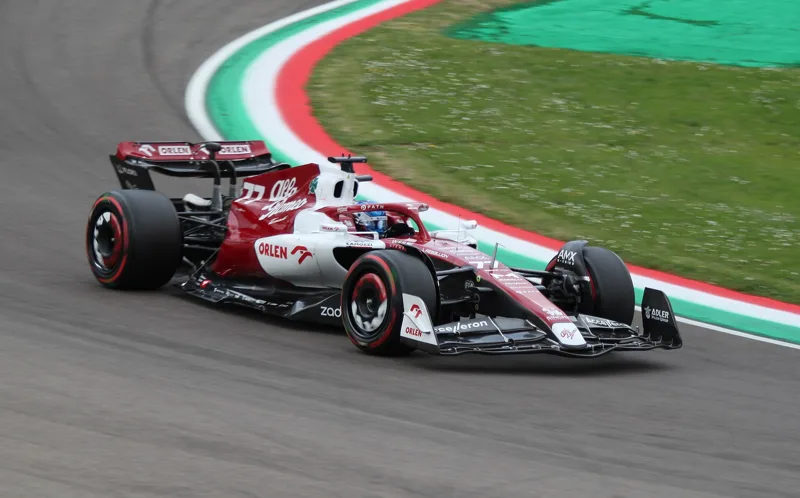
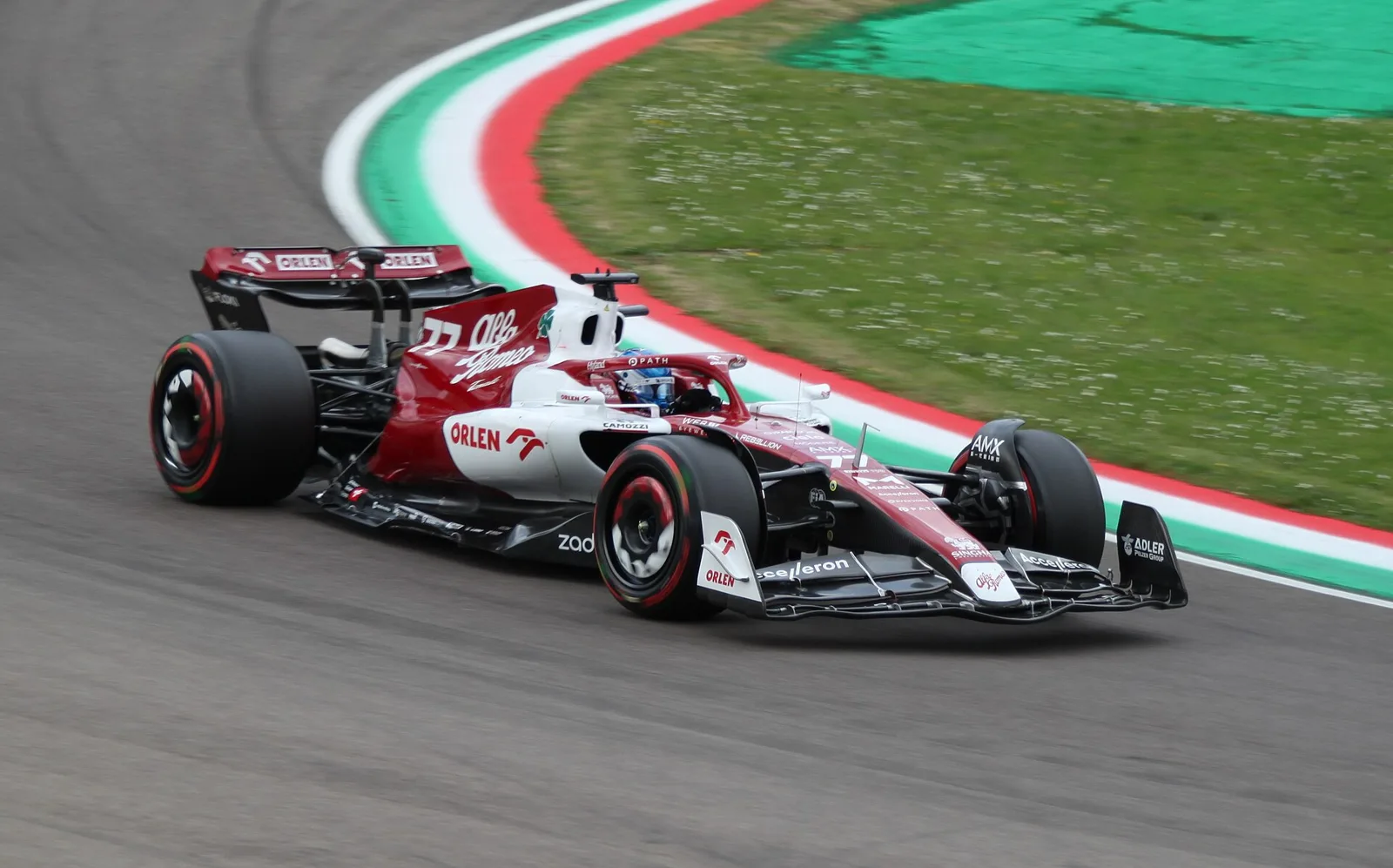
Several drivers arrived at new teams for 2022. Valtteri Bottas moved to Alfa Romeo in place of the retired Kimi Raikkonen. George Russell took Bottas's seat at Mercedes, which left a vacancy at Williams that was filled by Alex Albon, a Red Bull reserve driver. Zhou Guanyu joined Alfa Romeo after finishing third in the 2021 Formula 2 Championship, and he was the only rookie on the 2022 grid.
Nikita Mazepin had been contracted to race for Haas, but his sponsor's contract was terminated after Russia's invasion of Ukraine, and Kevin Magnussen returned in his place. Magnussen had driven for the team earlier, between 2017 and 2020. Sebastian Vettel of Aston Martin returned a positive coronavirus test before the weekend, and reserve Nico Hulkenberg stepped in. Hulkenberg had last raced at the 2020 Eifel Grand Prix, a single appearance.
How did practice and qualifying shape the grid?
Three one-hour practice sessions were held, two on Friday and one on Saturday. Session one opened at 15:00 local time, which is UTC+03:00, but it was red flagged after Esteban Ocon's Alpine lost its sidepod bodywork on the main straight. Once running resumed, Pierre Gasly was quickest on soft tyres.
Verstappen was top of the timesheets in the second and third sessions, with Leclerc just behind on both occasions. Mercedes struggled for pace across practice and never finished higher than fourth on the timesheets. Yuki Tsunoda was unable to set a time in the third session after a hydraulic leak sent him back to the garage.
Qualifying's start time was 18:00 local time on 19 March. Both Aston Martins, along with Tsunoda, Daniel Ricciardo and Nicholas Latifi, were eliminated in the first segment. Valtteri Bottas surprised everyone by placing his Alfa Romeo fourth, with Kevin Magnussen of Haas just behind. Mick Schumacher took 13th, putting both Haas cars into Q2 for the first time since the 2019 Brazil race.
In Q2 Verstappen was quickest, with the two Ferraris close behind him. Sergio Perez was next, ahead of the Mercedes drivers. Magnussen reached Q3 in seventh, the team's first appearance there in more than two years, before a hydraulic fault sent him back to the pits. Late on, Bottas's lap edged Ocon out of the final segment by 0.065 seconds, and McLaren and Williams both fell short of Q3.
Leclerc took pole ahead of Verstappen and Sainz. Perez was fourth, three-tenths off Sainz's time, and the two Mercedes split fifth and ninth. Pierre Gasly completed the top ten.
| Driver | Team | Race outcome |
|---|---|---|
| Charles Leclerc | Ferrari | Winner from pole, fastest lap |
| Carlos Sainz Jr. | Ferrari | Second |
| Lewis Hamilton | Mercedes | Third |
| George Russell | Mercedes | Fourth |
| Kevin Magnussen | Haas | Fifth |
| Max Verstappen | Red Bull | Retired on lap 54 with a suspected power unit issue |
| Sergio Perez | Red Bull | Retired on the final lap with a fuel system fault |
| Zhou Guanyu | Alfa Romeo | Tenth, his first points on debut |
How did the race unfold?
The start was set for 18:00 local time on 20 March. Leclerc led through turn 1, with Verstappen and Sainz behind him, and Hamilton and Magnussen got past Perez early on. Starting sixth, Bottas had dropped to 14th before the first lap ended. On that same lap Ocon collided with Schumacher and spun him, which earned Ocon a five-second penalty. By lap 10 Perez had repassed Magnussen and Hamilton to regain fourth.
Hamilton became the first driver to pit, entering the pit lane on lap 12 and rejoining 12th. Verstappen stopped on lap 15 to try to undercut Leclerc, with Sainz following him in. Leclerc pitted a lap later and came out narrowly ahead of Verstappen, keeping the lead. Verstappen used DRS to pass Leclerc on lap 17, but Leclerc soon regained the position. On lap 19 Verstappen tried again, but he locked up and overshot turn 1, which let Leclerc pull away.
Verstappen made his second stop on lap 31, with Leclerc following a lap later, and both switched to medium tyres. Sainz, who had been leading, came in on lap 34, putting Leclerc and Verstappen at the head of the order. Verstappen pitted for a third time on lap 44, and Sainz and Hamilton responded. All three rejoined on soft rubber.
Gasly's car went up in flames on lap 46, and the safety car followed. Leclerc pitted for soft tyres during that window and returned to the field in the lead. When racing resumed on lap 51, Leclerc kept his advantage over Verstappen, who radioed that he suspected a power unit problem. Verstappen slowed, was passed by Sainz and Hamilton, and retired in the pit lane on lap 54.
On the final lap Perez suffered a fuel system fault that switched off his power unit, and he spun and retired. Leclerc and Sainz held the first two places, with Hamilton third. Russell finished fourth and Magnussen fifth.
Why did the result matter for Ferrari?
The victory broke a 45-race drought that dated to the 2019 Singapore race, the team's second-longest such run. Team principal Mattia Binotto called the outcome fantastic and a relief, and he praised the unity inside the team. He also warned against overconfidence, saying Mercedes would come back very strong.
Leclerc led all but two laps, a sign of how firmly he controlled the race from the front. He said the win and the 1-2 finish marked a return to winning form after two incredibly difficult years. He credited the team's adaptation to the 2022 regulations and his own growth as a driver. Sainz praised the car's development but was frustrated by his own pace, saying he had homework to do.
The result also put Ferrari on top. Leclerc took the lead of the Drivers' Championship and Ferrari took the lead of the Constructors' Championship. Ferrari had not held the top of the Drivers' standings since 2019, and not the Constructors' table since 2018.
What did the double retirement mean for Red Bull?
Red Bull's team principal Christian Horner described the double DNF as harsh and the outfit's worst fear, though he stayed upbeat about the car. Verstappen was critical, saying that at this level, with so much information already available on engines, such a failure should not happen.
Perez described the day as very disappointing and a very disappointing start, but he said he had confidence in the team to fix the fault. Both drivers had been running near the front, so the double retirement cost Red Bull a strong result on day one. Verstappen and Red Bull took over the championship lead at the 2022 Spanish Grand Prix.
Did Mercedes see promise in the race?
Mercedes had dominated Bahrain in recent years, taking six of the previous eight races, five of them with Lewis Hamilton. Hamilton and Mercedes had won three races in a row at the venue before this year, but 2022 looked different. Russell took fourth for Mercedes behind his team-mate, while Magnussen's fifth place gave Haas a strong start to the year. Practice had been difficult, and the team placed no higher than fourth in the sessions.
After the race Hamilton found the team's performance remarkable, even though he had expressed reservations about the car earlier. Toto Wolff, the team principal, admitted that defending the Constructors' title was a very long shot. Mercedes would continue to struggle with porpoising through the opening rounds.
What did the weekend reveal about the rest of the field?
The opening round made the pecking order clear. Ferrari and Red Bull set the pace, Mercedes qualified fifth and ninth and found the race hard going, and Hamilton's third place was the best the silver cars could salvage. Behind them, McLaren and Williams both failed to reach the final segment of qualifying.
Alfa Romeo briefly looked like a surprise package when Bottas placed fourth on the grid, and Haas converted Magnussen's qualifying effort into a fifth place. Those results showed how much the midfield could change in a single afternoon under the new rules.
What did Zhou's debut mean?
Zhou Guanyu made history as the first driver from China to start a Formula One race. He finished tenth, which made him the first Chinese driver to score points in the sport. His tenth place was enough for a point on his first weekend in the sport. It was a milestone for the sport on his debut weekend.
The result gave Alfa Romeo an early points finish and gave the sport a new national milestone. For a driver who had come through Formula 2 to reach the grid, the points were a clear sign of the progress he had made.