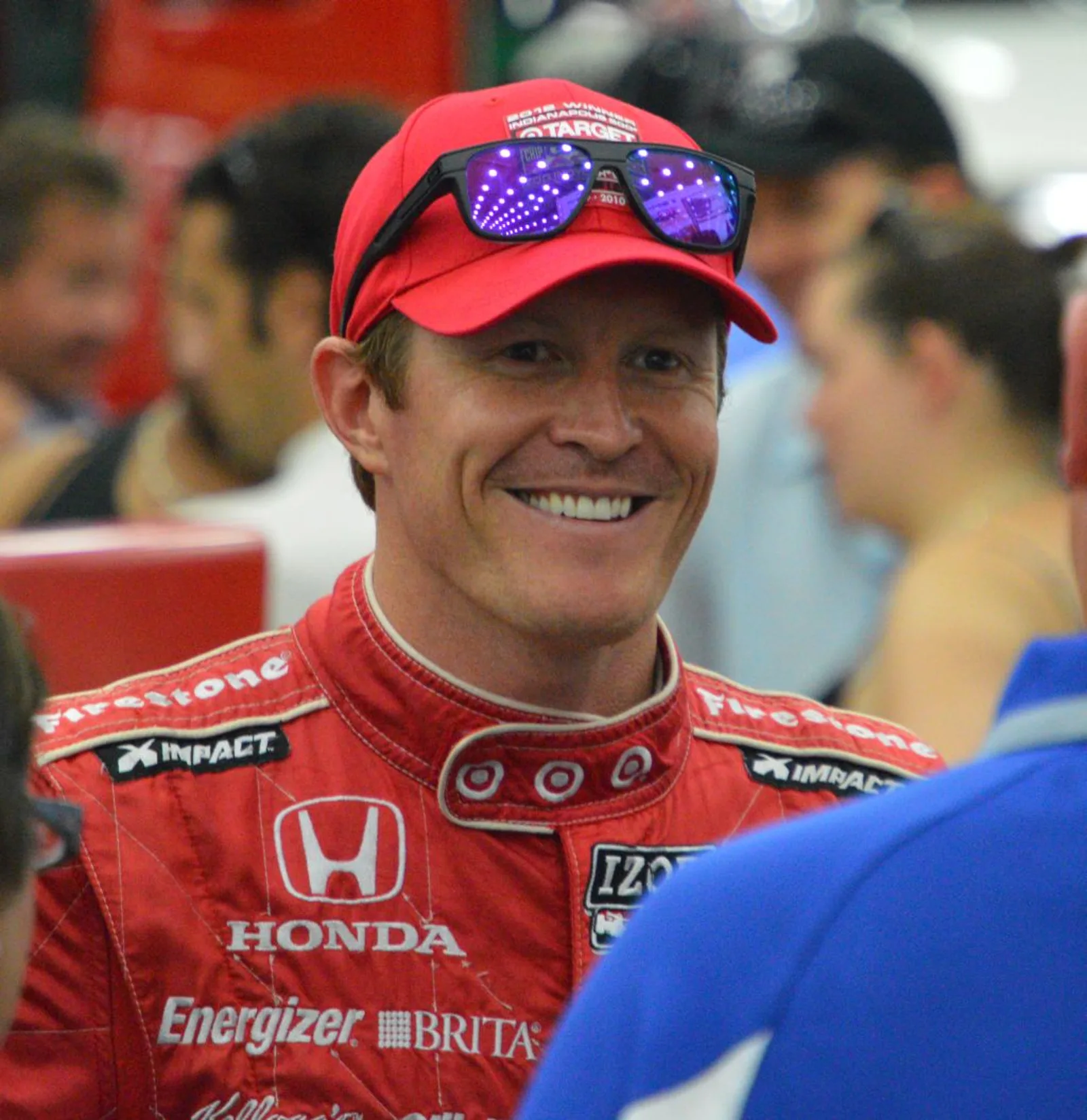
Scott Dixon won the championship on a tiebreak with Juan Pablo Montoya at Sonoma, a week after the death of Justin Wilson overshadowed a season of many winners.
Scott Dixon won the 2015 IndyCar championship for Chip Ganassi Racing, his fourth title, after a tiebreak with Juan Pablo Montoya at Sonoma. Montoya had won the Indianapolis 500 earlier in the year, and Will Power finished third after a season overshadowed by the death of Justin Wilson.
Counted as the 20th season of the IndyCar Series, 2015 also marked the 104th year of American open-wheel racing. Scott Dixon won his fourth championship on a tiebreak over Juan Pablo Montoya at the Sonoma finale, with Will Power third in the standings.
The season was overshadowed by the death of Justin Wilson, who was struck on the head by debris from another car at Pocono. It was a competitive year with many different race winners, and no driver won more than three races, so Dixon's three wins were the most of anyone and the title decision was unusually fine-grained.
What rule changes shaped the 2015 season?
The most visible change was the new aero kits. Manufacturer-specific bodywork became a rule for Honda and Chevrolet, and the series debuted those kits at St. Petersburg, where fragile front wings caused countless on-track contacts. Double points were restricted to the Indianapolis 500 and the Sonoma finale, down from the three 500-mile oval races that had carried them before.
Several operational rules also changed. Teams kept two weeks of testing, but promoter days and open tests counted towards that allocation, and pit selections were based on each team's performance in the last race rather than on the driver. Standing starts were eliminated for 2015 after several aborted attempts and a pile-up at the Indianapolis road course the year before.
The Indianapolis 500 rookie programme also got harder. Each phase raised the speed target by 5 mph, with Phase One at 205-210 mph for 10 laps, Phase Two at 210-215 mph for 15 laps and Phase Three at 215 mph or more for another 15 laps. The laps did not have to be consecutive.
No driver won more than three races, and the title came down to a tiebreak that few fans expected at the start of the year.
Which drivers and teams changed for 2015?
The most significant personnel change came at Ed Carpenter Racing, which merged with Sarah Fisher Hartman Racing to form CFH Racing. Josef Newgarden took the No. 67 CFH entry full-time, while Simon Pagenaud left Schmidt Peterson Motorsports after three years to join Team Penske in the No. 22 car. Will Power moved into the No. 1 car at Team Penske, and James Hinchcliffe took Pagenaud's seat at Schmidt Peterson Motorsports.
Ryan Briscoe did not return to Chip Ganassi Racing and pursued another ride, and Jack Hawksworth took the No. 41 car at A. J. Foyt Enterprises full-time while Takuma Sato returned to the No. 14. Mikhail Aleshin returned to Schmidt Peterson Motorsports for a third entry at Sonoma. Ryan Hunter-Reay re-signed with Andretti Autosport and his sponsor DHL on a multi-year deal.
The schedule also moved around. The Brasilia race was cancelled in January after the regional government changed, and the series sent representatives to check the Goiania venue as a replacement option. NOLA Motorsports Park joined the calendar, Texas returned to its June weekend on NBCSN, and the Houston doubleheader was dropped. Detroit was the only double-header weekend of the year.
How did the opening rounds unfold?
Will Power took pole at St. Petersburg, leading a Penske sweep of the first four grid spots. Juan Pablo Montoya grabbed the lead during the final round of pit stops after a quicker stop than Power, and he held on to win. It was Montoya's first road-course victory since 1999. Contact across the field damaged wing components throughout the race.
New Orleans was a messy wet-and-dry race. Lightning cancelled qualifying, so the grid was set by points, with Montoya on pole. James Hinchcliffe won under yellow after a three-car crash involving Ryan Hunter-Reay, Sebastien Bourdais and Simon Pagenaud, and the race ended when the 1 hour and 45 minute time limit was reached.
At Long Beach Helio Castroneves took pole with a track record of 1:06.7442, but a delayed stop allowed Scott Dixon to take the lead and win, his first victory on the street course. Birmingham brought Josef Newgarden his first career win by 2.2 seconds. Castroneves lost the lead on lap 19 after a pit stop problem and then ran out of fuel on the final lap, dropping to 15th.
Qualifying groups for the road and street course events were set by the final practice session rather than the first session of the weekend. That gave teams a reason to tune their cars carefully before qualifying, rather than relying on the opening session to find the right set-up.
What happened at the Indianapolis races?
The Grand Prix of Indianapolis, the road course event, was dominated by Will Power. He took pole, led 65 of the 82 laps and became the fifth different winner in as many races of the season. Dixon spun out in front of the field after a multi-car tangle at turn one, and Castroneves was involved in contact on the way to his milestone 300th IndyCar start.
The 99th Indianapolis 500 was won by Juan Pablo Montoya, his second win in the race. Dixon started from pole, and a three-way shootout over the final 14 laps between Montoya, Power and Dixon decided the result. James Hinchcliffe, however, had a life-threatening crash during practice on 18 May and missed the rest of the season, returning in 2016.
| Event | Winner | Notable detail |
|---|---|---|
| St. Petersburg | Juan Pablo Montoya | Penske sweep on the grid |
| New Orleans | James Hinchcliffe | Time limit ended the race |
| Long Beach | Scott Dixon | First win on the street course |
| Birmingham | Josef Newgarden | First career win by 2.2 seconds |
| Grand Prix of Indianapolis | Will Power | Led 65 of 82 laps |
| Indianapolis 500 | Juan Pablo Montoya | Second Indy 500 win |
| Detroit race one | Carlos Munoz | First IndyCar win |
| Detroit race two | Sebastien Bourdais | Won a race run in fog |
| Texas | Scott Dixon | Kanaan second, 7.8 seconds back |
| Toronto | Josef Newgarden | Single-file rolling start |
| Fontana | Graham Rahal | Lead changed 80 times in the race |
| Milwaukee | Sebastien Bourdais | Lapped the entire field |
| Iowa | Ryan Hunter-Reay | First win of the season |
| Mid-Ohio | Graham Rahal | Second win of the season |
| Pocono | Ryan Hunter-Reay | Race marked by Justin Wilson's injury |
| Sonoma | Scott Dixon | Third win of the season and the title |
How did the street and oval rounds play out?
Detroit was a double-header with very different races. Carlos Munoz took his first IndyCar win in wet conditions on the Saturday, with Marco Andretti second, and Sebastien Bourdais won on the Sunday through heavy fog and a damp track that produced very few green-flag runs. The second race ran 50 per cent of its last 31 laps under caution.
Texas was the first oval of the middle portion. Scott Dixon won ahead of Tony Kanaan, with the two Ganassi drivers finishing 7.8 seconds apart, while Power started from pole in the heat and humidity. Toronto followed, where Newgarden won after a mandatory single-file rolling start, beating CFH Racing teammate Luca Filippi by 1.4 seconds.
At Fontana, Simon Pagenaud took pole, followed by Helio Castroneves and Marco Andretti. The lead changed hands 80 times across 500 miles, a series record for lead changes. A late crash, triggered when Hunter-Reay was squeezed into Briscoe, sent Briscoe airborne and brought the race home under caution, and Graham Rahal took his first win of the year.
Milwaukee was a Bourdais race. He claimed his second win of the year and lapped the entire field, holding off Helio Castroneves and Graham Rahal. Iowa gave Ryan Hunter-Reay his first win of the season. The first start was waved off when Castroneves jumped his teammate Tony Kanaan, and six cautions made it a long afternoon, with Hunter-Reay holding off Newgarden and Sage Karam at the finish.
The middle of the season showed how quickly the lead could change hands. Graham Rahal, Sebastien Bourdais, Ryan Hunter-Reay and Josef Newgarden each won at least once in the stretch between Fontana and Pocono, so no team could build a lasting edge in the points.
Why was Pocono the defining round of the season?
Pocono was the race that defined the season. Montoya and Newgarden were in the mix, and Hunter-Reay's win came after a race that set a record for caution flags at an IndyCar event, with 12 yellow periods in total. Multiple incidents and restarts made the race a test of patience for drivers and officials.
The most serious incident came late in the race, when a rookie, Sage Karam, spun and hit the wall at turn one. Debris from his car struck Justin Wilson's helmet, and Wilson crashed into the infield, suffering severe head injuries. He died 24 hours after the race on 24 August. It was the first fatality for the Dallara DW12 chassis and the first since Dan Wheldon at Las Vegas.
How was the title decided at Sonoma?
Six drivers had a mathematical chance of winning the title heading into the Sonoma finale: Montoya, Graham Rahal, Dixon, Power, Castroneves and Newgarden. Power took pole for the fifth time at Sonoma, his sixth pole of the season and his 35th of his career, with Newgarden second and Montoya fifth.
Early in the race On lap 39 Montoya collided with Power, his teammate and title rival, in turn four. Later Rahal's race was disrupted when Sebastien Bourdais spun him in turn seven, leading to an angry exchange. Dixon, starting ninth, drove through the field to win his third race of the year at Sonoma, while Ryan Hunter-Reay and Charlie Kimball finished behind him. Ryan Briscoe, an eight-time race winner, made the last start of his career in that race.
What were the final standings?
Dixon and Montoya finished level on points, and the tiebreak was decided on race wins: Dixon had three to Montoya's two. Dixon's fourth championship tied him with Dario Franchitti, Sebastien Bourdais and Mario Andretti for U.S. open-wheel titles. Power, who had won the title the year before, was third, and the gap to the top two was substantial.
The points system rewarded leaders and poles. A driver earned one point for each lap led and two extra for the most laps led, and every pole winner earned a point except at the Indianapolis 500. Engine change-outs before the required distance cost ten points, and manufacturers lost twenty points for engines that failed to reach the change-out threshold. That gave the competition a clear financial stake in reliability.
Why does the 2015 season matter?
The season opened with a familiar cast of champions. Will Power arrived as the reigning title holder, Ryan Hunter-Reay as the defending Indianapolis 500 winner and Chevrolet as the reigning manufacturers' champion. By the finale in California the title had moved to Dixon and Montoya, and Power finished third in the standings.
The 2015 season is remembered for two things: the close and varied championship race, and the loss of Justin Wilson. It was a year in which the field produced a long list of winners, and in which the points race stayed open until the final round. Dixon's fourth title came from consistency rather than dominance, which fits a season where no team dominated the calendar.
The aero kit changes, the restrictions on double points and the new rookie speed targets all show how the series was trying to balance cost, safety and the spectacle of racing. Hinchcliffe returned to the series in 2016.