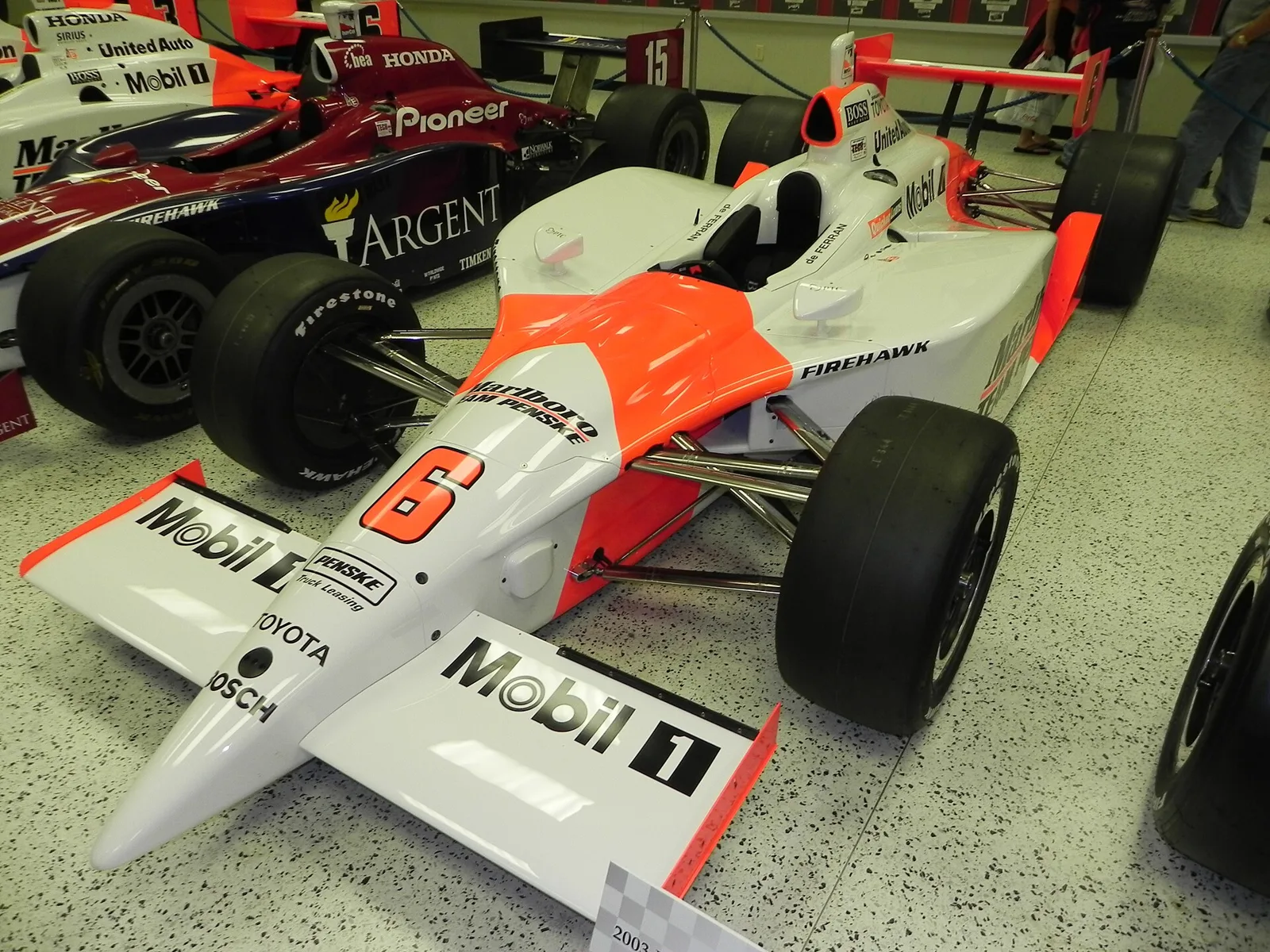

Gil de Ferran won a Penske one-two, ending Helio Castroneves' bid for a third straight win, in a race that only filled its 33-car field on the final day of qualifying.
Gil de Ferran won the 2003 race by 0.2290 seconds for Penske, with Helio Castroneves second and Tony Kanaan third in a Honda. The win ended Castroneves' bid for three straight victories.
The 87th Indianapolis 500 was run on Sunday, May 25, 2003, and it came close to lacking a full starting field. A Penske one-two decided the race, with Gil de Ferran winning by 0.2290 seconds from teammate Helio Castroneves. Honda and Toyota returned to the Speedway's engine list that year, and the race marked a turning point in the open-wheel split.
Who won the 2003 Indianapolis 500?
Gil de Ferran won the 2003 Indianapolis 500 by 0.2290 seconds, the only Indy 500 victory of his career. It gave Penske a one-two finish, with Helio Castroneves second from pole. Tony Kanaan finished third in a Honda, the best result for that manufacturer at the Speedway to that point.
Castroneves had taken pole and was attempting to become the first driver in Indy history to win three races in a row. De Ferran passed him on lap 169, with 31 laps still to run, after Castroneves was held up behind a lapped car on the backstretch. The green flag returned with six laps left, and de Ferran kept his position to the line.
After the race Castroneves persuaded de Ferran to climb the catch fence on the main straight, copying his own traditional celebration. De Ferran retired at the end of the season, becoming the fourth Indy 500 winner to retire as a reigning champion of the race.
The field was only completed on the last day of qualifying, and the race was decided by 0.2290 seconds.
How did the race unfold?
Castroneves led the first 16 laps from pole, and Scott Dixon took the lead on lap 17 after the first pit stops. Michael Andretti led 28 laps in the first half before his car quit on lap 98 with a broken throttle linkage. Tomas Scheckter led laps 101 to 128, and de Ferran moved into the lead late on lap 169.
The start was given at 10:47 a.m. EST by Mari Hulman George, and all 33 cars pulled away from the grid. It was the final time the race began at the traditional 11 a.m. time slot. Billy Boat stalled in turn two on lap 9 and brought out the first caution, and Sarah Fisher spun in turn three after the restart on lap 15.
On lap 61 Richie Hearn lost his car in the marbles in turn two and hit the outside wall, while Jaques Lazier spun to avoid him. Both drivers were uninjured. The lead changed hands several times in the first half, as Scheckter, Tony Kanaan and Jimmy Vasser each took turns in front. Castroneves and de Ferran ran in the top five for most of that period.
On lap 127 Airton Dare crashed in turn two, bringing out a caution and a round of pit stops. Castroneves beat Scheckter out of the pits to take the lead, and de Ferran moved into third. On the lap 135 restart de Ferran passed Scheckter for second place, and by lap 150 the two Penske cars were running first and second again.
The leaders made their final pit stops on laps 165 to 168. On lap 169 Castroneves was caught behind A. J. Foyt IV's lapped car on the backstretch. Earlier in the race Foyt had made contact with Castroneves while being lapped in turn two, and de Ferran slipped through for the lead going into turn three.
Robby Gordon stopped on the track with a broken gearbox on lap 172, and he left the grounds to fly to Charlotte for the Coca-Cola 600. On lap 182 Scott Sharp brushed the wall in turn four and then crashed in turn one. The green came back on lap 186, and one lap later Dan Wheldon spun in turn three, struck the outside wall and landed upside down. He was not injured.
During the caution for the Wheldon crash, Scott Dixon weaved across the main straight to warm his tyres and brushed the inside wall too hard. His car was too damaged to continue. The green flag came out for the final time with six laps to go, and de Ferran held off Castroneves by 0.2290 seconds.
Why did the field nearly fall short of 33 cars?
Cost issues, along with a shortage of engines and drivers, caused real concern in May 2003. The field was not filled until the final day of qualifying, when Vitor Meira took the last place at 4:05 p.m. It was also the first year since 1947 that no car was bumped from the field.
Practice opened with roughly 29 car and driver combinations named, four short of the usual 33. Alex Barron was named to replace Arie Luyendyk at Mo Nunn Racing after Luyendyk's crash, and Airton Dare and Vitor Meira were named to rides on the Sunday morning. Jimmy Vasser missed the first weekend of time trials because he was racing in the Champ Car German 500.
Time trials on Sunday May 18 opened with nine spots open. Jimmy Kite was first out but stalled with an electrical problem before returning to qualify. The field reached 27 cars in the first half hour, then 29 when Dare qualified, then 31 when Barron and Richie Hearn made their runs. Hearn's team had acquired a Penske back-up car.
Two cars remained on the sidelines, Robby McGehee and Meira. McGehee qualified at 224.493 mph at 3:30 p.m., and at 4:05 p.m. Meira's 227.158 mph filled the field to 33 cars. The track closed at six o'clock without any further qualifiers, and some media dubbed the afternoon Fill Day instead of Bump Day.
The race had not failed to reach 33 starters since 1947, when members of ASPAR, the American Society of Professional Auto Racing, threatened to boycott over the purse size. Despite the lack of drama on the final day, several commentators argued that the 2003 field was the deepest in talent since the open-wheel split began.
What happened in Mario Andretti's test?
Mario Andretti, who won the Indy 500 in 1969, tested Tony Kanaan's car on April 23 after Kanaan was hurt in a crash at Motegi. Andretti had last raced at the Speedway in 1994, and he was 63 at the time of the test. He was quickly up to speed, but a crash later that session ended his plans to qualify the car.
Andretti turned a lap of 212.509 mph in the morning and later pushed the car above 223 mph. The success of the test created speculation that he might attempt to qualify. If Kanaan was not cleared to drive in time, plans were drawn up for Andretti to qualify the car and hand it over, but no firm plan was made for him to race.
With two minutes left in the session, Kenny Brack crashed in turn one and the yellow came out. Andretti entered turn one at full speed and struck debris. The impact lifted the nose of his car, and it went into a rapid double-reverse somersault at more than 200 mph. The car clipped the top of the debris fence, then slid to a stop upright, and Andretti walked away with very minor injuries.
Andretti initially shrugged off the accident and still considered returning to qualify. A day later he reconsidered, and he did not race in 2003.
How did pole qualifying go?
Helio Castroneves took pole at 231.725 mph on pole day, Sunday May 11, which was cool and windy. Tony Kanaan was pushed to the middle of the front row at 231.006 mph, and Robby Gordon held the outside at 230.205 mph. Gil de Ferran, the last car with a realistic shot at the front row, managed 228.633 mph and 10th place.
Robbie Buhl made the first attempt and qualified at 224.369 mph. Scott Dixon became the first car over 230 mph at 12:30 p.m. with 230.099 mph, and Gordon took the provisional pole at 12:45 p.m. Kanaan's run at 2:41 p.m. was the next to top the leaderboard before Castroneves' final run settled the front row.
A. J. Foyt IV, racing on his 19th birthday on race day, attempted to become the youngest driver ever to qualify for the race. On his first lap he spun exiting turn two and slid backwards down almost the length of the backstretch, but he was uninjured. He later completed a run.
How did Honda and Toyota change the race?
The 2003 season brought a new chassis package and the arrival of Toyota and Honda engines. Honda had earlier partnered with the Judd program at the 1987 race and entered at Indy in 1994 and 1995, so its 2003 return was its third period of involvement. Toyota was making its first Indianapolis attempt, and it won at the first try.
Honda's third-place finish with Kanaan was its best Speedway result at the time and a sign of what was to come, as its first Indy win followed a year later. Toyota's victory was the first Indy 500 win for a Japanese engine maker, but it was also its only one. The company left IndyCar after 2005 to concentrate on NASCAR.
What were the main race results?
De Ferran won from the 10th starting position, Castroneves finished second from pole, and Kanaan took third for Honda. Michael Andretti's last race ended early on lap 98, and Dixon retired after brushing the wall. The result gave Penske its second one-two finish at the Speedway, following the one in 2001.
| Finish | Driver | Note |
|---|---|---|
| 1st | Gil de Ferran | Won by 0.2290 seconds; first and only Indy 500 win |
| 2nd | Helio Castroneves | Pole-sitter at 231.725 mph; sought a third straight win |
| 3rd | Tony Kanaan | Honda's best Speedway result at the time |
| Out | Michael Andretti | Led 28 laps in the first half; car quit on lap 98 |
| Out | Scott Dixon | Led from lap 17; car too damaged to continue |
Castroneves' three-race record of first, first and second established an Indy record for a driver's first three starts. His second place tied Al Unser's run of 1970 to 1972, which had the same pattern.
Who attended, and how was the event received?
Former presidents George H. W. Bush and Bill Clinton attended the race, the first time in Indy history that two former presidents were at the race. The elder Bush had also opened the 1987 Pan American Games at the track. The race was not announced as a sell-out for the first time since the 1970s, after usually selling out by July of the previous year since 1985.
Bob Jenkins and Jack Arute defended the 33-car field on air. Arute opened an interview with Meira by addressing the critics, and Jenkins later received criticism for his stance. ABC coverage of the event was the final 500 on television for Jenkins, who was released by ABC and ESPN at the end of the 2003 season.
It was never announced whether the on-air comments played a part in his release, and Jenkins said he was never told that they had. The broadcast was billed as the Indianapolis 500 presented by 7-Eleven, the first presenting sponsor the race had featured on TV.
What changed going into the 2003 race?
Michael Andretti's final race before he retired to focus on team ownership was the biggest story of the season. Greg Ray ran car number 13, the first time that number had appeared at the race since George Mason in 1914, and a Menards Infiniti Pro Series race at the Speedway was scheduled for the first time in May.
Robby Gordon had been named to replace Dario Franchitti in the Andretti Green car after Franchitti's spring injury, and he planned to attempt the Indy-Charlotte Double Duty.