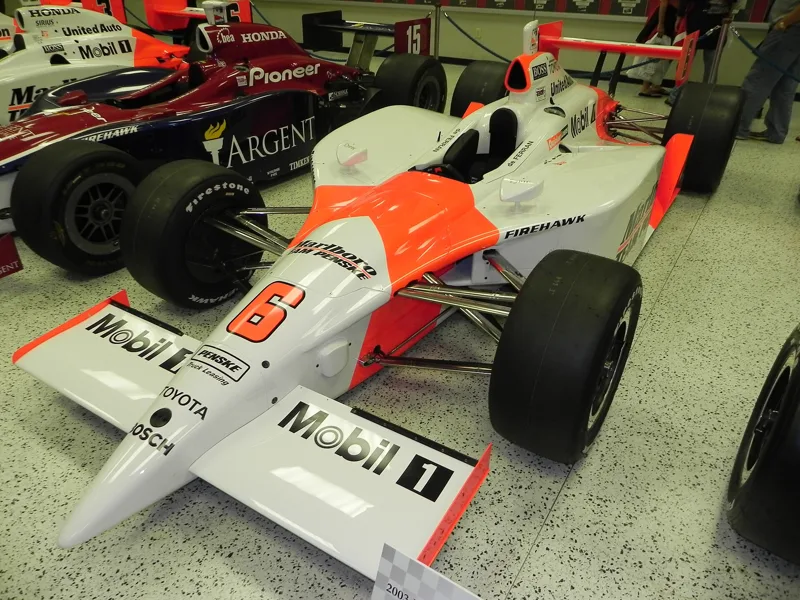
A five-way title fight, a last pit stop that set up the lead and a 214G crash that ended the race 5 laps early.
Gil de Ferran won the 2003 Chevy 500 at Texas Motor Speedway on October 12, 2003, his final start in American open-wheel racing. The race finished after 195 laps when Kenny Brack hit the catch fence, and Scott Dixon's second place clinched his first IndyCar title.
Gil de Ferran ended his American open-wheel career with a win at the 2003 Chevy 500, but the day is remembered for Kenny Brack's crash. The race was cut to 195 of its 200 laps after Brack's car hit the catch fence at a recorded 214G. Scott Dixon's second place gave him his first IndyCar Series championship on the final afternoon.
Who won the 2003 Chevy 500?
Gil de Ferran won the final round of the 2003 IRL IndyCar Series from pole position. He led 68 laps, more than any other driver, and claimed his twelfth and final American open-wheel victory. Dixon finished second to clinch the title, and Dan Wheldon took third.
Five drivers could still win the title, and the final race ended with a 214G crash.
What was at stake for the title contenders?
Five drivers could still take the championship, and the race was worth as many as 52 points. Dixon and Helio Castroneves were tied on 467 points, with Tony Kanaan seven points back. Sam Hornish Jr. was fourth on 448 points and de Ferran fifth on 437.
Robin Miller called the Texas track the calling card of the Indy Racing League for its breathtaking racing. Mario Andretti, Rick Mears and Bobby Unser all spoke well of the competition, which the league said was the closest title fight in the near century-long history of American open-wheel racing.
For de Ferran it was the last start of a career that included two CART championships and the 2003 Indianapolis 500 win. He had announced his retirement on August 25, and he described himself as the long shot. Hornish needed to win and lead the most laps to take the title, a feat that would have made him only the second driver to win three straight American open-wheel championships.
The course itself was the sixth running of the event at Texas Motor Speedway, a four-turn oval of 2.4 km (1.5 miles) with 24-degree banking in the turns. Hornish wished his points deficit had been smaller, because it left him needing a win and the most laps led. Castroneves called the race a war, compared it with the 2002 Chevy 500, and said he had hung a horseshoe above his garage stall for luck. Kanaan, who had one victory in his first IndyCar season, planned to drive patiently and wait for the end.
Dixon, meanwhile, was confident his team could win the race and the title, just as it had done in the 2000 Indy Lights season.
How did practice and qualifying set the grid?
Four practice sessions came before the race, two on Friday and two on Saturday. The first three lasted 60 minutes each, with the drivers split into two groups, while the final session was open to everyone and lasted 30 minutes. Dixon set the pace early with a lap of 23.4233 seconds in the first session and 23.4391 seconds in the second.
De Ferran took pole in the Friday qualifier, a 65-minute session in which each driver had two timed laps. His time of 23.5031 seconds was his fifth IndyCar pole. Dixon started second, just 0.0009 seconds slower, which was the closest deficit between the top two qualifiers in series history.
A. J. Foyt IV had a fuel system problem and was the last driver to make an attempt, qualifying nineteenth. Hornish sat out the third practice session to avoid using mileage on a new engine, then set the fastest time of the final session at 23.3563 seconds.
Wheldon had trouble locating his pit stall in one session and had to be reminded that he was in the No. 7 car, which he had taken for the weekend to promote 7-Eleven. Scheckter, Meira and Brack all posted competitive times, and Barron and Buhl made slight contact during Saturday's practice without damage.
In the qualifier Scheckter took third, Giaffone fourth and Castroneves fifth, with Meira, Brack, Herta, Kanaan and Buhl completing the top ten. Takagi, Hornish, Ray, Barron, Yasukawa, Wheldon, Al Unser Jr. and Hearn filled eleventh to eighteenth.
How did the race unfold before the crash?
Chevrolet general manager Brent Dewar gave the command to start engines, and the race began at 2:45 p.m. under sunny skies, with air temperatures between 22 and 24 degrees Celsius (72 to 75 Fahrenheit) and track temperatures between 32 and 40 degrees Celsius (90 to 104 Fahrenheit). Johnny Rutherford, a three-time Indianapolis 500 winner, led the field round as the pace car.
De Ferran led the first lap, but Dixon was alongside him and crossed the line 0.0056 seconds ahead on lap two. De Ferran took the lead back on lap five, and Hornish moved into the top ten before passing Castroneves for fourth by the twentieth lap.
The first caution came on lap 31 for debris on the back straight, and the leaders all pitted. Meira's right-rear tyre came off as he left pit road, forcing him to return. Kanaan led the restart on lap 37, and the second caution followed on lap 52, when Carpenter stopped with an alternator problem.
Later in the race Giaffone was squeezed into the wall while trying to pass Sharp, and Barron spun trying to avoid him. De Ferran ran through the infield grass and avoided the wreck, but he came onto pit road to check for damage. That stop committed his team to a conservative fuel strategy, and only five other drivers pitted at the same time.
Four laps after de Ferran assumed the lead on lap 160, Hornish's championship hopes suffered when a rev limiter problem forced him to slow sharply. Hornish came in on lap 176 and retired after his engine leaked oil onto the track. Castroneves and Kanaan collided at turn three on lap 180, and both lost their title chances.
Scheckter had dropped from fourth to eighth a lap after the start after nearly losing control in turn two, and Kanaan moved up to fourth by the third lap. Hornish led lap 138 and was not fully ahead of Dixon until lap 141, when he pulled clear through the third and fourth turns. Buhl started the first cycle of green-flag pit stops eight laps after that, coming in for fuel and tyres. On lap 152 Hornish made his stop and gave up the lead to Kanaan, who pitted two laps later.
De Ferran took the lead on lap 160 through the pit sequence and kept it through his final stop. Earlier, Carpenter had stalled in turn one with a faulty alternator, bringing out the third caution. A. J. Foyt IV lost 17 laps while his electronic control unit was replaced, and engine trouble forced him out of the race later on.
Kanaan set the fastest lap of the race, 23.4413 seconds, shortly after rejoining following his pit stop.
What happened in the crash that ended the race?
On lap 188 Brack steered to the right to pass Scheckter for third on the back straight. The left-side tyres of Brack's car touched the right-side tyres of Scheckter's car, and both cars were thrown into a spin up the track.
At about 350 km/h (220 mph), Brack's car flew 3.7 m (12 feet) into the air and its nose pierced a steel post in the 7.0 m (23 ft) fence, which sat atop a 0.99 m (39 in) wall. The car came apart, apart from the drivers' compartment, and pinwheeled across the track to rest upside down at the apron of turn three.
Scheckter climbed out without help. Brack was taken from his car by track officials, treated at the infield care centre and then airlifted to hospital in serious but stable condition. A black box in the car recorded the 214G impact, a figure Guinness World Records recognises as the highest G-force a human has survived.
The catch fence was badly damaged, and track executive Eddie Gossage estimated that about 30 m (100 ft) of fencing would need replacing. Race officials announced that the race would finish after 195 laps, and de Ferran paced under the yellow to take the win.
Brack was chatting with his wife Anita and the Team Rahal manager in the infield care centre when he was flown to Parkland Memorial Hospital. His condition was listed as serious but stable, and it was upgraded to satisfactory on October 19. Two days later he was moved by helicopter to Indiana University Health Methodist Hospital.
Who took the 2003 title?
Dixon's second place was enough to clinch his first IndyCar Series Drivers' Championship, with 507 points, 18 more than de Ferran. Castroneves finished with 484 points, Kanaan with 476 and Hornish with 461. Wheldon's third place earned him the Rookie of the Year title.
De Ferran's victory gave him a rare distinction, since Keith Kauffman was the last driver to win in his final race, at the 1982 Nazareth 100. He earned US$126,400 for the win, and he led 68 laps in total while six drivers exchanged the lead 11 times.
De Ferran said afterwards that most of his concern had been for Brack, whom he had known for years, and he apologised for sounding somber. Dixon admitted to mixed emotions when Chip Ganassi Racing switched to the IndyCar Series after two years in CART. Ganassi likened him to Juan Pablo Montoya, Alex Zanardi and Jimmy Vasser, who had all won titles for the team.
What was the aftermath for Brack?
Brack had broken his sternum, two ribs, an L3 vertebra, his right femur and both ankles. He had two surgeries on the Sunday and Monday night, and the rehabilitation that followed lasted six months at a hospital in Indianapolis. He later said he had no memory of the crash.
Buddy Rice took over Brack's seat at Team Rahal for 2004. Brack drove an Indy car only twice afterwards, first in a test at Richmond International Raceway in June 2004 and then in the 2005 Indianapolis 500. On both occasions he complained of low stamina, and three months after the 500 he retired to work in the financial side of motor racing.
What changed in the series after Texas?
Concern grew about pack racing and the new Dallara IR-03 chassis, since Brack was one of four drivers to suffer an airborne crash during 2003. Robin Miller pointed out that 76 drivers had been injured in the Indy Racing League since 1996, compared with 32 in CART.
Tony Renna died in testing at Indianapolis on October 22, when his car went airborne and struck the catch fence. The league denied that the new chassis was to blame, but it cut engine capacity to 3 L (0.79 U.S. gal) from 3.5 L (0.92 U.S. gal) for 2004 to reduce speeds.
Toyota won the manufacturers' championship with 145 points, ahead of Honda on 106 and Chevrolet on 101.
Final standings and classification
| Driver | Points | Detail |
|---|---|---|
| Scott Dixon | 507 | Champion; second in the race |
| Helio Castroneves | 484 | Third in the standings |
| Tony Kanaan | 476 | Fourth in the standings |
| Sam Hornish Jr. | 461 | Retired on lap 176 |
| Gil de Ferran | 18 behind Dixon | Race winner; led 68 laps |