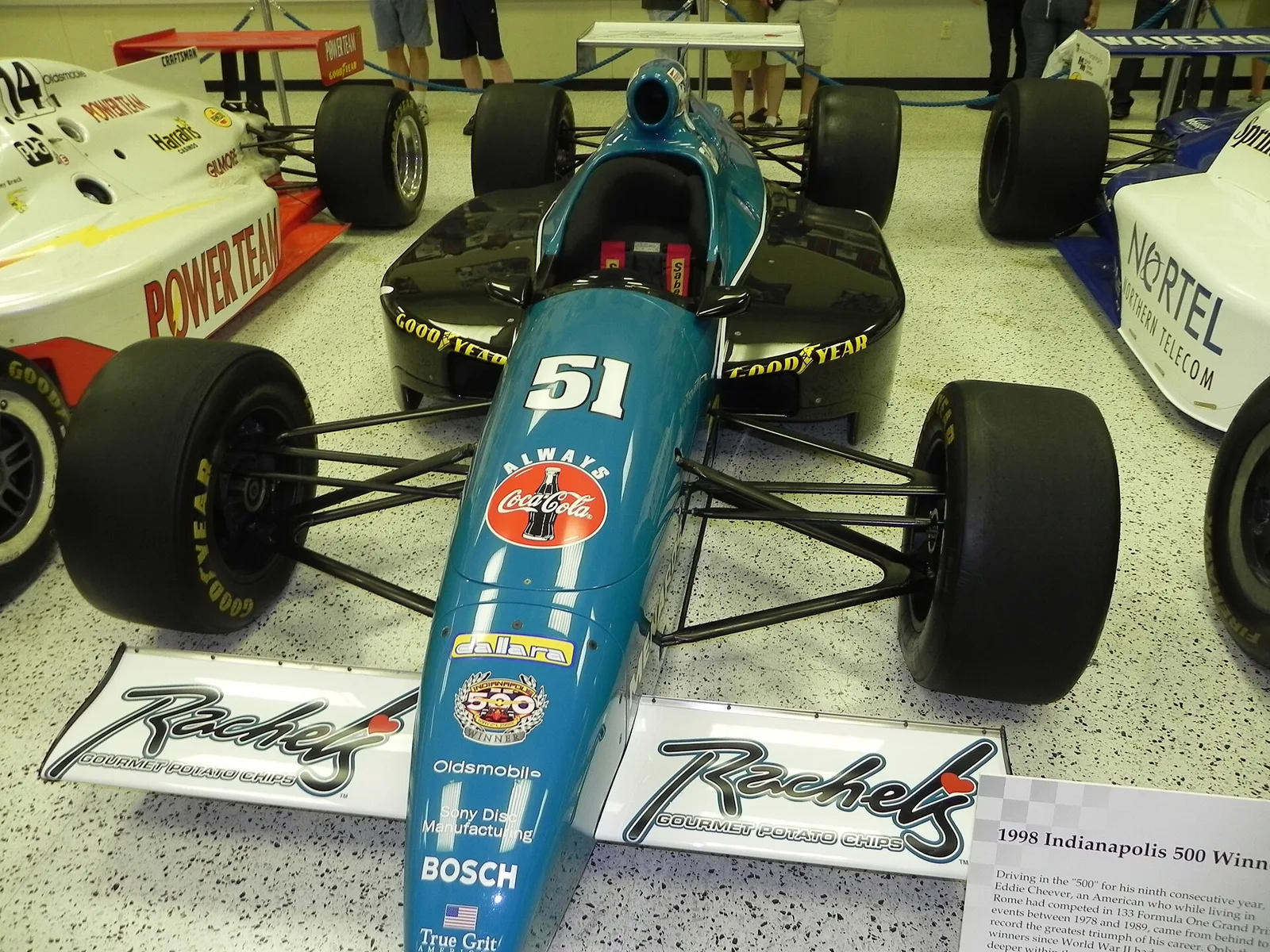
A rain-delayed start, a turn three pileup and a Dallara win for an owner-driver who started 17th.
Eddie Cheever won the 1998 Indianapolis 500 on May 24, 1998, by 3.19 seconds over Buddy Lazier, starting 17th on the grid. He was the first owner-driver to win the race since A. J. Foyt in 1977, and his Dallara gave the chassis maker its first Indianapolis victory.
The 1998 Indianapolis 500 was the 82nd running of the race, held on Sunday, May 24, 1998. It was the first race fully sanctioned by the Indy Racing League, and Eddie Cheever won it from 17th on the grid after a rain delay and a pileup in turn three.
Why was 1998 the first fully sanctioned IRL race?
The IRL had run the race in 1996 and 1997 with USAC sanctioning, but for 1998 the series sanctioned the event on its own. It was the third Indianapolis 500 run as part of the IRL and fell within the 1998 Pep Boys Indy Racing League season.
The IRL and CART split entered its third year. For the second time, no major CART teams entered at Indianapolis, and CART teams raced the Motorola 300 on the Saturday before the 500.
An owner-driver from 17th, a 3.19-second margin and the first Dallara win at Indianapolis.
What rule changes applied in 1998?
The 25/8 Rule, which had locked entries into the field according to championship points, was scrapped after controversy in 1997. The 33-car field returned to the traditional 33 fastest qualifiers, so the points standings no longer decided who could start.
Cars that bumped their way in on the second day of time trials were slotted into the 33rd starting position at that moment, whatever their overall speed rank. The change was meant to encourage more cars to qualify on pole day, and the grid was then ordered by pole day qualifiers, followed by second day qualifiers and then bump-day cars.
Another change allowed cars to return to the garage area to make repairs and re-enter the race. Before 1998 any car that crossed the entrance to Gasoline Alley was out, and a car towed back through the infield escape roads was also excluded, even when the problem was as minor as running out of fuel.
The new repair rule was made at the request of teams, who regarded it as a safety measure. Crew members had been working on the pit lane for long periods, exposed to cars entering and leaving inches away, and the change let them carry out major repairs. A limit applied, so that no car could re-enter after the leaders had completed 190 laps.
How was the 1998 schedule changed?
The schedule for May was trimmed to reduce costs. The new format was an experimental two-week schedule, with one week of practice and two days of time trials, instead of two full weeks of practice and four days of qualifying across two weekends.
Qualifying was therefore cut from four days to two. A four-day open test in April also included rookie orientation, so the teams had a chance to prepare before the month began.
Who was on the entry list?
The first entry list came out on April 14, and it included the 34 cars that had competed in either of the first two rounds of 1998, and the number of competitors rose to 40 before practice started as new teams and drivers were registered.
Several driver changes were made for budgetary reasons. Chitwood Motorsports signed Andy Michner in place of Brian Tyler, and PDM Racing replaced John Paul Jr. with rookie Jack Hewitt on May 5.
What happened in the first practice days?
Mike Groff took the honour of first car on the track on Sunday, May 10. Robbie Buhl was the fastest car of the opening day at 219.325 mph, and Jack Hewitt and Jimmy Kite had crashes that were not serious.
Tony Stewart led the speed chart on Monday, May 11, with a lap of 223.703 mph. That was the fastest lap since the normally aspirated engine formula was adopted in 1997, and eight drivers in total broke the 200 mph barrier that day.
Danny Ongais suffered the most serious crash of the month so far and was sidelined with a concussion. He never raced an IndyCar or Champ Car again. Eddie Cheever announced a sponsorship deal with Rachel's Gourmet Potato Chips the same day.
How did the speeds develop during practice?
Stewart came close to matching his speed the next day with a fast lap of 223.691 mph on May 12. Kenny Brack was a full 2 mph slower at 221.593 mph, and the sunny weather held for a third day in a row.
Moisture from an overnight shower delayed practice by about half an hour on May 13. Billy Boat took the honours for fastest of the day at 221.691 mph, while Stewart sat out that day.
On Friday, May 15, Stewart topped the speed chart with 223.797 mph, the fastest lap of the month. Stewart led the speed chart on four of the six days of practice, and Brack and Boat were also over 221 mph that day.
Boat's primary car was wrecked in turn three shortly after the start of that session, and a separate spin by Jack Hewitt did not involve contact. The crash seemed to dim Boat's chances of the pole, although he was among the favourites before it.
Who won the pole in 1998?
Billy Boat won the pole with a four-lap average of 223.503 mph. His first lap of 224.573 mph was the fastest of the month, and the three laps after it dropped off, but the average was enough to take the position.
Before Boat's run, Robbie Buhl had managed 220.236 mph and Stewart 220.386 mph, but the speeds were below what the teams had expected. Kenny Brack took the provisional pole at 220.982 mph at noon.
Greg Ray then squeezed onto the front row as the second-fastest qualifier at 221.125 mph, and he completed his run at 5:15 p.m. Sixteen cars had completed runs before the mid-afternoon downtime, which was followed by a late resumption.
Boat's speed in the heat of the day drew attention from rivals. He ran about 2 1/2 mph faster than he had all week, and Team Menard threatened to protest, accusing Foyt Racing of illegally using nitrous. The series did not act, and no penalty was given to Boat.
How was the field filled on bump day?
At the end of pole day the field stood at 26 cars, after a record 42 qualifying attempts. On bump day, Jimmy Kite filled the field to 33 cars at 4:55 p.m., and the bubble then shifted with each bump.
Billy Roe was the first driver on the bubble at 215.781 mph. Mike Groff bumped him out at 5:23 p.m., and Roe then went back out and bumped his way back in, which put Johnny Unser on the bubble at 216.316 mph.
Hideshi Matsuda was waiting in line at the 6 o'clock gun. Lyn St. James missed the cut, making it the first all-male field since 1991.
Who missed the 1998 field?
Tyce Carlson, Claude Bourbonnais, Joe Gosek, Hideshi Matsuda, Scott Harrington, Dan Drinan and Paul Durant were among those who did not make the field. Eliseo Salazar was the first alternate after being bumped, and Lyn St. James was the second alternate.
How did the pit stop challenge work in 1998?
The 22nd annual Coors Pit Stop Challenge was held on May 21, with eight teams competing for a $40,000 top prize. The top three race qualifiers and their pit crews were automatically eligible, and five more spots were earned by teams that won the Pit Performance Award at the IRL races held since the previous Indy 500.
Panther Racing, with driver Scott Goodyear, beat Team Menard in the final after Buhl's car stayed stuck in its box. That was the first of Panther's two wins in the event, and Galles Racing did not take part, as it had not competed in the IRL during the 1998 season.
How did the race start after the rain?
Rain fell during the morning and delayed the start by about 35 minutes. During the track drying effort a dog got onto the circuit in turn four and ran down the pit lane, eluding officials all the way to turn two before it was caught.
Mari Hulman George gave the command to start engines at 11:32 a.m. EST. Raul Boesel had gone into the pits with a fuel pump problem before the final pace lap, and he missed the start, completing only three racing laps before he was towed to the garage on lap 8.
What happened in the opening laps?
Eddie Cheever got loose in turn one and pinched J. J. Yeley to the inside, causing a half-spin for both drivers and an early caution. Cheever continued without serious damage, while Yeley's engine stalled and he lost a lap before safety crews restarted it.
Billy Boat led the first dozen laps, while Kenny Brack dropped from third to tenth after missing a shift on the restart. Greg Ray took the lead on lap 13, and Tony Stewart charged into third after exchanging passes with his teammate Robbie Buhl.
Buddy Lazier pitted out of sequence from tenth place on lap 16 as part of an alternative strategy. By lap 19 Brack had regained third place, passing Buhl and Boat on the same lap.
Why did Tony Stewart's race end early?
Stewart took the lead on lap 21, after Ray was slowed by traffic and Stewart dived through down the main straight. One lap later his engine blew as he approached the line, and he coasted to a stop, finishing last in 33rd place.
Stewart threw his steering wheel and gloves into his empty cockpit. It was the third straight 500 in which misfortune had struck him.
What happened in the turn three pileup?
On lap 49, with several cars running two-wide, a major crash occurred in turn three. Sam Schmidt tried an inside pass on Davey Hamilton for second, slid into the grass, lost control and spun backwards into the wall. Stan Wattles then ran into Mark Dismore, and both cars collected Roberto Guerrero.
Jim Guthrie tried to avoid the crash by cutting into the grass. As he rejoined the track he collected a wing that had come off Schmidt's car, and his car struck the outside wall head-on. He was taken to hospital with a broken elbow, a broken leg and cracked ribs.
Billy Roe got clear of the first impact, but he spun on the deceleration lane between turns three and four and hit the inside wall. Eddie Cheever was immediately behind Schmidt but slipped underneath and escaped, and the pileup collected six cars in total.
Who led the middle stint of the race?
After a long yellow and a series of pit stops, Kenny Brack and Eddie Cheever were leading over Scott Sharp. Cheever took the lead for the first time on lap 68, and John Paul Jr. climbed into second by lap 73.
Buddy Lazier stayed out in the lead until lap 61 and was placed tenth at that time. Arie Luyendyk moved up to fourth ahead of the improving John Paul Jr. and Davey Hamilton, who had made minor repairs at a pit stop.
A miscalculation by Foyt's crew left Brack out of fuel and cost him two laps. A. J. Foyt was caught on the broadcast scolding his engineers and smashing one of the team's laptops.
Cheever left his pit box before his crew had removed the fuel nozzle, which cost him time, but he kept the lead by 1.5 seconds over John Paul Jr. Davey Hamilton was another five seconds behind, and Robby Unser held Luyendyk in fourth.
How did John Paul Jr. come to lead?
Johnny Unser retired with a blown engine at the halfway point. With only seven cars on the lead lap, Cheever and Steve Knapp topped off during a yellow, and John Paul Jr. inherited the lead.
Paul then built a five-second lead over Davey Hamilton before pitting on lap 113. Robby Unser, Hamilton and Luyendyk pitted after him, and Jack Miller then stopped on turn two with a battery problem.
Billy Boat's gearbox had seized on lap 49, and he dropped out for good on lap 132. Jeff Ward also lost a rear wheel under caution, a wheel that had been poorly attached at an earlier green-flag stop.
Why did John Paul Jr. lose the race?
Luyendyk's clutch problems took their toll on lap 150, when he left the pits very slowly and had to pull off between turns three and four. Of the nine cautions up to that point, six had been caused by cars stopped on track with mechanical issues.
Paul Jr. offered resistance until lap 163, when he lifted off because of a malfunction in the yellow flag indicator on his steering wheel. Later, John Paul Jr. stalled four times trying to engage first gear, and he lost three laps in the process.
After that, Buddy Lazier and Steve Knapp were the only other drivers on the lead lap, and John Paul Jr.'s chances of winning had gone.
How was the finish decided?
With 17 laps to go, Buddy Lazier got past the lapped traffic on the restart and chased Cheever, keeping close for a few laps. Cheever then stretched his lead to more than 3 seconds, but a yellow on lap 191 for the smoking car of Marco Greco brought the field back together.
On the last restart, with five laps left, Lazier was right on Cheever's gearbox. Cheever held him off, weaving from side to side along the front straight, and then set off at a blistering pace.
Cheever pulled out to a 3.19-second margin to take the win. He became the first driver to win the Indianapolis 500 in his own car since A. J. Foyt in 1977.
Why was Cheever's win notable?
Cheever started 17th, which was the lowest starting position for a winner in Indy car racing and in the 500 since Al Unser's fourth win in 1987, when he started 20th. His victory was the first win for the Dallara chassis at Indianapolis.
Steve Knapp finished third on the lead lap and won rookie of the year honours in his first Indy car race. That was a feat last achieved by Lyn St. James in 1992.
For the first time since 1982, all drivers in the top five were from the United States, and that had not happened again up to 2024. Four rookies also finished in the top ten, the first time that had happened since 1965.
What were the other finishing positions?
Kenny Brack saved sixth, and Andy Michner, dealing with an electrical fault, crossed in eighth ahead of J. J. Yeley. Both were three laps down, and neither would run the Indianapolis 500 again.
Mike Groff suffered engine misfires during the whole race and finished 15th. It was his final Indy car start.
How was the 1998 race broadcast?
The ABC telecast was carried flag to flag, with Paul Page as host and play-by-play announcer and Tom Sneva as analyst. Bobby Unser had left ABC, and Danny Sullivan was reassigned to cover CART races, so the booth was reshaped for the year.
Bob Jenkins served as chief announcer for the ninth and final year on the radio. Dave Calabro, the WTHR sports director and Speedway public address announcer, joined the crew as a pit reporter, which was his only radio network appearance.
The radio broadcast was carried on the Indy Racing Radio Network, previously the Indianapolis Motor Speedway Radio Network, and reached at least 541 affiliates across the United States. The race was also carried on a special signal for televisions within the grounds, the first and only time that signal was used.
What were the key figures for the 1998 race?
| Item | Detail |
|---|---|
| Date | Sunday, May 24, 1998 |
| Venue | Indianapolis Motor Speedway |
| Winner | Eddie Cheever, from 17th on the grid |
| Margin | 3.19 seconds over Buddy Lazier |
| Pole | Billy Boat, four-lap average of 223.503 mph |
| Fastest lap of the month | Billy Boat, 224.573 mph in qualifying |
| Field | 33 cars after bump day |
| Last place | Tony Stewart, 33rd, after an engine failure just after lap 21 |
| Pit Stop Challenge prize | $40,000 top prize |