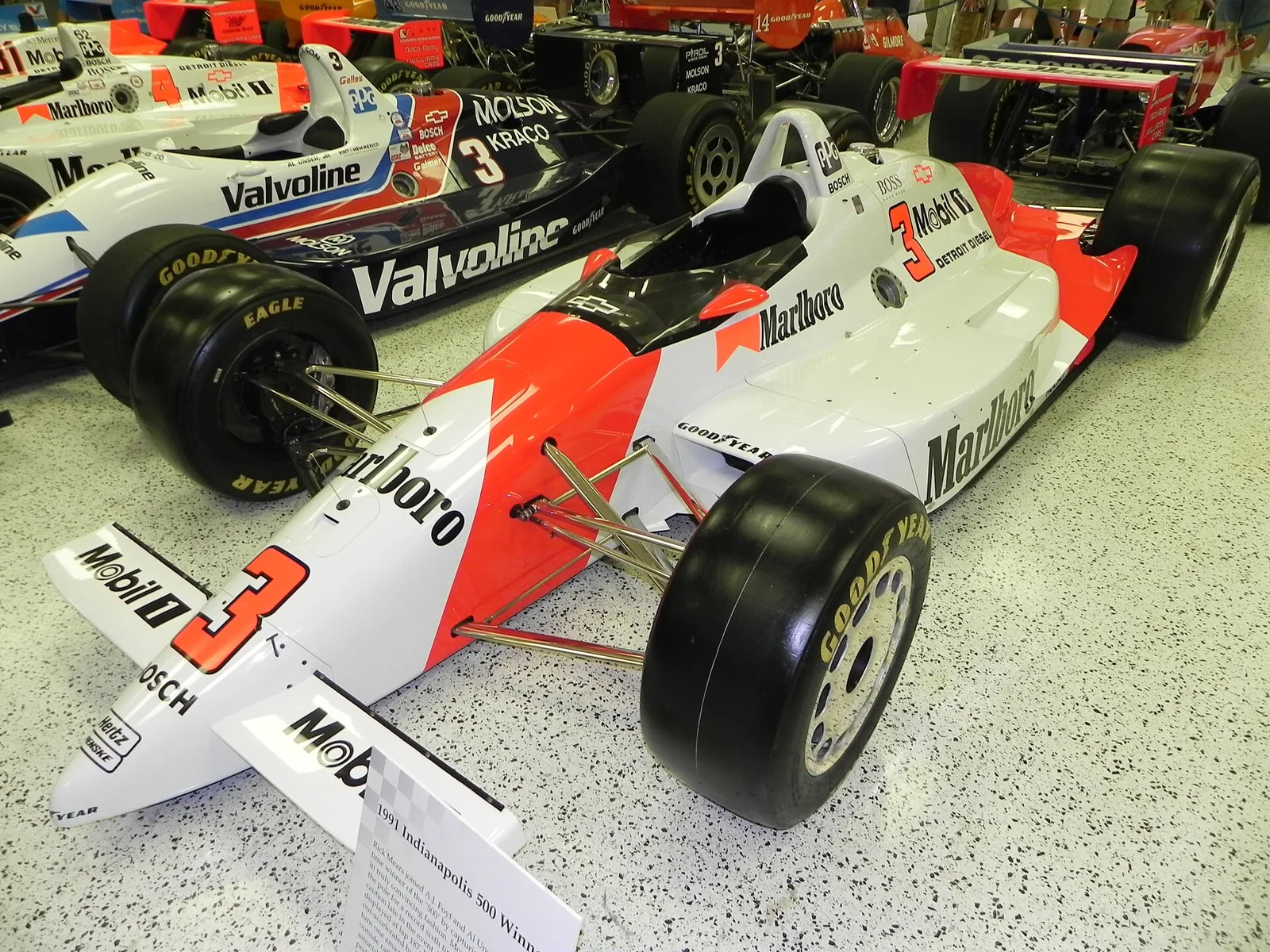
Rick Mears re-passed Michael Andretti on the outside of turn one to take his fourth Indianapolis 500, in a 75th running shaped by a damaged foot, a storm-cut qualifying day and a disputed caution.
The 1991 Indianapolis 500 was the 75th running of the race, held on 26 May 1991. Rick Mears won from pole, with a late move around Michael Andretti giving him his fourth victory.
Rick Mears won the 75th Indianapolis 500 on Sunday 26 May 1991, taking the lead for good with a move on the outside of turn one. It made him the third four-time winner in the race's history, after A. J. Foyt and Al Unser, in a month shaped by injury, a storm-cut qualifying day and a disputed caution.
Why is the 1991 race remembered?
Rick Mears won from pole position and joined A. J. Foyt and Al Unser as a four-time winner, a status few drivers have reached. The race was advertised as the Diamond Jubilee Running, marking the seventy-fifth edition of the event.
Mears had suffered a bad month. It was his first crash at the Speedway since his 1977 rookie year, and the injury to his right foot was kept largely quiet. He later admitted that the pain was so bad he had to work the throttle with his left foot.
Michael Andretti's second place was the best Indianapolis finish of his career. He had led the most laps and was still in front with 13 laps remaining, yet he could not hold off Mears at the end.
A cut tyre, a stalled pit entrance and a re-pass on the outside of turn one that nobody expected.
What was the backdrop before the race?
A. J. Foyt had crashed at Road America in September 1990, badly injuring his feet and legs. In November 1990 he said he would stop driving after the 1991 season, and this race was planned as his final start at the Speedway.
Still unable to drive, Foyt sat out the February Daytona 500 for the first time since 1968. His first practice laps came after a cautious and sometimes frustrating return, and he later reversed the retirement decision.
Willy T. Ribbs became the first African American driver to make the field, and Hiro Matsushita became the first Japanese driver in it. Both drivers faced hard months, with engine and turbocharger failures at key moments.
How did the pace car become a talking point?
The Dodge Stealth was first chosen as the pace car, but the UAW and traditionalists protested because it was a captive import built by Mitsubishi in Japan. The Stealth was downgraded to the festival and backup car, and the pre-production Dodge Viper RT/10 took over as the official pace car.
Carroll Shelby drove the Viper pace car, his second turn at Indy. He had also taken the wheel of the pace car back in 1987, when it was a Chrysler product. Because the Viper was not yet in production, dealers sold replicas of the Stealth instead.
What rule changes shaped the race?
Chief steward Tom Binford warned the field that cars must stay above the yellow line in turn four. Earlier rules that had threatened penalties for dropping below the white apron line in all four turns were abandoned, because they had proved impossible to enforce.
USAC also amended the rules for V-8 pushrod engines to attract smaller independent builders. Displacement was set at 209 in3 (3.42 L), and boost was allowed to reach 55 inHg (1,900 mbar), the same level the stock block V-6 engines were allowed.
How did practice go?
The first two practice days, 4 and 5 May, were rained out, and the early on-track activity was only a few shakedown laps. Practice then picked up, with Bobby Rahal becoming the second driver over 226 mph on 8 May.
On Fast Friday, 10 May, Mears crashed at 2:06 p.m. when the locking pin on his right rear wheel sheared off and sent his car into the turn one wall. His right foot was hurt, yet he was passed fit to race, and he went back out in his spare car in the final hour.
Earlier that day rookie Mark Dismore crashed hard at the exit of turn four, and his car broke apart near the pit entrance. Dismore suffered multiple injuries but recovered, and the debris closed the track for the day. Officials then moved two pit stalls to the south end of the pit lane to add a safety buffer for the crews.
How did pole day unfold?
Pole day on Saturday 11 May was hot and humid. Foyt drew the number one spot in the qualifying order and was first out, putting himself on the provisional pole with a four-lap run. Randy Lewis crashed in turn one on his opening lap.
At 12:51 p.m., a day after his crash, Mears was back in a car and qualified for the pole. His run was not a track record, but it gave him his sixth Indianapolis pole, a record for the event.
Fittipaldi's first try came at 3:52 p.m., and his crew called it off as storm clouds gathered to the east. Lightning struck near turn three, and rain washed out the rest of the day after only twelve cars had qualified.
Roger Penske later received the Jigger Award, a mocking prize, after the waved-off run cost Fittipaldi a better starting spot. The front row read Mears, Foyt and then Mario Andretti on the outside, a row that historians still count among the most storied in the race's history.
What happened on the second day of time trials?
Many drivers left out the day before returned on Sunday 12 May. Gary Bettenhausen completed a run that was faster than Mears' pole speed and became the fastest qualifier, but as a second-day qualifier he started 13th, behind the first-day group.
Arie Luyendyk qualified third fastest, but his second-day status put him 14th, while Fittipaldi qualified 15th. The three cars of the fifth row qualified faster than the front row, which made the grid order look unusual.
Dominic Dobson broke his left leg in a turn four crash that wiped out his Lola, and he was put into a backup car bought from Truesports. By the close the field stood at 22 cars.
Who made the field on bump day?
Ribbs had struggled with multiple engine failures during the second week of practice. On Bump Day, Sunday 19 May, four positions were open, and his car started smoking after a turbocharger failure, which delayed the team further while a damaged scavenger pump was found.
Pancho Carter completed the grid at 2:45 p.m., with Tom Sneva left on the bubble. At 5:05 p.m. Ribbs finally completed his four-lap qualifying run and bumped Sneva into the bubble, cheering from his cockpit on the cool-down lap.
Randy Lewis bumped Johnny Parsons in the final car attempt. In the last 15 minutes three drivers went out and waved off their runs, and Gordon Johncock survived the bubble to qualify 33rd.
How did the race start?
Morning rain pushed the start back 55 minutes. At 11:46 a.m., Mary F. Hulman gave the order to fire engines, and Mears took the lead into turn one. Bettenhausen slid sideways in the first turn, and Buddy Lazier tagged the outside wall with his nosecone and was out.
Danny Sullivan joined late after a fuel-pump problem, and he was given a three-lap penalty for missing the warm-up laps. On lap 5 Ribbs pitted with a misfire and dropped out, which ended a difficult race for the team.
How did the first half unfold?
Mario Andretti grabbed the front from Mears on lap 12, and Michael then took over and ruled most of the first half, pulling clear of a thinning field. Several cars fell out before halfway, and the leaders kept their order.
On lap 25 Cogan and Guerrero touched wheels in turn one and slammed the outside wall. Wreckage littered the racing line, and A. J. Foyt hit a large chunk, which broke his left-front suspension. Foyt walked back to the pits, and he left the race still non-committal about retirement.
Cogan blamed Guerrero that evening, and the blame has never been fully settled. Later amateur grandstand footage hinted Cogan may have come down on Guerrero, while the broadcast footage was inconclusive.
Several cars dropped out with mechanical trouble, including Crawford and Groff, all before halfway, and Michael Andretti still led with Fittipaldi second.
What happened in the second half?
Fittipaldi went ahead on lap 113 and kept the place for 46 laps in the second half. A gearbox failure as he left the pits on lap 171 ended his race, and Michael Andretti had the front to himself for much of the closing stage.
The field thinned to roughly 13 cars across the closing 50 laps. Rahal's engine let go on lap 130, and Brayton's followed on lap 149. Mario Andretti fell two laps down, and only Michael Andretti and Mears remained on the lead lap.
Luyendyk rose to third one lap adrift, and Al Unser Jr. was also in the top five, although Unser's car was troubled by wastegate problems. Gordon Johncock, who had begun 33rd and felt ill with flu symptoms, had climbed into the top ten.
How did the finish decide the race?
On lap 183 Danny Sullivan's engine let go on the frontstretch, and a caution followed. Michael Andretti took advantage of the break, pitted for fuel and came out second, lining up just behind Mears for the restart. The restart drama made the closing laps among the most watched of the era.
On the restart to complete lap 186, Andretti went around Mears on the outside of turn one, a manoeuvre drivers seldom attempted. Mears reeled him in, then made the same move on the same line to take the lead back, and he pulled away as Andretti's handling deteriorated.
With 11 laps to go Mears lengthened his lead. On lap 190, however, Mario Andretti stalled at the pit entrance, and the yellow bunched the field for another restart. Many felt the stop was deliberate, to help his son, but Mario denied it, saying he had warned that he would create a yellow because he could not reach the pits.
A spectator who had recorded Mario's radio traffic handed USAC a tape later. USAC's spokesman said the organisation would take no action, since Mario had not acknowledged any wrongdoing and the stop had not changed the outcome.
With six laps left, racing resumed and Mears got the better start. Michael Andretti's car still was not handling, so he could not match him, and Mears cruised home as the third four-time winner.
A 2011 interview saw Michael Andretti and Roger Penske agree that a lap on Mears might have ended the contest. A cut tyre just before that point changed the complexion of the race.
Who finished where?
Mears finished first and Michael Andretti second. Their battle at the front was the centre of the race, and the table below lists the principal finishers and the retirements that shaped the afternoon. The positions listed reflect the principal finishers and the notable retirements only.
| Position | Driver | Note |
|---|---|---|
| 1st | Rick Mears | From pole; fourth Indianapolis 500 win |
| 2nd | Michael Andretti | Best Indy finish of his career; led the most laps |
| Top ten | Gordon Johncock | Began 33rd and felt ill with flu symptoms before the race |
| Retired, lap 113 onward | Emerson Fittipaldi | Led 46 laps in the second half; gearbox failure on lap 171 |
| Retired, lap 130 | Bobby Rahal | Engine failure |
| Retired, lap 149 | Scott Brayton | Engine failure |
| Retired, lap 183 | Danny Sullivan | Engine blew down the frontstretch |
| Retired, lap 25 | A. J. Foyt | Broke his left front suspension on debris |
Mario Andretti's stall on lap 190 had made his son's position harder to read in the closing laps. The table is therefore a guide to the main results rather than a full classification.
What did the win mean for Mears?
Mears took his sixth Indianapolis 500 pole and his fourth victory, becoming the third four-time winner after Foyt and Al Unser. He won the Michigan 500 later in the year, sweeping both 500-mile races of the season. It came with the sixth pole of his career, a record for the event.
How was the race broadcast?
ABC Sports carried the race live flag to flag, with Paul Page as host and play-by-play announcer, alongside Bobby Unser and Sam Posey. The start slipped about an hour, and ABC kept viewers entertained with interviews and features. The same crew from 1990 returned for the broadcast.
Essayist Jack Whitaker was added to the pre-race show to mark the 75th anniversary. Mears was the first winner to carry a camera for the TV broadcast, and the leading four finishers had cameras too.