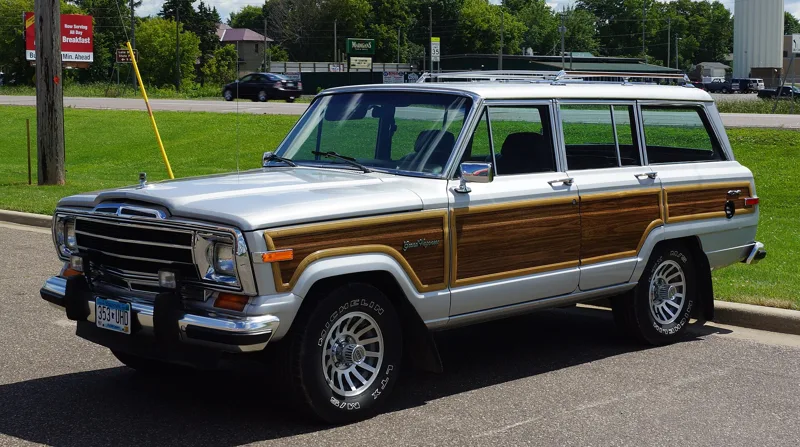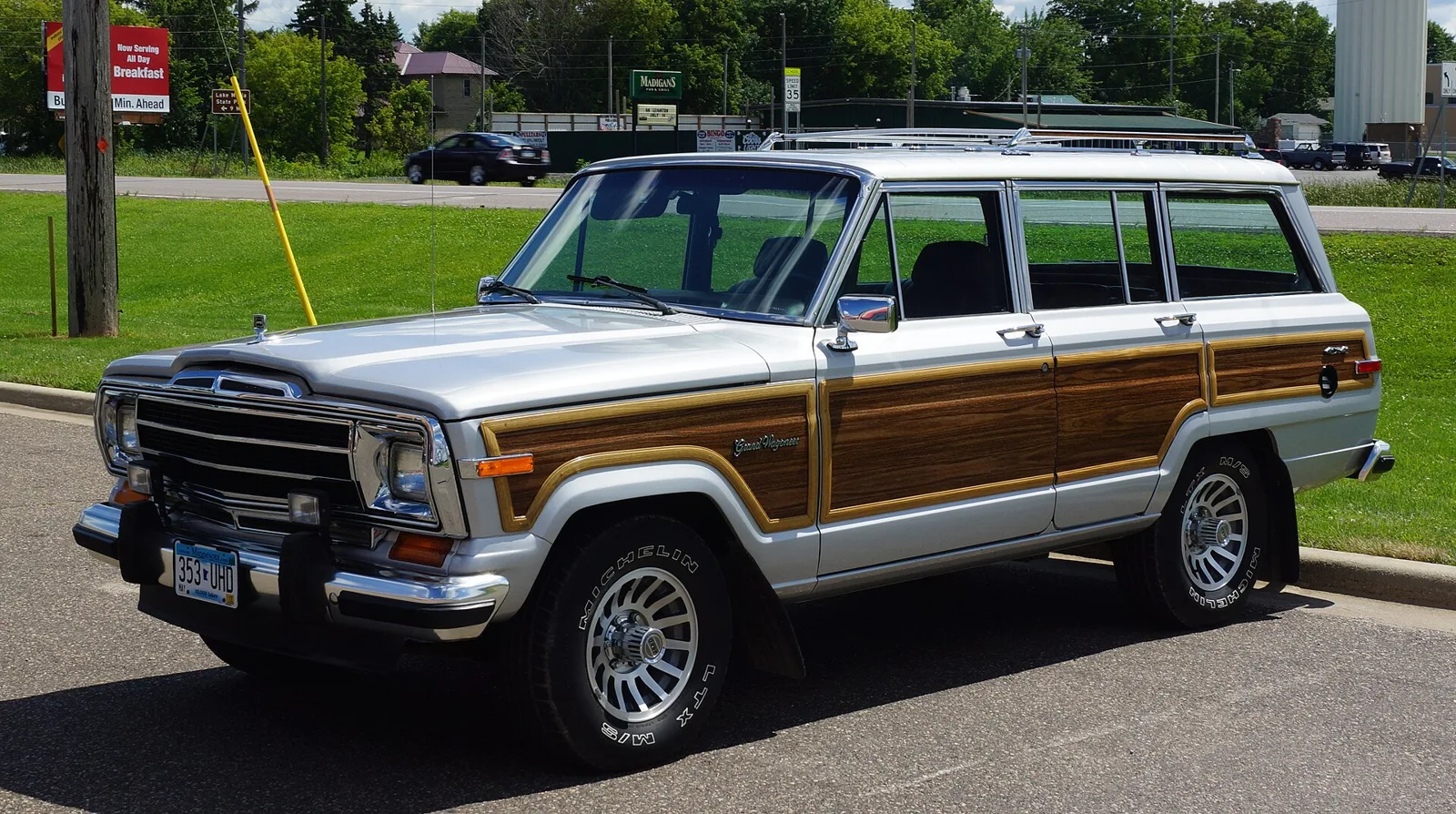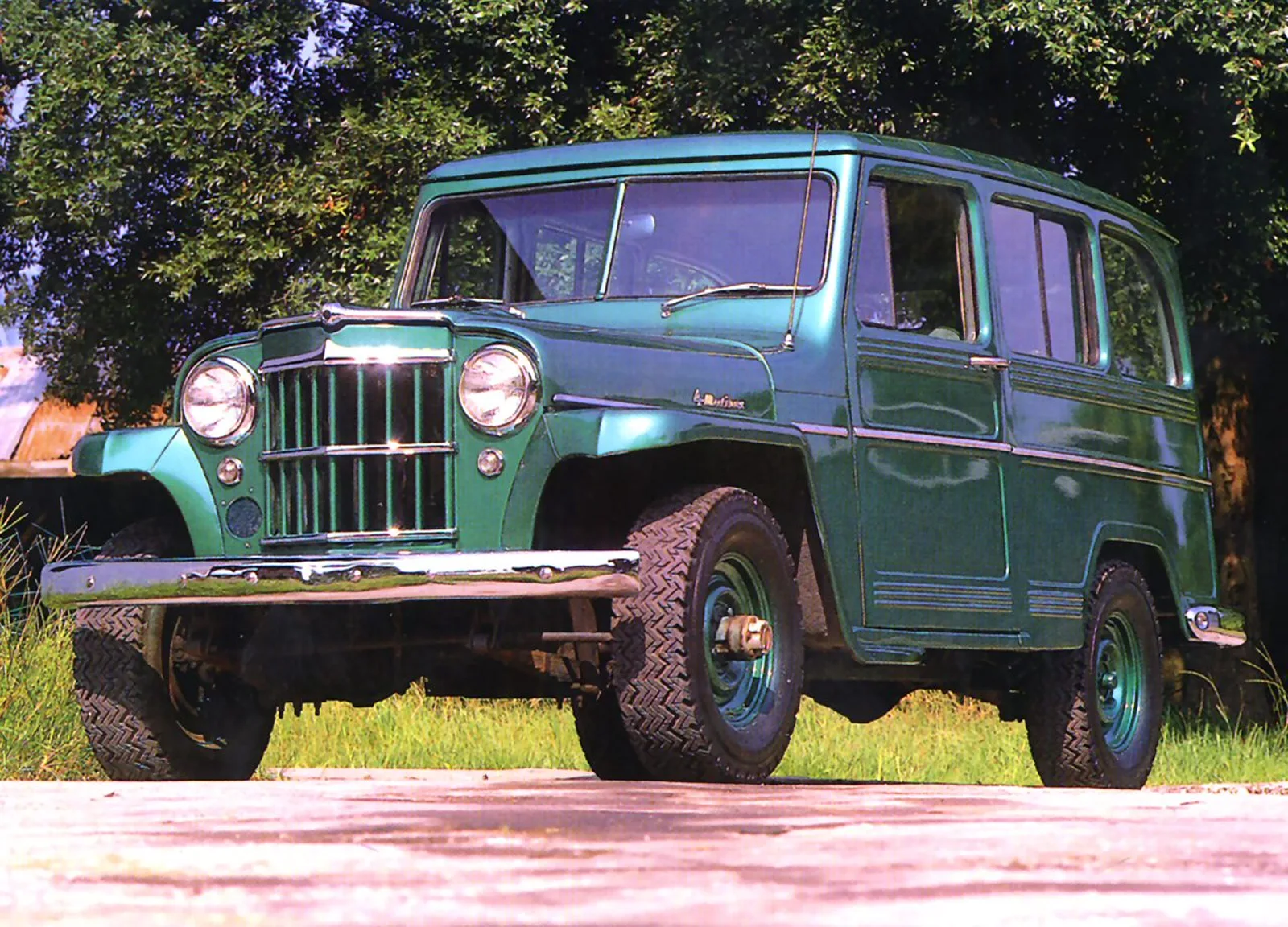
A body shaped by appliance-shop tooling gave Willys a wagon built more than 300,000 times in the US, while its sporty sibling reached only 19,132.
The Willys Jeep Station Wagon was a steel-bodied wagon built from 1946 to 1964, with over 300,000 made in the US, and its four-wheel-drive version is often called the first SUV. The Willys-Overland Jeepster was a sporty rear-drive spin-off sold from 1948 to 1950, of which 19,132 were built.
The body of the first Jeep station wagon was designed around what a maker of household appliance parts could press. Willys had little money and no body plant of its own, so designer Brooks Stevens drew panels that sheet metal fabricators could form with no more than 6 inches (152 mm) of draw. The shortcut produced a plain, flat-sided steel body, and the 4x4 version is often called the first production SUV.
The same constraint shaped the Willys-Overland Jeepster two years later, a sporty open car built from the station wagon's parts. More than 300,000 wagons and variants were built in the United States. The Jeepster did not come close.
How the Willys Jeep Station Wagon began
After the war, Willys-Overland had the fame of the four-wheel-drive Jeep but no modern car for the civilian market. Executive vice president and chief engineer Barney Roos feared for the company's survival and phoned Brooks Stevens, an industrial designer, begging him to help at once. Stevens took the challenge and stretched the Jeep's platform into something more like a car.
Drawing is the process of pulling or pushing a flat sheet into a three-dimensional shape. The deeper the draw, the heavier the press and the greater the risk of tearing the metal, which is why a limit of 6 inches kept tooling cheap and meant flat panels with only gentle curves.
Body makers were swamped with postwar demand and Willys was short of cash, so Stevens designed bodies that ordinary fabricators could build. Steel proved efficient to build in volume, simpler to look after and safer than the wood-bodied wagons then on sale. In the first two years, the only US maker with a wagon at a comparable price was Crosley, which launched an all-steel wagon in 1947. The Jeep Wagon was the first mass-market all-steel station wagon designed and built as a passenger vehicle.
The first wagons went on sale in July 1946 as the model 4-63, with a four-cylinder engine and rear-wheel drive. A six-cylinder version arrived for the 1948 model year, and sales were good for such a small maker. Four-wheel-drive versions followed in 1949 to compete in a segment Willys dominated. Even so, the two-wheel-drive wagons outsold the 4x4 until the 1950s.
Once four-wheel drive was available, the rear-drive version was sold as the Station Wagon and the four-wheel-drive models as the Utility Wagon. The four-wheel-drive wagon is frequently ranked as the first SUV made in series. More than 300,000 wagons and variants left US factories, and the model was also assembled abroad under joint ventures, licences or knock-down kits.
The Planadyne front suspension
The wagon was the first Willys with independent front suspension. Roos devised a system around a single transverse seven-leaf spring, which Willys called Planadyne. In concept it resembled the planar suspension he had developed for Studebaker in the mid-1930s. A transverse spring works like a bow laid across the front of the car, with each end carrying one wheel, and it let the front wheels move independently without the cost of coil springs and wishbones. In 1953 the US military listed the 4x4 wagon models 463 and 473 as non-standard 1/4-ton trucks under Standard Nomenclature List number G-740.
The Jeepster looked rugged and off-road capable, but it was not.
Willys Jeep Station Wagon year by year
1946 to 1949: Go-Devil, panel van and Station Sedan
The 1946 car was the 463 with a flat grille of 10 slots, powered by the L-134 Go-Devil flathead four. In 1947 came a Jeep Panel Delivery van with one seat, a pair of rear doors instead of a tailgate, and no side windows behind the front doors. The 663, with the L-148 Lightning straight-six, appeared late that year, and 50 were built. In 1948 a luxury version, the Station Sedan, arrived with solid body colours, basket-weave side trim and better finish throughout. Four-wheel drive became an option in 1949.
1950 to 1954: new grille, new engines, Kaiser takes over
The 10-slot grille gave way to a pointed V-shape with five horizontal bars across vertical ones, and the new 1950 model was introduced on 16 April. The 473 got the new F-134 Hurricane four, and the 673 the 161 cu in (2.6 L) Lightning six. The Station Sedan was dropped.
In 1952 the Lightning flathead gave way to the F-161 Hurricane in the 685 model. A key start replaced the floor start, a chrome strip was added to the bonnet, and flush side-mounted tail lights replaced a single lamp. Kaiser took ownership in 1954, and the 6-226 Super Hurricane flathead six, a version of the Kaiser Supersonic and Continental Red Seal engine, became available on four-wheel-drive models. The grille went from five horizontal slats to three. Few changes followed between 1953 and 1955.
1955 to 1964: Utility Wagon, Maverick and the end
For 1955 the six-cylinder range gained stripped-chassis, flat-face cowl, cowl-and-windshield and ambulance models. Willys pulled out of the passenger car business and the vehicle became the Utility Wagon. The seventh seat and the overdrive were dropped, and a beam axle replaced Planadyne on the two-wheel-drive wagon. Warn hubs, turned by hand to disconnect the front drive, became an option on four-wheel-drive models. Unlocking the hubs lets the front wheels spin freely on the road, so the front drive parts are not turning when four-wheel drive is not needed.
In 1958 came the Maverick, a more luxurious two-wheel-drive wagon available only with the four-cylinder engine. It had two-tone paint with a matching two-tone interior, a standard AM radio and an extra stainless steel ring under the windows. The name came from the TV series Maverick, which Willys sponsored. A one-piece windscreen reached two-wheel-drive wagons in 1959 and 4x4 wagons and delivery models in late 1960. In May 1962 the 6-230 Tornado overhead-cam six replaced the flathead. Production ended in 1964, as the Jeep Wagoneer, introduced for the 1963 model year, had phased out the Willys wagon. Some leftover 1964 models were given 1965 VINs by dealers.
Argentina and Brazil
Industrias Kaiser Argentina built the wagon as the IKA Estanciera from 1957 to 1970. In Brazil, a version based on the 1946 US car appeared in the 1950s, and a pickup followed in 1961. Ford Brazil bought the Willys factory in 1967, renaming the Rural Jeep wagon the Ford Rural and, in 1972, the truck the Ford F-75. Both used an inline-six, the first gasoline engine built in Brazil, in rear-drive or 4x4 form. The Rural ended in 1977 and the F-75 in 1981.
Willys-Overland Jeepster: the sporty Jeep
After the war, Willys, whose name is pronounced "WILL-iss", sold the CJ, short for Civilian Jeep, to farmers, foresters and others who wanted a tool. It added the Jeep Wagon, Panel Utility and pickup in 1946 and the Jeep Truck in 1947. Spotting a gap between those utilitarian vehicles and the passenger car market, the company developed the Jeepster. The aim was to widen its customer base. The new sporty, rear-drive-only model was to suit both town and country, and the advertising called it "America's greatest value in sports cars!"
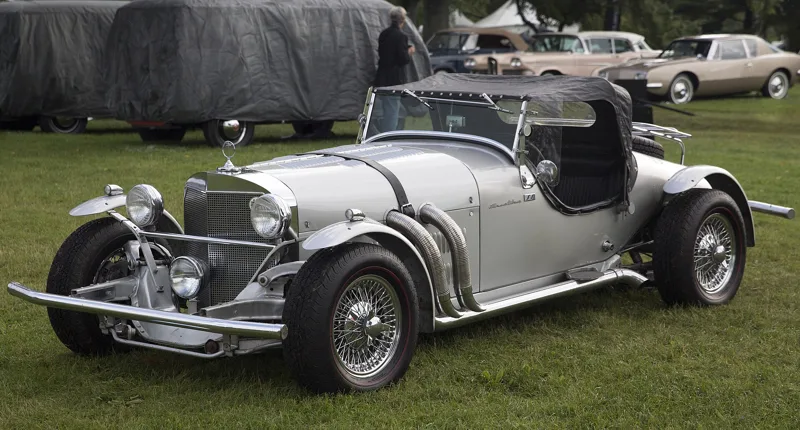
With no equipment for deep-drawn fenders or intricate shapes, Willys-Overland had to keep the Jeepster simple and slab-sided. Brooks Stevens styled a postwar family on a common platform that took in the pickup, the station wagon and a sporty open two-door he imagined as a sports car for veterans. The Jeepster, internally the VJ, was introduced in April 1948 and made through 1950, with some leftovers sold as 1951 models.
The 1948 Jeepster
The basic 1948 car came loaded with deluxe equipment that cost extra on other cars: whitewall tyres, hubcaps with bright trim rings, sun visors, a deluxe steering wheel, wind wings, a locking glovebox, a cigar lighter and a continental spare in a fabric cover. Power came from Willys' proven 134.2 cu in (2.2 L) Go-Devil four, rated at 63 hp (47 kW; 64 PS), through a Borg-Warner T-96 three-speed manual with overdrive as standard. The Planadyne front suspension, drivetrain, front end, rear suspension, steering and four-wheel drum brakes all came from the station wagon, and the flat-topped rear fenders from the Jeep truck line. It had plastic side curtains rather than roll-up windows.
At US$1,765, it cost about the same as a Ford Super DeLuxe Club convertible, which had roll-down windows, fancier styling and a V8. Journalists praised the boxy styling and performance. But rear-wheel drive limited its appeal to typical Jeep buyers, and sparse advertising and an inadequate dealer network held sales back.
1949 and 1950
In 1949 the line began with one model and one engine, and the price fell to $1,495, with some previously standard features moved to the options list. Midyear brought the VJ3-6, powered by Willys' new L148 Lightning six. The 1950 model year brought the first styling changes: a new instrument panel and a front end with a V-shaped grille with horizontal chrome trim. A new model with reduced standard equipment sold at a lower price, and the L161 Lightning six was offered alongside the Go-Devil four.
Model codes depended on build date. Early 1950 four-cylinder cars were VJ-3 463 and sixes VJ-3 663, changing later to VJ-473 and VJ-673.
Jeepster engines
| Engine | Layout | Years | Capacity |
|---|---|---|---|
| L134 Go Devil | Inline-four | 1948 to 1950 | 134.1 cu in (2,198 cc) |
| L148 Lightning | Inline-six | 1949 to 1950 | 148.5 cu in (2,433 cc) |
| F134 Hurricane | Inline-four | 1950 | 134.2 cu in (2,199 cc) |
| L161 Lightning | Inline-six | 1950 | 161 cu in (2,638 cc) |
Why the Jeepster struggled
The Jeepster looked rugged and off-road capable but was not. It was weak on utility and practicality, with basic construction, poor all-weather protection and low performance in four-cylinder form. Even with the optional six and a cheaper VJ3, it drew few new buyers because of its relatively high price, low performance and lack of roll-up windows.
The comparison with the wagon is stark. The two shared the Go-Devil four, the Planadyne front end and most of the running gear, but the wagon offered real load space and, from 1949, four-wheel drive, and more than 300,000 were built in the United States. The rear-drive Jeepster, with plastic curtains in place of windows, managed far fewer.
Sales by model year were 10,326 in 1948, 2,960 in 1949 and 5,836 in 1950, for a total of 19,132 cars.
The Jeepster Commando revival
Kaiser revived the name for the 1967 model year as the C-101 Jeepster Commando. It had roll-up door windows, a V6 and four-wheel drive, and came as a pickup, convertible and station wagon as well as a roadster. American Motors bought Kaiser's Jeep utility-vehicle business in 1970 to add to its car lines, and the Jeepster was reengineered around AMC engines: a 232 cu in (3.8 L) or 258 cu in (4.2 L) six, or a 304 cu in (5.0 L) V8. The Jeepster name was dropped after 1971. For 1972 the wheelbase grew and a facelift brought a full-width grille. Commando production ended in 1973 in favour of the full-size SJ Cherokee, introduced for the 1974 model year.