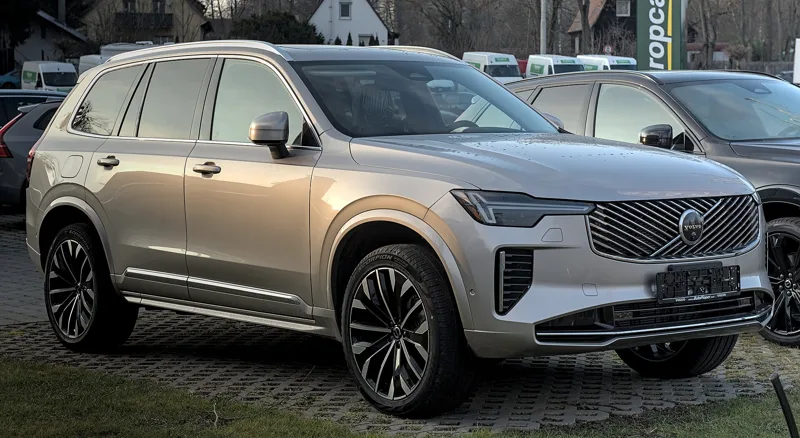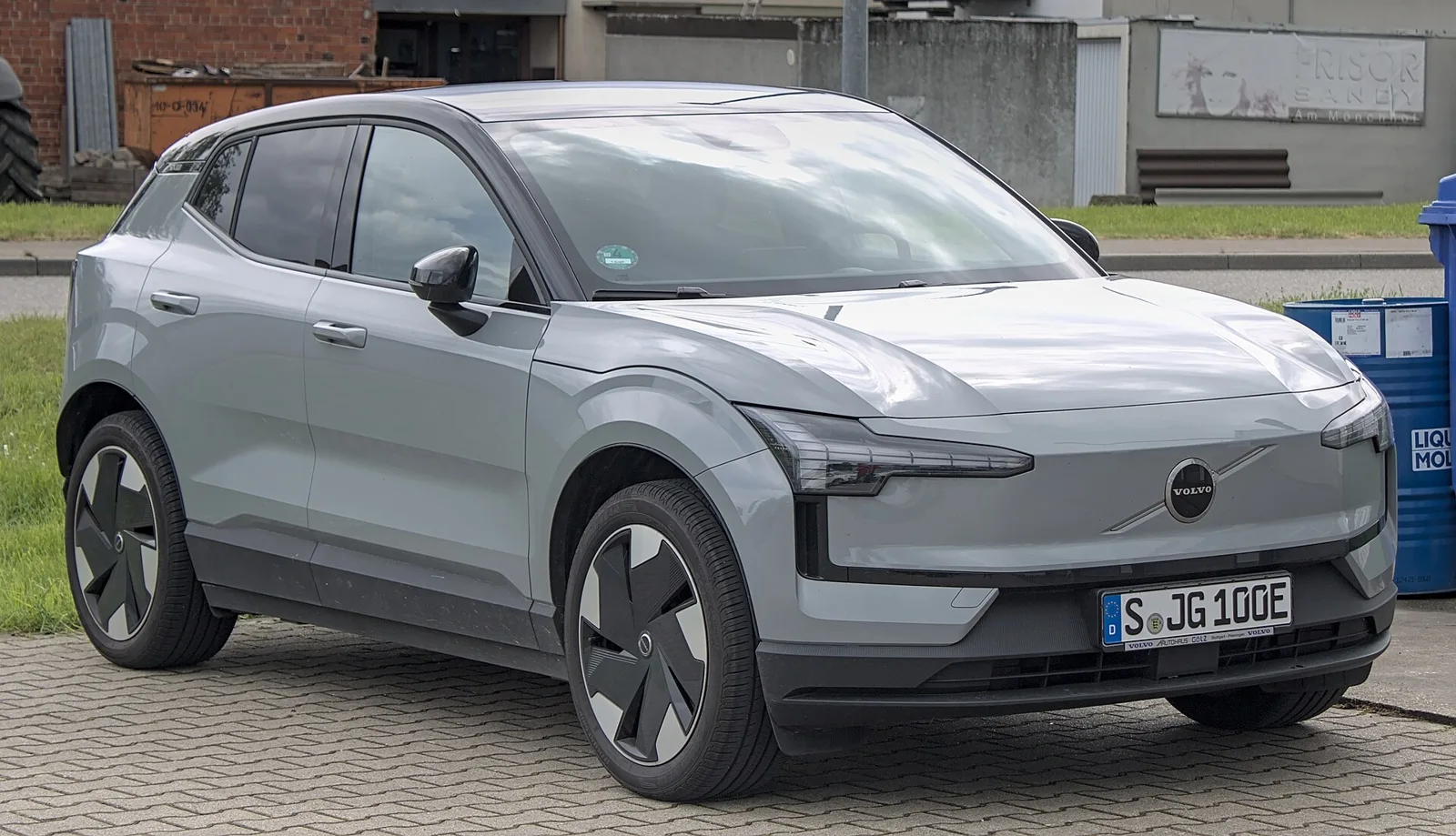
The smallest Volvo on sale is also its quickest, while the EX90 is the big seven-seater built around lidar and a 111 kWh battery.
The Volvo EX30 is the smallest Volvo on sale, a subcompact electric crossover revealed in June 2023 that is also Volvo's quickest car. The EX90 is the full-size, seven-seat electric flagship, built since May 2024 with lidar and a 111 kWh battery.
The smallest Volvo on sale is also the quickest the company has ever built. In Twin Motor Performance form the EX30 covers 0-100 km/h (0-62 mph) in 3.4 seconds, a figure that no Volvo of any size has bettered. It is the compact end of an electric range whose other bookend, the EX90, is a seven-seat flagship.
The two cars were first teased together in November 2022. Between them they span almost the whole width of what an electric Volvo can be.
Volvo EX30: the smallest Volvo
Volvo revealed the EX30 on 7 June 2023. It is a battery electric subcompact crossover, positioned below the XC40 and C40, and it is sold globally. Its length is 4,233 mm (166.7 in) on a 2,650 mm (104.3 in) wheelbase, so the wheels sit close to the corners of the body and the overhangs are short. Ground clearance is 177 mm (7.0 in) when unladen.
The EX30 is built on Geely's SEA platform, which makes it a relative of the Zeekr X and the Smart #1, two cars of similar size. A shared platform is the set of underpinnings from which several different bodies can be built, which is how three brands can field cars of this size without each starting from a blank sheet. Production began in China and has stayed there since launch, but in 2025 assembly also started at Ghent in Belgium and at Shah Alam in Malaysia. Volvo's stated reason was to build cars nearer to the people who buy them and to raise global output.
As an entry-level model it is expected to bring in new faces. Volvo expects roughly three in four EX30 customers to be people who have never owned one of its cars before. In Europe it competes with the Jeep Avenger EV and the Kia Niro EV.
Cabin and technology
Inside, the EX30 has a vertically mounted 12.3-inch tablet-style screen running Google's Android Automotive system, which is the car's own operating system rather than a mirror of a phone. It still works with Apple CarPlay and Android Auto. There is wireless phone charging, USB-C ports and a 12-volt power outlet.
The smallest Volvo on sale is the quickest Volvo ever made.
Volvo EX90: the seven-seat flagship
The EX90 sits at the other extreme. Volvo showed it in November 2022 and describes it as the first electric vehicle designed from scratch to carry its badge, and production has run since May 2024. The Volvo Concept Recharge previewed its shape in June 2021, and reports once suggested the production car would be called Embla. The EX90 is a full-size luxury crossover and carries seven seats.
Efficiency was a design target. The drag coefficient is 0.29, a measure of how easily the body slips through the air, and lower numbers mean less energy lost to wind. The battery is the same pack used in the Polestar 3: a 111 kWh unit built by CATL, of which 107 kWh is usable. The gap between the two figures works like a fuel tank's reserve, a buffer the car keeps back to protect the cells. With 250 kW DC charging the battery can go from 10 to 80 per cent in around 30 minutes, and it also supports bi-directional charging.
Power and range
The base Twin Motor produces 300 kW (402 hp; 408 PS) and 770 Nm (568 lb ft), with a WLTP range of around 600 km (373 mi). The Twin Motor Performance claims 590 km (367 mi). Output depends on the market: 380 kW (510 hp; 517 PS) for the version designated EE, and 370 kW (496 hp; 503 PS) for the North American version, designated E2. Every EX90 is electronically limited to 180 km/h (112 mph).
Sensors and screens
Luminar lidar is fitted as standard across the range and can detect pedestrians up to 250 m (820 ft) away. Lidar works like radar but uses light, building a detailed three-dimensional picture of what lies ahead. Combined with 12 ultrasonic sensors, 8 cameras and 5 radars, it gives the EX90 what is described as Level 3 autonomous capability.
The cabin centres on a 14.5-inch vertically mounted touchscreen with 5G connectivity. It runs on the Snapdragon Cockpit Platform from Qualcomm, which brings Unreal Engine graphics to the display, while Nvidia Drive AI powers the core system. On space, What Car? reported that a passenger 180 centimetres (5 ft 11 in) tall found the third row short of the headroom needed to sit upright.
Volvo EX30 vs EX90 compared
| Detail | EX30 | EX90 |
|---|---|---|
| Body | Subcompact crossover | Full-size luxury crossover |
| Revealed | 7 June 2023 | November 2022 |
| Top speed | 180 km/h (112 mph), dual-motor all-wheel drive | 180 km/h (112 mph), all models |
| Screen | 12.3-inch, Android Automotive | 14.5-inch, 5G |
| Built | China, Belgium, Malaysia | Produced since May 2024 |
| Platform links | Geely SEA, shared with Zeekr X and Smart #1 | Battery shared with Polestar 3 |
Volvo EX30 range: trims, motors and batteries
Buyers can choose rear-wheel drive or all-wheel drive, and the second layout puts one electric motor on each axle. In dual-motor all-wheel-drive form it reaches 100 km/h in 3.6 seconds and tops out at 180 km/h (112 mph), while the Twin Motor Performance, as noted, takes 3.4 seconds.
Europe received three trim levels from the start. The Plus gets self-switching LED headlights, adaptive cruise, a climate system with separate driver and passenger zones, and warmed front seats. Ultra adds a 360 degree camera, park pilot assist, a panoramic sunroof and 19 inch wheels as standard, with 20 inch wheels optional. Core arrived later. It has one motor and, like the Plus, can be had with an Extended Range Battery, but it rides on 18 inch alloys and keeps the full safety kit.
A budget trim called Essential strips back more. It loses the aero-rim inserts, the Extended Range option, the frunk and comfort features such as adaptive cruise control. At the other end, the Cross Country is styled for rough roads and has raised ground clearance; it was released in 2025.
Safety and driver monitoring
The EX30 packs a lot of assistance into a small body. Park Pilot Assist finds a free space, lists it on the centre display for the driver to choose, and then steers the car into it. Rear radars watch for cyclists and scooters approaching from behind and warn anyone inside who reaches for a door handle at the wrong moment.
On the motorway, Pilot Assist can change lanes, keep a safe gap from vehicles alongside while passing, and adjust speed to hold a distance from the car ahead. If it senses the driver is not responding it prompts them to steer, escalates its warnings, and if there is still no reaction brings the car to a complete stop. Collision avoidance covers other vehicles, pedestrians and cyclists, with audio and visual alerts and brake pulses, automatic braking if a crash is imminent or the car turns across an oncoming vehicle's path at a junction, and in some situations steering to avoid the impact.
Looking after the driver is part of the job too. An infrared sensor on the steering column follows the eyes and head, and even notes the speed and frequency of blinking. A front camera that watches for erratic driving and a sensor on the steering wheel feed the same judgement, and between them the car can recognise a distracted or drowsy driver and suggest they concentrate or take a break.
A 2026 battery recall
In 2026 Volvo issued a recall in some markets over a high-voltage battery issue that could lead to high-energy fires. It is understood that owners of some EX30 versions, the long-range one among them, were told to stop charging at 70 per cent so that the battery would not overheat.
Materials and footprint
According to Volvo, the EX30 has the smallest lifetime carbon footprint of any Volvo model to date: 30 tonnes (66,000 lb) across 200,000 km (124,000 mi) of driving, counting both building the car and running it. Recycled material makes up part of the body: 25% of the aluminium, 17% of the steel and 17% of the plastic. Inside, the seats, dashboard and doors use old denim, flax and a wool blend containing around 70% recycled polyester, and about one fifth of the plastics are recycled. Volvo also states the car's footprint is less than half that of the petrol XC40.
The EX90 Excellence and the awards
The EX90 also has a version for buyers who want a very different cabin. The EX90 Excellence made its debut at Auto Shanghai in April 2023 as a four-seater: two individual rear seats replace the second and third rows, with a centre console between them that holds a refrigerator. Two-tone paint and a different 22-inch wheel design complete it, and journalists likened it to the Mercedes-Maybach EQS SUV, which introduced a similar concept.
Both models have collected recognition. The EX30 collected Carwow's 2024 Car of the Year title and a 2024 Car of the Year from Electrifying.com, plus Top Gear's Eco Warrior of the Year in 2023 and World Urban Car for 2024, among others. It also took a Red Dot Best of the Best design award in 2024 and Auto Express Small Premium SUV of the Year in 2025. The EX90 received the Best Safety Innovation Award from the Automobile Journalists Association of Canada before it reached the market, and in April 2025 was named World Luxury Car, ahead of the Porsche Macan and Porsche Panamera.
What the choice looks like for a buyer
The EX30 offers the widest spread of choices, and it is the entry point to Volvo's electric line, an entry-level model aimed at newcomers to the brand. A buyer can pick rear-wheel drive or twin-motor all-wheel drive, a Core, Plus or Ultra trim in Europe, a long-range battery on some versions, or the cut-down Essential. The Cross Country adds raised ground clearance for rougher roads. Owners of certain versions should also note the 2026 charging limit set by the recall.
The EX90 narrows the decisions and widens the ambition. Lidar comes standard on every car, the battery is the same size throughout, and the main choices are between the Twin Motor and the Performance version, with the rated output varying by market. Seven seats suit larger groups, though What Car? found the third row tight for a taller adult, and the four-seat Excellence swaps the back rows for individual chairs.
The EX30 leaves the US after 2026
American buyers lose the EX30 after the 2026 model year, a run of just two years. Volvo gave no reason, though US tariffs and slowing electric-car sales after the removal of tax credits have been suggested as factors. The EX30 will continue in Canada and Mexico, and Volvo later announced a replacement developed specifically for the US market, due to debut in 2027.