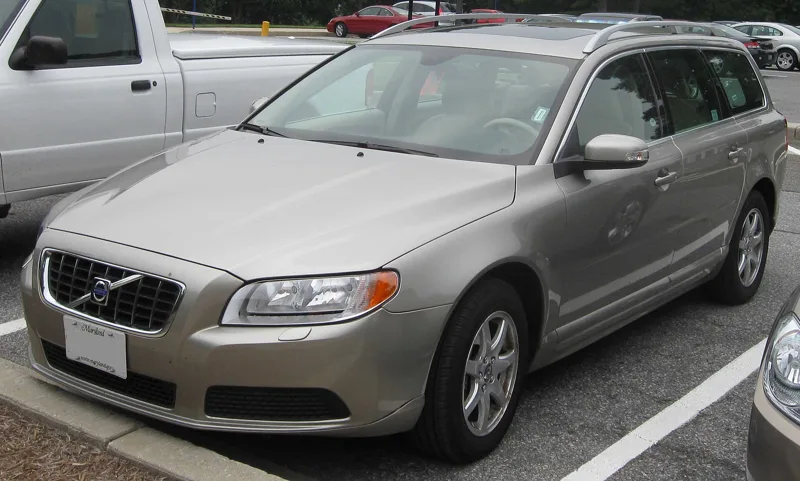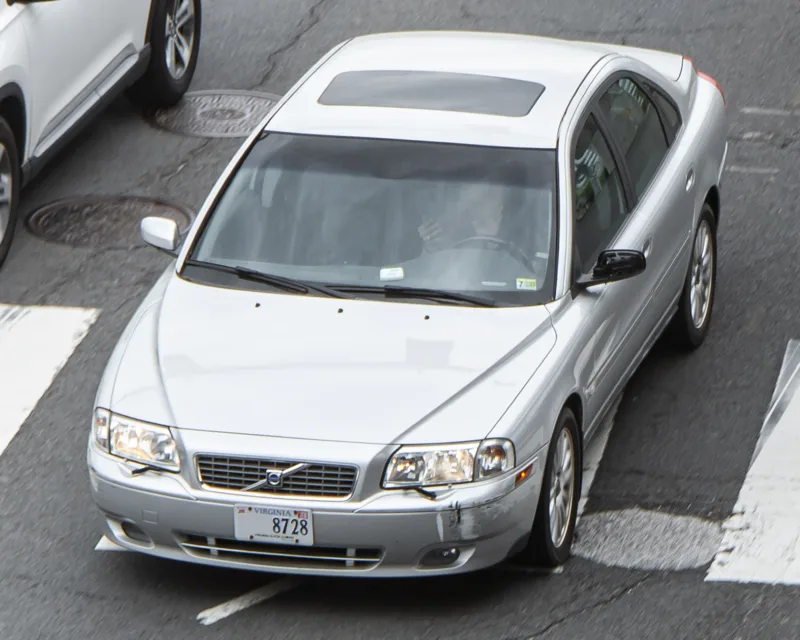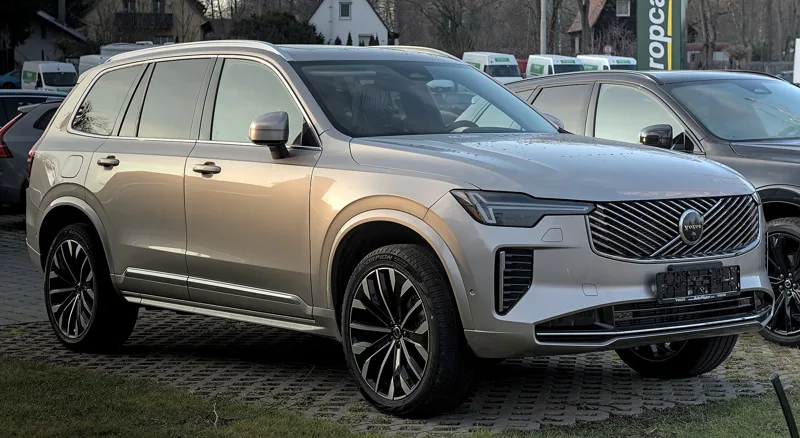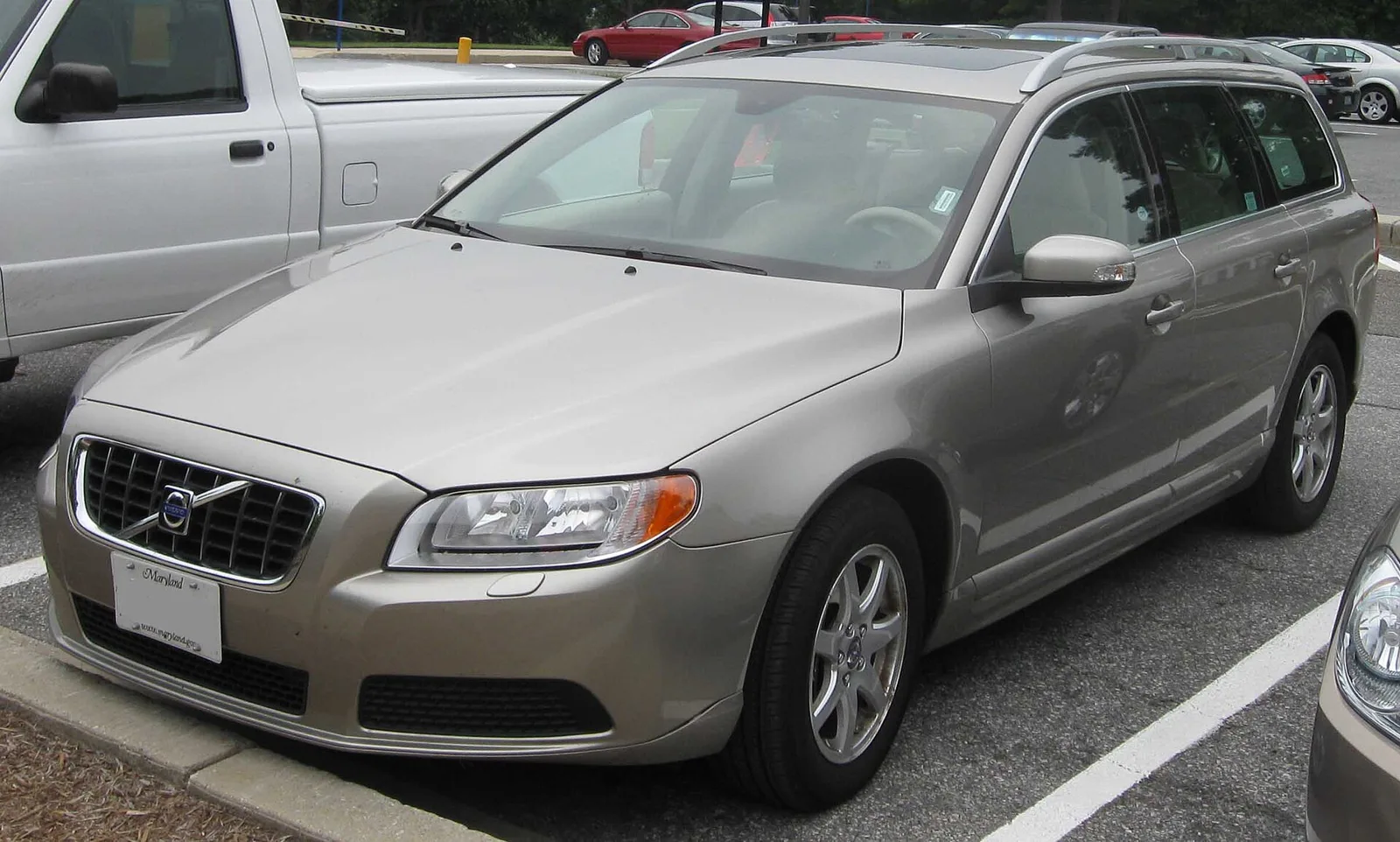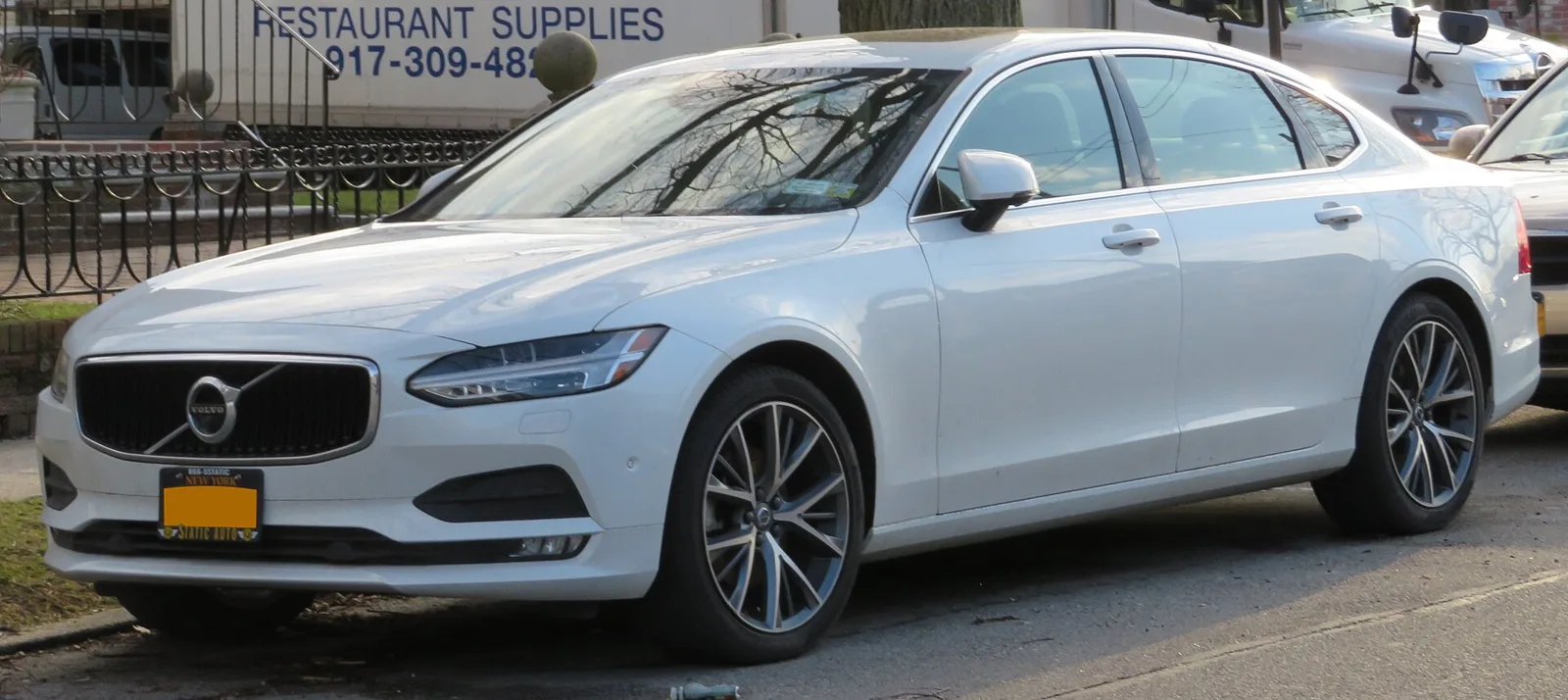
Seat belts as standard in 1959, a facelifted 850 with 1800 changes, a Cross Country hatchback and a Chinese-built flagship: four Volvos from the 1950s to the 2020s.
The Volvo Amazon was a mid-sized car built from 1956 to 1970, the S70 was a facelifted 850 saloon sold from 1996 to 2000, the V40 was a small family car from 2012 to 2019, and the S90 is an executive saloon launched in 2016. Each marks a different stage in Volvo's history.
Volvo made front seat belts standard on every Amazon from 1959, export models included, which made it the first manufacturer in the world to do so. The firm then went on to be the first with three-point belts as standard equipment. Few details say more about why the Amazon matters.
Four Volvos tell the larger story. The Amazon is the car that set the tone from 1956. The S70 of the 1990s shows what a facelift can do when a saloon is already well engineered. The V40 is the small hatchback of the 2010s, and the S90 is the executive saloon that has now been withdrawn from many Western markets.
Volvo Amazon: the 1956 saloon with standard seat belts
Volvo Cars built the Amazon, a mid-sized car, between 1956 and 1970. American buyers first met it as the 122S, shown at the 1959 New York show, and it came as a two-door saloon, a four-door saloon and a five-door estate, all in the ponton style of the period. It borrowed the wheelbase, tall seating position and high hip point of the PV444 and PV544 that came before it.
The name caused trouble. At launch the car was the Amason, spelled with an s, after the fierce female warriors of Greek mythology. Kreidler, a German motorcycle maker, had already registered Amazone, and the two firms agreed that Volvo could use its version only in Sweden, so the spelling changed to Amazon elsewhere. Volvo then adopted its three-digit naming scheme, and the whole range was then called the 120 Series.
Amazon seat belts: which year, which belt
The detail varies by date. One version of the history says that in 1959 Volvo became the first manufacturer to offer front seat belts as standard, on all Amazons including exports, and that three-point belts followed. Another says the 1958 Amazon was the first production car with a three-point belt in the front seats as standard. Either way, the car was ahead of its time. North American cars often carried only lap belts until 1968, yet Amazon owners there got the three-point shoulder type.
Styling and construction
The three-box shape drew on American cars of the early 1950s and strongly resembled the Chrysler New Yorker saloon and the 300C hardtop coupe from the same maker. Designer Jan Wilsgaard said his inspiration was a Kaiser spotted at Gothenburg's harbour. Pronounced shoulders and slight but visible tailfins gave the body strong shape from nose to tail. Decades later, Peter Horbury looked back to those features when he redirected Volvo's design with the V70 after years of boxy, slab-sided shapes.
The body was made of phosphate-treated steel, chosen to help paint stick, with heavy undercoating and anti-corrosion oil. The estate arrived at the 1962 Stockholm Auto Show, and Volvo built 73,000 between 1962 and 1969. It had a two-piece tailgate with a lower section that folded down as a load floor, and the rear number plate, mounted on that section, folded up so it stayed visible. The original 1959 Mini used the same idea, and the Subaru Baja later did. The Amazon platform also underpinned the P1800 and the 1800ES.
Models and milestones
The Amazon reached the press in February 1956, with deliveries beginning in August 1956 and the first customer cars arriving in February 1957. The base 121 had a single-carburettor engine with 66 bhp (49 kW), and the 122S of 1958 used twin carburettors and 85 bhp (63 kW). A Sport model appeared in 1958, and in 1962 Volvo introduced the two-door and estate bodies along with the B18 engine. A Borg-Warner BW35 three-speed automatic joined the list in 1964.
In 1965 the estate became the first foreign-built police car bought by a British force. Hampshire Constabulary trialled it against a Citroen DS19 Safari and a Humber Super Snipe estate, then bought a white Amazon 1800 estate with a Ruddspeed-tuned engine, first to carry accident equipment and later for traffic duties. It acquired five in all. The buying of foreign cars drew letters of complaint to the Chief Constable and to Autocar, and the force was later criticised by the Home Office for buying Volvo 144 saloons.
The Amazon Favorit of 1966 was a cheaper version without chrome trim and with a three-speed gearbox. The 140 Series was becoming Volvo's mainstream model, and the last four-door 120 saloons were built in 1967, the year of the 123GT, which used a high-compression B18B engine from the P1800. The B18 was enlarged in 1969 and renamed B20. The last Amazon was built on 3 July 1970 at the factory, although the final one assembled was in Durban, South Africa, on 18 December 1970. Production at Lundby, and from 1964 at Torslandaverken, totalled 667,791 cars, around 60% of them exported.
The Amazon put seat belts on every car it sold, export models included, in 1959.
Volvo S70: a facelifted 850 with 1800 changes
Sold from 1996 to 2000, the S70 was a compact executive car and essentially a facelifted 850 saloon. Volvo said it made a total of 1800 changes, among them a more rounded body, a new nose with new lights, bumpers and side trim painted in the body colour, clear rear indicator lenses and a fresh interior. It reached Europe in late 1996 as a 1997 model and arrived in the United States for the 1998 model year. The Volvo S60 replaced it.
Every car came with remote central locking, heated power mirrors, 4 airbags, ABS brakes and power windows. In the United States the badge told you the engine and, loosely, the equipment level, while in Europe buyers chose engines and options individually. The T5 and R were the performance versions. A minor facelift for the 1999 model year brought a larger second-generation side airbag and Volvo's WHIPS whiplash system as standard. Turbo engines gained drive-by-wire throttles, traction control was upgraded to include brake intervention and renamed STC, and ABS moved from three channels to four. For 2000, a new 5-speed automatic with adaptive shift-logic was added, but only on front-wheel-drive models without a turbo.
Engines went up to 250 PS, and a diesel finally became available in the saloon, alongside a Bi-Fuel version. It used a modified version of Audi's 2.5 TDI. Outside Europe neither the TDI nor the Bi-Fuel was sold. The factory also offered taxi and police variants, and some British highway patrol forces and North American police forces used S70s. For all that, the saloon was well received but outsold by the V70 estate.
The S70 R and S70 AWD
An S70 AWD ran from the 1998 model year to 2000. It shared its set-up with the V70 AWD, except that rear self-levelling suspension was optional rather than standard, and it had one engine: a 193 PS 2.4-litre turbo, with a 4-speed automatic or 5-speed manual.
The S70 R, introduced in 1997 for 1998, was the top-performance model of the line. With the five-speed manual gearbox and a limited-slip differential it made 250 metric horsepower (184 kW; 247 hp) and 350 N.m (258 lbf ft). With the four-speed automatic, output was 240 metric horsepower (177 kW; 237 hp) and 330 N.m (240 lb ft). It was front-wheel drive only and sold in Europe and a few other countries. Its cabin was trimmed in leather and Alcantara with diamond stitching, the instrument dials had blue faces, and buyers could choose a colour reserved for the R and either 16-inch or 17-inch alloy wheels. Production ended with the 1998 model year.
Volvo V40: the small family car of the 2010s
Volvo built the V40, a small family car in Europe's C-segment, from 2012 to 2019. Geneva hosted its 2012 unveiling, and it was on sale across Europe for the whole run. The American designer Chris Benjamin drew it, Pontus Fontaeus designed the interior, and it was the last Volvo shaped under Steve Mattin before he left the company. It sat on the Global C platform with revised electric power steering and different spring and damper settings.
The launch range had two petrol engines, a 1.6-litre EcoBoost with 150 or 180 hp and a 2.5-litre five-cylinder with 254 hp. The two diesels were a 1.6-litre unit from PSA Peugeot Citroen and Ford with 115 hp and CO2 emissions of 94 g/km, and a 2.0-litre five-cylinder offered with 150 or 177 hp. In some countries the T5 used a 2.0-litre five-cylinder with 213 hp.
Drive-E and the end of the five-cylinder
Starting with 2014 models, Volvo fitted its own Drive-E engines. By January 2015 they were available in the new D4 and T5, replacing the five-cylinder versions with the same names. The D4 was a four-cylinder twin-turbo diesel rated at 190 PS (140 kW; 187 hp) and 400 N.m (295 lb ft), with a six-speed manual tuned for economy. The T5 was a four-cylinder turbo petrol rated at 243 PS (179 kW; 240 hp) and 350 N.m (258 lb ft), with an eight-speed automatic. The older D2 and D3 diesels gave way to 2.0-litre versions of the same names, and the T2, T3 and T4 petrols took over from the EcoBoost and five-cylinder. For some automatic petrol models, a 1.5-litre engine was created by shortening the stroke of the 2.0-litre to 70.9 mm from 93.2 mm, with the bore held at 82.0 mm.
A facelift in 2016 gave every V40 the Thor's hammer headlights already used on the second-generation XC90, S90 and V90, and added a straw-pattern seat option. The IntelliSafe pre-crash system was available.
V40 Cross Country
The Cross Country, built from 2013 to 2019, added protective body panels, bigger wheels and tyres and more ride height. Its T4 and T5 petrol versions could be fitted with Haldex Gen-5 all-wheel drive and hill descent control, and it had more powerful engines than the regular V40. The Cross Country won recognition at the 2013 Tow Car Awards for pulling a caravan from 30 to 60 mph in 11.7 seconds, and in 2015 for doing the same in 9.8 seconds.
The V40 collected other prizes as well: the Scottish Car of the Year title of Best Executive Hatch in 2012, an Auto Express Safety Award in 2013, two Carsite.co.uk awards in 2013, one for best medium family car and one as overall car of the year, and a Road Safety Award in 2014 for its safety features and high Euro NCAP ratings.
Volvo S90: the flagship built in China
The Volvo S90 is an executive saloon built by Volvo Cars from 2016, with the V90 as its estate. The first official pictures were released on Wednesday 2 December 2015, and Detroit hosted the public unveiling in January 2016. The design was named Production Car Design of the Year for 2015. It is not the S80's direct heir, though it took over as the flagship saloon. Trims ran from Momentum to Inscription, and an R-Design package was announced in July 2016.
For 2017 there was a short-wheelbase saloon for North America and Europe and a long-wheelbase version made mainly for China, with 12 cm (4.7 in) added behind the B pillar. From the 2018 model year the long-wheelbase car replaced the standard one in the United States, and both were sold in Europe and the Middle East.
S90 engines and safety
Every S90 engine is a 2.0-litre four-cylinder petrol or diesel from the Drive-E family. The more powerful petrols are compound charged, as is the T8 plug-in hybrid. The D5 diesel has PowerPulse technology, built to eliminate turbo lag, and an i-Art injection system. A mild-hybrid version arrived in 2020, and in 2023 Volvo removed conventional engines in the United States, so mild hybrids became the base option. The 2022 British range was limited to the S90 Recharge in Plus and Ultimate trims, with the T8 all-wheel-drive engine, a 2.0-litre four-cylinder rated at 455 hp (339 kW).
The Insurance Institute for Highway Safety named it a Top Safety Pick for 2017, 2018 and 2019, and a Top Safety Pick+ for 2021, 2022 and 2023.
Moving production, and the withdrawal from Western markets
By mid-2017 the Torslanda plant in Sweden no longer built the S90. Production moved mainly to Daqing in China, and cars were shipped to Europe by train. It was also assembled locally from kits in Shah Alam, Malaysia, and at a plant in Bengaluru, India. A late-2024 end to production, with 2025 the last model year, sits alongside a second facelift in April 2025 that keeps the car on sale in China, South Korea and Vietnam.
A first facelift was previewed by leaked photos in February 2020 and brought sequential LED indicators and chrome garnish on Inscription cars. The second, introduced on 17 April 2025, gave the S90 the nose of the 2024 XC90 and an 11.2-inch infotainment screen. It did not reach the United States, Australia, Canada or Europe. The S90 was discontinued there because of poor sales and, in the United States, new tariffs on Chinese-built vehicles, since the S90 for those markets came only from China. It was also withdrawn in India, where it faced tough competition from the Audi A6, Lexus ES, BMW 5 Series and Mercedes E-Class. China, South Korea and Vietnam will continue to receive it.
Volvo saloon history in one table
| Model | Years | Class | Defining detail |
|---|---|---|---|
| Volvo Amazon | 1956 to 1970 | Mid-sized car | Standard front seat belts; 667,791 built |
| Volvo S70 | 1996 to 2000 | Compact executive car | Facelifted 850 with 1800 changes |
| Volvo V40 | 2012 to 2019 | Small family car | Drive-E engines replaced the five-cylinders |
| Volvo S90 | From 2016 | Executive saloon | Built mainly in Daqing, China |
The electric successor to the S90
In December 2023 Volvo revealed that pre-production versions of an electric S90 successor had begun testing in China. Its codename is V551, and it is rumoured to be called the ES90. It uses the SPA2 platform that underpins the EX90, along with the same 111 kWh battery pack. In the meantime the existing car carries on in China, South Korea and Vietnam with its second facelift.
What this means if you drive or buy one
An Amazon buyer is choosing between a base 121 with 66 bhp (49 kW) and a 122S with 85 bhp (63 kW), and between two-door, four-door and estate bodies, though by 1970 only the two-door was left. An S70 is the practical saloon of its line, the S70 R the rare one: it was front-wheel drive only, and production ended after the 1998 model year. A V40 bought after 2014 has the four-cylinder Drive-E engines rather than the earlier five-cylinders, and the Cross Country brings the extra ride height and optional all-wheel drive. The S90 remains the most modern of the four, but anyone shopping new in the United States, Australia, Canada or Europe will find it has been withdrawn from sale there.