Why the union that sat down in Flint in 1936 chose, in 2023, to walk out of three plants first and the rest later.
The UAW is the United Auto Workers, a Detroit-based union founded in 1935 that won recognition at General Motors in 1937 after the Flint sit-down strike. In 2023 it struck Ford, GM and Stellantis together for 46 days, widening the stand-up strike plant by plant until all three agreed contracts.
When the United Auto Workers walked out on 15 September 2023, it did not shut down the Big Three. It sent about 13,000 workers out of roughly 145,000, from just three plants, one at each company, chosen because they were profitable. Then it waited. Each time talks stalled, more plants were called out. By the end of the 46-day strike, tens of thousands had joined, and all three automakers had signed contracts that largely matched the union's demands.
That tactic, which president Shawn Fain called a stand-up strike, stood in contrast to the union's first great weapon, the sit-down strike of the 1930s. The path between the two runs through war, prosperity, decline and a new fight over electric vehicles.
What is the UAW?
The full title is the International Union, United Automobile, Aerospace and Agricultural Implement Workers of America. In practice it is the UAW, a labor union for workers across the United States, Puerto Rico included, and in southern Ontario, with its headquarters in Detroit.
Its membership today looks nothing like its 1940s heartland. By February 2022 the UAW counted over 391,000 working members and over 580,000 retirees in more than 600 locals, with 1,150 contracts covering some 1,600 employers, and assets just above $1 billion. Members work in autos and parts, but also in health care, casino gambling and higher education.
The union that won with a sit-down in Flint won in 2023 by standing up plant by plant.
How the UAW began
The union grew out of an American Federation of Labor organising drive. The AFL had long concentrated on skilled craft workers, and since most car workers were unskilled, they were largely outside any union in the early 1930s. That changed after the National Industrial Recovery Act of 1933, when AFL president William Green decided to recruit unskilled and semi-skilled workers. His plan was to gather them at each factory into temporary federal labor unions, then divide the members among the craft unions. William Collins was sent to Detroit to do it, and struggled. The programme lacked militancy and money, workers feared retaliation, Black and foreign workers distrusted it, and the car companies fought it hard.
By 1935 most federal union members had been recruited by local activists acting on their own, often outside Michigan, and they resisted being split up. They wanted a single union for the whole industry. After the Toledo local led an unauthorised but successful strike against General Motors, the AFL gave way and called a convention.
The UAW's founding convention opened on 26 August 1935 in Detroit, with constituent unions totalling 25,769 members. The AFL tried to hold on to control through a charter that would have stopped the rank and file from electing their own officers. Militant locals reversed that, and the fight left the UAW estranged from the AFL leadership. It joined John L. Lewis's Committee for Industrial Organization in 1936, and when the AFL expelled the industrial unions in 1938, it became part of the Congress of Industrial Organizations.
Sit-downs at General Motors, Chrysler and Ford
The UAW's fortunes turned once it organised by industry rather than craft. It found rapid success with the sitdown strike, in which workers stop at their stations and occupy the factory. A small number of people could halt an assembly line and with it an entire plant. If the plant was a key link in a corporation, the occupation could paralyse the whole company.
After sitdown wins at General Motors plants in Atlanta and Kansas City, the union demanded to represent GM workers nationwide. The Flint sit-down strike followed, starting on 30 December 1936. Within weeks, by 25 January, shutdowns had left 150,000 workers idle across fifty GM plants, from California to New York. The strikers held off attempts by police and the National Guard to take the buildings back. GM agreed on 11 February 1937 to bargain with the UAW and in time recognised it as bargaining agent under the new National Labor Relations Act. The following month Chrysler workers won recognition in a sitdown of their own. By mid-1937 the union claimed 150,000 members.
Ford was last. Henry Ford and his security manager Harry Bennett used force to keep the union out, building a Service Department to watch and frighten workers. At the Battle of the Overpass, staff from that department beat union organisers while news photographers looked on, and the pictures helped turn public opinion against the company. Ford still refused to sign. The union struggled in part with Black workers, many older ones loyal to Henry Ford for hiring and paying them well when others would not, and others afraid of being pushed aside once the union had their votes. After four years, and a strike at the Rouge plant, a decisive majority of Ford employees, including most Black employees, voted for the UAW on 21 May 1941. The contract included pay rises, a closed shop, rehiring of pro-union workers and a non-discrimination clause drafted by Shelton Tappes, a Black foundryman on the negotiating team.
War, Walter Reuther and the Treaty of Detroit
The Second World War changed the union. Its executive board voted for a no-strike pledge so that the war effort would not be hindered, and the membership later reaffirmed it. As factories converted to tank building, the UAW organised new locals, including in aircraft plants, and in 1944 membership peaked at over a million. That year Lillian Hatcher became the union's first Black female international representative.
Peacetime brought a harder test. A strike against GM began in November 1945 and lasted 113 days. The union wanted a greater voice in management, and GM would pay more but refused to share power. The union settled for an eighteen-and-a-half-cent wage increase and little else. From that strike came a strategy, credited to Walter Reuther, of targeting one company at a time.
Walter Reuther won the presidency in 1946 and held it until he died in a plane crash near Black Lake, Michigan, on 9 May 1970. He rejected the left-wing demand for a 30-hour week at 40 hours pay and concentrated on total annual wages. His method was to pick one of the Big Three and, if it would not concede, strike it and let the other two absorb its sales. In 1950 he negotiated an industry-first contract with General Motors that became known as the Treaty of Detroit. Chrysler workers got company-funded pensions, GM workers medical insurance, and in 1955 Ford workers supplementary unemployment benefits. Many smaller suppliers followed.
The union also stepped onto a wider stage. Reuther walked with Martin Luther King Jr. at the 1963 March on Washington, and the UAW was the most important outside supporter of the first Earth Day in 1970. It left the AFL-CIO on 1 July 1968 after Reuther and George Meany could not agree on policy and governance. Political scientist Charles Williams argues that the union's liberal-nationalist language was used both to fight for Black workers and to limit their own organising.
Why did UAW membership fall?
After the 1970s the union proved unable to unionise car plants built in the South by foreign-based makers, and membership went into steady decline. Reasons given include automation, reduced use of labour, mismanagement, movement of manufacturing, including the reaction to NAFTA, and globalisation. Since the 1950s the shrinking membership and the growth of the service sector have also reduced the economic impact a strike can have. In 2024, after the 2023 strike, the union organised its first foreign plant, at Volkswagen.
What triggered the 2023 UAW strike?
The three unionised automakers, Ford, General Motors and Stellantis, employ about 145,000 UAW members and build about half of US vehicles each year, equal to 1.5 percent of US GDP. The strike started on 15 September 2023, when the contracts ran out without a deal.
Newly elected president Shawn Fain took a hard line. He criticised wages that had not kept pace with inflation, wanted an end to the tiered system that underpays newer employees, and asked for the restoration of overtime and retirement benefits lost after the 2008 financial crisis. He also pressed for a four-day workweek and better protection against plant closures as electric vehicle production grows. In March 2023 he said workers were fed up with the status quo. Members worried about the idling of the Belvidere Assembly Plant in Illinois and about lower wages at joint venture battery factories.
Contract talks began on 14 July. Fain updated members online and, on camera, threw one automaker's proposal in the bin. On 15 August he announced a strike vote, which passed on 27 August with 97 percent in favour. The union asked for an immediate 20 percent raise and gradual yearly increases that would total a 46 percent rise in hourly pay, along with traditional pensions, retiree health care, a four-day week, job protections and a fair transition to electric vehicles. Fain acknowledged the demands were audacious but called them justified.
How the stand-up strike worked
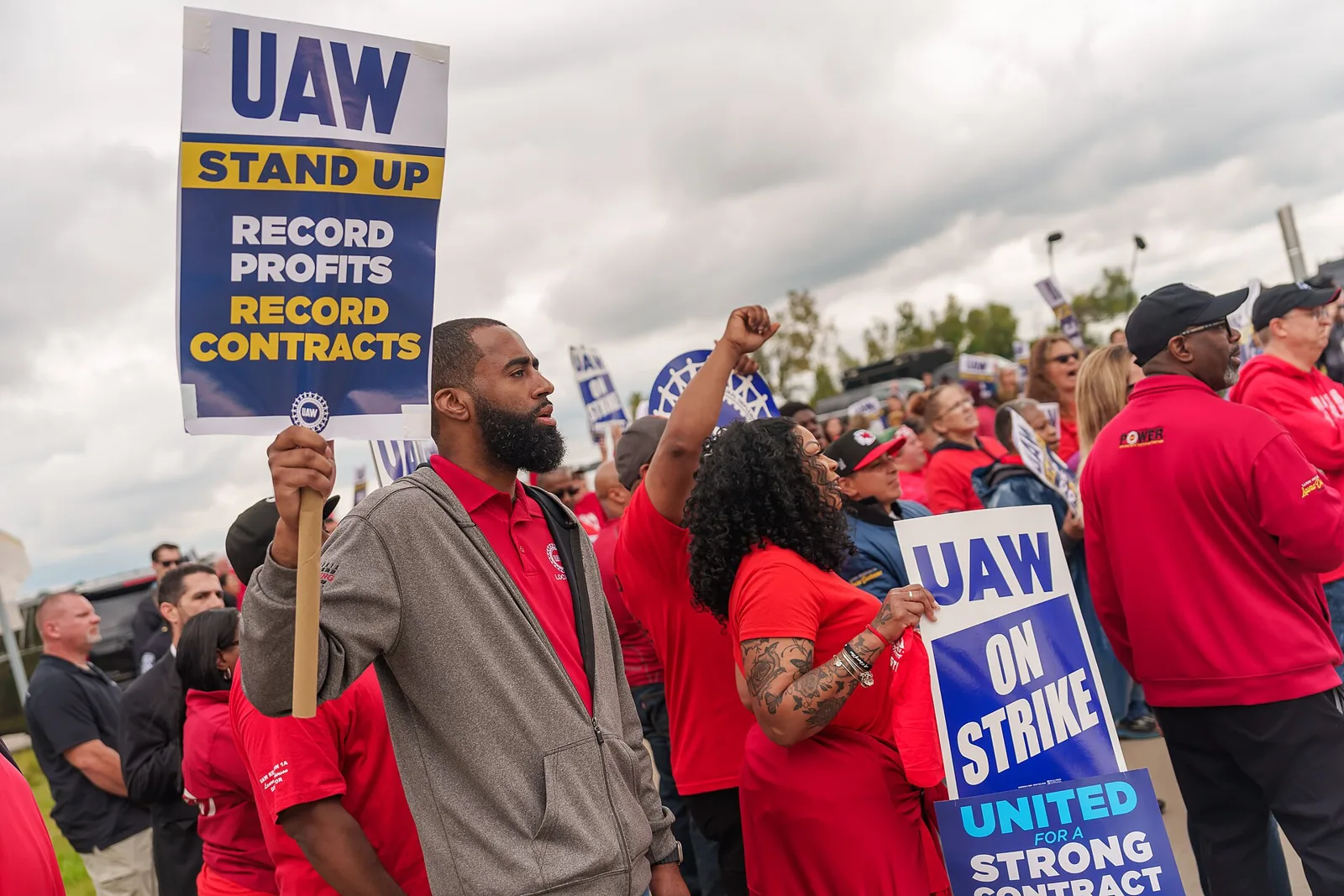
On 14 September Fain declared that the UAW would strike all three at once for the first time in its history. The first targets were Ford's Michigan Assembly Plant in Wayne, Stellantis's Toledo Complex in Ohio and General Motors's Wentzville Assembly in Missouri, with about 13,000 workers. The limited scope was meant to stretch the strike fund. The plants were chosen for their profitability.
Think of an ordinary rolling strike as a wave that passes from one workplace to the next, each section moving on without the strike growing. Fain's version kept adding. On 19 September he gave the companies until Friday 22 September to make progress or see more plants join, and called it a stand-up strike. The next expansion came on 22 September, when 5,600 workers left 38 parts-distribution plants run by Stellantis and GM. Ford was spared, because Fain said it was showing it was serious about a deal.
On 29 September another 7,000 joined: 4,600 at Ford's Chicago Assembly and 2,300 at GM's Lansing Delta Township plant. On 11 October 8,700 workers left Ford's Kentucky Truck Assembly. On 23 October 6,800 walked out at Stellantis's Sterling Heights Assembly, where the union considered Stellantis's latest proposal the worst of the three. The next day around 5,000 at GM's Arlington Assembly followed.
What the UAW contract changed
Ford reached a tentative agreement on 25 October. It included an 11% wage rise in the first year, a total 25% increase over a 4.5 year contract, a $5,000 ratification bonus and a cost-of-living adjustment. Counting that adjustment, total pay could rise by 30%. Stellantis followed on 28 October, the day 4,000 workers at GM's Spring Hill Manufacturing joined the strike despite late-night talks the evening before. On 30 October the UAW announced a deal with General Motors, suspended the strike and told all striking workers to return, ending a 46-day dispute.
All three contracts removed the two-tier wage system, in which some workers were classed as temporary and paid less. At Ford a temporary worker who earned $16.67 an hour became permanent at a minimum of $24.91. Workers employed in or before 2023 would reach $40.82 an hour by the end of the contract at full seniority. Ratification votes ended on 16 and 17 November. The first vote, at Local 900, the first plant to strike, passed with 82%. Members approved the Stellantis and Ford contracts by over 69%, while at General Motors just over 54% voted yes.
The cost of labour and the electric vehicle question
| Employer | Labour cost per hour |
|---|---|
| Tesla (non-union) | $45 |
| Toyota (non-union) | $55 |
| Detroit automakers under UAW contract | $65 |
| Wells Fargo estimate if the UAW proposal had been accepted | $136 |
Those figures sit at the heart of the carmakers' case. They said they had to switch to electric vehicles to meet government regulations and stay competitive, a move requiring them to reinvest billions of dollars of profit. Ford said it would lose $4.5 billion in its electric vehicle business in 2023. Ford, GM and Stellantis claimed the UAW proposal would stop them competing against foreign makers during the shift. Tesla, Lucid, Rivian and foreign carmakers all have non-union workforces.
The union saw it differently. The 2022 Inflation Reduction Act brought federal funding and tax incentives for domestic electric vehicle production. According to The Atlantic's Ronald Brownstein, union officials feared the companies were using the shift to move work from well-paid union jobs, mostly in northern states, to lower-paid non-union jobs mostly in the South. Fain argued that with billions of public dollars involved, workers could not be left behind. The UAW seeks to make unionisation of battery factories mandatory without a vote of the employees.
Politicians and the picket line
A day after the strike began, on 15 September, the union staged a rally in Detroit outside the venue hosting the North American International Auto Show, with speeches from Michigan governor Gretchen Whitmer and senator Bernie Sanders. On 26 September President Joe Biden visited a picket line at a GM warehouse in Van Buren Township, the first sitting US president to do so. Former president Donald Trump did not publicly back the strike. He criticised union leadership and the administration's electric car policy, and on 27 September spoke at a non-union auto parts plant in Clinton Township, on the same night as the second Republican presidential debate.
What it means for an autoworker or a buyer
For a worker, the practical change is the end of the two-tier wage system and a clear pay scale to full seniority. For a car buyer, the carmakers' warning is that the switch to electric vehicles requires heavy reinvestment and that a more costly contract would hurt their competitiveness. The 2019 strike against GM, which lasted 40 days, cost the company $3.6 billion and caused a single-quarter recession in Michigan. The 2023 strike is described as the first one to hit all three at once.
What happens after the 2023 contracts?
The Ford contract runs for 4.5 years. The UAW organised its first foreign plant, at Volkswagen, in 2024. The union seeks to mandate unionisation of battery factories, while the automakers have said they expect to pay for electric vehicle technology from the profits of petrol vehicles.