A rubber town in the Amazon that never sent a drop of latex to Detroit, and a freezing march on the River Rouge gates in 1932 that ended in gunfire.
Fordlandia was Henry Ford's planned rubber town in the Brazilian Amazon, founded in 1928 and abandoned in 1934 without supplying rubber to Ford. The Ford Hunger March of 7 March 1932 was a protest by unemployed auto workers at the River Rouge plant in which four were shot dead.
The Ford family lost more than US$20 million on a town in the Amazon that was meant to grow rubber for his tyres, and not a drop of that rubber ever went into a Ford. The town was Fordlandia, in Brazil. While it was still struggling, a very different crowd gathered at his factory gates in Michigan, and the two stories belong side by side.
What was Fordlandia in Brazil?
Fordlandia was a prefabricated industrial town that Henry Ford founded in 1928 in the Amazon rainforest, on the east bank of the Tapajos river, roughly 300 kilometres (190 mi) south of Santarem. It was designed for 10,000 residents and existed to supply cultivated rubber to the Ford Motor Company's car factories in the United States.
The land deal ran to about 10,000 square kilometres (3,900 sq mi), an area known as Boa Vista, which Ford secured from the Brazilian authorities. In return the state took a 9% share of any profit: 7% for the national government and 2% for local municipalities. Ford was also exempted from taxes on exports of the goods produced there.
Talks began when the then governor of Para, Dionisio Bentes, travelled to the United States to meet Ford. The Ford Motor Company had announced its interest in the land a year earlier, in 1927.
Ford planned a utopia on the Tapajos and a rubber supply for his tyres, yet the town ran out of both while his workers in Michigan marched for bread and jobs.
Why did Henry Ford want a rubber plantation?
Ford wanted to loosen his dependence on rubber from European suppliers, a worry that sharpened when Winston Churchill floated the idea of a rubber cartel. A plantation of his own would take the supply out of foreign hands.
The plan went beyond agriculture. Ford had a utopian picture of the place and drew up a Midwest-style town to sit around the plantation. Offices opened in Belem and Manaus to hire labour, and people from neighbouring states, promised good wages, signed up.
What was life like in a Ford town in the jungle?
The site was laid out in zones. Brazilian workers lived in one part, while American managers occupied their own enclave, the American Village. Money went into serious infrastructure: houses in the American style, a school and a hospital, with a pool, a golf course, tennis courts and a movie theatre for leisure.
Then came the rules. Alcohol, tobacco and prostitution were banned across the town, and that included the inside of workers' own homes. Managers walked from house to house to police the ban.
People found ways round it. Workers paddled out to merchant riverboats moored beyond the town's jurisdiction, and some smuggled goods back inside fruit such as watermelons. Eight kilometres (5 mi) upstream, a small settlement known as the Island of Innocence offered drinking, dancing and brothels.
Food was a second front. Ford held firm views on what a proper diet looked like, and he pushed brown rice, whole-wheat bread, canned peaches and oatmeal on a workforce raised on very different meals. Staff were also required to labour through the middle of the day under a tropical sun, and they often refused, fearing the heat and humidity would make them ill.
Why did Henry Ford's rubber plantation fail?
The ground was hilly, rocky and infertile, and none of Ford's managers understood tropical agriculture. That second problem did the most damage. A wild rubber tree grows well apart from its neighbours, often beside larger trees of other species, and that spacing protects it from plagues and disease.
At Fordlandia the trees were planted close together in neat plantation rows. They became easy targets for tree blight, lace bugs, red spiders, Saua ants and caterpillars that eat leaves. The same shortage of expertise let sickness and unrest spread through the camp.
Help from outside was thin. The Brazilian government distrusted foreign investment in the northern Amazon region in particular, and offered the project little support.
What was the Quebra-Panelas revolt of 1930?
In 1930, workers who were fed up with the imposed menu, and with a change in the way meals were handed out, rose up in the town cafeteria. The episode is remembered as the Breaking Pans, or Quebra-Panelas in Portuguese.
The rebels cut the telegraph wires and drove the managers, and even the cook, out into the jungle for a few days. The revolt ended only when the Brazilian Army arrived. Agreements on what the workers would be served followed.
How did Fordlandia end?
The Ford Motor Company abandoned the town in 1934 and moved the effort upriver to Belterra, 40 kilometres (25 mi) south of Santarem, where conditions for growing rubber were better. The second site did not rescue the scheme. By 1945 synthetic rubber had been developed and world demand for the natural product fell away.
Almost overnight the opportunity vanished, without yielding any rubber for Ford's tyres, and Belterra was abandoned as well. Also in 1945, Henry Ford II, the founder's grandson, sold the land covering both towns back to the Brazilian government, taking a loss of more than US$20 million. The founder never set foot in either place, despite repeated invitations.
What is left of Fordlandia today?
From the 1950s to the late 1970s, with the rights back in its hands, the Brazilian government used the area through its Ministry of Agriculture. The houses that had belonged to Ford's rubber tappers were handed to the families of ministry staff, and some of their descendants still live in them. That effort faded as well and left the town almost empty.
About 90 people stayed on into the latter half of the 2000s, with no basic services and medical help arriving by boat at long intervals. Then people hunting for somewhere to live began moving back in, often claiming empty houses. Now a district of Aveiro, Fordlandia had nearly 3,000 residents as of 2017.
Much of Ford's construction survives:
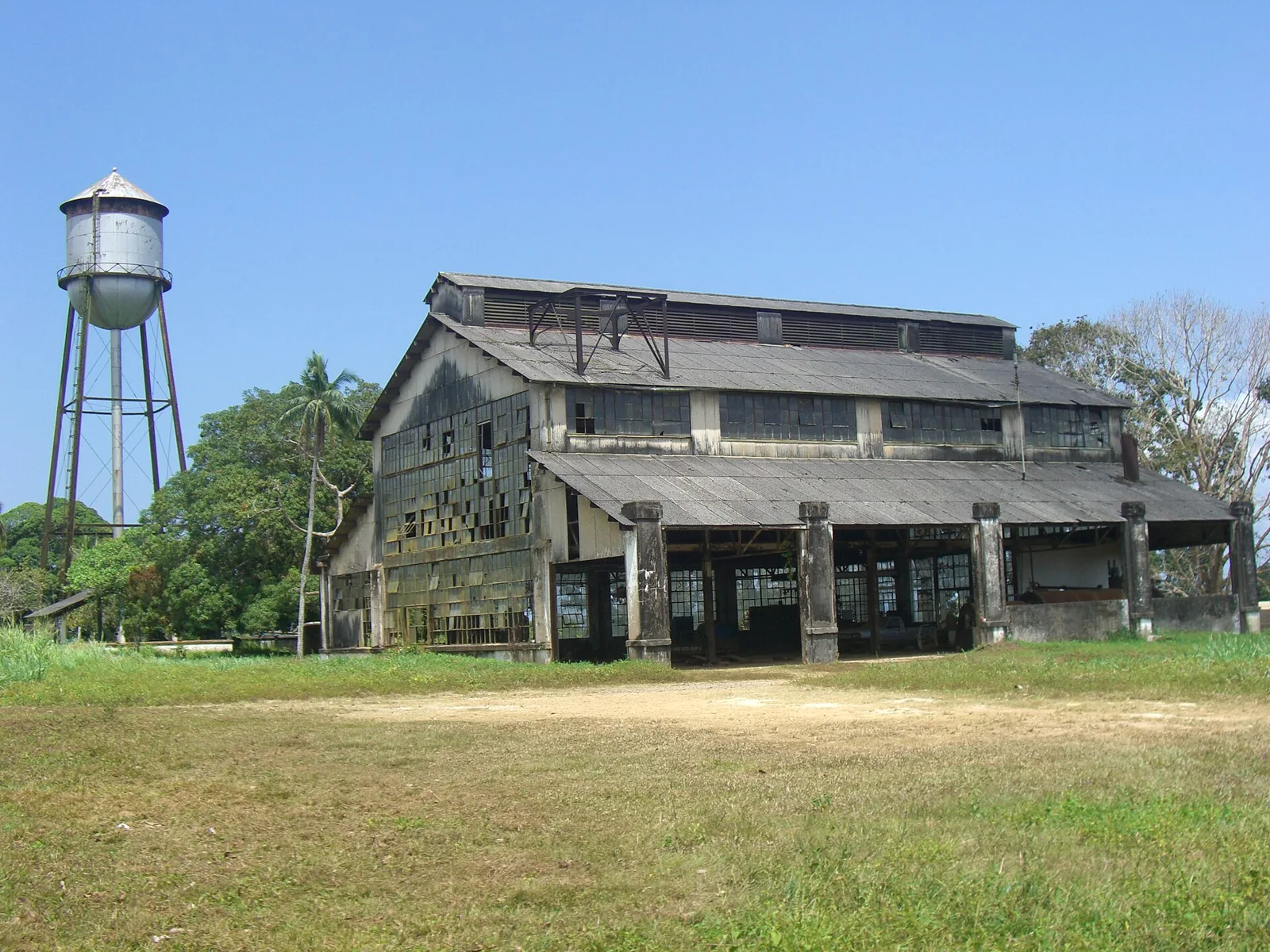
- The water tower, 50 metres (160 ft) tall and the symbol of the place, was built in Michigan and shipped over. It, the water treatment plant and the original plumbing still work.
- The sawmill and its kiln stand, although most of the equipment has gone.
- The three-storey workshop retains most of its machinery and is now a warehouse for objects from the Ford years, including hospital beds, a lead coffin and X-ray equipment. Seed processing on the upper floor soaked the timber with oil and the floor has collapsed in places.
- The six houses of the American Village once held furniture, silverware and clothes left behind. Locals claimed the houses and sold or took most of the contents, and a fire destroyed one house.
- The hospital is gone, taken apart by looters in the late 2000s. Before that, boxes of radioactive material from its X-ray equipment were found, which frightened nearby communities and led the authorities to remove them.
What was the Ford Hunger March of 1932?
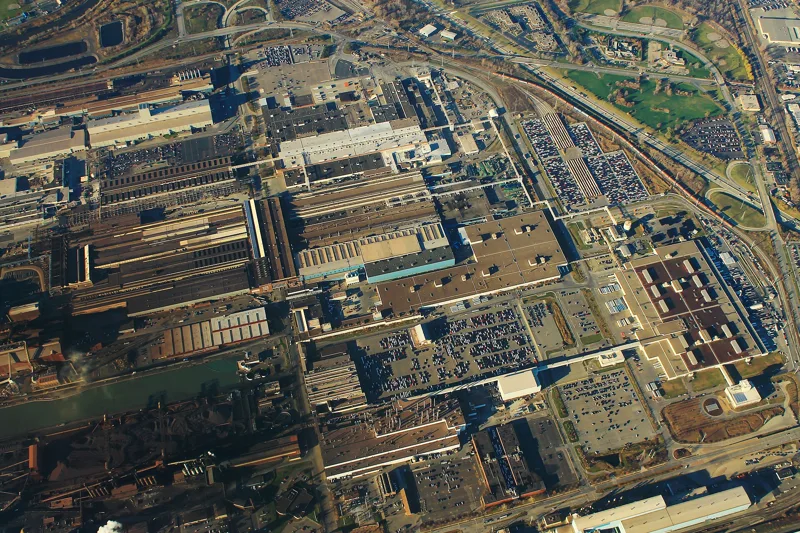
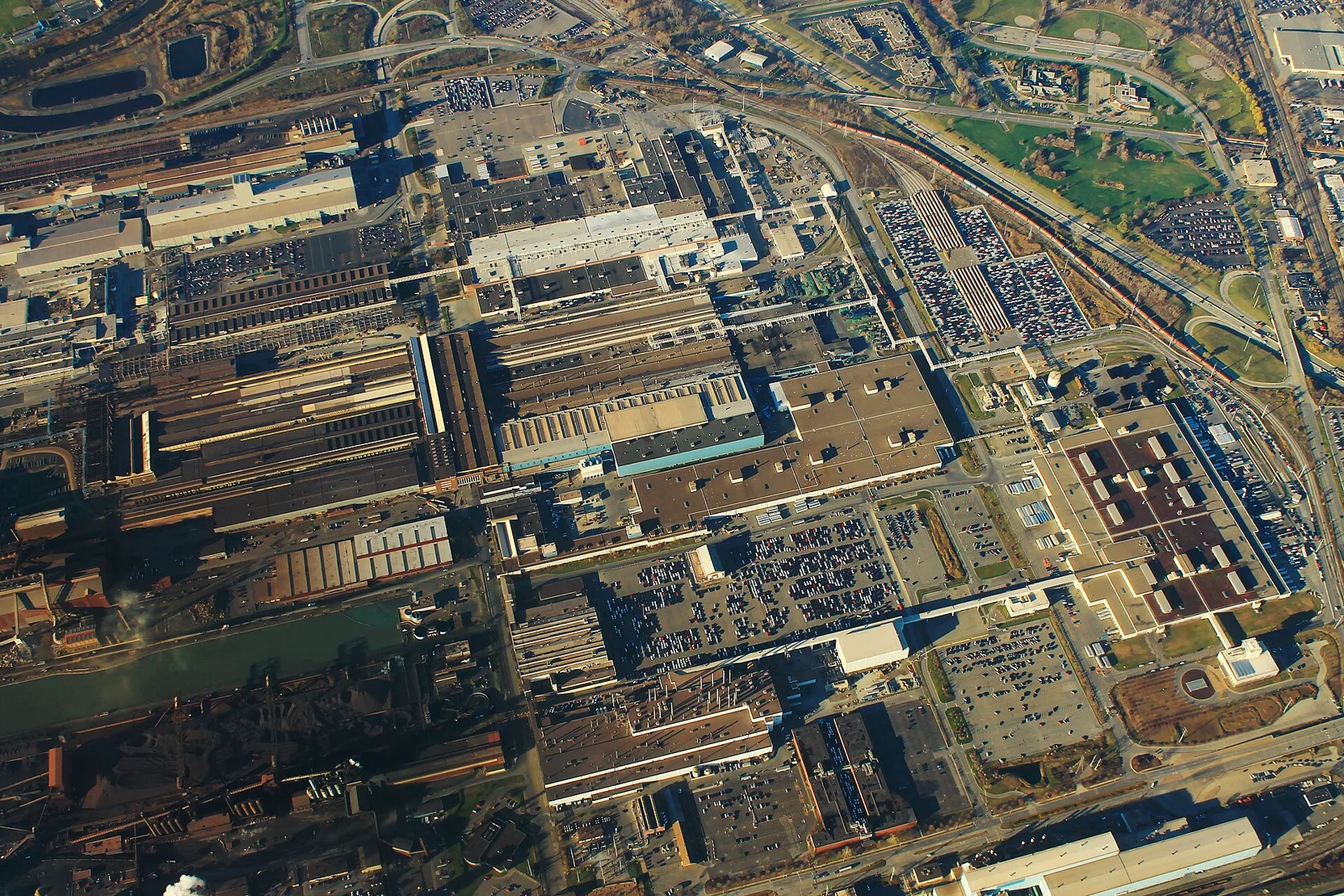
On 7 March 1932, at least 3,000 unemployed auto workers walked from Detroit towards the River Rouge complex in Dearborn, Michigan, the largest Ford factory. Police and company security guards shot four of them dead in the middle of the Great Depression, and a fifth marcher succumbed to his wounds five months afterwards. The event is also called the Ford Massacre.
The one-mile march was called by the Unemployed Councils, an offshoot of the Communist Party USA, together with Auto, Aircraft and Vehicle Workers of America. The main organisers were Albert Goetz, who led the Detroit Unemployed Council, and John Schmies, who stood for mayor of Detroit as the Communist candidate. Detroit's mayor, Frank Murphy, granted a permit. Dearborn's mayor, Clyde Ford, who was related to Henry Ford and ran a Ford dealership, refused one.
Why were Detroit's auto workers marching?
The 1920s had been generous to Detroit. The industry built 5,337,000 vehicles in 1929. After the stock market crashed on 29 October 1929, output fell to 3,363,000 in 1930 and to 1,332,000 in 1931, only 25% of the figure two years earlier.
Wages followed. The average annual pay of an auto worker was US$1,639 in 1929 and had fallen 54% to US$757 by 1931. By 1932 some 400,000 people in Michigan had no work. Suicides in Detroit rose from 113 in 1927 to 568 in 1931, and the welfare allowance was US$0.15 a day per person. There was no unemployment insurance and no Social Security, and every neighbourhood bank in the city had gone under.
The marchers carried 14 demands for Henry Ford. They included rehiring the unemployed, money for health care, an end to racial discrimination in hiring and promotion, winter fuel for jobless families, an end to company spies and private police, and recognition of workers' right to form unions.
What happened at the River Rouge gates?
A crowd of between 3,000 and 5,000 gathered near the Dearborn city limits, about a mile from the plant, in a bitter wind on what a newspaper called among the coldest days of that winter. Banners called for work and bread and for the rich to be taxed. Goetz addressed them and urged them to avoid violence, and the march reached the city limits peacefully.
There, Dearborn police fired tear gas and struck marchers with clubs, and one officer fired a gun in their direction. With no weapons of their own, the marchers fled into a field and threw stones back, then regrouped and advanced almost a mile towards the factory. Fire engines sprayed cold water onto them from an overpass. Police and Ford security guards then fired into the crowd.
Three marchers died at that point: Joseph York (20), Kalman Leny (26) and Joseph DeBlasio (31). Gunfire wounded at least 22 more. The leaders called off the march and ordered a withdrawal. Harry Bennett, the head of Ford security, drove up, lowered a window and fired a pistol at the marchers. Rocks hit the car and injured him, but he got out and kept firing at the retreating marchers.
Machine guns were turned on the marchers as they withdrew. Joseph Bussell (16) died, dozens more were wounded and Bennett ended up in hospital. About 25 Dearborn police officers were hurt by thrown rocks and debris, and none by gunfire.
What happened after the Ford Hunger March?
Every seriously wounded marcher was arrested, and police chained many of them to their hospital beds. William Z. Foster, a Communist leader who had spoken in Detroit the day before the march, was the subject of a nationwide search but was never arrested. Nobody from the police or Ford security was arrested, although reliable reports showed that only they had fired weapons.
Detroit newspapers first printed sensational and mistaken versions, one claiming that Bennett and four policemen had been shot. A few days on, local papers shifted their tone and placed the blame for the deaths on those who handled the crowd. The New York Herald Tribune wrote that the Dearborn police deserved condemnation for using guns on an unarmed crowd. The Detroit Federation of Labor said the killings had cast a stain on the community.
On 12 March an estimated 25,000 to 60,000 people joined the funeral procession for the four dead, laid to rest next to one another in Woodmere Cemetery. Curtis Williams (36) died of his injuries on 7 August 1932. Woodmere refused to bury him because he was African American, so his family arranged a cremation, and the union chartered an aeroplane to scatter his ashes over the River Rouge complex.
What did the grand jury and Mayor Murphy say?
Mayor Murphy called the chaining of patients to beds a brutal practice, branded Bennett an "inhuman brute" and described Henry Ford as a "terrible man". Asked how Dearborn's police differed from Ford's guards, he answered that the difference was a legalistic one. His profile rose, and he went on to become Governor of Michigan and a justice of the US Supreme Court.
A grand jury convened by prosecutor Harry S. Toy reported at the end of June that there was no basis for indictments. It condemned the demonstrators as ill-considered and unlawful, said the police had been well-intended though perhaps not discreet in using tear gas, and accepted that gunfire was used to protect life and property. Grand juror Mrs Jerry Houghton Bacon dissented and described the proceeding in the harshest terms.
What did Fordlandia and the Hunger March say about Ford's workers and ambitions?
| Detail | Fordlandia | Ford Hunger March |
|---|---|---|
| Place | Tapajos river, Brazil | Detroit and Dearborn, Michigan |
| Date | Founded 1928, abandoned 1934 | 7 March 1932 |
| Workers | Recruited with promises of good wages | At least 3,000 unemployed auto workers |
| Flashpoint | Diet and food distribution, 1930 | 14 demands including jobs and union rights |
| How the unrest ended | The Brazilian Army arrived | Dearborn police and Ford security opened fire |
| Outcome | Sold back to Brazil in 1945 at a loss of over US$20 million | Four dead at the scene, a fifth five months later |
In the Amazon, Ford tried to design the whole life of his workers, from the menu to the front door, and the 1930 revolt began over the food. In Dearborn the people at his gates were unemployed auto workers, and they were asking for jobs, health care and the right to organise.
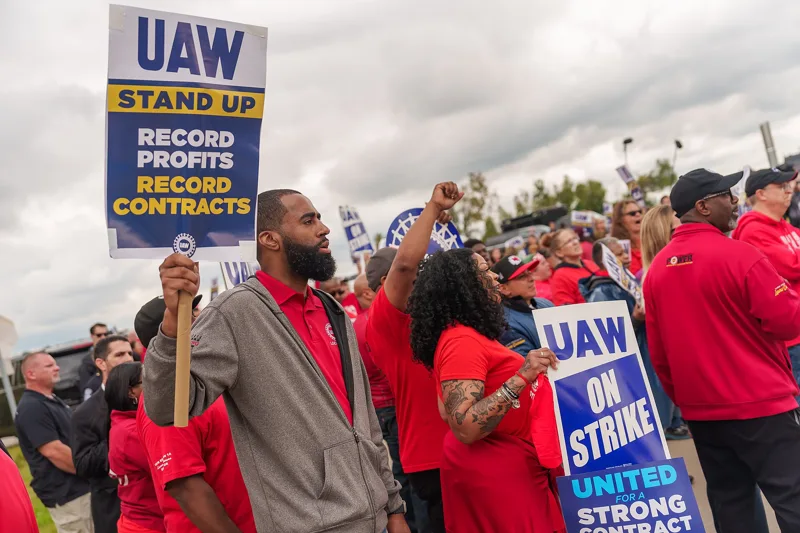
The Hunger March is counted as one link in a chain of events that led to the unionisation of the American auto industry, a chain that includes the Battle of the Overpass in 1937. On 11 April 1941, once 40,000 Ford workers had staged a ten-day sit-down strike, Ford agreed a collective bargaining contract with the United Auto Workers.
How has Fordlandia been remembered?
Fordlandia has become a subject in its own right. It featured in the second episode of Michael Palin's Brazil travel series on BBC1 on 31 October 2012, in a 2009 book by Greg Grandin, and in a 2017 film and a 2019 documentary. The future London of Aldous Huxley's Brave New World drew on the idea of the town, and a 1991 Marsupilami comic album set in the place is titled Fordlandia. Musicians, novelists and photographers have taken it up too, and the Icelandic composer Johann Johannsson released an album of that name in November 2008.