Four decades of Crewe-built cars, from the 1955 Silver Cloud to the limousines and convertibles that ended with the licence passing to BMW.
Between 1955 and 1997 Rolls-Royce moved from the Silver Cloud, with its six and later V8, and the Phantom V limousine to the two-door Corniche of 1971 and the Silver Spirit of 1980. The Corniche ended in 2002, when Rolls-Royce car building passed to a new BMW factory at Goodwood.
John Lennon wanted the radiator of his Phantom V painted black. Everything else on the car was already black, from the body to the wheels, but Rolls-Royce refused. It is a small story that sums up the company in the years between the Silver Cloud of 1955 and the Silver Spirit that ended in 1997: customers could order almost anything, and the factory still decided what a Rolls-Royce looked like.
Rolls-Royce Silver Cloud: the core of the range
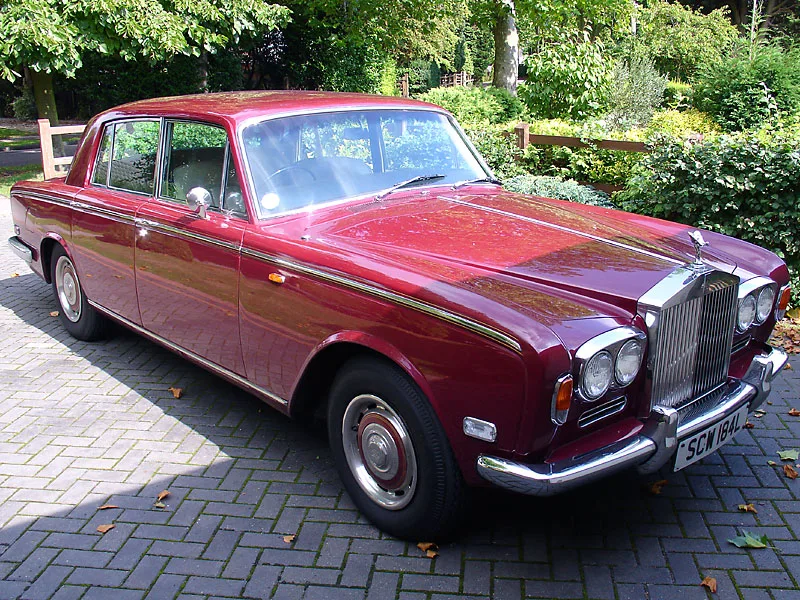
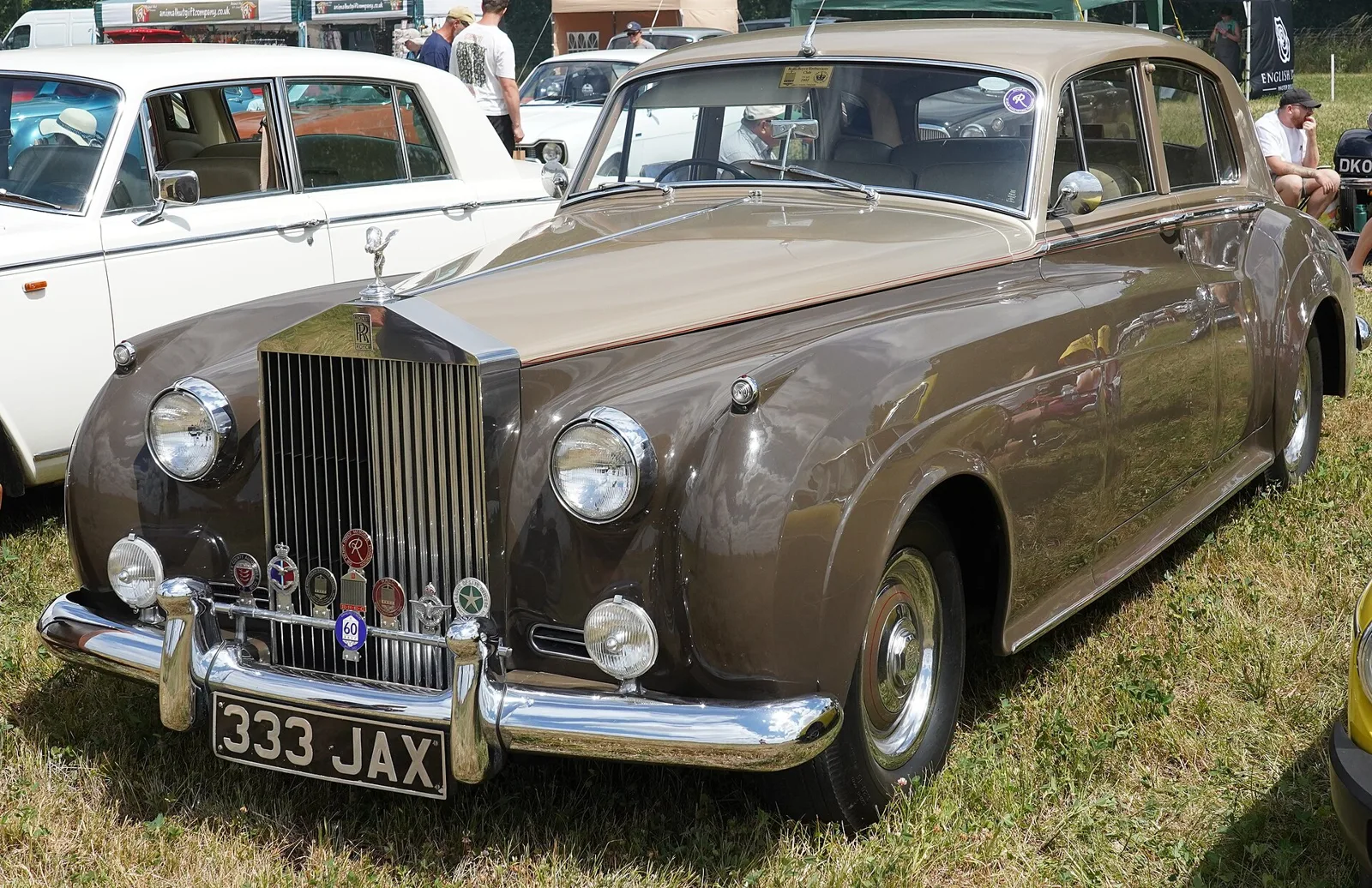
The Silver Cloud was built from April 1955 to March 1966 and was the main model of the Rolls-Royce range throughout. It replaced the Silver Dawn and was itself replaced by the Silver Shadow. The design came from John P. Blatchley and was a major departure from the pre-war models and the derivative Dawn. Rationalising the range meant the Bentley S1 became essentially the same car, told apart by its grille and badges.
Construction was body-on-frame, which allowed special bodies, though the great majority wore the standard steel shell made by the Pressed Steel Company, with light aluminium alloy for the doors, bonnet and boot lid. The box-section steel chassis was welded and very rigid. The car was 5.38 m (212 in) long, 1.90 m (75 in) wide and weighed 1.95 tonnes. A 4.9 L (300 cu in) six-cylinder engine with inlet-over-exhaust valves produced 155 hp at 4000 rpm, with twin SU carburettors added in September 1957, and drove through a four-speed General Motors Hydramatic gearbox that Rolls-Royce literature called simply the Automatic Gearbox.
Power steering and air conditioning became options in 1956, and a long-wheelbase version, 4 in (102 mm) longer for rear-seat legroom, arrived in September 1957. A 1956 road test of a standard-wheelbase Series I recorded 165.6 km/h (102.9 mph), 0-60 mph (97 km/h) in 13.5 seconds and 19.5 L/100 km. That car cost GBP 5,078 with taxes.
Everything was black except the radiator; Rolls-Royce refused to paint that too.
Silver Cloud II and the V8
Introduced in 1959, the Silver Cloud II looked almost the same but had a new 6.2 L V8 developed by Rolls-Royce. Weight rose to 2.11 tonnes and top speed to 183 km/h (114 mph), though the real gain was in acceleration and torque, and power steering was now standard. Contemporary commentators welcomed the speed but found the V8 less hushed and less smooth than the six. It was also cramped in an engine bay designed for a narrower unit, so changing the spark plugs on the right side meant removing the front wheel. Early V8s also suffered crankshaft breakages, blamed on poor lubrication to the bearings.
The Motor tested a Series II in 1960 and recorded 168.5 km/h (104.7 mph), 0-60 mph in 10.9 seconds and 22 L/100 km. The price was GBP 6,092.
Silver Cloud III and the road to the Shadow
The Cloud III was shown at the Paris salon in early October 1962, displayed together with the Bentley S3 on a specialist coachwork stand as though the changes had been ordered by a particular customer. The interior was remodelled, weight fell by a little over 100 kg (220 lb) and the engine received 2-inch SU carburettors, a 9:1 compression ratio (8:1 for poor fuel markets) and a nitride-hardened crankshaft, in response to those broken cranks. Rolls-Royce still would not disclose power, saying only the gain was "perhaps 7%".
Four headlamps were grouped in a layout that the Silver Shadow later continued, and the bonnet sloped slightly more to match a radiator grille 1+1/2 inches (3.8 cm) lower. Changes to 1966 were small: stainless wheel trims in April 1963, wider front seats in January 1964 and a tiny RR monogram on the headlamp surround later that year.
Coachbuilders kept using the chassis. The best-known coupes were Mulliner Park Ward's Fixed Head and Drop Head, with unusual slanted headlights, shared by contemporary Lancia, Triumph, Lagonda and Gordon-Keeble models. About 100 of the 328 coach-built Cloud IIIs were of this style.
| Model | Standard | Long wheelbase | Coachbuilt |
|---|---|---|---|
| Silver Cloud | 2,238 | 85 | 121 |
| Silver Cloud II | 2,417 | 258 | 107 |
| Silver Cloud III | 2,044 | 206 | 328 |
Rolls-Royce Phantom V: the limousine
Built from 1959 to 1968, the Phantom V was a large four-door limousine based on the Silver Cloud II and sharing its V8 and Hydramatic transmission. Rolls-Royce built the chassis and drivetrains, with bodies mainly to standard designs from James Young, Park Ward and Mulliner Park Ward. Twin SU carburettors fed a 6,230 cc 90-degree V8, the brakes were massive drums and the wheelbase was 3,683 mm. A low final-drive ratio allowed walking-pace progress for ceremonies. From 1963 the Cloud III's engine, 7% more powerful, and its front wings with quad headlamps were fitted.
Of 518 Phantom Vs, Park Ward made 133 bodies, James Young 197 and H. J. Mulliner nine before Rolls-Royce acquired it in 1959 and merged it into Park Ward in 1961 to form Mulliner Park Ward, which built 174.
The owners read like a guest list. Lennon bought a 1964 Mulliner Park Ward, with black leather, a cocktail cabinet, a writing table, a portable television, a fridge in the boot and tinted windows, among the first in England. He paid probably GBP 11,000. After a trip to Spain for filming How I Won the War it was repainted as a Romany gypsy wagon. In 1977 Lennon donated it to the Cooper-Hewitt Museum to cover a $250,000 tax bill, and it sold at Sotheby's in 1985 for $2,299,000. Since 1993 it has lived at the Royal British Columbia Museum.
Elvis Presley's 1963 James Young had a telephone and a microphone, and was repainted silver because his mother's chickens kept pecking the original midnight blue. Elton John had a pink 1960 Park Ward. The Queen Mother took a Landaulet in 1962 that Charles III now uses, and Hong Kong's governors used one from 1961 until the 1997 handover. Tito and the Shah of Iran also owned examples, while Nicolae Ceausescu returned a 1967 landaulet he had bought after the Politburo disapproved.
Rolls-Royce Corniche: a name from 1939
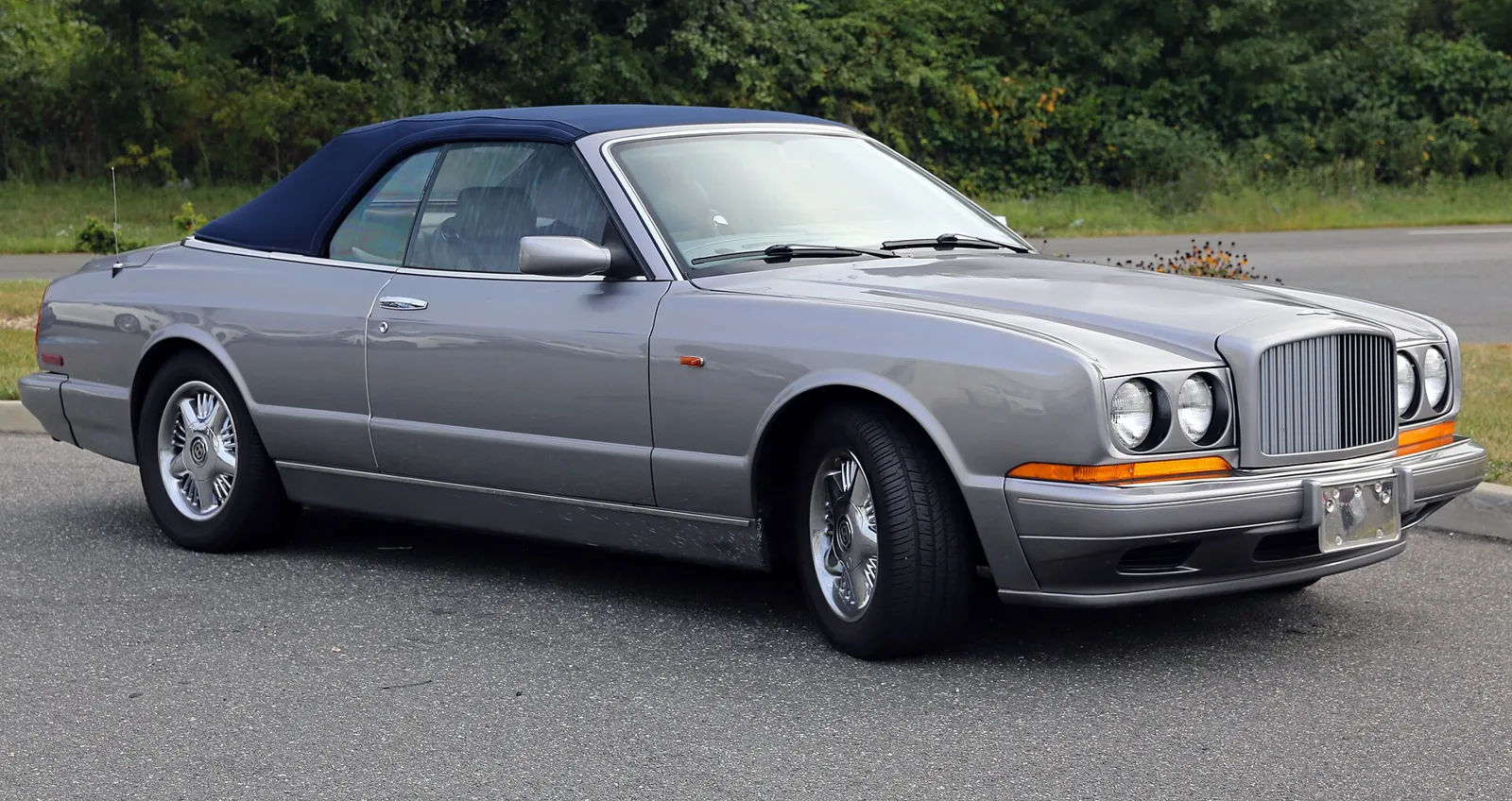
The Corniche was a two-door, front-engine, rear-drive car. The hardtop coupe ran from 1971 and the convertible lasted from 1971 to 1995, returning for 1999 to 2002. It developed from the Mulliner Park Ward two-door Silver Shadows, the 2-door Saloon of 1965 and the Drophead Coupe of 1966, and the new name arrived in March 1971. A Bentley version became the Bentley Continental in 1984.
The first Corniche was a 1939 prototype on a Bentley Mark V, bodied with help from the French designer Georges Paulin by Vanvooren. After 15,000 miles (24,000 km) of testing on the continent it was destroyed by a bomb at the Dieppe docks. War ended plans for production, but the company registered the name. Mulliner finished a full recreation in 2019.
Corniche I: the celebrity car
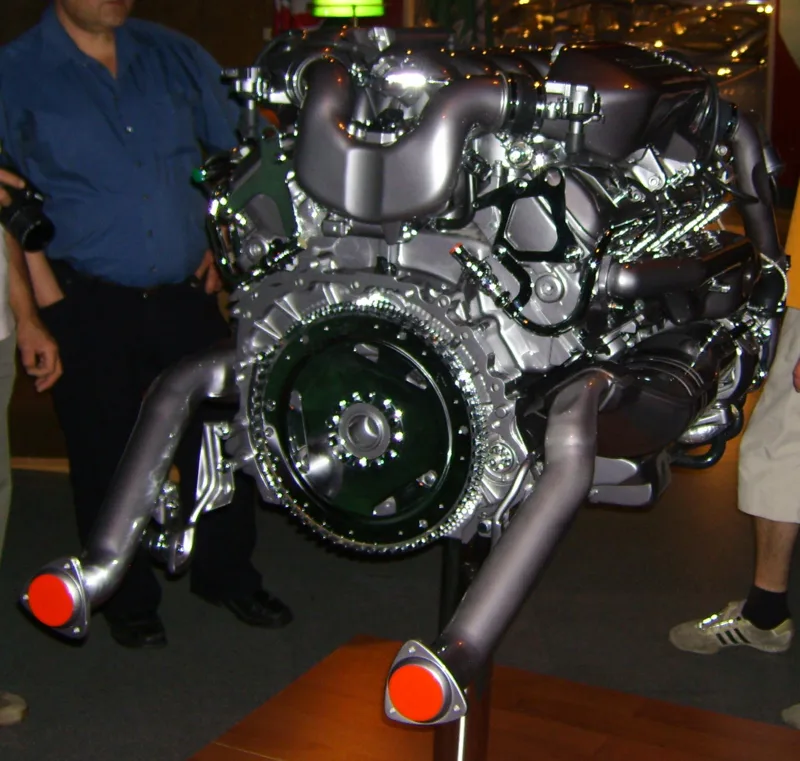
The 6.75 L aluminium V8 at first drank through twin SU carburettors, then a Solex four-barrel from 1977, and fuel injection arrived later. A three-speed Turbo Hydramatic 400 was standard. Independent coil suspension had hydraulic self-levelling, and all four brakes were discs, ventilated from 1972. The wheelbase of 3,042 mm grew to 3,048 mm in 1974 and 3,061 mm in 1979. Unique features included half wheel covers, a wood-rimmed three-spoke wheel and Rolls-Royce's first standard tachometer.
It became a celebrity badge at once. Paul McCartney, Frank Sinatra and Tom Jones bought one, while Dean Martin, Elton John, Michael Caine and David Bowie put their names down for waits of two years. A mild restyle in spring 1977 brought rack-and-pinion steering, an aluminium radiator and oil cooler, new bumpers in alloy and rubber, and bi-level air conditioning. The injected engine made roughly 240 PS (177 kW; 237 hp) for 190 km/h (118 mph). In March 1981, once the Silver Spirit was on sale, the fixed-roof Corniche was dropped.
Tallies differ slightly. One counts 1,090 Rolls-Royce saloons and 3,239 convertibles, with 69 and 77 Bentleys; another lists 1,108 saloons and 3,224 convertibles.
Corniche II to Corniche V
The Corniche II name was used in the United States from 1986 and elsewhere from 1988, with ABS arriving in 1988 and 1,234 built. Air bags waited for the Corniche III, shown at the 1989 Frankfurt Motor Show with alloy wheels, colour-coded bumpers, better suspension and MK-Motronic fuel injection; 452 were made.
The Corniche IV, presented in Detroit in January 1992, came as production moved to Crewe ahead of the 1994 closure of Mulliner Park Ward. It had a four-speed 4L80-E automatic, adaptive suspension, a glass rear window and airbags. To mark the 21st anniversary, 25 cars were painted Ming Blue and fitted with cream hoods in October 1992. The last 25 were turbocharged Corniche S models, completed in summer 1995.
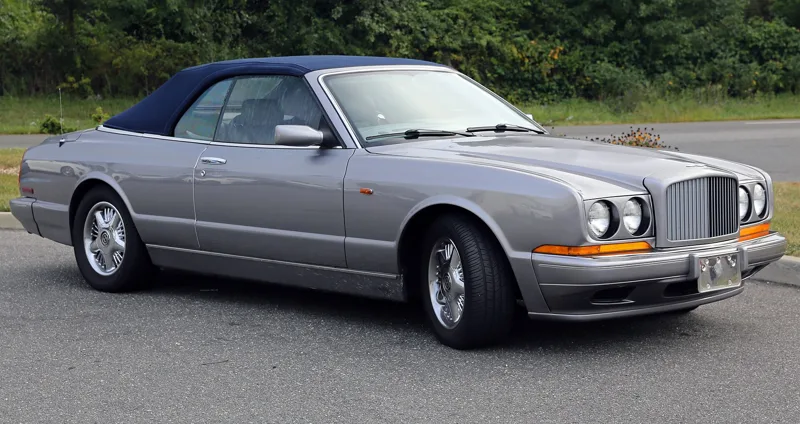
The Corniche V debuted in January 2000 at US$359,900, the most expensive Rolls-Royce of the day. The 384 built included 45 Final Series cars, and production ended in August 2002 after Bentley, by then a Volkswagen subsidiary, took over Crewe and BMW began building Rolls-Royce cars at a new factory on the Goodwood Estate near Chichester.
Rolls-Royce Silver Spirit: a new generation
The Silver Spirit, built at Crewe from 1980 to 1997 and the first of the SZ series, was the foundation for the Bentley Mulsanne as well as the Flying Spur, Silver Dawn, Touring Limousine and Park Ward. The long-wheelbase Silver Spur ran from 1980 to 2000. It was the first car with a retractable Spirit of Ecstasy, a spring-loaded mascot that sank into the radiator shell if knocked.
Underneath, it kept much of the Silver Shadow: the 6.75 L L410 V8, a General Motors three-speed automatic, a Pressed Steel unitary shell styled after the Pininfarina-designed Camargue, and ride quality through hydropneumatic self-levelling suspension with Girling height control. US cars had sealed-beam headlamps under old regulations, while Europe could use composite units.
Spirit Mark II, III and IV
The Mark II of 1989 introduced Automatic Ride Control, which altered the damping at each wheel as the car moved, with ABS and fuel injection standard everywhere. A four-speed gearbox came in winter 1991, and a 107 L tank (23.5 imp gal) gave a range over 500 km. The Mark III of 1993 improved the engine with a new intake manifold and cylinder heads, set worn shock absorbers to default to soft instead of hard, and added dual airbags. The 1994-1995 Flying Spur was a turbocharged Silver Spur III, with 134 built. The Silver Dawn special edition had a lower radiator and a Spirit of Ecstasy 20 per cent smaller.
The final New Silver Spirit, designed from autumn 1992 and introduced in late 1995 as a 1996 model, never got an official Series IV name because four sounds like death in some Far Eastern languages. It gained a Garrett turbocharger on all models, Zytec engine management and sixteen-inch wheels. From 1997 the long wheelbase became standard. The Silver Spirit's production run closed within the 1997 model year, with occasional cars built through 2000 to use remaining bodies.
Stretched limousines were made too. Robert Jankel's design with Mulliner Park Ward produced the first Silver Spur Limousine in 1982, with 16 cars extended 36 inches (914 mm) and 84 extended 42 inches (1,067 mm). From 1991, 99 more were stretched 24 inches (610 mm), and the Park Ward Limousine, with 70 built from 1996 to 1999, was the last official stretch.
How the Corniche ended and BMW took over
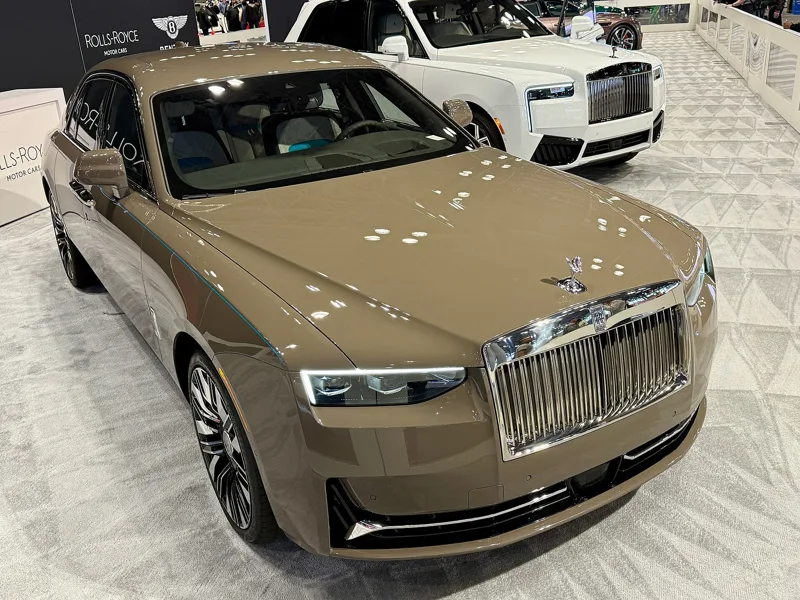
The Corniche V ended in August 2002, when BMW, licensed to use the Rolls-Royce name, began building cars at Goodwood while Bentley kept Crewe. The Park Ward Limousine is not to be confused with the Silver Seraph Park Ward that replaced the Spirit line and ran from 2000 to 2002.