How an American journalist's idle comment, a Tokyo versus California design contest and a 940 kg car became the best-selling two-seat sports car in history.
The Mazda MX-5, sold as the Miata in the United States, is a lightweight two-seat roadster that debuted in 1989 and has run through four generations coded NA, NB, NC and ND. More than one million have been sold, making it the best-selling two-seat convertible sports car in history.
When the Mazda MX-5 reached American showrooms in 1989, it carried a list price of $14,000 to $16,000. Dealers were asking as much as US$10,000 on top of that, and buyers were crossing state lines to find one. Mazda's concept had been an inexpensive sports car, a kind of machine that had almost vanished from the market.
What is the Mazda MX-5?
Mazda builds the MX-5 at its Hiroshima plant: a light, two-seat sports car. Japan knows it as the Mazda Roadster, previously the Eunos Roadster, and the United States sells it as the MX-5 Miata. Miata comes from an Old High German word meaning "reward", while the MX-5 label is said to reflect its status as the fifth vehicle produced by Mazda's experimental division.
It debuted at the Chicago Auto Show in February 1989 built around a philosophy named Jinba ittai, which means horse and rider as one. Small, light, balanced and minimalist, it has often been described as the heir to the Italian and British roadsters of the 1950s and 1960s, with the Lotus Elan as a benchmark. Each generation carries a two-letter code: NA, then NB from 1998, NC from 2005 and ND from 2015.
Sales have passed a million, more than any other two-seat convertible sports car ever managed.
Mazda set out to build an inexpensive roadster and ended up with a waiting list.
How did Miata history begin in 1976?
With a journalist who talked too much. In 1976 Bob Hall, who wrote for Motor Trend, knew Japanese cars well and spoke the language, sat down with Kenichi Yamamoto and with Gai Arai, who ran Mazda's research and development. They asked what kind of car Mazda should make. Hall, by his own account, rambled about the simple, bugs-in-the-teeth classic British sports car that no longer existed, and said someone should build an inexpensive roadster.
Yamamoto remembered. In 1981 Hall moved into product planning at Mazda USA and met him again, by then chairman of Mazda Motors, and in 1982 he got the go-ahead to research the idea. Hall hired the designer Mark Jordan for Mazda's newly formed design studio in Southern California, and together they worked out the image and proportions of a "light-weight sports" concept. In 1983 it was approved under the "Offline 55" programme, an internal initiative to change how new models were developed.
The car arrived in a market with few rivals. Small roadsters had almost disappeared, and Alfa Romeo's Spider was among the few similar cars still in production, and it cost far more. The MX-5 therefore stepped in as the natural heir to the MGB, the Fiat Spider and the Triumph TR7 and Spitfire.
How did Mazda pick a rear-wheel-drive roadster?
By holding a contest. Development turned into a contest between Mazda's studios in Tokyo and in California. The Californians pushed Duo 101, with the engine up front and drive to the rear wheels, as British roadsters had it. The Japanese team leaned toward a conventional front-drive car or one with the engine behind the seats.
The first judging in April 1984 was paper-only. The mid-engined idea looked appealing, though it was understood that this arrangement would have trouble meeting the project's noise, vibration and harshness targets. The verdict came in August 1984, once clay models at full size were on display, and Duo 101 won. It got its name because either a soft top or a hardtop could be fitted, and it borrowed stylistic cues from the Lotus Elan, including the door handles, tail lamps, grille opening, engine appearance and centre console layout.
International Automotive Design in Worthing, England, built a running prototype coded V705. Its fibreglass body hid a 1.4 L (85 cu in) engine borrowed from the Mazda Familia, with parts taken from a range of early Mazda models, and it was finished in August 1985. Taken to Santa Barbara, California, it rolled around the local roads, and the positive public reactions were filmed for executives back in Hiroshima.
Final approval came on 18 January 1986. The project was recoded P729 under programme head Toshihiko Hirai, International Automotive Design built five engineering mules and ran the first crash tests, and the work moved to Japan for engineering and production detail. By 1989 the car was ready, a true lightweight at just 940 kg (2,070 lb).
What was the first-generation MX-5 like?
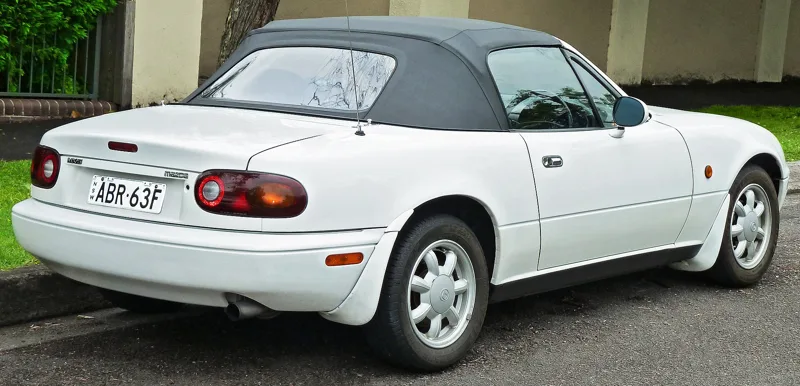
Basic, and proud of it. The NA was on sale from 1989 to 1997 and sold 228,961 units. It was unveiled on 10 February 1989 at the Chicago Auto Show for US$14,000, and deliveries began in the US and Canada in May 1989 as a 1990 model, in Japan on 1 September 1989 and in Europe in 1990. Demand outstripped production, helped by enthusiastic press reviews.
To hold down weight and price, base cars had steel wheels and no power steering, no air conditioning and no stereo. The NA used a steel unibody with an aluminium bonnet, double wishbone suspension at all four corners, and a 1.6 L (98 cu in) four-cylinder that made 86 kW (115 bhp) at 6,500 rpm. A five-speed manual gearbox, whose shift pattern was kept as small as possible, was standard, and an optional four-speed automatic was offered. Pop-up headlights were unique to this generation. Quoted weights run from 940 kg (2,070 lb) to 980 kg (2,160 lb) for a car without options.
For the 1990 car Mazda reported 8.6 seconds to 60 mph (97 km/h) and 116.8 mph (188.0 km/h) flat out. Car and Driver measured 9.2 seconds and 116 mph (187 km/h) in September 1989 with the hardtop on, and Motor Trend recorded 8.9 seconds in July 1989.
The 1994 model year brought a 1.8 L engine of 96 kW (129 bhp), later 99 kW (133 bhp), dual airbags, a Torsen limited-slip diff in certain markets and a substantially braced chassis to meet side-impact rules. The "R" package added Bilstein shocks, stiffer sway bars and a Torsen differential. Mazda also marked the end of the line with 1,500 "STO" cars in the US and 400 Berkeley cars in the UK in 1998.
How has the MX-5 changed across four generations?
| Generation | Years | Defining feature | Engine note |
|---|---|---|---|
| NA | 1989 to 1997 | Pop-up headlights, Lotus Elan cues | 1.6 L, then 1.8 L from 1994 |
| NB | 1998 to 2005 | Fixed headlamps; Mazdaspeed variant | 1.8 L, 106 kW (142 hp) with variable valve timing from 2001 |
| NC | 2005 to 2015 | Power Retractable Hard Top | Design cues from the 2003 Ibuki concept |
| ND | 2015 onward | About 100 kg (220 lb) lighter; Retractable Fastback | 1.5 L 96 kW (129 hp); 2.0 L, 135 kW (181 hp) from 2019 |
The second generation, the NB, was unveiled in 1997 and sold from 1998. It kept the proportions but dropped the retractable headlamps because of tougher pedestrian safety testing. In 2001 Mazda restyled the front and rear and added variable valve timing to the 1.8 L engine. The Mazdaspeed variant of 2004 and 2005 is the only factory-turbocharged MX-5, with 133 kW (178 hp), a quarter mile in 15.2 seconds and 0-60 mph in 6.7 seconds, plus stiffer springs, Bilstein shocks and 17-inch wheels.
The NC took design cues from the 2003 Mazda Ibuki concept and ran from 2005 to 2015. It brought the Power Retractable Hard Top, a folding roof that does not intrude on boot space.
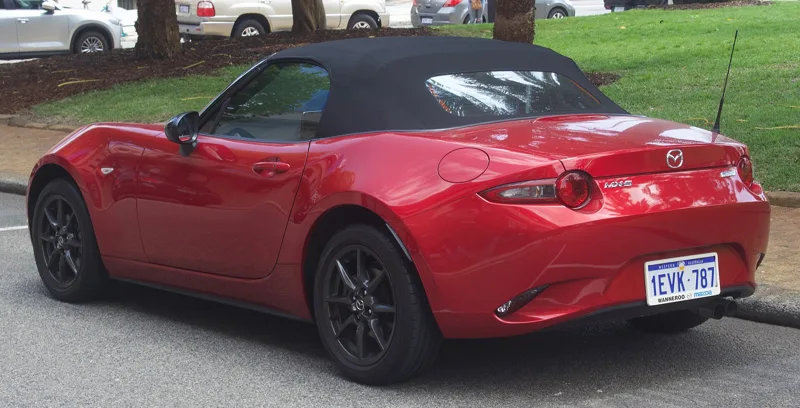
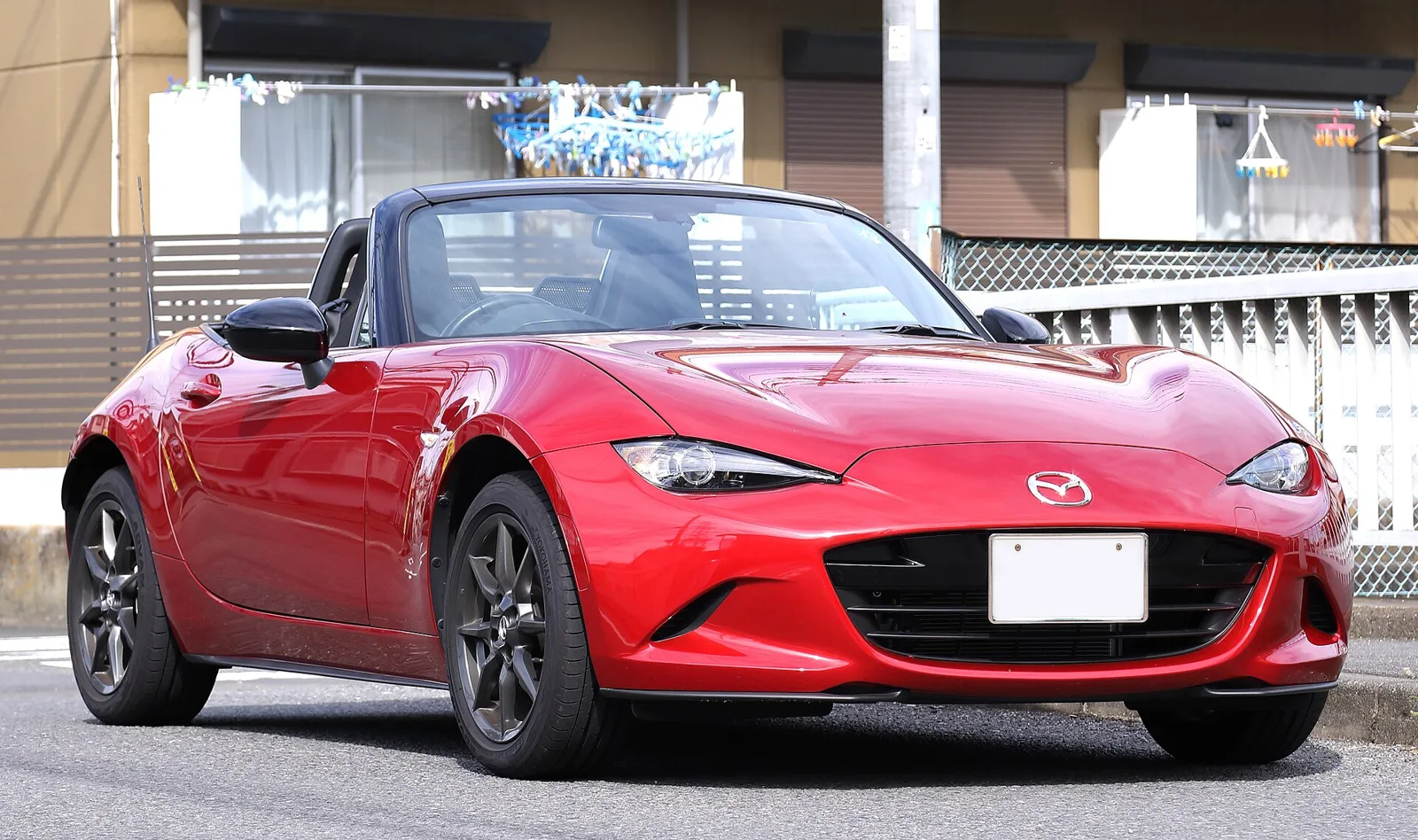
The ND, unveiled on 3 September 2014 and built in Hiroshima since 4 March 2015, gave up 105 mm (4 inches) of length and 100 kg (220 lb) of weight against its predecessor, bringing kerb weight near 1,000 kg (2,200 lb). It uses Skyactiv technology and two naturally aspirated direct-injection petrol engines, a 1.5 L with 96 kW (129 hp; 131 PS) and, in the US and Canada before 2019, a 2.0 L of 116 kW (155 hp; 157 PS). Electric power steering replaced the old hydraulic system. In the US the list price ran from $24,915 to $30,065. The Retractable Fastback (RF), announced in late 2016, has a rigid roof and buttresses for a more coupe-like look, and its roof folds away behind the seats.
Fiat Chrysler announced the Fiat 124 Spider and the Abarth 124 Spider in 2015, both built on the ND platform. A planned joint venture with Alfa Romeo on a rear-wheel-drive platform had been announced in 2012 and cancelled in 2014. The Detroit News wrote in 2016 that the Fiat link-up probably saved the MX-5 itself, calling it the most celebrated small sports car in 25 years, and pointed to the rising cost of developing a new car and the costliest wave of regulation since the 1970s.
Why does the MX-5 handle so well?
Weight and balance. The unibody car weighs under 1,100 kg (2,500 lb), and a longitudinal truss marketed as the Powerplant Frame ties engine and differential together to reduce flex. Front-to-rear weight balance is approximately 50:50, which gives nearly neutral handling. Oversteer is easy to provoke and controllable, so the car is a popular choice for amateur racing, autocross and club racing.
That is why lightly modified MX-5s fill grids around the world. Spec Miata is a racing class in the US, the Global MX-5 Cup is a Spec Miata series there sanctioned by IMSA, and the MaX5 Racing Championship is its British counterpart.
How many MX-5s have been sold, and what has it won?
Guinness World Records ruled in 2000 that the MX-5 was the top-selling two-seat sports car ever, on 531,890 cars built to that date. The 250,000th car left the factory on 9 November 1992 and the 500,000th on 8 February 1999. March 2004 saw the 750,000th, January 2007 the 800,000th and February 2011 the 900,000th. Mazda built its one millionth on 22 April 2016, and the first 240 people who saw it on tour could sign it.
The honours list is long. The MX-5 was Automobile Magazine's Automobile of the Year for 1990 and has made Car and Driver's 10Best list 17 times. Wheels magazine named it Car of the Year in 1989, 2005 and 2016, it won Car of the Year Japan in 2005-2006 and 2015-2016, and at the 2016 World Car Awards it won both the main prize and the design prize, making it the second Mazda to win the main title after the Mazda2 in 2008. Grassroots Motorsports named it the most important sports car of the previous 25 years in December 2009. Jeremy Clarkson gave it five stars that year and said he could not give it fourteen. iSeeCars found that US owners hold on to it longer than any other sports car.
Which special editions mattered?
There have been dozens. In 1993 Mazda made 1,500 Limited Edition cars, all black, with red leather, a Nardi wheel and shift knob, a limited-slip differential and BBS wheels. The 30th Anniversary Edition of 2019, in Racing Orange, was limited to 3,000 cars worldwide, with Recaro seats and Brembo front calipers. The Spirit Racing Roadster 12R, a road-registered but track-ready car for Japan, has a 2.0 L engine making 147 kW (197 hp) and, Mazda claims, 0-100 km/h in 5.4 seconds. Only 200 will be made.
Has there been an electric MX-5?
Only as an experiment, and a heavy one. In 1993 Mazda worked with the Chugoku Electric Power Company on a prototype called the Energia Electric Vehicle. It reached 130 km/h (81 mph), had a range of 180 km (110 miles) and weighed 1,410 kg (3,110 lb), far more than any production car.
The current MX-5 remains petrol powered. Tighter emissions rules ended sales of the 2.0 L model in Europe in 2024.
What does the MX-5 mean for someone buying or driving one?
The MX-5 is an inexpensive, simple car by design. The first car's spartan trim kept the price low. In 2019 the US range was Sport, Club and Grand Touring, all with the 2.0 L engine rated at 135 kW (181 hp; 184 PS), and a claimed manual economy of 9.0 L/100 km in the city and 7.0 L/100 km on the highway. The GT-S trim added the Club car's limited-slip differential, Bilstein shocks and a strut tower brace to the top model, and became standard on the GT in 2020.
For 2022 Mazda said it would sharpen steering and cut body roll in hard corners by braking the inner rear wheel. The February 2024 update brought fresh infotainment, headlights that include daytime running lamps, a reworked steering rack, a different type of limited-slip differential and a stability control mode that allows greater slip angles on track.
Where this goes next
The 2.0 L engine will stay on sale in the UK until January 2027, because of derogation timings, even though it left Europe's other markets in 2024. In June 2024 deliveries of the Japanese-market Roadster RF were suspended after rewritten engine control software was found during power output tests, and they resumed on 28 June 2024 once the car met safety regulations and type approval.