Wilhelm Karmann wanted a roadster, Luigi Segre of Ghia delivered a coupe, and Volkswagen agreed to build it the day it saw the car.
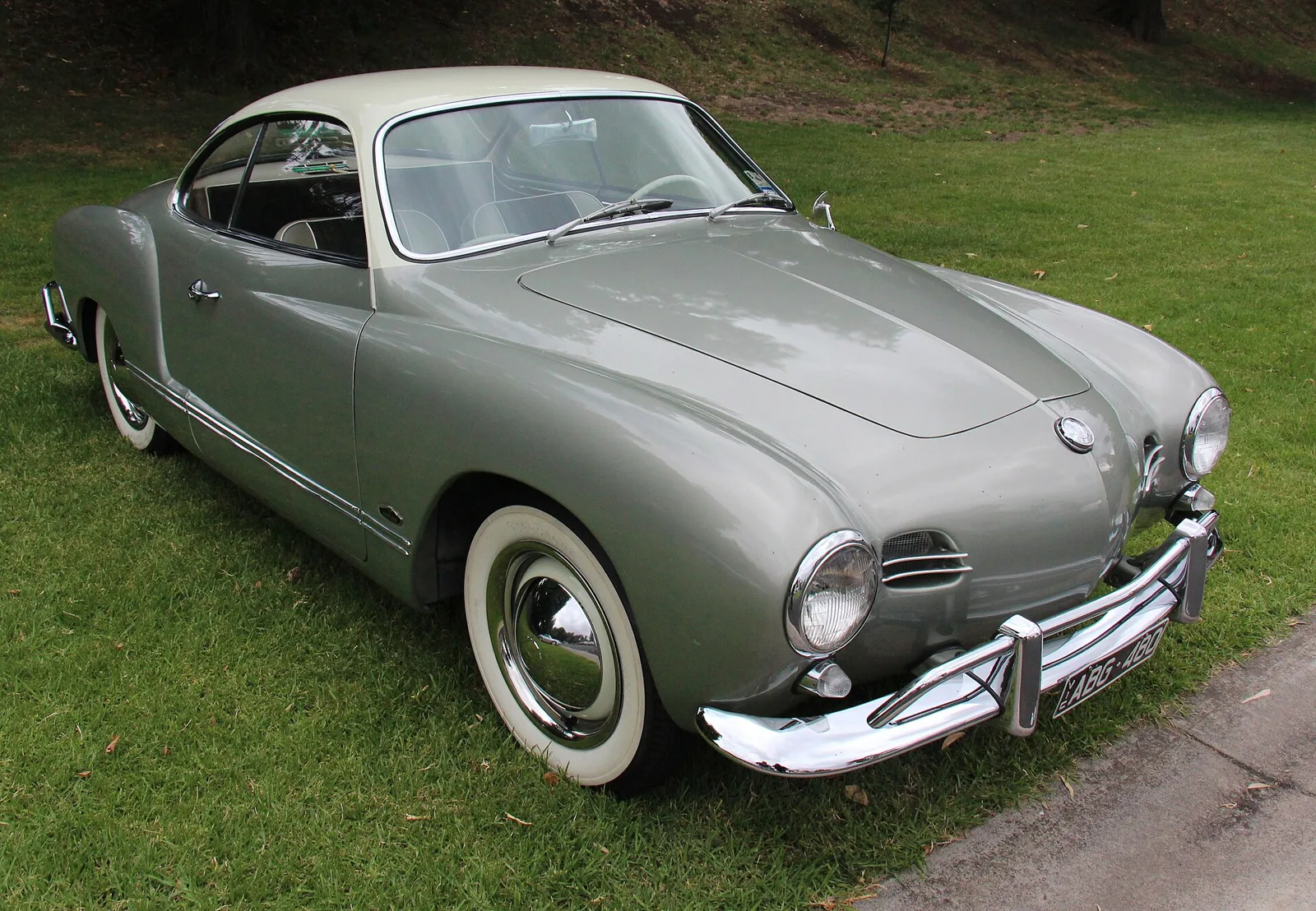
The Volkswagen Karmann Ghia combined Beetle mechanicals with a body styled by Carrozzeria Ghia of Turin and hand-built by Karmann in Osnabruck. The Type 14 coupe launched in 1955, a convertible followed in 1957, and more than 445,000 were made in Germany.
Wilhelm Karmann asked for a roadster. Luigi Segre of Ghia turned up in Paris with a coupe instead, and Volkswagen's boss, Heinrich Nordhoff, liked it so much that he agreed to build the car the same day he saw it.
That is how a German coachbuilder and an Italian styling house turned a Beetle chassis into the Volkswagen Karmann Ghia, the car that went on to sell far beyond its brief. Along the way two firms, one in Osnabruck and one in Turin, collected a long list of other customers.
Who was Karmann?
Karmann was founded in 1901, when Wilhelm Karmann bought a coachbuilder called Klages, which had been in business since 1874, and renamed it. The company grew with the car industry and became known for convertibles, coupes and other niche models. After the Second World War and the rebuilding of its bombed plant, it turned to contract manufacturing and development for Volkswagen.
The link with Volkswagen was older than the war. Ferdinand Porsche had asked Karmann in 1935/36 to look at a convertible prototype, but the chaos of war stopped the work. On 1 August 1949 Wilhelm Karmann signed Volkswagen's order for 1,000 four-seat convertibles, the Beetle Cabriolet.
Wilhelm Karmann asked for a roadster and was handed a coupe, then watched Volkswagen approve it the day it saw it.
Who was Ghia?
Carrozzeria Ghia was established in Turin in 1916 by Giacinto Ghia and a partner named Gariglio. It first built lightweight aluminium-bodied cars and became famous when an Alfa Romeo 6C 1500 with Ghia bodywork won the Mille Miglia in 1929. Between the wars it made special bodies for Alfa Romeo, Fiat and Lancia, and its Fiat 508 Balilla sports coupe of 1933 ranks among the best known. An air raid demolished the factory in 1943.
After Giacinto Ghia died in 1944 the firm was sold to Mario Boano and Giorgio Alberti. Boano left in 1953, and ownership passed to the chief engineer and designer Luigi Segre in 1954. Under Segre, with Giovanni Savonuzzi as technical director, Ghia became a leading voice of the Italian styling that shaped car design worldwide. Between 1953 and 1963 many foreign firms ordered Ghia designs, among them Volkswagen and Volvo. The longest partner was Chrysler, which worked with Ghia and its designer Virgil Exner for 15 years, producing eighteen Chrysler Ghia Specials, the K-310, the Norseman and the Imperial Crown limousines. Ghia's output was always very low in volume, which added to its exclusivity.
How the Karmann Ghia came together
Wilhelm Karmann Jr. conceived the idea in 1953, a year after taking over his father's firm. He wanted a sporty open two-seater built on Beetle mechanicals, and Volkswagen was interested in a roadster that American soldiers stationed in Europe might take home to the United States.
Karmann brought Segre into the plan around the Geneva Automobile Salon. Segre secretly obtained a Beetle, which was hard to find: Gian Paolo Boano, Mario's son, bought one in Paris and drove it to Turin. Ghia built a prototype body on the chassis in five months.
Segre presented it in Paris in late 1953, to Karmann's amazement, as a coupe rather than a roadster. Karmann reportedly said he would like to build it. Shortly afterwards the car was shown to Volkswagen's general director at Osnabruck, and Nordhoff, who liked the coupe's flowing lines and rounded shapes, agreed to build it that day. Volkswagen approved the design in November 1953.
Who actually drew the Karmann Ghia?
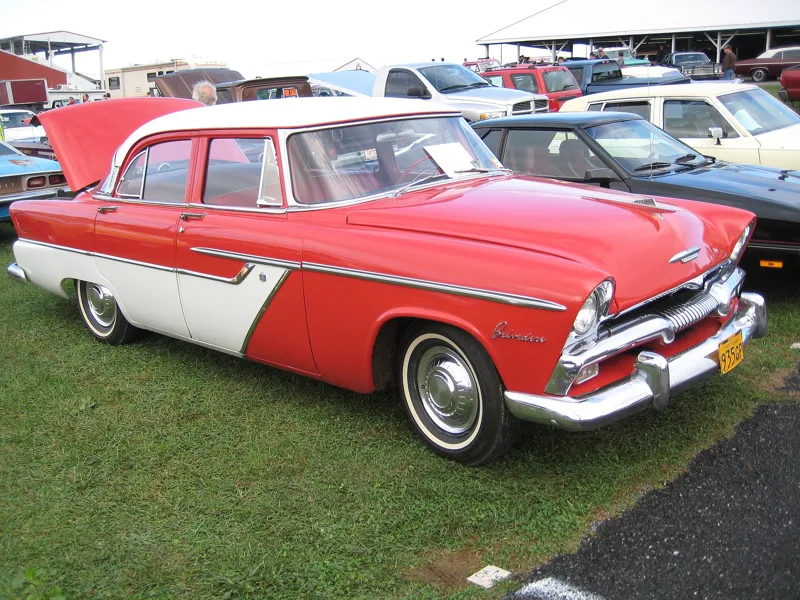
Nobody can say for certain. Segre, Mario Boano, Sergio Coggiola and Giovanni Savonuzzi all contributed to the styling, and each laid claim to it at some point. The shape also echoed Virgil Exner's Chrysler D'Elegance and K-310 concepts, both of which Ghia had built as prototypes. Exner's son recalled that Savonuzzi downsized the D'Elegance, swapping its egg-crate grille for a gentle, boat-like prow, and described the result as a direct, intentional borrowing that nobody minded.
Exner himself, when he saw the Karmann Ghia in 1955, was reportedly pleased that one of his designs had reached large-scale production, and Segre sent him the first production car imported into the state of Michigan as thanks. Because roles were poorly documented before the designers died, a definitive attribution was never made.
Volkswagen Karmann Ghia Type 14: Beetle underneath
The Type 14 combined the floorpan and mechanicals of the Beetle with Ghia styling and Karmann's hand-built bodywork. It was only the second Volkswagen passenger car, after the Beetle. The coupe appeared at the Paris show in October 1953 as a styling concept "by Ghia", and the production car was unveiled at the 1955 Frankfurt show and at a hotel in Westphalia on 14 July 1955. The first Type 14 was manufactured in Osnabruck in August 1955.
Public reaction exceeded expectations. Volkswagen delivered more than 10,000 coupes in the first year instead of the planned 3,000. Production doubled soon after the car reached the United States, where it became the most imported car. A convertible followed in August 1957.
The Karmann Ghia's price reflected how it was made. Where the Beetle's body was machine-welded with bolt-on fenders, the Karmann Ghia's panels were butt-welded, shaped by hand and dressed with English pewter, a slow process more usual at higher-end makers. It was marketed as a practical, stylish 2+2 rather than a true sports car, and it was cramped in the back.
Performance never matched the looks. The early car had only 30 HP and a top speed of 115 km/h. As the Type 14 shared engines with the Beetle, its capacity grew along with it, finishing at 1584 cc and 61 PS (45 kW; 60 hp).
Changes through the years
The Type 14 stayed virtually unchanged for 19 years. Exterior changes in 1961 brought wider, finned front grilles, taller and more rounded taillights and headlights positioned higher, and earlier cars with the low headlights are known as "lowlights". The Italian designer Sergio Sartorelli oversaw the restylings. Larger taillights arrived in 1970, and square-section bumpers replaced the smooth round ones in 1972.
For 1973, US safety rules brought energy-absorbing bumpers, and a carpeted package shelf replaced the rear seat. In 1974 North American cars were sold strictly as two-seaters, because the vestigial rear seat lacked seat-belt provisions. Late that year the Golf-based Scirocco superseded it. In Germany more than 445,000 Type 14 cars were produced.
Karmann Ghia Type 34: the big Karmann
In September 1961 Volkswagen introduced a second Karmann Ghia based on the new VW 1500 Type 3. Its body, drawn by the Italian engineer Sergio Sartorelli, was more angular, more modern and roomier, with three luggage spaces despite an unchanged wheelbase. With the 1500 cc engine it was the fastest production Volkswagen of its day.
The Type 34 was also VW's most luxurious car of the 1960s, costing up to twice as much as a Beetle. In 1962 it offered an electrically operated sliding steel sunroof, only the second car in the world to do so. Round taillights, built-in fog lights, an electric clock and padded dash and door panels completed the package.
Sales were limited. The Type 34 was not officially offered in the United States, Volkswagen's largest export market, and its high price hurt elsewhere. Once the Type 14 also received the 1500 cc engine in 1967, Type 34 production ended in 1969 after 42,505 cars, plus 17 prototype convertibles. Only the cheaper Type 14 ever came as a convertible. Many Type 34s still reached the US, mostly via Canada, and the US now has the largest number of known survivors: about 400 of the 1,500 to 2,000 or so remaining.
Enthusiasts used several names for it. Germans called it "Der Grosse Karmann", the big Karmann, British buyers said "Razor Edge Ghia" and Americans said "European Ghia". Today the name Type 34 is the worldwide convention.
Karmann Ghia TC: the Brazilian coupe
At the end of the 1960s, Volkswagen do Brasil went back to Ghia for a reworked Type 14. By then Ghia employed Giorgetto Giugiaro, who designed the Karmann Ghia TC, or Touring Coupe, internally the Type 145. It was a roomy fastback 2+2 with a modern, comfortable interior, built on the platform of the VW 1600 Type 3 rather than the Beetle's floorpan.
The TC carried the 1,584 cc flat-four from the Type 3, producing 65 hp (48 kW) at 4,600 rpm and reaching 138 km/h (86 mph). The 1200 cc Type 14 managed 34 hp (25 kW) and 116 km/h (72 mph). Production started in 1971 and ended in 1975; 18,119 were sold, only in South America.
Karmann Ghia models compared
| Model | Years | Platform | Engine | Output or numbers |
|---|---|---|---|---|
| Type 14 coupe and convertible | 1955 to 1975 | Beetle floorpan | Up to 1584 cc | 61 PS (45 kW); over 445,000 built |
| Type 34 | 1962 to 1969 | Type 3 floorpan | 1500 cc | 42,505 built |
| Type 145 TC | 1971 to 1975 | Type 3 platform | 1,584 cc flat-four | 65 hp (48 kW); 18,119 sold |
Karmann after the Karmann Ghia
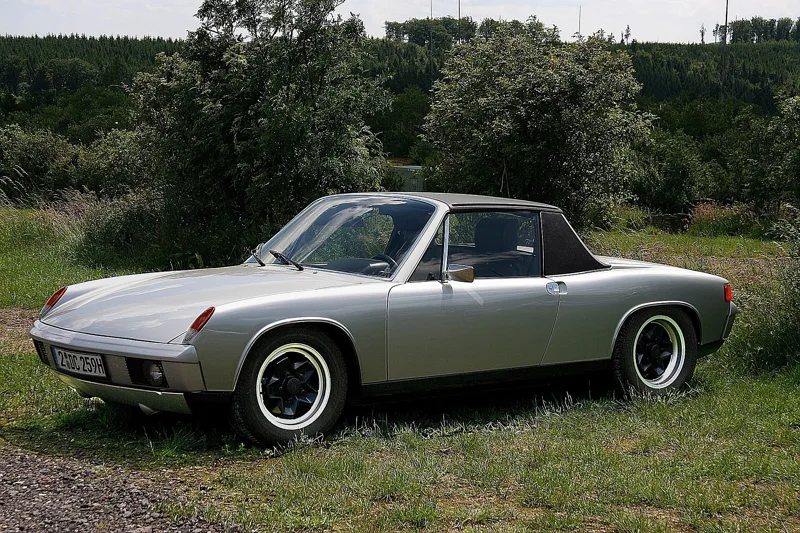
The Karmann Ghia was Karmann's best-known car, but the factory made far more. It built every Golf Cabriolet, the Scirocco and the Corrado. After 1965 it assembled bodies and complete cars for BMW's New Class Coupe and its larger successor at Rheine, with BMW fitting the engines in Munich, and it built cars for Porsche to raise 912 and 911 output. In 1969 it began on the Porsche 914.
The American Motors Javelin was another job. AMC had no European plant, so Karmann assembled the cars in Rheine with 280 hp (209 kW) 343 cu in (5.6 L) V8 engines, importing about 90 percent of the parts from the US. Every car was an SST, and its Javelin 79-K name stood for AMC's model number and Karmann's initial.
Later work included the Merkur XR4Ti from 1985 to 1989, the Audi Cabriolet and the Chrysler Crossfire, built in Osnabruck from 2003 to 2007. Karmann also built camper conversions, the first from 1974 on the Volkswagen Type 2, with about 1,000 produced through 1979. Its roof systems fitted the Mercedes-Benz CLK, Renault Megane CC, Nissan Micra C+C, Pontiac G6, Ford Mustang, Bentley Continental and BMW 1 Series convertibles. Many Karmann-built cars carry a small wagon wheel, the coat of arms of Osnabruck.
What happened to Karmann and Ghia
Karmann filed for insolvency on 8 April 2009, after demand for cars fell sharply and large manufacturers, keen to protect jobs, brought niche vehicle production in-house instead of outsourcing it. On 20 November Volkswagen took over the factory, machinery and land. Karmann's North American operations went to Webasto in August 2010, its Japanese site to Magna effective 25 February 2010, and its roof-component sections in Osnabruck and Zary, Poland, to Valmet Automotive under an agreement signed on 4 November 2010.
Ghia changed hands several times. After Segre's death in 1963 it went to Ramfis Trujillo in 1965, to Alejandro de Tomaso in 1967 and to Ford in 1970. From 1973 Ford used the Ghia name as its top trim level, a practice phased out in Britain in 2010 when Titanium took over. The British Fiesta kept Ghia trim for 31 years and 8 months, longer than any other model.
The Karmann Ghia idea has resurfaced in small ways. Karmann showed a Karmann Ghia-inspired concept, the Karmann Coupe, at the 1990 Frankfurt Motor Show. In April 2013, Karmann Ghia do Brasil asked Brazilian students to design a modern take on the classic coupe, in a competition that might lead to a prototype.