A straight-six family from the 1500 of 1925 to the 2500 of 1952, with Grand Prix roots, Mille Miglia wins and a one-off aerodynamic spider.
Launched as the 6C 1500 in 1925 under Vittorio Jano, the straight-six line ran through the 1750, 2300 and 2500 road cars and into the 3000 racing machines. The name was carried until 1954 and shaped Alfa's sporting reputation for decades.
The Alfa Romeo 6C was a family of road, race and sports cars that carried the name from 1927 to 1954. The six in the name referred to the cylinders of the straight-six engine that powered almost every model. Its story runs from the 6C 1500 of the 1920s to the 2500 road cars of the early 1950s, with racing successes along the way.
Where did the 6C name come from?
In the early twenties Vittorio Jano was asked to design a light, fast car to succeed Giuseppe Merosi's RL and RM models. The result was the 6C 1500, which appeared in April 1925 at the Milan motor show. Its six-cylinder layout gave the whole family its name.
The new car was based on Alfa's P2 Grand Prix machine. It used a single overhead cam 1,487 cc straight-six that produced 44 horsepower. In 1928 the 1500 Sport followed, which was the first Alfa road car to use double overhead camshafts.
Pinin Farina, Castagna, Touring Superleggera, Zagato and James Young all clothed these chassis at various points. From 1933 onward there was also a 6C with an Alfa factory body built at the Portello works.
Six cylinders, a Grand Prix pedigree and a family that ran from Mille Miglia wins to a one-off aerodynamic spider.
How did the 6C 1500 differ from the earlier RL?
The RL had been judged too big and weighty, which prompted fresh development in the mid-1920s. The 2-litre formula that had carried Alfa to the 1925 Automobile World Championship changed to 1.5 litres for the 1926 season, and the new 6C was shaped by that rule.
Production for customers began in 1927, using the P2 racer as the template. The 1,487 cc engine had a bore of 62 mm and a stroke of 82 mm, against the P2's 1,987 cc, and supercharging was dropped. Twin overhead cams drove the valves.
The 1928 Sport version, with its dual-cam engine, collected numerous victories, the 1928 Mille Miglia among them. Total production of the 6C 1500 reached 3,000, of which around 200 had DOHC engines. Ten supercharged Super Sport examples were also built.
What was the 6C 1750?
The more powerful 6C 1750 was introduced in Rome in 1929, with a displacement of 1,752 cc from a 65 x 88 mm bore and stroke. It reached 153 km/h (95 mph) flat out, and its chassis was built to flex over bumpy roads.
Six series were made between 1929 and 1933. The base model used a single overhead cam, while the Super Sport and Gran Sport versions used double overhead cams. Superchargers were available, and most cars left the factory as rolling chassis for coachbuilders such as Zagato and Touring Superleggera.
In 1929 the 6C was unbeaten in every major event it entered, with victories at the Belgian, Spanish, Tunis and Monza Grands Prix. Giuseppe Campari and Giulio Ramponi won the Mille Miglia, and the car also took the Brooklands Double Twelve and the Ulster TT. The Mille Miglia and the Spa 24 Hours went to the 6C again in 1930, and total production reached 2,635.
What were the 6C 1900 and 6C 2300?
Only 197 of the 6C 1900 were built in 1933, a bridging model ahead of the 2300. It was built only as a Gran Turismo on a 2,920 mm (115.0 in) wheelbase, and it replaced the corresponding 6C 1750 in the range.
The 1900 enlarged the twin-cam straight-six to 1,917 cc and used an aluminium cylinder head for the first time on a 6C. It produced 68 hp (50 kW) at 4,500 rpm, and its frame used fully boxed rails in place of the 1750's C-shaped sections. A four-speed gearbox with synchromesh on the top two gears completed the changes.
Jano conceived the 6C 2300 as a cheaper counterpart to the 8C. Its 2,309 cc engine measured 70 x 100 mm, and it arrived in 1934, the year Alfa Romeo became a state-owned enterprise. A year later the revised 6C 2300 B brought independent front suspension, a rear swing axle and hydraulic brakes.
The rigid-axle 6C 2300 accounted for 760 cars, and the B-model reached 870. The 2300 was a more modern car than the 1750 it followed.
What was the Aerodinamica Spider?
The Aerodinamica Spider was a one-off, mid-engined streamlined prototype built by the brothers Gino and Oscar Jankovits, with Alfa Romeo's involvement, between 1935 and 1937 in Fiume, today Rijeka. It was meant to take an Alfa 12-cylinder engine, but its power came from a 2,309 cc straight-six taken from the 6C 2300.
The car was an early attempt at many ideas. Its central driving position, fully enveloping underbody and integrated door handles and lights anticipated later sports car thinking, and its horizontally mounted radiator allowed a very low front profile for a pre-war car.
Its suspension was all independent, with double wishbones at the front and swing axles at the rear. Lockheed-type brakes with 17 by 2 inch drums were fitted at each corner, and the wheels were 18-inch Rudge-type wire wheels. Top speed was said to exceed 140 mph (225 km/h).
The prototype was hidden away during the Second World War, and after the war money was tight and the prototype passed to an Anglo-American officer. On Christmas Eve 1946 Gino Jankovits drove it through a closed border into Italy, causing a border shootout. The car then vanished for about 30 years before it was found again in England.
How did the 6C 2500 become Alfa's postwar icon?
The 2500 was introduced in 1938 as the final 6C road car. Its engine was bored out from 70 mm to 72 mm, giving 2,443 cc. The Turismo stretched to 3,250 mm (128.0 in) of wheelbase, against 3,000 mm (118.1 in) for the Sport and 2,700 mm (106.3 in) for the Super Sport.
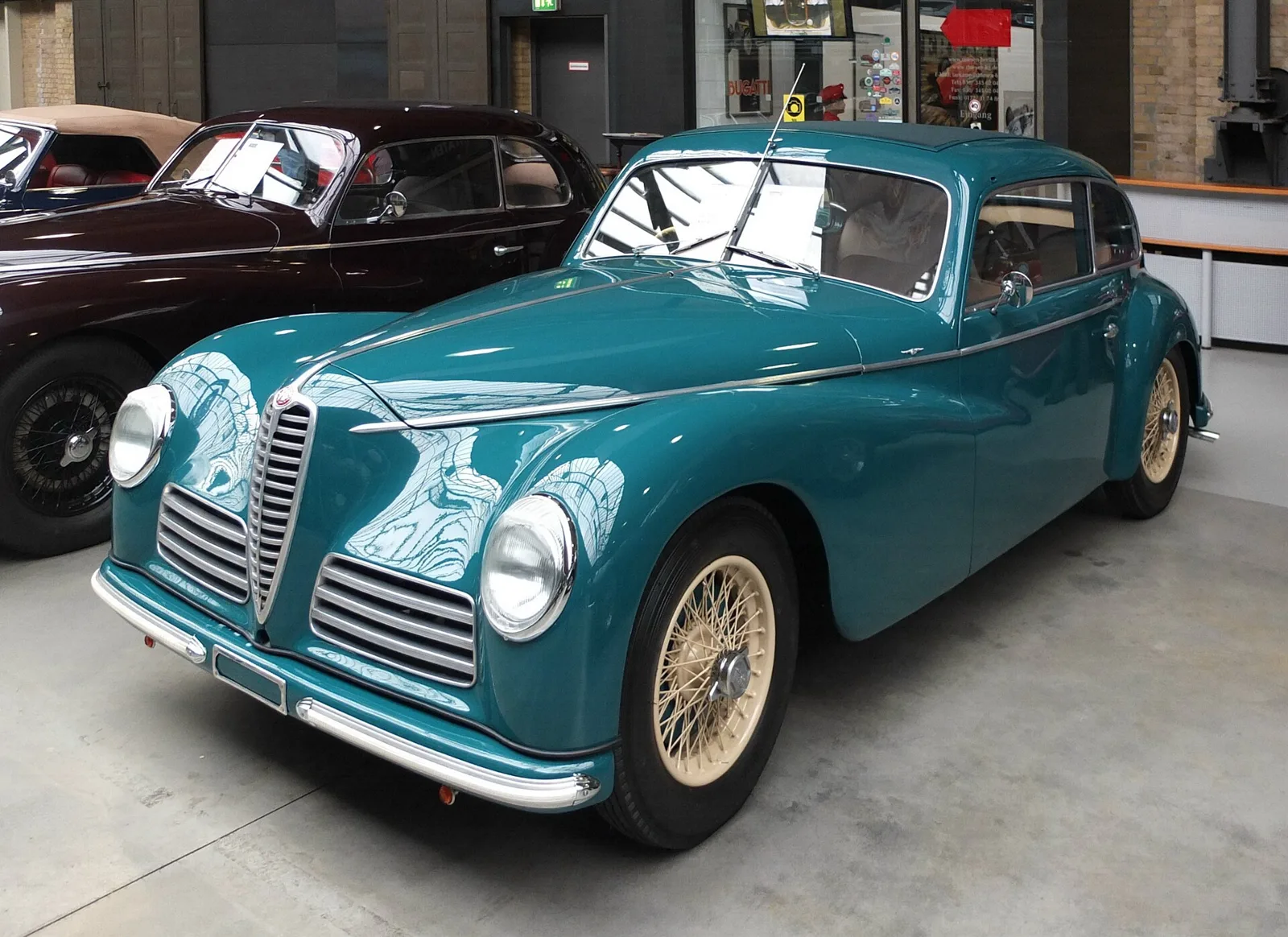
Development stopped during the Second World War, but only a few hundred examples of the 2500 were completed between 1940 and 1945. After the war the 1946 6C 2500 Freccia d'Oro, or Golden Arrow, became the first new postwar Alfa. Alfa built 680 of them until late 1951, with bodies from its own works.
The 2500 was one of the most expensive cars of its time. Buyers ranged from King Farouk to Prince Rainier, and a car of this line later appeared in The Godfather in 1972.
Two derivatives stand out. The Villa d'Este of 1949 was a Touring Superleggera berlinetta with a 110 bhp engine, and only 36 were built, including five cabriolets. The name came from a design win at the Concorso d'Eleganza on Lake Como. The Coloniale was a staff car for the Italian colonies, with extra fuel capacity and a locking differential.
Why was the 6C 3000 never built in quantity?
In 1948 Alfa built a 6C 3000 prototype, a four-door saloon of the same class as the 2500 but intended for more modern and economical manufacturing. Its three-litre engine developed 120 PS (88 kW) through a twin-choke carburettor and a four-speed gearbox.
After three prototypes had been made between 1948 and 1949, the project was abandoned. Market analysis and product planning favoured a smaller four-cylinder car, which became the Alfa Romeo 1900. The three-litre engine was not wasted, though, because it went on to power a family of competition cars.
The 6C 3000 C50 was built in 1950 by fitting a tuned prototype engine into a 6C 2500 Competizione. Its 2.50 m (98 in) wheelbase and 870 kg (1,918 lb) dry weight made it light, and three twin-choke carburettors pushed output to 168 PS (124 kW).
What happened to the 6C 3000 racing cars?
The 6C 3000 CM, short for Competizione Maggiorata, appeared in 1952 with a 3,495 cc engine developed from the three-litre unit by Giuseppe Busso. Its tube frame had a centre backbone and a De Dion tube at the rear, and six were built, four coupes and two spiders bodied by Colli.
A CM coupe finished second at the 1953 Mille Miglia with Juan Manuel Fangio and Giulio Sala, and the engine was tuned to 275 PS (202 kW) for the event. Fangio led the race until a steering problem forced him to slow down. The same year a CM spider, driven by Fangio, won the first Gran Premio Supercortemaggiore at Merano.
After racing, that winning spider served as a test bed for the Experimental Department, which fitted disc brakes in 1955. The brakes remain fitted, and the car now sits in the Museo Storico Alfa Romeo. The Mille Miglia coupe went to Pinin Farina and was rebodied four times as a series of show cars.
One CM spider was modified in 1954 to meet new rules that limited engine capacity to three litres. Its engine was de-stroked to 2,943 cc, and the wheelbase was shortened by 50 cm (19.7 in), which turned it into the 6C 3000 PR. It was written off in a crash at Monza in 1954, and it was rescued from a Brazilian museum in the mid-1980s.
Which surviving 6C cars have the best stories?
A 1931 6C 1750 with a Zagato spider body is one of the best documented. It was sold new that year to Giovanni Battista Aldo Barabini of Genova, and in 1934 it competed in the Varese-Campo dei Fiori rally, finishing fourth in class and eleventh overall.
In 1938 the body shop Giuseppe Aprile rebuilt the bodywork in a modern style, with a design attributed to Mario Revelli di Beaumont. The car survived the war and changed hands again in 1956. It is now owned by the collector Corrado Lopresto, whose 2015 Skira book tells its story.
Alfa Romeo 6C specifications
| Model | Key figures |
|---|---|
| 6C 1500 (1925 launch) | 1,487 cc straight-six, 44 horsepower, single overhead cam |
| 6C 1750 (1929) | 1,752 cc, 65 x 88 mm, 153 km/h (95 mph) top speed |
| 6C 1900 (1933) | 1,917 cc; peak 50 kW (68 hp) at 4,500 rpm |
| 6C 2300 (1934) | 2,309 cc, 70 x 100 mm |
| 6C 2500 (1938) | 2,443 cc, final road 6C built in 1952 |
| Freccia d'Oro | 90 bhp (67 kW), 155 km/h (96 mph), 1,550 kg (3,420 lb) |
| 6C 3000 prototype | 120 PS (88 kW), 3.05 m (120 in) wheelbase |
| 6C 3000 C50 | 168 PS (124 kW), 870 kg (1,918 lb) |
| 6C 3000 CM | 3,495 cc, tuned to 275 PS (202 kW) |
| 6C 3000 PR | 2,943 cc, 50 cm (19.7 in) shorter wheelbase |