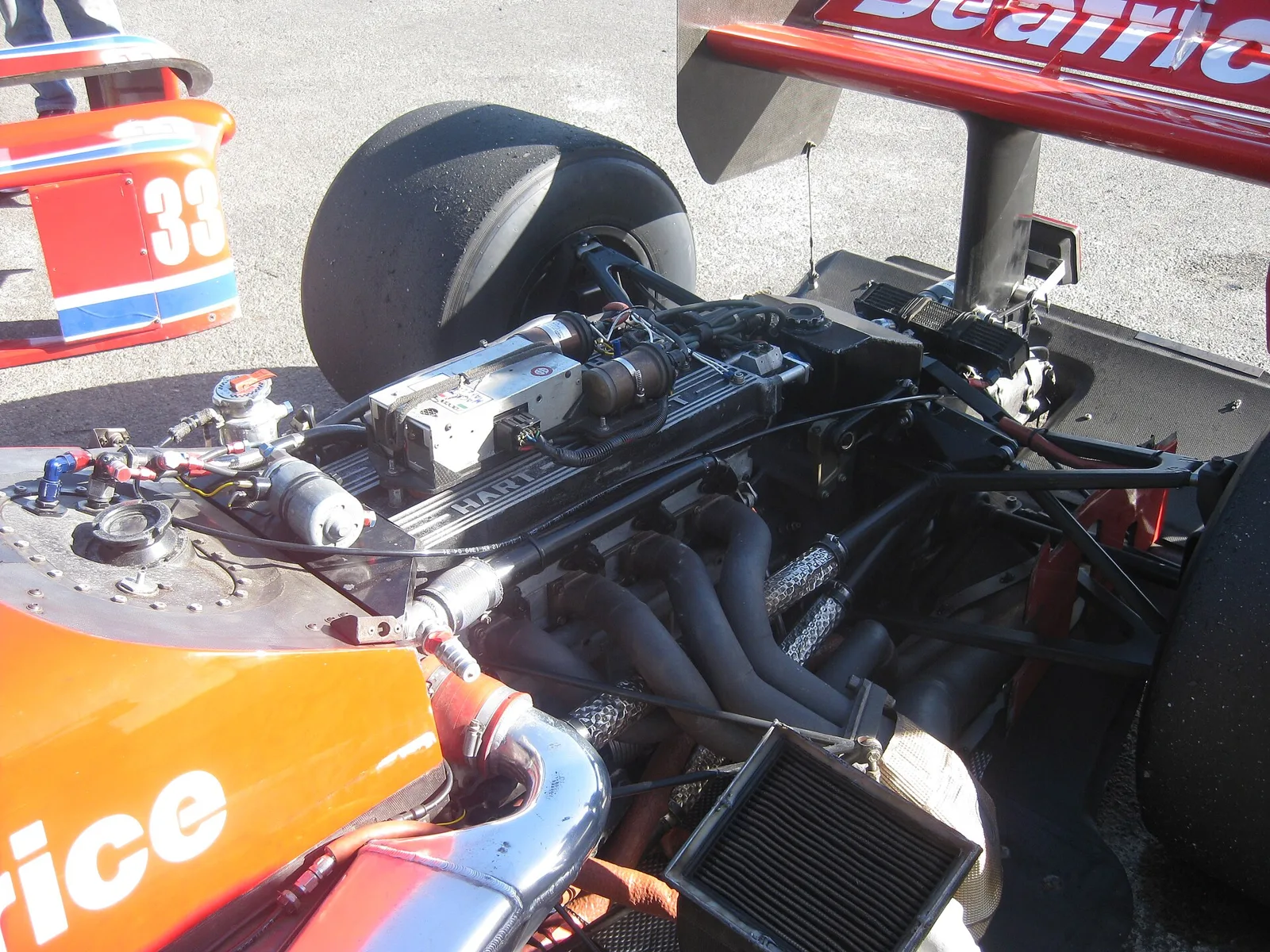
From a 1.5-litre turbo four that qualified twice in 1981 to a V8 that revved past 20,000 rpm and a Toyota built to an 18,000 rpm limit.
The Cosworth CR was a 3.0-litre V10 used from 1999 to 2005, followed by the TJ and CA V10s and V8s to 2013. Hart built a small-budget turbo in the 1980s and V10s and V8s later. The Toyota RVX was a V10 and V8 series raced from 2002 to 2009.
In 2006 the Cosworth CA2006 V8 was reported to make about 755 bhp at 19,250 rpm, which works out at 315 horsepower from every litre, in the season when Formula One engines spun faster than they ever had. Cosworth's engine was one of several different Formula One answers to the rule book that run from a tiny British turbo of the 1980s to Toyota's own V8 of 2009. Four families tell the story: the Cosworth CR, the Cosworth TJ and CA, the Hart engines and the Toyota RVX.
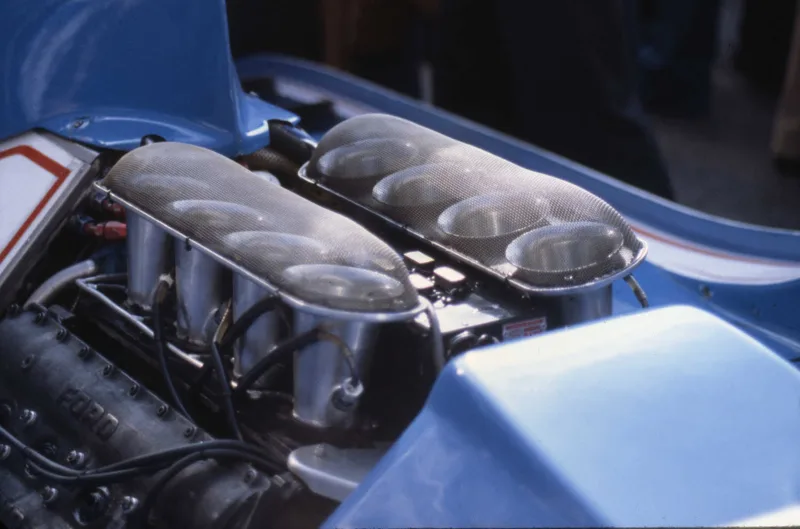
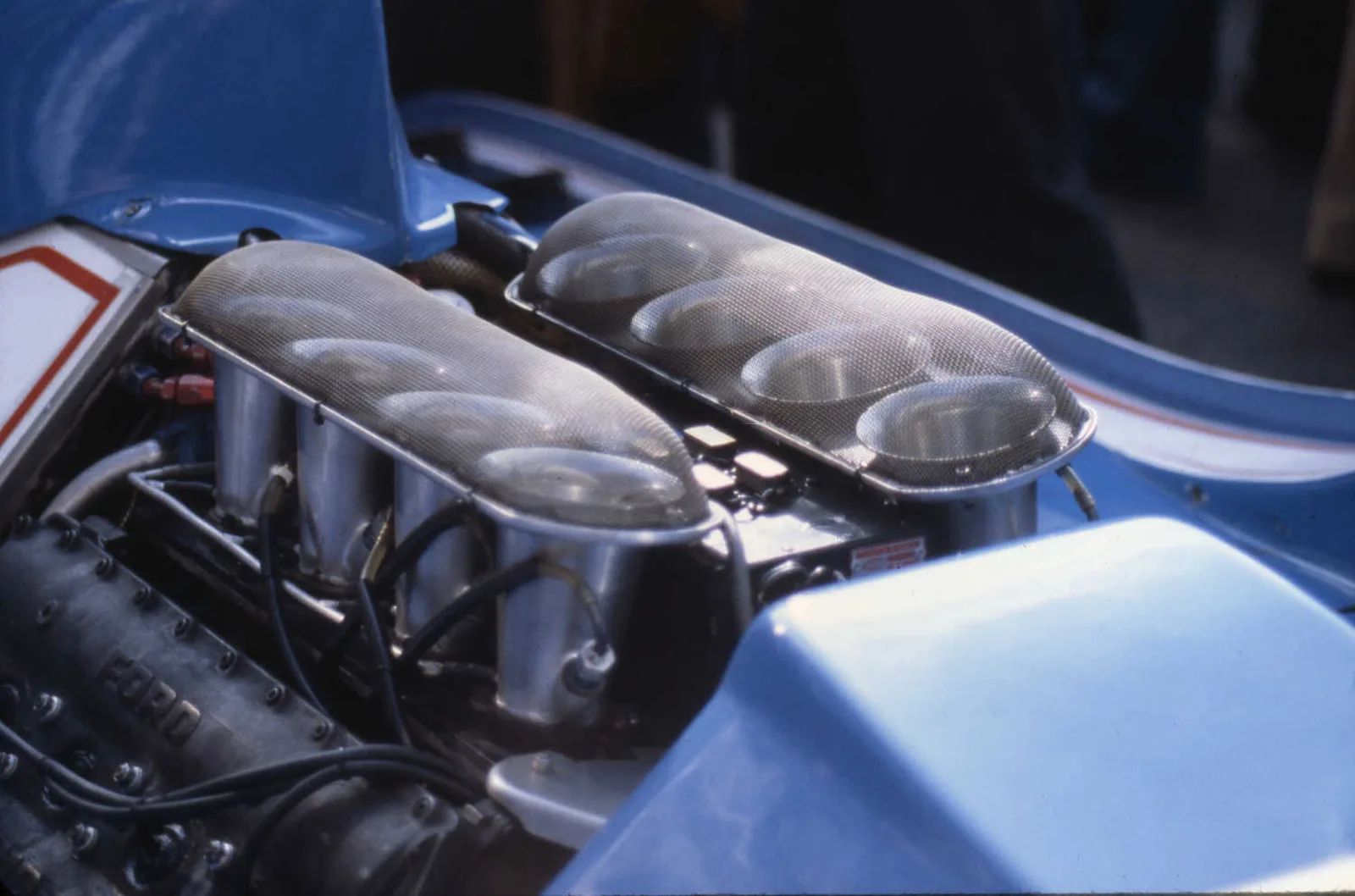
The Cosworth CR engine and the Ford connection
The Cosworth CR was a series of 3.0-litre, naturally aspirated V10 engines, designed by Cosworth in partnership with Ford. Customers were Stewart, Jaguar, Arrows, Jordan and Minardi. 'Naturally aspirated' simply means that the engine breathes at atmospheric pressure, with no turbocharger or supercharger forcing air in, so all its power comes from burning fuel with the air it can draw in itself.
In effect Ford's works outfit, Stewart Grand Prix ran the Cosworth CR-1 from the team's debut season in 1997. The CR-1 was a much lighter version of the VJM, and by 2001 it had reached 770 bhp at 16,500 rpm. Ford grew more involved with Stewart over the next few years, finally bought the team and renamed it Jaguar Racing for 2000. The CR family as a whole is listed as used between 1999 and 2005. Jaguar pulled out of Formula One at the end of 2004. The team carried on under the name Red Bull Racing and kept using Cosworth V10 engines until it switched to a Ferrari V8 for 2006. Minardi also ran re-badged Cosworth engines until 2005.
At its 1986 peak Hart's turbo made a reported 750 bhp; BMW's rival engine made 1,400.
The Cosworth TJ and CA engines
The TJ and CA series came next: naturally aspirated V10 and V8 engines in both 3-litre and 2.4-litre forms. Cosworth designed and developed the lot, and they were built from 2005 to 2013. Minardi was an early customer, then Red Bull and Toro Rosso, and later Williams, Lotus, HRT, Virgin and finally Marussia.
Williams began testing the new CA2006 in November 2005, and used Cosworth V8 engines throughout the 2006 season. Scuderia Toro Rosso, meanwhile, ran V10s based on the 2005 units but detuned.
The 2006 rules, in plain terms
For 2006 the regulations demanded a 90-degree V8 of no more than 2.4 litres, with a circular bore of at most 98 mm (3.9 in). Simple geometry then fixes the stroke. Displacement is the area of the bore multiplied by the stroke, for every cylinder, so a 2.4-litre eight-cylinder with the widest allowed bore has a stroke of only 39.8 mm (1.57 in). A stroke that short keeps the pistons moving a small distance with each pass, so the engine can spin very fast without the pistons reaching ruinous speeds. Each cylinder had to have two inlet and two exhaust valves, the engine had to be naturally aspirated, and it had to weigh at least 95 kg (209 lb).
Teams that could not get hold of a V8 were allowed to run the previous year's engines, fitted with a rev limiter, in 2006 and 2007. Scuderia Toro Rosso did so with a rev-limited, air-restricted Cosworth TJ2005 V10, because the deal under which Red Bull took over the old Minardi team had not brought new engines with it.
The highest revs in Formula One history
The 2006 season had the highest rev limits Formula One has seen, at well over 20,000 rpm, and Cosworth managed just over that figure with its V8. A mandatory limit of 19,000 rpm for every competitor came in for 2007. Cosworth was by then without a partner, since Williams chose Toyota power and Toro Rosso moved to Ferrari engines, the same ones its sister team Red Bull Racing had used in 2006.
The standard engine and the return of Cosworth
The next chapter came from Max Mosley's letter following Honda's withdrawal from Formula One in December 2008. It named Cosworth as the winner of the tender to supply a standard engine to any participant that wanted one. Teams could take complete units, build their own from designs supplied by Cosworth, or make an engine of their own design on condition that its power was limited to match the standard one.
In 2010 Cosworth came back as the engine supplier to Williams and to the newcomers Hispania Racing, Lotus Racing and Virgin Racing. The CA2010 used the same 2.4-litre V8 base as the CA2006 that Williams had run, but it was re-tuned for the 18,000 rpm limit then required of all engines, down from the 20,000 rpm of the original. Cosworth had the first engines delivered to teams by mid-January, a fortnight ahead of the season's first running on track.
| Family | Layout | Years | Customers or users |
|---|---|---|---|
| Cosworth CR | 3.0-litre V10 | 1999-2005 | Stewart, Jaguar, Arrows, Jordan, Minardi |
| Cosworth TJ and CA | 3-litre V10 and 2.4-litre V8 | 2005-2013 | Williams, Toro Rosso, Red Bull, Minardi, plus Lotus, HRT, Virgin and Marussia |
| Toyota RVX | V10 and V8 | 2002-2009 | Toyota, Jordan, Midland, Williams |
| Hart 415T | 1.5-litre turbo four | 1981-1986 | Toleman, RAM, Spirit, Haas Lola |
Hart Racing Engines: a small firm in Formula One
Brian Hart Ltd, known as Hart or Hart Racing Engines, took part in 157 Formula One Grands Prix and powered a total of 368 entries. British engineer Brian Hart founded it in 1969, at first to service and tune engines made by other manufacturers for independent British teams across motorsport.
Developing Ford's FVA brought particular success, and it led the multinational to commission Hart's small outfit to create the 1.6 litre BDA, an engine for the 2.0L class. Hart-built Ford engines won the European Formula Two title in both 1971 and 1972, and the 2.0L BDA powered most of Ford's rallying successes of the 1970s.
When Ford left Formula Two in the mid-1970s, Hart moved to building its own designs. The first engine to carry only the Hart name was the 420R, a twin-cam four-cylinder that appeared in 1976 and went on winning races through to the end of the decade. In 1978 Toleman agreed to a partnership and put up finance for further Hart designs, and the fruits showed in 1980 when Toleman finished first and second in the European F2 Championship.
The Hart turbo years
In 1981 Hart went with Toleman into Formula One, with the 415T, a 1.5 litre turbocharged inline four. The first year was a disaster. A small operation struggled against better-funded outfits, and Toleman's cars qualified to race only twice. Hart persisted all the same. The best result of the five-year relationship came when Ayrton Senna finished second at the 1984 Monaco Grand Prix, and Toleman took seventh in that year's Constructors Championship. Teo Fabi also put a Toleman-Hart on pole position at the 1985 German Grand Prix, the first of just two poles that Hart-powered cars would ever take.
Three other teams used Hart turbos: RAM and Spirit in 1984 and 1985, and the Haas Lola team in 1985 and 1986. None did well, but Hart earned a name for excellent work on a small budget.
Why the 415T ran out of road
A turbocharger uses exhaust gas to spin a compressor that packs extra air into the cylinders, and the pressure it adds is called boost. After 1984 bigger names, from Renault, Honda and BMW to Ferrari and the TAG-funded Porsche, pushed their engines to run far more boost than the 415T could, and Brian Hart stopped development. Its final appearance came in the 1986 San Marino Grand Prix with Haas Lola, where Patrick Tambay qualified eleventh and retired with engine trouble after five laps.
At its peak in 1986, with turbo boost unrestricted, the Hart 415T produced a reported 559 kW (750 bhp; 760 PS) at 11,000 rpm. The comparison was unflattering. BMW's engine made 1,400 bhp, the Renault, Honda and Ferrari engines 1,200 bhp, the TAG-Porsche 1,000 bhp, and even the new Cosworth-designed and built Ford V6 turbo of 1986 made 900 bhp.
V10s and V8s after the turbo ban
Turbocharged engines were outlawed after the 1988 season, and Hart turned to freelance work, mostly tuning Cosworth DFR V8 engines: for Arrows (then called Footwork) in 1990 and 1991, for Tyrrell in 1990, and for Larrousse and AGS in 1991.
The company came back with its own engine in 1993, a 3.5 litre V10 called the 1035, under a two-year deal with Jordan. It peaked in 1994, when Rubens Barrichello finished third at the Pacific Grand Prix and took the engine company's last F1 pole at the Belgian Grand Prix.
When the 3.0 litre formula arrived in 1995, Hart built a V8, the 830, which Arrows used in 1995 and 1996. Gianni Morbidelli took third in the 1995 Australian Grand Prix. Minardi took over the engines for 1997. Brian Hart designed a new V10, the 1030, though no money was available to build it. Later in 1997 Tom Walkinshaw Racing bought Brian Hart Ltd and merged it into the Arrows team, and the 1030 was finally built and raced in 1998 and 1999 as the Arrows T2-F1 V10. Mika Salo came fourth at Monaco in 1998. Brian Hart, unhappy that the engine was not being developed further, walked away from Arrows.
How the rev limits fell
Read in order, the engines trace a steady fall in permitted speed. The 3.0-litre V10s of the Cosworth CR era ran to 16,500 rpm by 2001. The 2.4-litre V8 formula of 2006 then allowed engine speeds well over 20,000 rpm, with Cosworth just clearing that mark. The 19,000 rpm limiter of 2007 pulled everyone back, and by 2010 Cosworth was re-tuning its V8 for 18,000 rpm. Toyota's RVX-09 sat at exactly that limit, which the regulations set. A rev limiter is a simple protection: when the engine reaches the set speed, the electronics cut fuel or spark so that it cannot go any faster, which stops teams trading reliability for extra revs.
Hart's story runs on a different axis, that of money. The 415T was ready in 1981 and could not match engines that other manufacturers could afford to develop for years, and its reported 750 bhp against the best rival's 1,400 bhp in 1986 is the plainest proof of the gap. Yet the same small firm took a third place at Pacific in 1994 with Barrichello, a pole at Spa, and fourth with Salo at Monaco in 1998.
The Toyota RVX engine
Toyota built the RVX range of four-stroke V10 and V8 racing engines for Formula One. They were naturally aspirated, designed and engineered in-house, and ran in Toyota, Jordan, Midland and Williams cars between 2002 and 2009.
Jordan's EJ15 and EJ15B and Midland's M16 were customer cars. Toyota's own run from the TF101 to the TF110, though neither the TF101 nor the TF110 ever raced. Williams fitted the engine to its FW29, FW30 and FW31, after choosing to switch to Toyota power for 2007.
Inside the 2009 RVX-09
The RVX-09 was a 90-degree V8 with bore and stroke of 96.8 mm by 40.77 mm, which makes 2,399 cc. It ran on unleaded gasoline containing 5.75% bio-ethanol. The block and heads were aluminium, and linerless: instead of separate sleeves pressed into the cylinders, the pistons ran directly against bores formed in the aluminium itself. A plain steel crankshaft with four pins turned on five main bearings, and the connecting rods were titanium, which is strong and light. The pistons were light alloy with two rings.
Twin overhead camshafts worked four valves per cylinder, with one spark plug. The intake valves were inclined at 10.2 degrees and the exhaust valves at 11 degrees, each with a 3.2 degree compound angle, and they measured 41.5 mm on the intake side and 33.5 mm on the exhaust. A full engine management system, called SECU, handled electronic ignition and sequential injection. Compression ratio was 13.6:1, and the maximum engine speed was 18,000 rpm, set by regulation.