One team won 105 races without ever winning at Indianapolis, one won the 500 and two titles in a row, one folded after a decade, and one never won a race at all.
Newman/Haas won eight titles and 105 CART or Champ Car races but never won at Indianapolis. Truesports won the 1986 Indy 500 and two straight titles. PacWest won four races in 1997 before closing in 2002, and Dick Simon Racing took two poles but no wins.
Newman/Haas Racing won 105 CART and Champ Car races and eight championships, and it never won the Indianapolis 500. Its best result there was second place, twice. The same era produced a team that won the 500 and two titles in a row before collapsing, one that peaked in a single season, and one that took two poles and never a victory. All four were Indy car outfits built around one or two people, and their fortunes rose and fell with sponsors, engines and chassis.
Newman/Haas Racing: the actor and the owner
Newman/Haas was a partnership between the actor and part-time racer Paul Newman and the long-time owner and driver Carl Haas. The two had been rivals in sports car racing in the 1970s and early 1980s, and in 1983 they combined to enter Indy car racing. The team, based in Lincolnshire, Illinois, ran in CART, then Champ Car, then the IndyCar Series until 2011. Besides its 105 CART and Champ Car wins and eight titles, it took two further wins in the IRL and IndyCar Series.
Newman/Haas won eight CART titles and more than 100 races, yet the Indianapolis 500 never fell its way.
Mario Andretti and the Lola years, 1983 to 1992
It began with one car and Mario Andretti, who had been Formula One World Champion in 1978, as lead driver. Haas also brought in Lola as chassis supplier, bringing the constructor back to Indy car racing. Other teams quickly copied the move, and by the decade's end Lola had pushed March aside as a dominant maker.
Andretti won twice in 1983 and was third in points. In 1984 he won six races, took nine poles and finished in the top ten ten times, giving the team its first title. A hot start to 1985, with three wins and a second in the first four races, gave way to a mid-season slump and a broken collarbone that left him fifth in points.
The Indianapolis 500 that year hurt more than any injury. Andretti lost to Danny Sullivan, a defeat widely seen as a heavy disappointment. Two wins in 1986 left him fifth in points. In 1987 the team moved to the Ilmor Chevy Indy V-8, and he won the opening round at Long Beach, that engine's first Indy car victory.
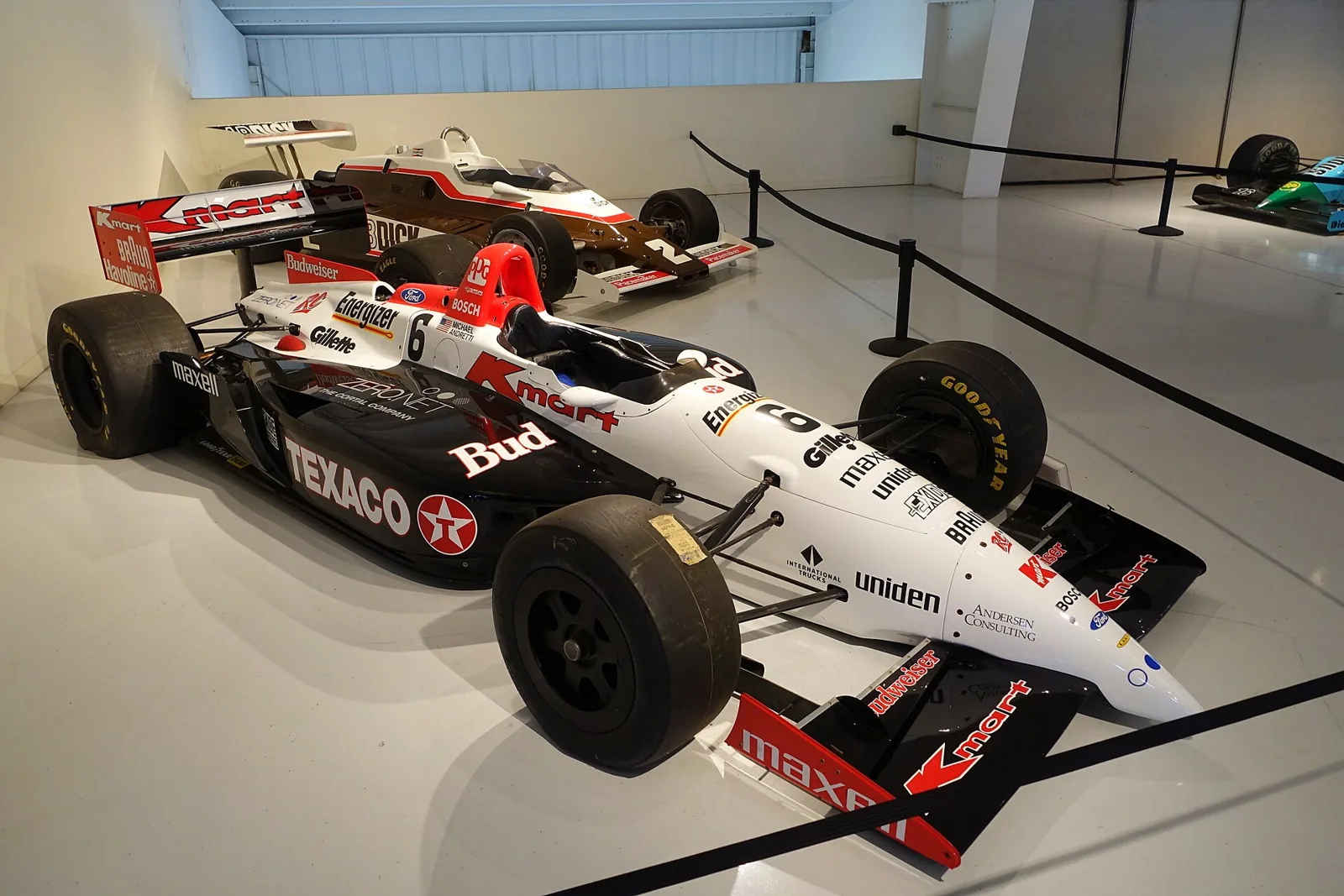
Michael Andretti joined in 1989 to make a two-car team. In their first season together father and son were 6th and 3rd in points. Michael won the 1991 CART title and was runner-up in the standings in 1990 and 1992, the latter year on the new Ford Cosworth XB engine. But the 500 still refused to come. Michael was second in 1991, and in 1992 he was leading with 11 laps to go when he dropped out.
Nigel Mansell and the 1993 title
Michael went to McLaren for the 1993 Formula One season, and the Englishman Nigel Mansell, then reigning Formula One World Champion, arrived to replace him with great fanfare. As a CART rookie Mansell won five races, stood on the podium ten times and clinched the championship, which made him the only driver ever to hold the Formula One and Champ Car crowns together. Mario Andretti won at Phoenix that year, his last Indy car victory.
Indianapolis again let them down. Andretti led more laps than anyone but a penalty and handling trouble dropped him to fifth. Mansell, new to rolling restarts after a safety car, was passed for the lead with 16 laps left, then touched the wall and came third behind Emerson Fittipaldi and Arie Luyendyk.
Andretti's farewell year, 1994, was a long "Arrivederci Mario" tour, but the results were poor: three top fives and no wins. Mansell also went winless, and Bernie Ecclestone bought out his contract so he could return to Formula One. At Indianapolis Mario retired after only 23 laps with a fuel system failure and was classified 32nd in his final 500, while Mansell was knocked out in a strange crash with Dennis Vitolo.
Newman/Haas after Andretti, 1995 to 2002
Michael Andretti came back in 1995 after an unsuccessful season in Formula One and a year with Ganassi. He took one win and fourth in points; Paul Tracy won two races and was sixth. When the sport's open-wheel "split" arrived, Newman/Haas stayed firmly on the CART side, and Tracy went back to Penske.
From 1996 Michael Andretti and Christian Fittipaldi were the pair for five seasons, with Roberto Moreno standing in now and then. Andretti won ten races in that spell and was runner-up in 1996, while Fittipaldi won twice and was fifth in points. The Swift chassis, used from 1997 to 1999, was not a success, and Lola returned in 2000. Andretti left after that season, partly because the team would not enter an IRL car at Indianapolis.
Toyota replaced Ford-Cosworth as engine supplier in 2001. Cristiano da Matta came over from PPI Motorsports and won on his team debut at Monterrey, adding two more wins to finish fifth. In 2002 da Matta won the opener, then four in a row at Laguna Seca, Portland, Chicago and Toronto, and with Road America and Bayfront Park he reached seven wins and a seventy-three point margin over Bruno Junqueira. Both then left: Fittipaldi for NASCAR, da Matta for Toyota's Formula One team.
Champ Car and the Bourdais run, 2003 to 2007
When CART became the Champ Car World Series, several leading teams defected to the Indy Racing League, following Penske's example the year before. Newman/Haas stayed. Honda and Toyota also left, making Ford the only engine maker, and ChevronTexaco's Havoline brand dropped its sponsorship, so the team signed PacifiCare and brought in McDonald's as a secondary backer that became primary the next year.
It hired Bruno Junqueira, who had lost his Ganassi seat when that team moved to the IRL, and Sebastien Bourdais, the 2002 Formula 3000 champion. Junqueira won twice and was second in points in 2003, while Bourdais, Rookie of the Year, won three times and was sixth. In 2004 Bourdais won seven times, including three in a row at Portland, Cleveland and Toronto, to take his first title, and Junqueira won at Montreal and Surfers' Paradise for a 1-2 for the team in the standings.
The same year Newman/Haas went back to the Indianapolis 500 for the first time in the post-split period. Junqueira led on lap 150 and hoped to be in front when rain came, but a fuel stop was forced and he took fifth when officials ended the race on lap 180. In 2005 both drivers crashed out of the 500, Junqueira fracturing a vertebra that ended his season, and Oriol Servia filled in and won at Montreal. Bourdais won five more races and a second title.
Bourdais won seven more in 2006, including the first four races, for a third consecutive title. In 2007, the last Champ Car season, he won eight, a career high, with five of them in the final seven events, for a fourth straight championship. Graham Rahal replaced Junqueira, finished fifth in points and took second behind his teammate at Houston, which was the team's 100th series win. Bourdais then left for Toro Rosso in Formula One, and Justin Wilson replaced him as the two series unified in IndyCar.
How Newman/Haas ended
Mike Lanigan was a partner from 2007 to 2010, and the team carried his name in that time. For 2012 Haas announced that the economic climate meant no IndyCar entry. Lanigan went on to part-own Rahal Letterman Lanigan Racing, the team shut its doors and its equipment was sold. Newman died in 2008 and Haas in 2016.
Truesports: the Indianapolis winner
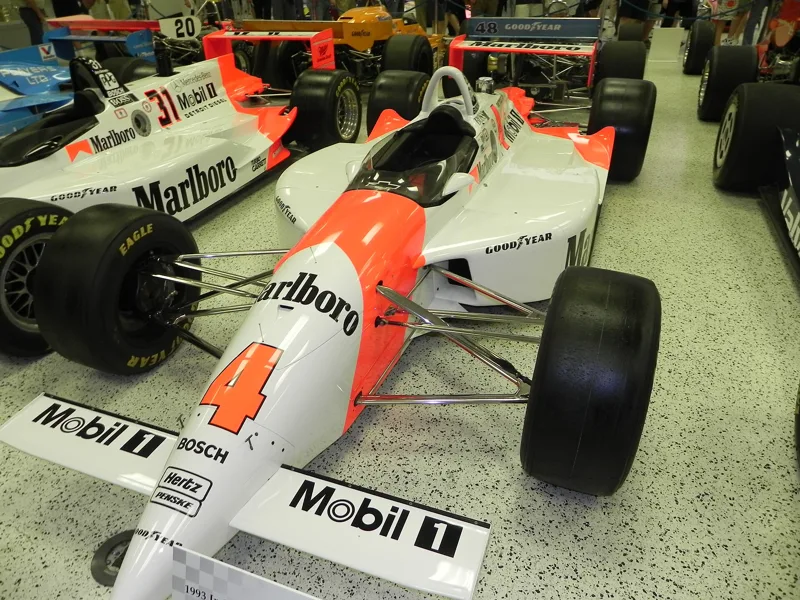
Truesports was founded by Jim Trueman and based in Hilliard, Ohio. The name joins his surname to the word sports. Trueman started racing sports cars in 1962 and teamed up with Bobby Rahal in Can-Am in the 1970s. They then looked to CART and the Indianapolis 500. Through his Red Roof Inn motels he sponsored Vern Schuppan's car at Indy in 1981, and it came home third.
The Truesports CART team started in 1982 with Rahal driving. He won midway through the year at Cleveland, then at Michigan, took second in the standings and was rookie of the year. Three more wins came in 1983 and 1984, with seventh in the 1984 Indianapolis 500. Budweiser became the sponsor in 1985, and Rahal won three of five races to take third in the standings.
Back-to-back titles and the loss of Jim Trueman
The 1986 season brought the 500 win. Trueman, who had battled cancer for two years, died eleven days after it. The team raced on in his memory, and Rahal won six races and the 1986 CART title.
Steve Horne and Trueman family members took over day-to-day running for 1987. The cars changed from March to Lola but kept the reliable Cosworth DFX, while Penske, Patrick and Newman/Haas moved to the stronger Chevrolet-Ilmor. An ignition problem ended his Indianapolis race after a second-place start, but he still won three races and a second straight title.
The Ferrari detour and the chassis project
In 1985 Trueman and Rahal went to Italy and demonstrated a March 85C-Cosworth for Ferrari. Ferrari later built its own Indy car chassis, the 637, and Truesports looked set to be the first to race it. The deal never happened, and it turned out to be a bargaining tool for Ferrari's Formula One team. The episode was not made public at the time, but it and the cancelled programme took a toll, and the team went without the Ilmor Chevy Indy V-8 in 1987 and 1988. Without that engine, Rahal had a key reason to go.
For 1988 Truesports used the Judd engine, underpowered but reliable and good on fuel in the 500-mile races. Rahal was fourth at Indianapolis and second in the Michigan 500, and he won the Pocono 500. That was the team's last victory, and Rahal left at the end of the year.
The rookie Scott Pruett joined in 1989 and shared Rookie of the Year honours at Indianapolis, and he was second at Detroit. In March 1990 he was badly hurt in a testing crash at West Palm Beach. Raul Boesel drove the whole season in his place, with a best finish of sixth, in year-old Lolas to save money.
From 1990 Truesports explored building its own car. The Truesports All-American chassis was designed mainly by Don Halliday and built entirely in the United States at the Hilliard shops, unlike the English-built Penske and Galmer chassis of the time. Pruett drove the 91C-Judd to a respectable first season in 1991. In 1992 it had the Chevy Indy A engine, but he still did not win. Budweiser announced it was leaving for King Racing, the team abandoned the chassis project in the middle of the season as costs rose, and Horne resigned in June.
What became of Truesports
The assets, headquarters and chassis program were leased and then absorbed into Rahal-Hogan Racing, co-owned by Rahal. In 1993 that team tried to keep the chassis alive as the R/H. It finished second at Long Beach early on but struggled on superspeedways, and a month later Rahal missed the Indianapolis field, after which the team changed to a Lola. The chassis project was dropped by the end of the year. The family's other businesses, which included the Mid-Ohio Sports Car Course that Trueman bought in 1981, ran separately.
PacWest Racing: one big year
Bruce McCaw owned PacWest, a Champ Car team he founded in 1993. Its first full season was 1994, with Dominic Dobson and Scott Sharp. In 1995 it hired Mauricio Gugelmin and Danny Sullivan, whose seat went late in the year to Juan Manuel Fangio II after an injury. Mark Blundell took over from Fangio in 1996.
The breakthrough came in 1997, with four wins: three for Blundell and Gugelmin's only CART victory, at Vancouver. PacWest was now seen as a major team and expected to contend for the 1998 title. The next three years were a disappointment. Blundell retired after 2000 and the 2000 Indy Lights champion Scott Dixon took his place in 2001, scoring PacWest's last win at Nazareth, a race Gugelmin left after his son died.
The end came in 2002. Short of money, with NTN as only an associate sponsor, the team began four races with Dixon and Oriol Servia. Dixon left for Chip Ganassi Racing after the third, and McCaw closed the organisation soon after Servia's fourth start. Kevin Kalkhoven and Craig Pollock bought it to create PK Racing, which ran as KV Racing Technology from 2003 to the end of the 2016 season. PacWest's two cars were also those driven by the lead characters in the 2001 film Driven.
Dick Simon Racing: no wins, plenty of firsts
Dick Simon Racing belonged to the driver Dick Simon. It ran in CART from 1983 to 1995, and its Indy Racing League years were 1999 to 2001. Simon started it by taking his Vermont American sponsorship to a team of his own, and immediately qualified for the 500 for the first time since 1980. Raul Boesel became the full-time driver in 1985 as Simon scaled back his own racing, and in 1986 Simon started just four races while Boesel was 17th in points. The team became a leading home for pay drivers.
Arie Luyendyk took over from Boesel in 1988, the last year Simon drove. Scott Brayton joined Luyendyk in 1989, the first time the team ran two fully funded cars, and Luyendyk finished 10th in the points and Brayton 15th. Lyn St. James became the second woman to start the Indianapolis 500 in a Simon car in 1992. The best of the later seasons was 1993, when Boesel was fifth with three second places. Boesel was seventh in 1994. In 1995 Dean Hall missed the Indianapolis field and left, while Eliseo Salazar and Carlos Guerrero ended 21st and 30th.
The team's CART record is a list of near-misses. It never won a race. Two poles came, both from Boesel at the Milwaukee Mile, in 1993 and again in 1994, and there were six runner-up finishes: Luyendyk had one in 1988 and Boesel the other five. Simon's rookies generally qualified for the 500, and his cars often tried to be the first on the track on the opening day of practice.
In 1996 Simon sold much of his team to Team Scandia's founder, Andy Evans, and ran under the Simon/Scandia banner. Scandia put seven cars into the Indianapolis 500 that year, a race record. Simon returned under his own name in 1999 with Stephan Gregoire, 15th in points, and Gregoire was 14th in 2000, when St. James, whose IndyCar career began with Simon eight years earlier, joined him for the 500. She wrecked early; Gregoire was eighth. After a failed qualification attempt at the 2001 500, the team closed in May. Simon then became race strategist for Robby Gordon at Foyt's team.
The four teams compared
| Team | Years | Biggest achievement | How it ended |
|---|---|---|---|
| Newman/Haas Racing | 1983 to 2011 | 105 CART/Champ Car wins; eight titles | Shut down after 2011 because of the economic climate |
| Truesports | 1982 to 1992 | 1986 Indianapolis 500; titles in 1986 and 1987 | Absorbed into Rahal-Hogan Racing |
| PacWest Racing | 1993 to 2002 | Four wins in 1997 | Closed by McCaw; became PK Racing |
| Dick Simon Racing | CART 1983 to 1995; IRL 1999 to 2001 | Two poles; six second places | Shut down in May 2001 |
What became of the four teams?
None of the four still races under its own name. Newman/Haas stopped after 2011, KV Racing Technology operated until the end of 2016, and Truesports lives on inside what is now Rahal Letterman Racing.