A billiard-room design from 1922 became the licensed ancestor of the first BMW, then made room for a best-selling Ten and a six-cylinder Sixteen.
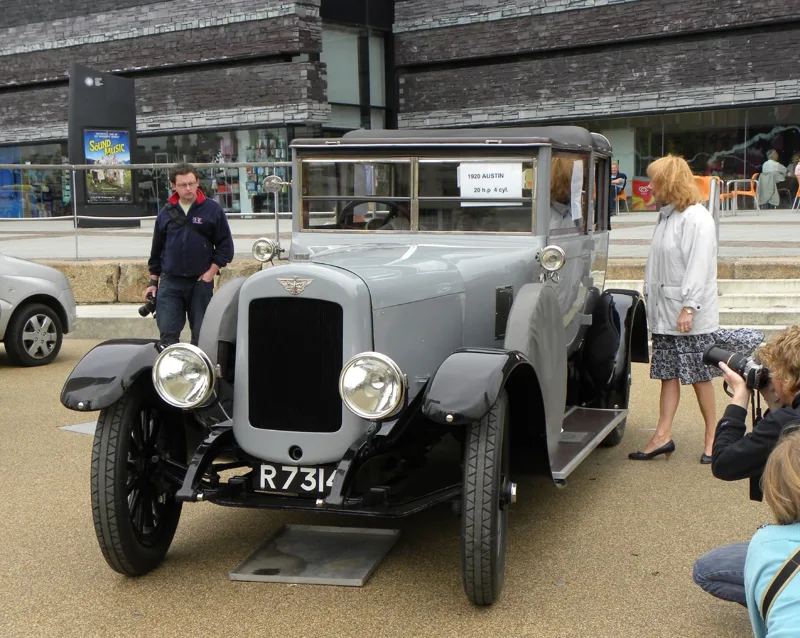
The Austin Seven of 1922 was a small, cheap car that was licensed around the world, including to Dixi, which became BMW's first car. Austin then built the larger Ten in 1932 and the six-cylinder Sixteen in 1927, giving buyers a ladder of models above the Seven.
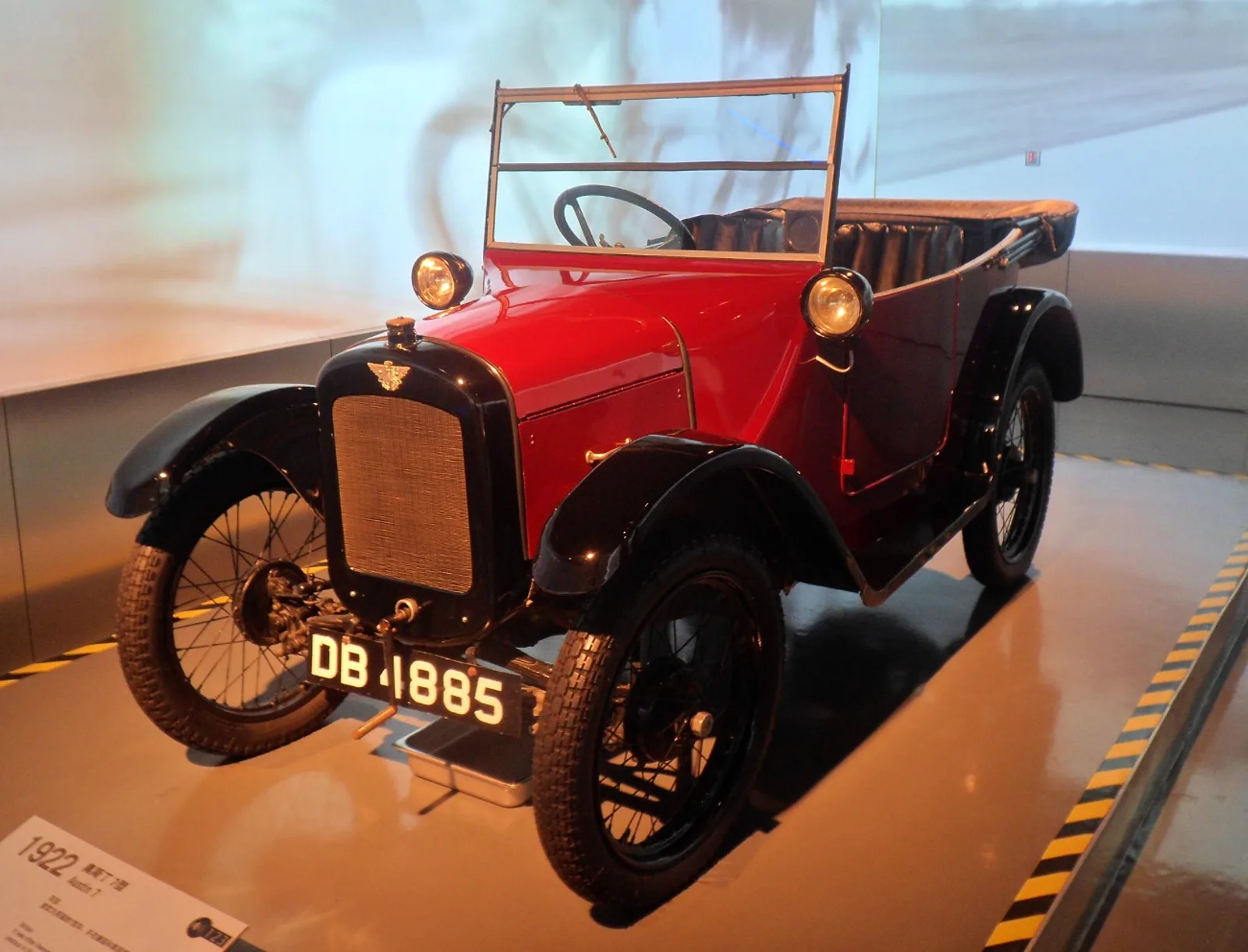
The first BMW car was an Austin. The BMW Dixi was a licensed Austin 7, and the first Lotus, the Mark I, was built from one too. Few cars have spread so far from a single small design, and the Seven's success also made room for larger Austins above it, the six-cylinder Sixteen of 1927 and the Ten of 1932, so that the name stopped meaning one car and started meaning a family.
Austin Seven history: a billiard-room project
Austin's catalogue before the First World War was dominated by big cars, with one exception in 1909: a single-cylinder 7 hp runabout built for the firm by Swift of Coventry. In 1920 Sir Herbert Austin began thinking about a smaller car for young families who wanted an affordable motor, a notion given urgency by the Horsepower Tax of 1921. His board and creditors opposed it. Because the company was in receivership, Austin carried out the project himself, hiring an 18-year-old draughtsman from Longbridge, Stanley Edge, in 1921. The drawings were done at Austin's home, Lickey Grange, in the billiard room.
The original side-valve engine displaced 696cc, giving an RAC rating of 7.2 hp. The cylinder block had a detachable head and sat on an aluminium crankcase. Edge later claimed credit for the small four-cylinder layout, the three-speed gearbox and the clutch. Austin did much of the styling, reportedly influenced by the Peugeot Quadrilette, and the A-shaped chassis may owe something to an American truck used at the Longbridge factory.
Three prototypes were built at Longbridge and the car was announced in July 1922. Austin had put his own money into it and patented many of its features in his own name, which earned him a royalty of two guineas on every car sold. Production in 1923 reached nearly 2,500, fewer than hoped, but within a few years the car, a "big car in miniature", had finished off the cyclecar trade and rescued the company's finances. By 1939, when production ended, 290,000 cars and vans had been made.
The first BMW car was a licensed Austin 7.
Austin 7 specs and chassis
Next to a Ford Model T the Seven was about three-quarter size, on a wheelbase of only 75 in (1.91 m) and a track of 40 in (1.02 m). It weighed 794 lb (360 kg), less than half the Ford. The engine that powered it, a 747 cc side-valve with an actual output of 10 hp, was enough for adequate performance.
The chassis was an "A", with the engine sitting at the narrow nose between its channel members. Quarter-elliptic springs cantilevered from the rear, and a front beam axle used a transverse semi-elliptic spring. Brakes worked on all four wheels from the start, though at first the footbrake operated only the rears and the handbrake the fronts; they were fully coupled from 1930. In late 1931 the chassis grew by six inches.
The engine changed in March 1923, when the bore went from 54.0 mm to 56 mm and capacity from 696 cc to 747 cc. Cooling was by thermosiphon with no water pump. An electric starter came in November 1923, and magneto ignition gave way to coil in 1928. A four-speed gearbox arrived in 1932, with synchromesh on third and top in 1933 and on second a year later. A three-bearing crankshaft followed in 1936.
Even the layout was ahead of its time. In a 2007 Top Gear episode, Jeremy Clarkson and James May concluded the Seven was the first mass-market car with the conventional control layout of a modern car, although the earliest they found was a 1916 Cadillac.
Austin Seven racing and sports models
Arthur Waite, Austin's son-in-law, began winning at Brooklands in March 1923 and at Monza the next month. Gordon England, a rival driver, talked Sir Herbert into lending him a racing Seven, set six class records at Brooklands and built a special two-seater body weighing 20 lb (9.1 kg). He finished second in the Junior Car Club 200 mile race that October. Austin responded in January 1924 with a Sports and a Brooklands Super-sports, the latter a replica of England's record-breaker with a certificate for 80 miles per hour (128.75 km/h). By 1925 England held nineteen 750 cc class records.
Archie Frazer-Nash finished third and S. V. Holbrook fourth at Ards, in County Down, in the 1929 RAC Tourist Trophy, the race that gave the Ulster its name. In Australia, Waite won the 1928 100 Miles Road Race in a Seven.
Saloons, Swallow and the coachbuilders
England's coachbuilding firm made the first Seven saloon. He had designed aeroplanes for Bristol, and his fabric-bodied saloon used aircraft methods; it was said to be the world's smallest closed car. At GBP 210, against GBP 112 for the chassis, it was nearly double the price, yet it showed the market was ready for an Austin-built steel saloon, introduced in September 1926 at GBP 165.
In 1927 William Lyons of the Swallow Sidecar Company saw the commercial potential of a re-bodied Seven. He bought a chassis from the dealer Parkers of Bolton and asked a Swallow coachbuilder, Cyril Holland, to create a striking open tourer. With two-tone paint and a price of GBP 175, the Austin Seven Swallow was popular and a saloon followed in 1928. About 3,500 bodies were built until 1932, when Lyons began making complete cars under the SS name. Demand forced a move from Blackpool to Coventry in 1928, and the Swallows helped lay the foundations of what became, by 1945, Jaguar Cars.
Austin Seven copies, BMW Dixi and other licensees
Licences were granted to Dixi in Germany from 1927, Rosengart in France from 1928 and American Austin from 1930. Dixi was later bought by BMW. American Austin was founded in 1929 in Butler, Pennsylvania, to assemble the car on a site formerly owned by the Standard Steel Car Company, but after initial success the Great Depression cut sales and the company filed for bankruptcy in 1934. Its 747 cc cars returned 40 mpg-US (5.9 L/100 km).
Nissan used the Seven design for its first cars. Reports differ on whether they were built under licence or as unlicensed copies, but by 1952 Nissan had a deal to build and sell Austins in Japan. Rolling chassis were also exported to Australia for local bodies, and Holden's Motor Body Builders built Seven tourers and roadsters from the mid-1920s.
After the Second World War, many Sevens were rebuilt as "specials", among them Bruce McLaren's first racer and the original Lotus. Speedex of Luton thrived in the late 1950s making race-proven bodies and parts for the Seven chassis. The name had such power that Austin reused it on early versions of the A30 in 1951 and the Mini in 1959.
Austin 10 1930s: the bread-and-butter car
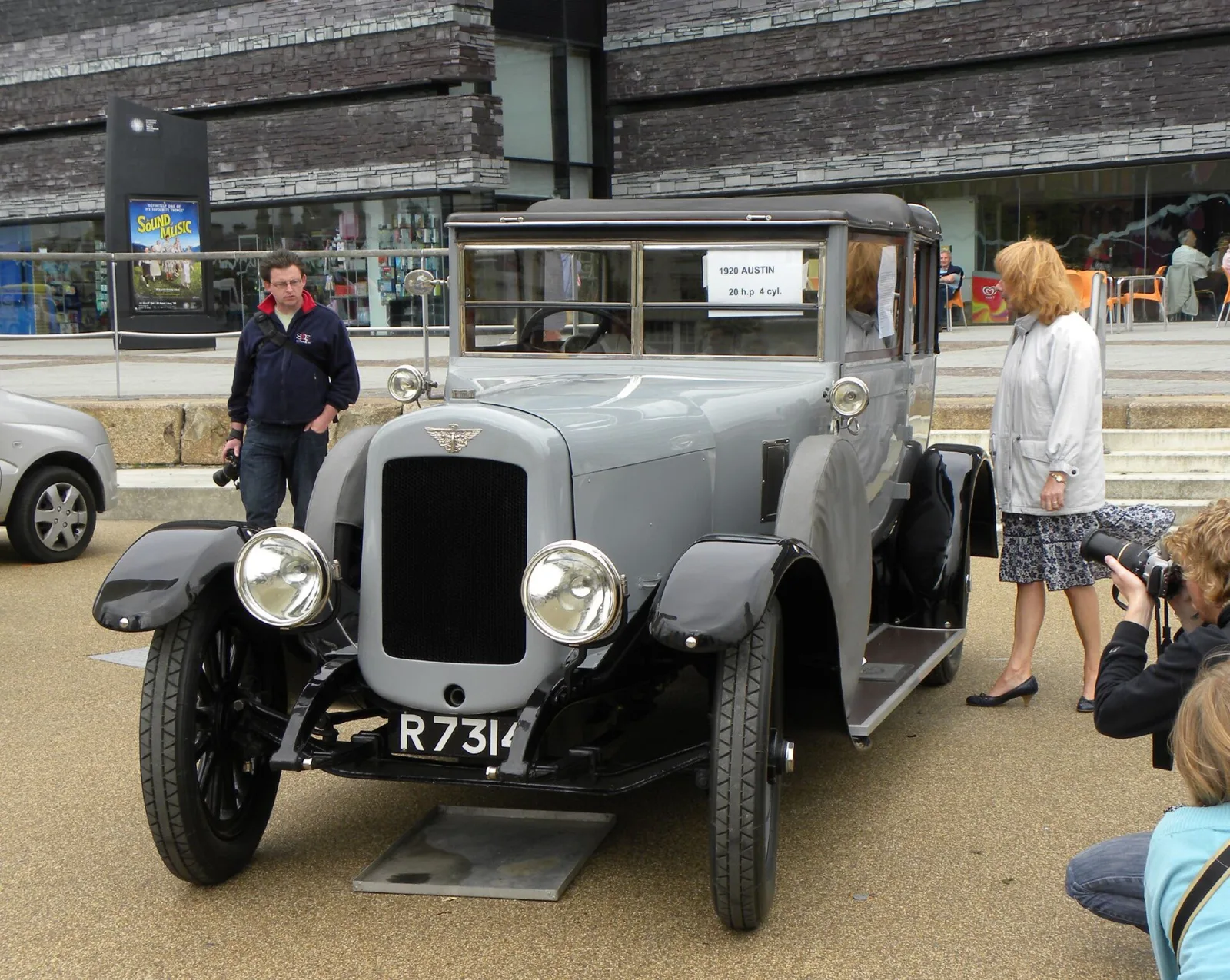
Launched on 19 April 1932, the Austin Ten was the company's best seller of the 1930s, and it stayed in production in upgraded forms until 1947. It slotted between the Seven and the Twelves. The design was conservative: a pressed steel body on a ladder chassis that dipped 2.75 inches (70 mm) between the axles to keep the car low. Power came from a 1125 cc four-cylinder side-valve engine rated at 21 bhp (15.7 kW), sent to the back axle by a four-speed gearbox, with worm-and-wheel steering and half-elliptic springs all round.
The basic four-door saloon cost GBP 155 and could reach 55 mph (89 km/h) while returning 34 mpg-imp (8.3 L/100 km). The Sunshine or De-Luxe, with an opening roof and leather, cost GBP 168, and the bare chassis GBP 120.
The range widened in 1933 with an open two-seater, a Colwyn cabriolet and a van, and in 1934 with the Ripley sports tourer, which managed 65 mph (105 km/h) with 30 bhp (22 kW). Mechanical upgrades that year added a sturdier chassis, 12-volt electrics and synchromesh on the two highest gears. A facelift in August 1934 brought a body-coloured radiator and the saloon name Lichfield.
In January 1936 came the six-light Sherborne, with a roofline swept to the rear in the fashionable "Airline" style, at GBP 10 more than the Lichfield. December 1936 saw the Cambridge saloon and Conway cabriolet, almost streamlined, with the passengers and engine much further forward, a smoother clutch, 16-inch steel wheels and a top speed up to 60 mph (97 km/h). The Times thought the car built for steady economical running rather than speed.
May 1939 brought a virtually new car with a semi-unitary shell, completely restyled by Dick Burzi, born in Argentina and recruited from Lancia in 1929. The Ten kept going through the war, with 53,000 saloons and utilities (the latter nicknamed "Tillys") made. After 1945 most went for export, the first reaching the United States in July 1945, and it was replaced by the A40 in October 1947.
Austin 16 and the Light Six
The Sixteen Light Six was announced in October 1927, with first deliveries planned for March 1928. It was a medium saloon above the Seven and the Twelve, but much smaller than the 3.6 litre Twenty, with a plated "Austin Six" script on the grille to set it apart from the four-cylinder cars. The new six-cylinder engine resembled the Twenty's, with the timing chain placed at the back of the block, and the gearbox was mounted in unit with the engine. Springs were semi-elliptic all round, and from March 1929 front screens were Triplex safety glass.
Body choice shrank over the years: coupes went in 1930 and the Weymann fabric saloons in 1931. For 1934 the gearbox gained synchromesh on third and fourth, and a larger 2511 cc 18 hp engine was offered at no extra charge, along with a longer 120 in (3,000 mm) wheelbase. Of that version 5742 Sixteens and 2630 Eighteens were built. An early automatic gearbox, the Hayes self-selector, was offered between 1934 and 1936 but few sold.
The 1935 range had only five- and seven-seat saloons, with a body-coloured radiator and a small external boot for the spare wheel. In 1937 the smaller-engined Sixteen was dropped, steel disc wheels replaced wires, and a new body only with the 18 hp engine became the Austin Eighteen. In all, 12,731 were produced between 1935 and 1937. The 16 hp car reached 60 mph (97 km/h) and about 21 miles per imperial gallon (13 L/100 km).
| Model | Launched | Engine |
|---|---|---|
| Austin Seven | Announced July 1922 | Four-cylinder, 696 cc then 747 cc from March 1923 |
| Austin Sixteen | Announced October 1927 | Six-cylinder; 2511 cc 18 hp engine offered from 1934 |
| Austin Ten | 19 April 1932 | 1125 cc four-cylinder, 21 bhp (15.7 kW) |
Where this went next
The Ten gave way to the A40 in October 1947, and the Seven's engine design lived on in sport. Reliant's early three-wheelers ran an engine derived from it, until a new aluminium unit came with the 1962 Reliant Regal 3/25, and the 750 Motor Club used that engine as the replacement in its Formula 750 racing. The Seven's own name reappeared on the A30 in 1951 and the Mini in 1959.