A 1965 coachbuilt six-cylinder, a 340 km/h V12 flagship and the company's first SUV, with the editions and engines behind each.
The Aston Martin DB6 was a 1965 to 1971 grand tourer with a 4.0-litre straight-six. The DBS Superleggera, sold 2018 to 2024, used a 725 PS V12 and a record 180 kg of downforce. The DBX, since 2020, is the company's first SUV, powered by a Mercedes-AMG V8.
Every Aston Martin DB6 cost the company a five-pound royalty, paid to a coachbuilder in Milan for the right to use the Superleggera name. A small sum for a big idea, and that idea runs from a 1965 grand tourer with a chopped-off tail, to a 2018 flagship that set a downforce record, to a high-riding SUV the company never attempted before 2020.
What are the Aston Martin DB6, DBS Superleggera and DBX?
The Aston Martin DB6 is a grand tourer built from September 1965 to January 1971. The DBS Superleggera is a V12 grand tourer sold from 2018 to 2024. The DBX is a crossover SUV on sale since 2020, and it is the first SUV Aston Martin has made. Between them they cover a six-cylinder classic, a twin-turbo V12 coupe and a V8 SUV.
Every DB6 carried a five-pound Superleggera royalty, a debt that outlived the badge itself.
How did the Aston Martin DB6 come about?
The DB6 succeeded the DB5, with improved aerodynamics and specification. The DB in the name stands for David Brown, who built the company up from 1947. When Touring of Milan proposed a replacement for the DB5, Aston Martin turned the idea down and instead developed its own test car, registered 4 YMC.
Wind tunnel work started in February 1965 and exposed a problem. The fastback shape produced aerodynamic lift, which reduced traction at the rear wheels at high speed. The answer was a lengthened DB5 chassis known as MP 219, fitted with a rear lip spoiler and the abbreviated Kammback tail that Aston Martin had already used on sports-racing prototypes. A de Dion rear axle was tried on the prototype and rejected, and Aston kept its live axle to save time, cost and complexity.
The DB6 appeared at the 1965 London Motor Show and was the first model engineered after the factory moved from Feltham to Newport Pagnell. The wheelbase grew by 95 mm, and together with the tail and the relocated axle it gave the car more stability at speed. The Kamm-style rear resembled the Ferrari 250, which did not help it with conservative Aston customers, who did not warm to it at launch.
What is different about the DB6 compared with the DB5?
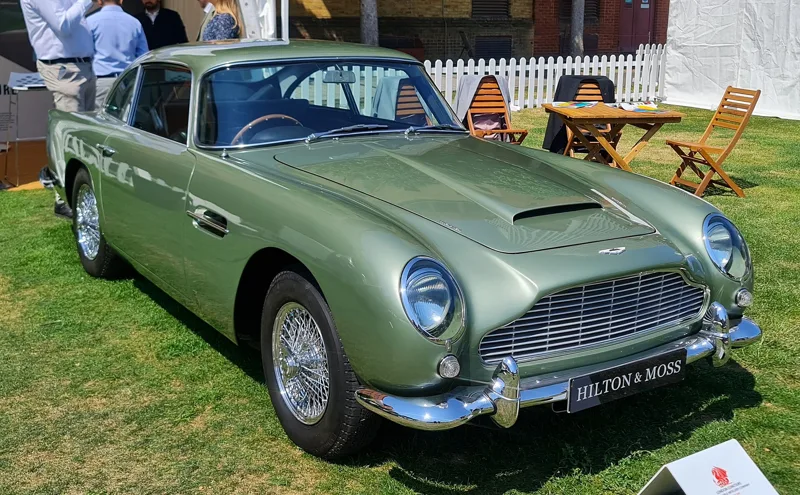
The two cars look alike, but the DB6 has a different wheelbase and side profile, split front and rear bumpers and rear panels finished with the Kammback tail. It kept the Armstrong Selectaride dampers that the driver could adjust from the cockpit and added front-door quarter windows, an oil-cooler scoop low on the front valance and revised tail-lamp clusters.
- The roof line is two inches higher, which gives rear passengers real headroom and leg room.
- The windscreen is more steeply raked yet taller.
- American cars came with chrome wire wheels on bias-ply whitewall tyres, with 185VR15 Pirelli Cinturato CA67 radials optional.
- Power steering and air conditioning were optional extras.
- A ZF five-speed manual was standard, with a BorgWarner three-speed automatic available at no extra cost.
The construction changed too. In the DB4 and DB5, the aluminium body was supported by steel tubes of one size and strength over a steel punt chassis. The DB6 used a similar chassis, but its support was a mix of tubes and steel sections that varied in size and weight according to where they were needed. It was still Superleggera construction, so Aston Martin still paid the royalty on each car, and DB6s carry a Touring of Milan plate in the engine bay and Superleggera badges on the bonnet. When Touring shut down the royalty ended, and some later cars lost the badging, though the method stayed the same. The revision meant a DB6 weighed only 7.7 kg more than a DB5, despite being longer.
How fast was the Aston Martin DB6?
The 4.0-litre (3,995 cc) twin-cam straight-six, designed by Tadek Marek, made 282 bhp (210 kW; 286 PS) at 5,500 rpm through triple SU carburettors, with 400 Nm of torque at 4,500 rpm. Aston Martin quoted 0-60 mph (97 km/h) in 6.2 seconds and a top speed of 150 mph (241 km/h).
The Vantage engine option raised output to 325 bhp (242 kW; 330 PS) at 5,750 rpm, up from the DB5 Vantage's 314 bhp, using triple side-draft Weber 45DCOE carburettors and a higher compression ratio of 9.4:1 against 8.9:1 for the standard engine. Period road tests put the Vantage at between 145 mph (233 km/h) and 148 mph (238 km/h), while John Bolster reached a two-way average of 152 mph (245 km/h) in a Vantage-spec car.
The car weighed 1,474 kg (3,250 lb). Steering was by rack and pinion with optional power assist, and the rear suspension used coil springs with ride control that could be adjusted from inside the car. The fuel tank held 19 imperial gallons, falling to 16 when air conditioning was fitted.
Mark II, Volante and Shooting Brake
The DB6 Mark II was announced on 21 August 1969. Its flared wheel arches and wider wheels carried 205VR15 Pirelli Cinturato CN72 radial tyres or Avon crossply tyres, and AE Brico electronic fuel injection with a higher-compression head was an optional extra. It shared many parts with the DBS that was then new.
The Volante convertible arrived at the 1966 London Motor Show, after the 1965-1966 "short chassis" Volantes that were built on the last of the DB5 chassis. Only 140 of the later DB6 Volantes were made, 29 of them high-output Vantage versions that collectors prize. Charles III owns a DB6 Volante Mark II converted to run on E85.
Harold Radford built six Shooting Brake estates and FLM Panelcraft added two more. One Radford car was the 1967 New York Auto Show exhibit, finished in Roman Purple, and was bought straight off the stand for $22,500, nearly three times the price of a standard DB6. The buyer's family kept it until 2017, and it was displayed at the 2018 Greenwich Concours d'Elegance.
What is the Aston Martin DBS Superleggera?
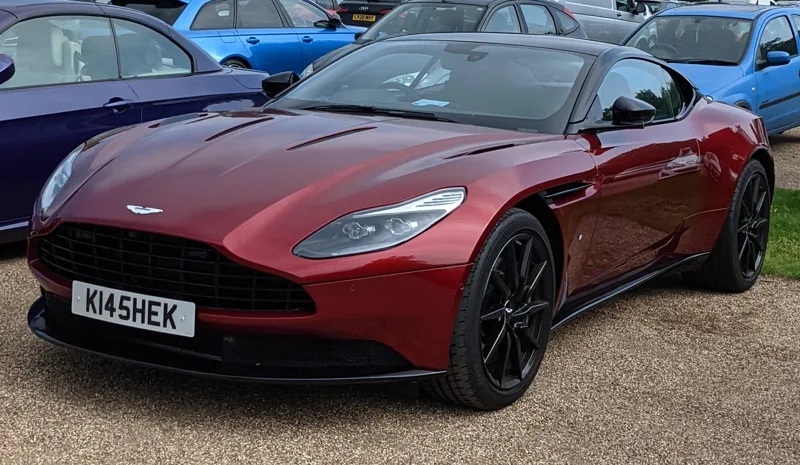
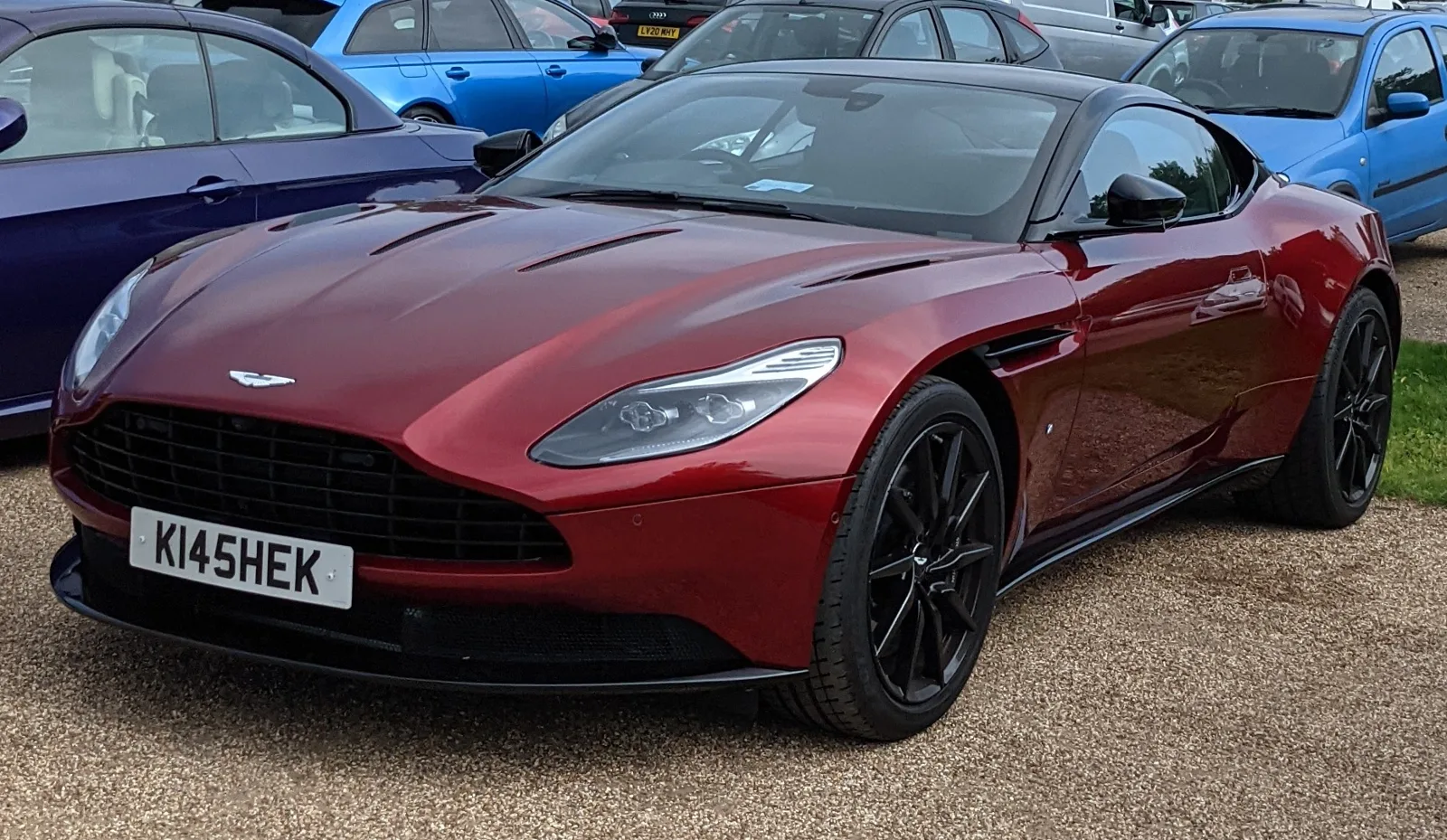
The DBS Superleggera is a grand tourer that Aston Martin built from 2018 to 2024. It was unveiled in June 2018 as the replacement for the second-generation Vanquish and is based on the DB11 V12, with changes that set it apart from the rest of the DB11 line.
The DBS name has history. It was used on a car built from 1967 to 1972 and again on a DB9-based model between 2007 and 2012. The Superleggera part honours Carrozzeria Touring Superleggera, the coachbuilder that helped Aston Martin create its featherweight tourers of the 1960s and 1970s. The third-generation Vanquish, announced in September 2024, is its successor.
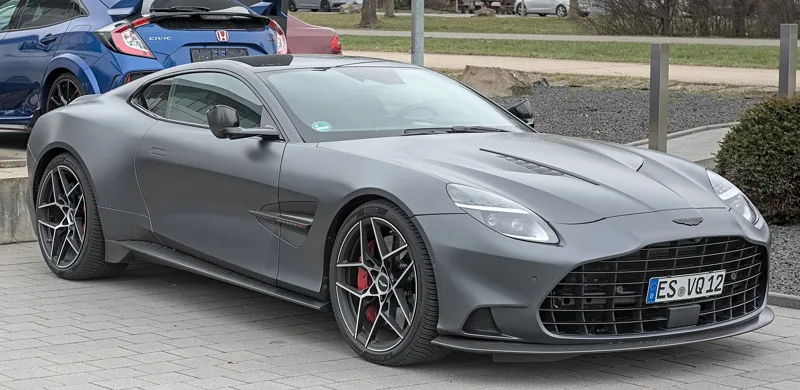
Outwardly it differs from the DB11 with a new front bumper and a larger centre grille for engine cooling. Side extractors help cool the brakes, and a pair of bonnet vents let hot air out of the engine bay.
How powerful is the DBS Superleggera?
Its 5.2-litre twin-turbocharged V12 produces 725 PS (533 kW; 715 hp) at 6,500 rpm and 900 Nm (664 lb ft) of torque from 1,800 to 5,000 rpm. The engine is cast by Grainger and Worrall in the United Kingdom and assembled at Aston Martin's engine plant in Cologne.
Engineers placed it as low and as far back in the chassis as they could, to improve the centre of gravity and weight distribution. A ZF 8HP95 gearbox has a shorter final drive of 2.93:1 against the DB11's 2.70:1, and torque vectoring and a mechanical limited-slip differential sharpen track behaviour.
Downforce is where the car broke ground. The Aeroblade system first seen on the DB11 is joined by a double diffuser inspired by Formula One, and together they produce 180 kg (397 lb) of downforce at the limit, the highest figure for any series-production Aston Martin. A quad-pipe titanium exhaust improves the sound, and carbon fibre in major areas keeps the weight to 1,693 kg (3,732 lb).
Acceleration to 100 km/h takes 3.4 seconds, and 161 km/h (100 mph) arrives after 6.4. Rolling from 80 to 161 km/h in fourth gear takes 4.2 seconds. Top speed is 340 km/h (211 mph). There are three driving modes, GT, Sport and Sport Plus.
Which special editions of the DBS Superleggera were built?
Aston Martin released a long run of limited versions, each tied to an anniversary, a brand or a film. The first, the DBS 59, marked the company's 1-2 finish at the 1959 24 Hours of Le Mans. Only 24 were made, one for each hour of the race, in Aston Martin Racing Green with bronze trim and Heritage Racing Seats. Buyers also received racing gloves, replica period helmets and a luggage set.
- Volante, April 2019: the same engine and transmission as the coupe, with an eight-layer soft top in eight colours and, for the first time on an Aston Martin, a carbon fibre windscreen surround and tonneau cover.
- TAG Heuer Edition, February 2019: 50 cars in Monaco Black with 21-inch satin black wheels, red brake calipers and a Carrera Heuer 02 watch for each buyer.
- OHMSS, May 2019: 50 cars in Olive Green, honouring 50 years of On Her Majesty's Secret Service.
- DBS GT Zagato, October 2019: shown at the Audrain's Newport Concours in Rhode Island, with output lifted from 715 hp to 760 hp. It was sold only inside the 6 million pound DBZ Centenary Collection with a DB4 GT Zagato continuation, and 19 such packs were offered.
- Concorde Edition, November 2019: 10 cars commissioned by Aston Martin Bristol, each with a registration matching one of the 10 British Airways Concordes, and some parts derived from Concorde itself.
- 007 Edition, August 2020: 25 cars in Ceramic Grey, for the 25th Bond film.
- Bijan Edition: Bijan Yellow paint with a paisley pattern on the bonnet and alligator leather inside, offered through the company's Q personalisation programme.
The send-off car, the 770 Ultimate, takes 770 PS (566 kW; 759 bhp) from the same 5.2-litre V12. Production is limited to 499 cars, 300 coupes and 199 convertibles, and every slot is already sold.
Autocar's Matt Saunders gave the standard car a perfect five stars, calling it an outstanding super-GT. The Sunday Times was more cautious, noting that low ground clearance could catch on speed bumps and that the power might make it dangerous in the wet. The DBS also appeared in the Bond film No Time to Die.
What is the Aston Martin DBX?
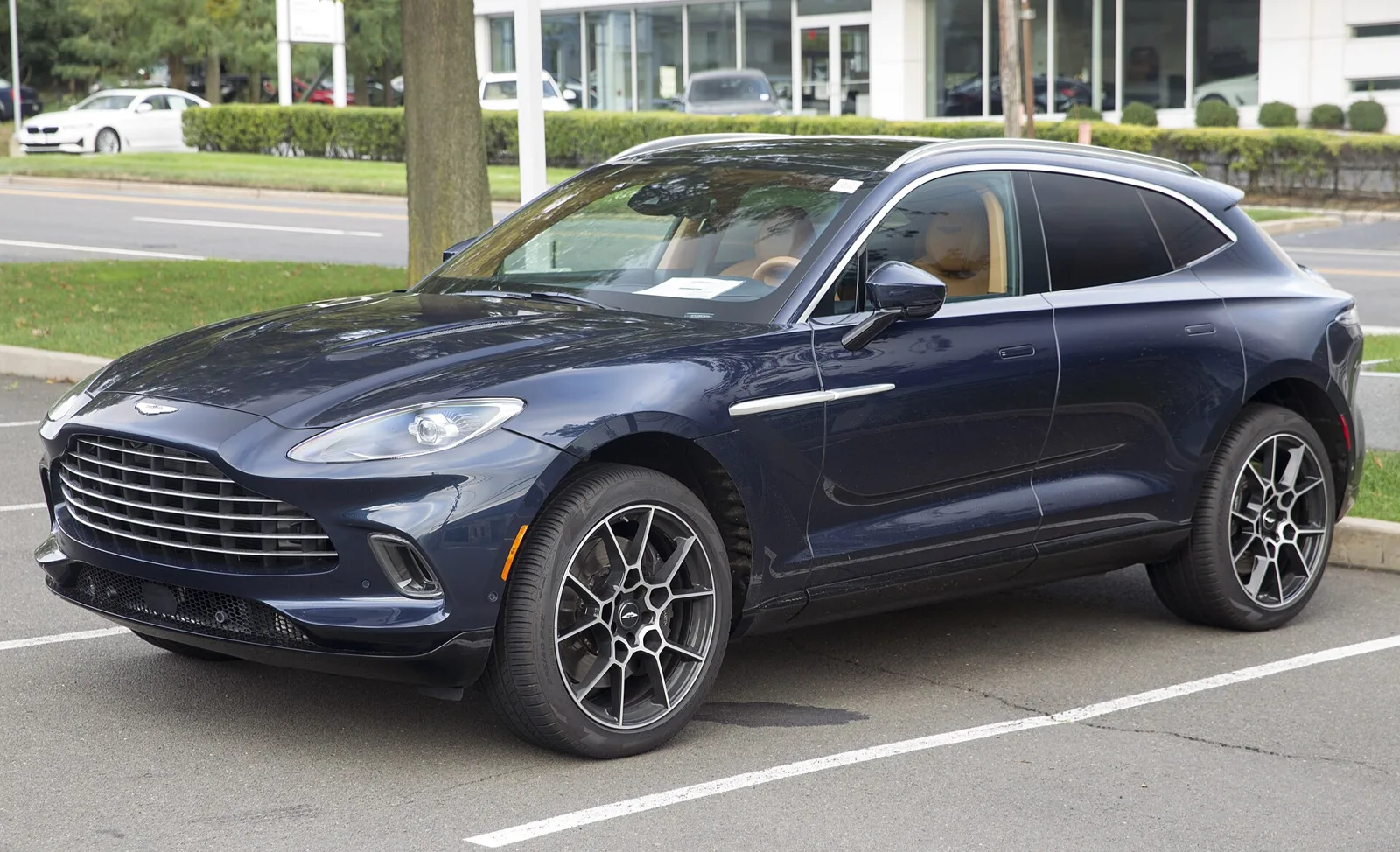
The DBX is a crossover SUV produced since 2020 and the first car built at Aston Martin's new facility in St Athan, Wales. The BBC and The Daily Telegraph called it the first full-size five-seater the company has sold.
Chief creative officer Marek Reichman says the wheelbase stretches as far as it can, putting the wheels at the corners, and that this and the low roofline make the car look smaller than it is. It has swan-hinged doors and the largest grille ever fitted to an Aston Martin.
Though related to the Vantage, the DBX sits on a dedicated platform built from bonded aluminium panels and extrusions. The powertrain and infotainment come from Mercedes-Benz. The 4.0-litre twin-turbo M177 V8 from Mercedes-AMG makes 550 PS (405 kW; 542 hp) and 700 Nm (516 lb ft), enough for a 4.5-second sprint to 100 km/h and a top speed of 292 km/h (181 mph). A nine-speed automatic is standard and towing is rated up to 2,700 kg.
A 48-volt electric active roll system counters body lean in hard cornering. There are five driving modes (GT, Sport, Sport Plus, Terrain and Terrain Plus) and an Access mode. An active centre transfer case sends torque to the front axle when needed, an electronic limited-slip differential works at the rear, and adaptive dampers and triple-chamber air springs give a wide range of ride height. In November 2021 a China-only engine arrived, Mercedes-AMG's 3.0-litre turbocharged straight-six with 435 PS (320 kW; 429 hp) and 520 Nm.
How quick are the DBX707, DBX S and DBX GT?
The DBX707, unveiled on 1 February 2022, is the most powerful of the line. Aston Martin modified the V8 and gave it ball-bearing turbochargers, lifting output to 707 PS (520 kW; 697 hp) and 900 Nm (664 lb ft). The nine-speed gearbox gained a wet clutch and new ratios, and the DBX707 reaches 60 mph in 3.1 seconds and 310 km/h (193 mph).
It also changed the suspension and steering, adding a carbon spoiler and splitter, a four-barrel exhaust and standard 22-inch wheels, with 23-inch ones optional. For the 2025 model year it received a new interior and infotainment system like the DB12's, and the standard DBX was dropped.
April 2025 brought the DBX S, a lighter and more powerful version of the DBX707. Power rises to 727 PS (535 kW; 717 hp) with the same 900 Nm, and weight can fall by up to 47 kg (103 lb) through options such as a polycarbonate honeycomb grille, a carbon roof with no roof rails and 23-inch forged magnesium wheels. The 100 km/h sprint takes 3.3 seconds, and the run to 200 km/h is a third of a second faster than in the DBX707. Top speed stays at 310 km/h.
The newest car, the DBX GT, was unveiled in October 2026 as a luxury-oriented DBX S. It has a dual-vaned grille, GT-specific 22-inch wheels and bright silver exterior trim. Inside, the seats have an extra memory foam layer and a "4+1" layout with two individual rear seats and an occasional middle one, plus a panoramic sunroof as standard. The body structure, sound dampening, exhaust and suspension are retuned, and the V8 and its performance match the DBX S.
The Formula One medical car
Formula One named the DBX its official Medical Car in an announcement made in 2021. It wears British Racing Green with neon yellow accents and sits alongside the Vantage in the series' safety fleet. From the 2023 season the DBX707 took over the job.
How do the DB6, DBS Superleggera and DBX compare?
| Feature | DB6 | DBS Superleggera | DBX | DBX707 |
|---|---|---|---|---|
| Built | 1965-1971 | 2018-2024 | From 2020 | From 2022 |
| Body | Grand tourer | Grand tourer | Crossover SUV | Crossover SUV |
| Engine | 4.0-litre straight-six | 5.2-litre twin-turbo V12 | 4.0-litre twin-turbo V8 | 4.0-litre twin-turbo V8 |
| Power | 282 bhp (Vantage 325 bhp) | 725 PS | 550 PS | 707 PS |
| Torque | 400 Nm | 900 Nm | 700 Nm | 900 Nm |
| Acceleration | 0-60 mph in 6.2 s | 0-100 km/h in 3.4 s | 0-100 km/h in 4.5 s | 0-60 mph in 3.1 s |
| Top speed | 150 mph (241 km/h) | 340 km/h (211 mph) | 292 km/h (181 mph) | 310 km/h (193 mph) |
| Gearbox | ZF five-speed manual or BorgWarner automatic | ZF 8HP95 eight-speed | Nine-speed automatic | Nine-speed automatic, wet clutch |
What replaced the DBS Superleggera and the standard DBX?
The DBS Superleggera has already been succeeded: Aston Martin announced the third-generation Vanquish in September 2024. The 770 Ultimate send-off cars are sold out. On the SUV side the DBX GT, revealed in October 2026, adds a luxury-focused version to a range that now runs through the DBX707, the DBX S and the DBX GT, since the standard DBX was dropped for the 2025 model year.