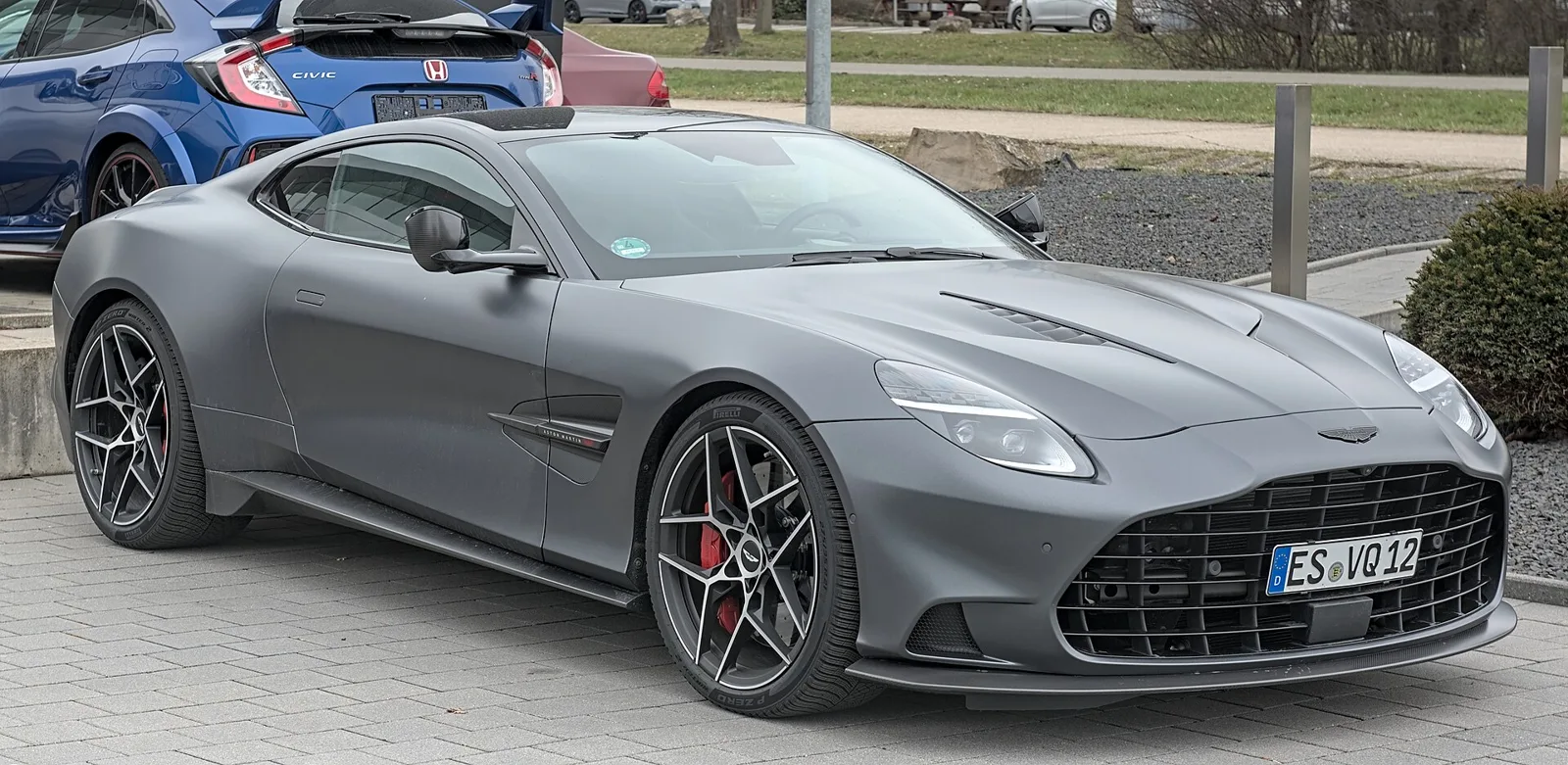
Ian Callum's 2001 grand tourer, its Volante convertibles and a third generation with an 835 PS twin-turbo V12.
The Aston Martin Vanquish is a grand tourer built in three generations, starting with the V12 car of 2001. The first generation ran until 2007, the second from 2012 to 2018 and the third from 2024, with Volante convertibles added along the way.
The Aston Martin Vanquish is a British grand tourer that has been built in three generations since 2001. Ian Callum styled the first car, which served as the flagship of its maker until 2007, while later versions moved to a new platform and a twin-turbo V12 producing 835 PS (614 kW; 824 hp). This guide follows each generation, the special editions and the car's appearances on screen.
Where did the Vanquish come from?
Aston Martin introduced the Vanquish in 2001 as the successor to the Virage, which had been introduced in 1993. Callum designed the V12 Vanquish, which made its debut at the 2001 Geneva Motor Show. It was built from 2001 to 2007 as the flagship of the marque.
The starting point was a concept called Project Vantage. It was the first Aston Martin that Callum had designed entirely by himself, and it evolved directly into the production V12 Vanquish. The concept was meant to show where the brand's future sports cars could go.
The production car closely resembled that concept. A mildly updated version, the V12 Vanquish S, arrived in 2004 with a more highly tuned engine and a more track-oriented ride, giving the range a sharper edge.
After 2007 the DBS indirectly took over the role the Vanquish had held. The name then returned in 2012 for a second-generation car built on the VH platform.
Three generations later, the Vanquish name still stands for Aston Martin's most ambitious grand tourer.
How was the first-generation car styled?
Ian Callum gave the first-generation Vanquish an aggressive stance drawing on the DB4 GT Zagato. It projected a more aggressive presence than his earlier DB7 Vantage, and the production model closely matched the concept that debuted in January 1998 at the North American International Auto Show.
The body sat on a bonded aluminium chassis with a carbon fibre backbone, developed in partnership with Lotus. That structure gave the car a distinct engineering identity within the range.
Callum's design also made the car easy to tell apart from the later Vanquish models, which shared the name but not the chassis.
What did the first-generation V12 deliver?
The first-generation car used a naturally aspirated 5,935 cc V12 with 343 kW of power, equal to 460 hp or 466 PS, arriving at 6,500 rpm. Peak torque reached 542 N m (400 lb ft) at 5,000 rpm, and the car reached a top speed of 306 km/h (190 mph).
The engine is a 60 degree DOHC V12, and Aston Martin described it as its most powerful V12 at that point. Those figures made the first generation the performance benchmark of its era for the company.
What changed on the Vanquish S?
The Vanquish S arrived in 2004 with the same basic V12 pushed to 388 kW; 520 hp (527 PS), and its torque rose to 578 N m (426 lb ft). Its top speed rose to 322 km/h (200 mph), and it went from 0-60 mph in 4.2 seconds.
Styling changes were modest, and the third high-level brake light moved onto the boot spoiler. The car kept the look of the original while gaining a more track-minded character.
Aerodynamics also improved. The drag coefficient fell from 0.33 to 0.32, which trimmed the car's resistance to the air.
What did the second generation bring?
The second-generation Vanquish was built at Gaydon on the VH platform that also underpinned the DB9. Its upgraded 5.9-litre V12 produced 421 kW, or 565 hp (573 PS), at 6,750 rpm, and it reached 100 km/h in 4.1 seconds. Kerb weight was 1,739 kg (3,834 lb).
Marek Reichman designed this generation, which began life as the Project AM310 concept shown at Villa d'Este in 2012. Its sides and rear borrowed flourishes from the One-77, and the design carried the family look forward.
The engine sits at the front with the transmission at the rear, giving the car a 51/49 front to rear weight split. Its boot holds 368 litres, which is over 60% larger than the DBS's.
The gearboxes changed during the run. The 2012 to 2014 cars used a ZF Touchtronic II six-speed automatic, and from the 2015 model year the car switched to the ZF Touchtronic III eight-speed. It was also the first Aston Martin model offered with launch control.
The Volante convertible arrived in 2013. It is 13% torsionally stiffer than the outgoing DBS Volante, and its boot is 50% larger than its predecessor's.
The second-generation Vanquish S used an AM29 V12 with 444 kW; 595 hp (603 PS). A Vanquish S Volante convertible was shown in 2017.
The second generation ended its run in 2018, when the DBS Superleggera replaced it.
What is the third-generation Vanquish?
The third-generation Vanquish was unveiled on 2 September 2024 with a twin-turbo 5.2-litre V12 and an eight-speed ZF gearbox. Output is 835 PS (614 kW; 824 hp), and torque reaches 1,001 N m (738 lb ft), while the coupe hits 100 km/h in 3.2 seconds on the way to 344 km/h (214 mph).
The new car is built on a revised form of the architecture shared by the DB12 and Vantage. Its coupe weighs 1,774 kg (3,911 lb), which makes it 89 kg (196 lb) heavier than the DB12.
Production is limited to under 1,000 units each year, which keeps the model exclusive. The Vanquish Volante was unveiled on 25 March 2025, and it accelerates to 100 km/h in 3.4 seconds with the same top speed as the coupe.
Which special editions were built?
The most notable special editions include the Vanquish S Ultimate Edition, whose final 50 cars used Ultimate Black paint, and a run of 12 Tom Brady Signature Edition Volantes for the 2018 model year. The Vanquish 25 restoration package by Ian Callum Design was limited to 25 cars.
The Vanquish S Ultimate Edition celebrated the end of production. Its last cars carried personalised sill plaques along with the Ultimate Black finish.
The Tom Brady Signature Edition Volantes were hand made by the Q division, and they formed a small, distinct run within the range.
The Vanquish Zagato Roadster was a one-off two-seat open-top car restyled by Zagato. It was first shown as a prototype at the 2004 Geneva show, and it was later offered at a Bonhams auction in Carmel in August 2015, with an estimate of US$700,000-850,000.
The Vanquish Bertone Jet 2 was a two-door shooting brake shown at the 2004 Geneva show. Giuliano Biasio designed it at Bertone, and its name recalls the 1960 DB4 GT Jet.
Vanquish 25 came from Ian Callum Design, which revealed the restoration package in September 2019 for first-generation cars. Only 25 cars were to be built by R-Reforged, and the tuned V12 produced 432 kW; 580 hp (588 PS), which is 45 kW (60 hp) more than the Vanquish S.
What was the Vision concept?
The Vanquish Vision concept appeared at the 2019 Geneva Motor Show with a rear mid-engine layout and a 3.0-litre V6. Its engine was rated at over 520 kW; 700 hp (710 PS), and the production version was planned for 2023 before being cancelled, making it a clear break from the V12 cars.
The mid-engined Vanquish never reached showrooms. The plan for 2023 production was dropped, and the concept remains the clearest picture of that direction.
How did the Vanquish feature in film and games?
The first-generation Vanquish gained its best-known role in Die Another Day, the 2002 James Bond film, where it served as Bond's gadget-loaded car. It also appeared in the 2003 remake of The Italian Job, driven by Steve Frazelli, played by Edward Norton.
The Bond car carried machine guns and missiles in the grille, tyre spikes for snowy roads and an ejector seat. Those features made it one of the most memorable vehicles in the franchise.
Its screen fame helped the car's reputation. It was ranked third on the Best Film Cars Ever list, behind the Minis and the DB5.
The car has also appeared in several racing and James Bond video games, which extended its presence beyond cinema screens.
How was the Vanquish received?
Reviewers generally welcomed the first-generation V12 Vanquish. Road and Track called it the ultimate grand tourer, while Car and Driver described it as a credible rival to the best Ferrari. Along with the DB4 GT Zagato, it was also recognised as one of the ten most beautiful cars of all time.
Its design drew as much attention as its engineering, and the car's film appearances added to a reputation that the press had already established.
Later generations attracted their own reviews, but the first car remains the one most closely linked with the name.
What ended first-generation production?
The first generation ended production on 19 July 2007, a date that coincided with the closure of the Newport Pagnell factory after 49 years of operation. The V12 Vanquish was the last all-new model built at that site. Its successor, the second-generation car, was built instead at Gaydon.
Newport Pagnell had been Aston Martin's home for 49 years, and the first Vanquish closed that chapter.
The Gaydon factory then took on the next generation, which used the VH platform shared with the DB9.
What are the Aston Martin Vanquish specifications?
Across three generations the Vanquish moved from a naturally aspirated 5,935 cc V12 making 460 hp to a twin-turbo 5.2-litre V12 making 824 hp. The second-generation coupe weighed 1,739 kg (3,834 lb), and the third generation has a kerb weight of 1,774 kg (3,911 lb). The table below gives the main figures.
| Specification | Detail |
|---|---|
| Production years | 2001-2007; 2012-2018; 2024 onward |
| Engine, first generation | 5,935 cc naturally aspirated V12 |
| Power, first generation | 343 kW; 460 hp (466 PS) at 6,500 rpm |
| Torque, first generation | 542 N m (400 lb ft), peaking at 5,000 rpm |
| Top speed, first generation | 306 km/h (190 mph) |
| Engine, second generation | 5.9-litre V12, 421 kW; 565 hp (573 PS) at 6,750 rpm |
| 0-100 km/h, second generation | 4.1 seconds |
| Kerb weight, second generation | 1,739 kg (3,834 lb) |
| Engine, third generation | Twin-turbo 5.2-litre V12, 835 PS (614 kW; 824 hp) |
| 0-100 km/h, third generation | 3.2 seconds |
| Top speed, third generation | 344 km/h (214 mph) |
| Kerb weight, third generation | 1,774 kg (3,911 lb) |
| Production limit, third generation | Under 1,000 units a year |
The Volante figures sit outside the table. Its kerb weight of 1,869 kg (4,120 lb) puts it above the coupe, and it reaches 100 km/h in 3.4 seconds.
_DSC_7892.jpg)