Allegations that patents on large nickel metal hydride batteries slowed electric cars, from the GM EV1 and Toyota RAV4 EV to the Chevron-controlled Cobasys venture.
The term covers allegations that patents held by General Motors, Chevron and their partners kept large NiMH packs out of electric cars. The events run from GM's 1994 stake in Ovonics to the expiry of a key Chevron patent in 2018.
Patent encumbrance of large automotive NiMH batteries is the name given to allegations that patent holdings were used to keep nickel metal hydride packs out of electric cars. The dispute centres on the battery patents of Stanford Ovshinsky, General Motors' 1994 stake in Ovonics, and the Chevron-controlled Cobasys venture, which held licensing power over large-format cells until a key US patent expired in 2018.
What is the patent encumbrance dispute about?
The claim is that large nickel metal hydride (NiMH) batteries could have powered mainstream electric cars sooner, but that patent holders and their partners blocked that route to market. The most detailed record comes from lawsuits and arbitration between Chevron and ECD Ovonics, along with public statements by Ovshinsky and by critics of the car and oil industries. Those statements are allegations rather than findings, and they remain contested.
Whether patents were the decisive reason large NiMH packs stayed out of mainstream cars remains a contested question, not a settled one.
Why was nickel metal hydride seen as the EV battery of choice?
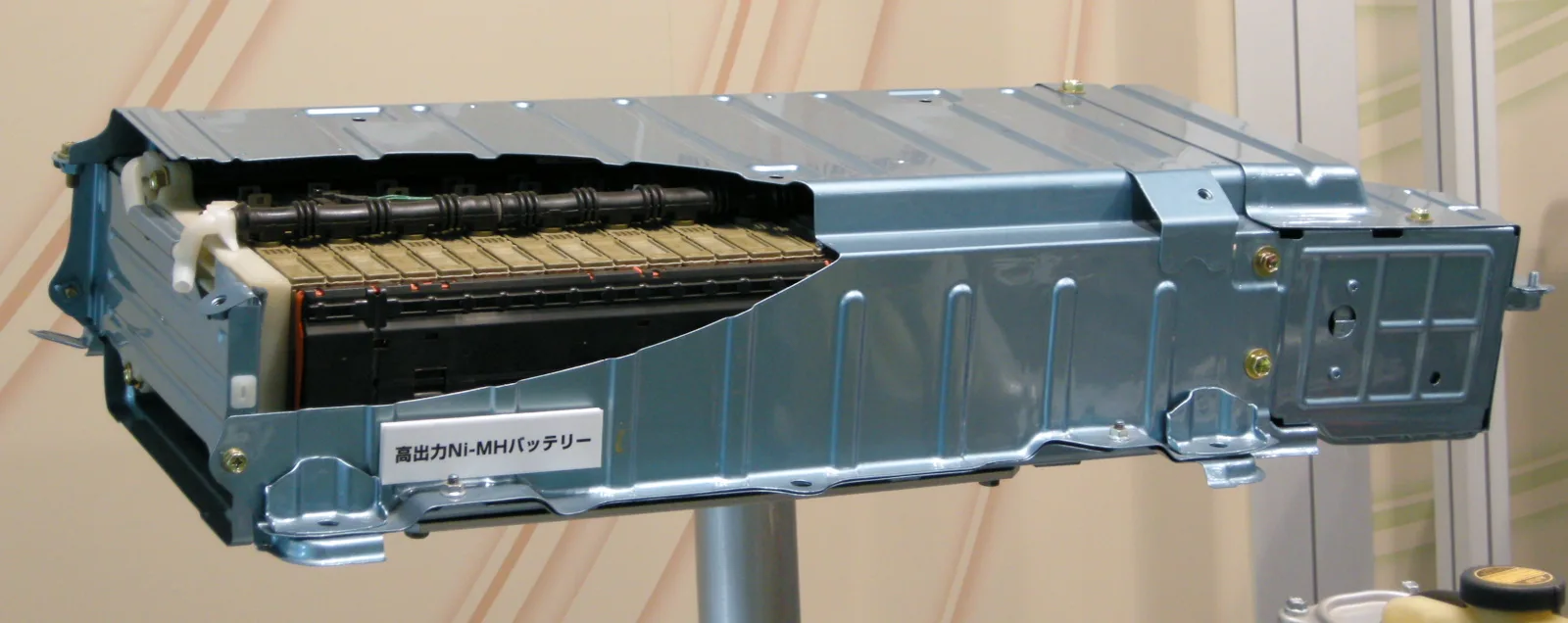
NiMH was regarded as important to battery electric vehicles, plug-in hybrids and hybrid electric vehicles before lithium-ion packs became a practical replacement. The modern automotive NiMH pack is credited to Dr. Masahiko Oshitani of GS Yuasa Corporation and to Stanford Ovshinsky, founder of the Ovonics Battery Company, who was granted a patent for the design.
Each chemistry had clear strengths and weaknesses. The United States Department of Energy listed lithium's power-to-weight figures and energy efficiency, its performance when hot and its low self-discharge over long idle periods as key advantages. NiMH cells showed higher self-discharge, generated heat at high temperatures and suffered hydrogen loss. None of those drawbacks stopped the Toyota Prius from earning an excellent reliability rating.
Lithium's own safety record was debated. In 2007 the National Renewable Energy Laboratory warned that lithium-ion cells could overheat and catch fire if they were mishandled or damaged. In 2011 the National Highway Traffic Safety Administration examined lithium battery vehicles and found they carried no greater fire risk than ordinary cars.
By 2009 Toyota was testing lithium batteries as a possible replacement for the NiMH packs in its Prius. Toyota kept NiMH for the Prius but planned a lithium-based all-electric model. Lithium-ion offered higher specific energy and power, but it cost more and had been relatively untested over the long term.
Was NiMH ready for the 1990s electric car market?
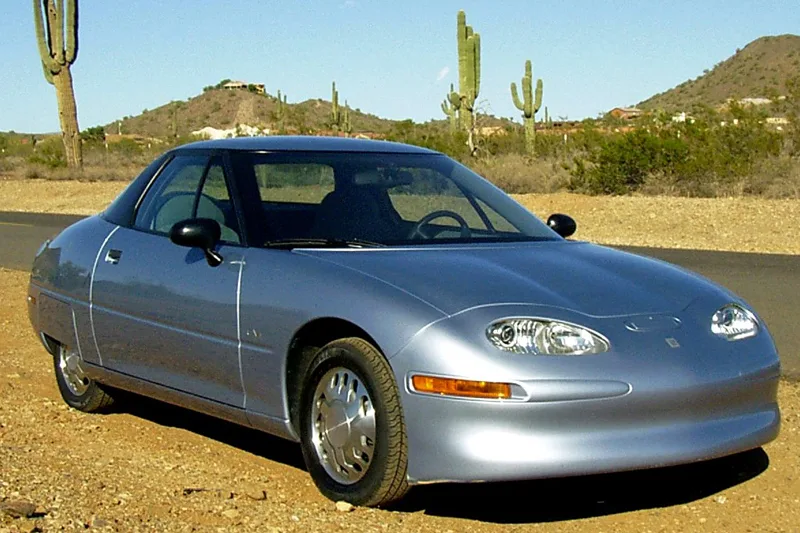
The industry said it was not, and that claim sits at the heart of the dispute. The 1999 General Motors EV1 used a NiMH pack of 26.4 kWh with an EPA range of 105 miles. The 2011 Nissan Leaf carried a smaller 24 kWh battery with an EPA range of 84 miles, yet it found 200,000 buyers worldwide before its battery capacity was first increased in 2016.
On that comparison, the argument that NiMH was not advanced enough in the 1990s looks weak. The comparison holds mainly for two-seat cars, which could more easily accommodate a large, heavy battery. A family hatchback has different packaging demands, so the numbers do not settle the question on their own.
| Specification | Detail |
|---|---|
| 1999 GM EV1 battery | 26.4 kWh of nickel metal hydride |
| 1999 GM EV1 EPA range | 105 miles |
| EV1 range with the Ovonics battery in field tests | Over 150 miles |
| 2011 Nissan Leaf battery | 24 kWh |
| 2011 Nissan Leaf EPA range | 84 miles |
| Leaf buyers worldwide before the 2016 battery increase | 200,000 |
How did General Motors and the USABC shape the dispute?
The US Auto Battery Consortium (USABC) was formed by the auto industry in the early 1990s. Ovshinsky later said, in an interview for the 2006 documentary Who Killed the Electric Car?, that the consortium was used to stop knowledge of his battery patents reaching the public through the California Air Resources Board, known as CARB. He also argued that the industry falsely suggested NiMH was not ready for road cars.
Ovshinsky said that members including General Motors, Ford and Chrysler threatened legal action if he kept promoting NiMH for battery electric vehicles or kept lending test batteries to Solectria, a start-up outside the consortium. The Big Three argued that their matched federal grant to Ovonics gave them exclusive rights to the technology. Critics, by contrast, believe the Big Three were more concerned with winning over CARB members, who might otherwise judge electric vehicles unworkable on technical and commercial grounds.
What happened to the EV1 battery deal?
In 1994 General Motors took a controlling stake in the battery development and manufacturing arm of Ovonics, including patents covering large NiMH cells. The equity alliance was originally meant to develop NiMH packs for the EV1. John Williams, a GM manager who had criticised CARB, later took over sales of GM-Ovonics batteries, and Ovshinsky reportedly questioned whether selling to GM had been a naive move.
GM ended the EV1 programme before the replacement NiMH pack reached wide production. Field tests, meaning real use by customers, reportedly showed the Ovonics battery extending the EV1's range to over 150 miles. Customers held the cars from 1999 until 2003. GM then took them back from lessees over their protests and crushed them.
How did Chevron and Cobasys control large NiMH batteries?
The Chevron link began in October 2000, when Texaco announced it would buy General Motors' share of GM Ovonics, and Chevron then acquired Texaco. By 2003 the business had become Cobasys, a 50/50 joint venture between ChevronTexaco and Ovonics. The venture could block any sale or licence of NiMH technology, giving Chevron a decisive say over who could build large batteries.
Early in 2001, Ovonics, by then under Chevron control, sued Panasonic, Toyota's battery supplier, and Toyota as well. The 2004 settlement brought cross-licensing of patents, a shared research effort on the chemistry and restrictions on certain large-format transport uses until 2010. A gag order on Toyota reportedly kept the banned uses secret, and that order is linked to Panasonic not developing size C and D Eneloop batteries.
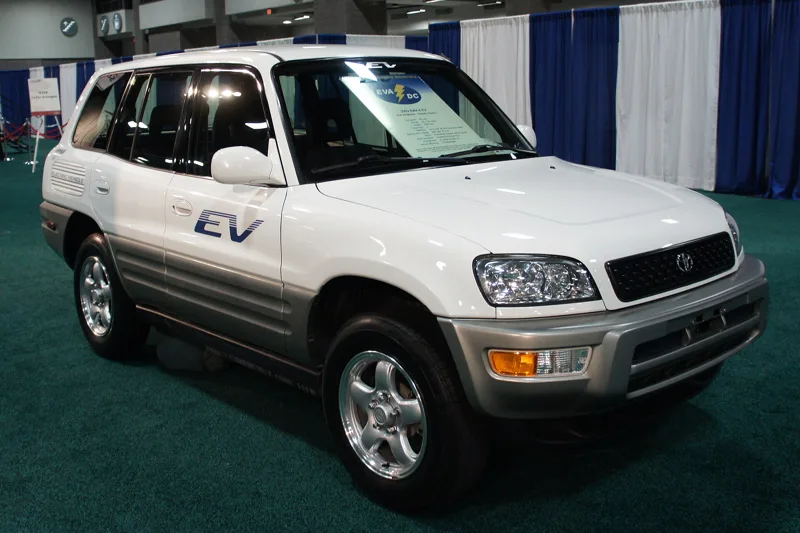
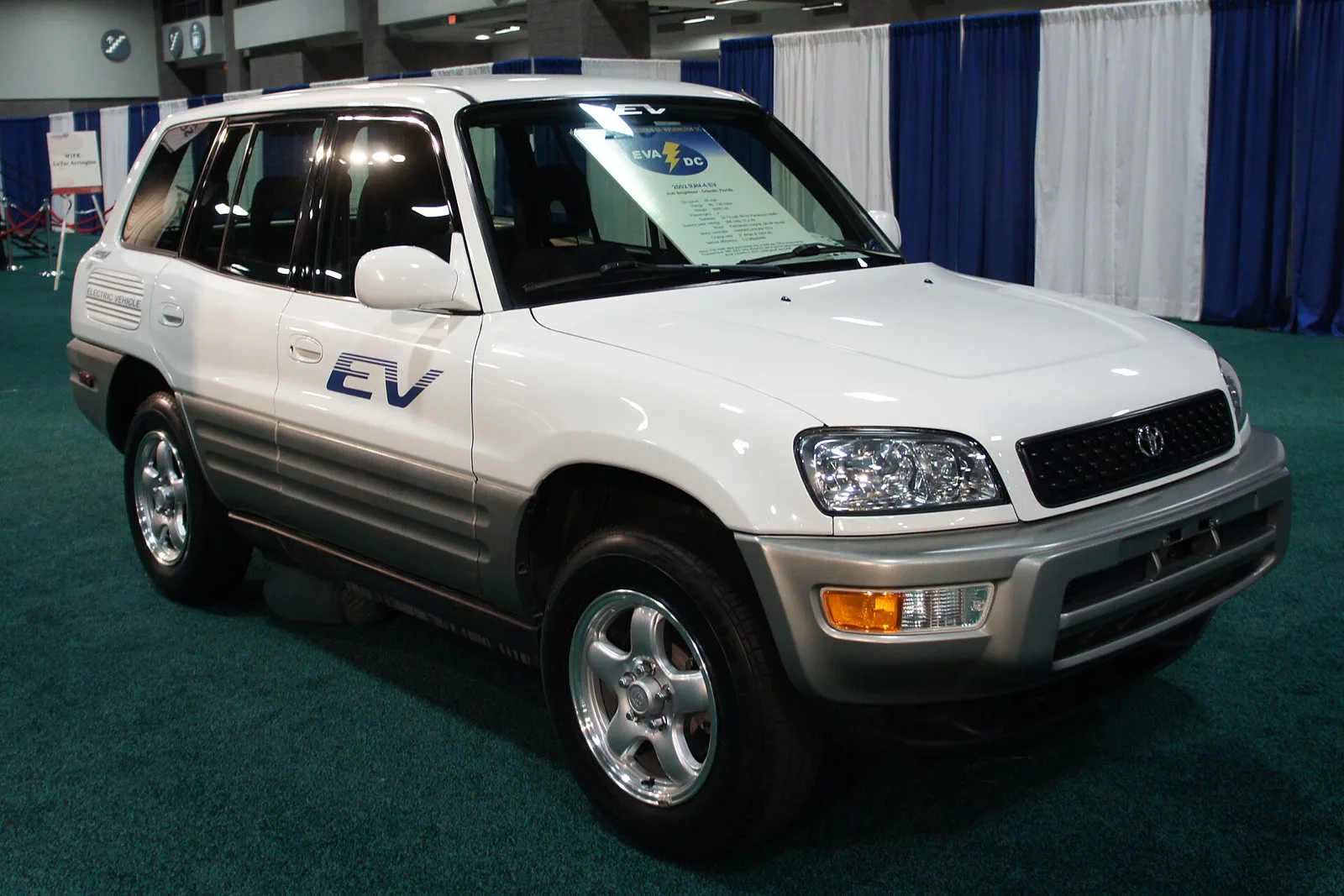
The settlement hit the RAV4 EV directly. Reports say the arrangement pushed Toyota to stop building the first-generation RAV4 EV, although existing cars were not scrapped. Toyota let buyers purchase the cars from March 2002, and sales ended in November 2002, shortly before an arbitration agreement in December 2002. Deliveries of the last cars continued until September 2003, with some built from spare parts.
Toyota employees complained that smaller orders of large-format batteries were hard to obtain, even though 825 RAV4 EVs needed servicing. Toyota continued to use NiMH in the non-plug-in Prius, so the restriction fell on plug-in vehicles. Until the relevant Chevron patents ran out, no fresh NiMH electric model reached American buyers, whether for sale or lease.
Why did Cobasys refuse large orders?
In a 2007 book on plug-in hybrids, Sherry Boschert argued that large-format NiMH batteries, those of 25 amp-hours or more, were commercially viable. Her point was that Cobasys would accept only very large orders, more than 10,000 batteries, which in practice excluded small companies, individuals and many test fleets.
Dave Goldstein, president of the Electric Vehicle Association of Washington D.C., argued that a large battery plant only pays off with guaranteed volumes of 100,000 batteries (about 12,000 EVs) a year over 3 years. Boschert set out two readings of Cobasys' conduct: that it was squeezing out a rival to petrol, or that it wanted the market to itself while waiting for a major automaker to build plug-in hybrids.
Ovshinsky took the first view in an interview with The Economist. He said ECD had made a mistake by forming a joint venture with an oil company, and that it was unwise to partner with a firm whose approach could drive it out of business. In the same interview he rejected the idea that Cobasys was stopping anyone, saying it simply needed an infusion of cash.
What lawsuits involved Cobasys?
The disputes went beyond Chevron and its partner. On 10 September 2007 ChevronTexaco sued ECD Ovonics, claiming it had failed to meet its contractual obligations. ECD disputed the claim, and arbitration was paused several times while talks with General Motors about buying Cobasys back went on. As of March 2008 no agreement had been reached.
Outside buyers also went to court. In October 2007 International Acquisitions Services, Inc. and Innovative Transportation Systems AG sued Cobasys and its parents for refusing to fill a large order previously agreed for large-format NiMH batteries for the Innovan electric vehicle. In August 2008 Mercedes-Benz sued Cobasys over a similar refusal of an agreed order for NiMH batteries.
Did other companies build NiMH batteries without Ovonics patents?
Several companies tried to work around the Ovonics patents. Electro Energy worked with CalCars to turn a Prius into a plug-in using its own bipolar NiMH cells. Plug-In Conversions fitted Nilar NiMH packs and an open-source control system from EAA-PHEV to its Prius conversions.
Both groups maintained that their technologies were not covered by Cobasys patents. Their batteries became commercially available in late 2007, showing that independent NiMH packs for conversions were reachable outside the main consortium.
When did the key NiMH patents expire?
The patent position loosened in stages. On 3 February 2010 Japanese patent JP2003504507 was refused, which removed the encumbrance in Japan. On 2 July 2010 US patent US6413670 expired because the fee for its eighth year was not paid, which removed the encumbrance in the USA.
Chevron held US patent US6969567 for a NiMH multi-cell battery pack for cars until its expiry on 23 August 2018. Its maintenance fees for the fourth (2008) and eighth (2012) years had been paid. By December 2019 the application status was recorded as expired for fee-related reasons.
Who took control of the technology after Cobasys?
In late July 2009 Automotive News reported that SB LiMotive, a joint venture of Bosch and Samsung, would acquire Cobasys from Energy Conversion Devices and Chevron. Control of NiMH technology passed back to ECD Ovonics at that sale. In October 2009 ECD Ovonics said its next-generation NiMH batteries would offer specific energy and power comparable to lithium-ion, at a significantly lower cost.
BASF bought Ovonic Battery Company from Energy Conversion Devices in February 2012. The Chevron patent remained in force until 2018, so the change of ownership did not by itself remove the earlier restrictions.
Does the dispute still matter for electric vehicles?
The record shows a technology with real reliability evidence and real customers, alongside a series of supply and legal decisions that limited it. Whether patents were the decisive reason large NiMH packs were not used more widely remains a contested view rather than an established finding. Supporters of the inventor point to the EV1 field tests, the RAV4 EV history and the refused orders, while Ovshinsky himself denied that Cobasys was blocking anyone.
His own position shifted over time. He regretted the oil-company partnership, yet insisted that Cobasys was not preventing anybody. That tension is why the dispute is still discussed: it concerns business choices, patent strategy and regulatory pressure as much as the chemistry itself.