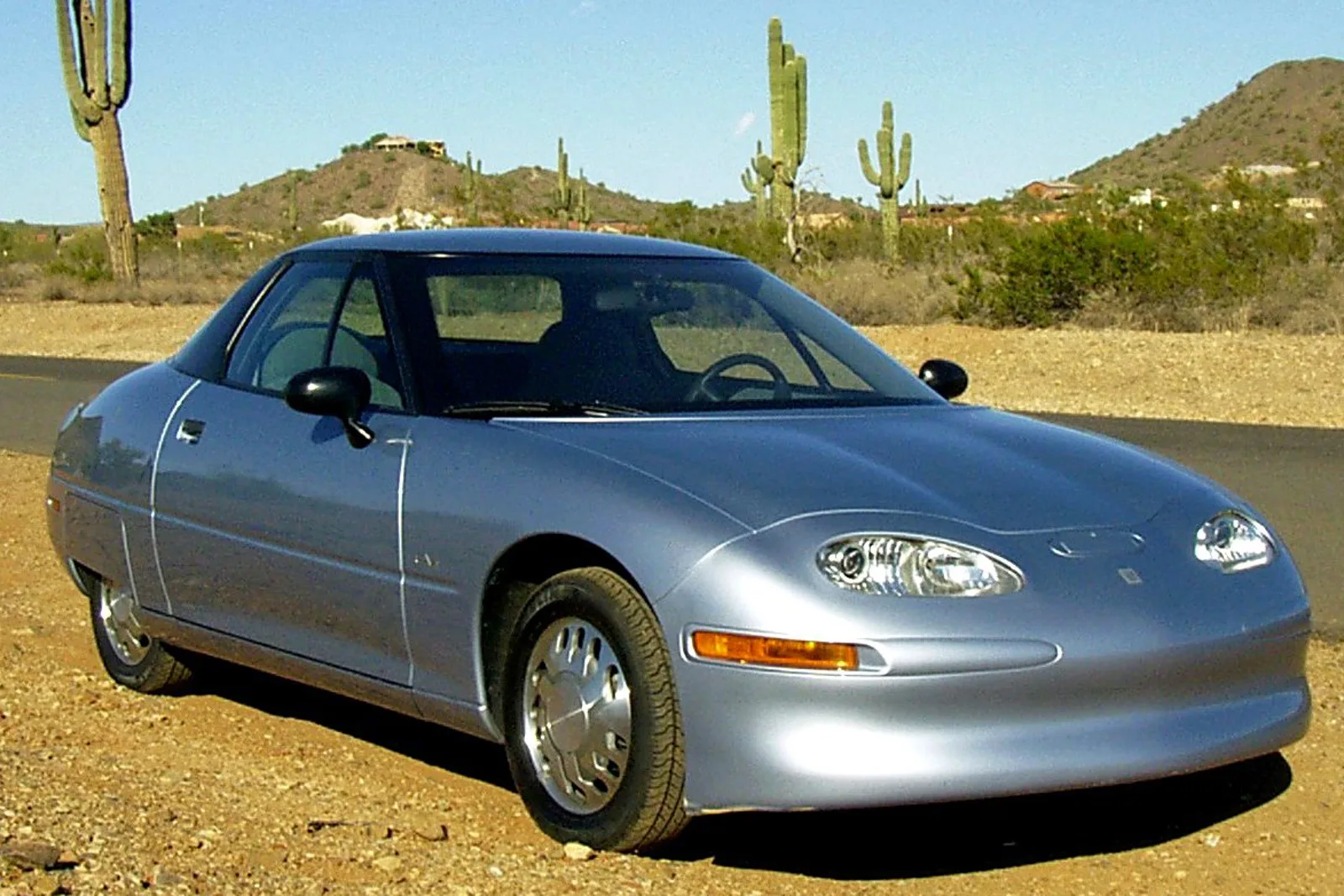
A purpose-built electric coupe leased to a few hundred households, a state rule that demanded it, and the argument that has followed its crushing for two decades.
The GM EV1 was a two-seat electric coupe built from 1996 to 1999, produced to meet California's 1990 zero-emission mandate. GM leased rather than sold it, judged electric cars an unprofitable niche, ended the programme in 2003, and reclaimed and crushed most of the cars.
General Motors leased its EV1 electric coupe and never sold one, and when the programme ended in 2003 the company took the cars back and crushed most of them, over the protests of the people driving them. How a car that customers praised came to be reclaimed is one of the more argued-over stories in the history of the motor industry.
What was the GM EV1?
The EV1 was a two-door, two-seat subcompact coupe that General Motors produced from 1996 to 1999. No major American maker had tried a purpose-built, mass-produced electric car before it, and it arrived after the introduction of the 1990 emissions standards in the United States. Rather than adapting an existing petrol model, GM designed it as an electric car from the start.
It came in two short generations. The first cars went to customers in California, Arizona and Georgia, and within a year leasing schemes had opened in other American states. At the 1998 Detroit Auto Show GM also showed several EV1 prototypes: two hybrids, one series and one parallel, a version running on compressed natural gas, and a four-door conversion.
Customers loved it, GM called electric cars an unprofitable niche, and most of the cars were crushed.
How did California's zero-emission rule drive the EV1?
In 1990 the California Air Resources Board required the seven largest carmakers selling in the United States to put zero-emission vehicles on the market if they wanted to keep selling in California at all. The target was 2 percent of each maker's fleet by 1998, rising to 5 percent by 2001 and 10 percent by 2003, depending on consumer demand. This is the CARB ZEV mandate that sits behind the EV1.
CARB is an agency of the California government set up in 1967, when Governor Ronald Reagan signed the Mulford-Carrell Act. It exists to reduce air pollution, and its first chair, Dr Arie Jan Haagen-Smit, is credited with working out what causes smog in California. Under the federal Clean Air Act, California is the only state allowed to issue its own vehicle emissions standards, subject to a waiver from the Environmental Protection Agency. Other states can follow either the California rules or the federal ones, but cannot write their own. New York, for one, adopted the California programme.
CARB justified the 1990 mandate by pointing to California's air, which it said at the time was worse than the combined pollution of the other forty-nine states. The zero-emission requirement was part of a wider Low-Emission Vehicle programme, first adopted in 1990 and covering cars sold in California from 1994 through 2003. Before all this, electric car development had largely stalled through the 1970s and 1980s, a period in which over 80 percent of American vehicles were powered by V8 engines. Federal changes, the 1990 Clean Air Act Amendment and the 1992 Energy Policy Act, joined the California rules to revive interest. Toyota, Nissan and Honda, fellow members of the former American Automobile Manufacturers Association, built prototype zero-emission cars of their own.
From the Impact to the EV1, the GM EV1 history
The story starts at the 1990 Los Angeles Auto Show, where GM chairman Roger Smith unveiled a battery electric concept called the Impact. GM first planned 20,000 units and later raised the goal to 100,000 a year; on 18 April 1990 Smith announced the car would go into production, with a stated goal of 25,000 annually. The Impact was developed by the electric vehicle company AeroVironment and drew on what GM had learned when its Sunraycer won the 1987 World Solar Challenge, a solar-powered race across Australia. Alan Cocconi of AC Propulsion designed the original drive electronics, which Hughes Electronics refined. Thirty-two lead-acid batteries powered it, and a modified Impact took the land speed record for a production electric vehicle, reaching 295 km/h (183 mph), in 1994.
That same year GM ran a programme called PrEView, lending fifty hand-built Impact cars to drivers for one to two weeks at a time on the condition that they report back. Feedback was positive, and so were the motoring magazines. Motor Trend called it the one electric vehicle that drove like a proper car. Yet a front-page New York Times report suggested GM was preparing for a flop and hoped lawmakers and regulators would agree and postpone or scrap the deadline. GM considered PrEView a failure and concluded that the market was not yet ready for electric cars. Dennis Minano, who ran energy and environment matters as a GM vice president, asked whether buyers wanted them at all, and Chrysler's chairman Robert James Eaton said in 1994 that nobody could forecast that an electric car could be made.
The doubts drew a rebuttal from Thomas C. Jorling, New York State's commissioner of environmental conservation. He said consumers had shown real interest and suggested that carmakers were unwilling to move off internal combustion because of their huge existing investments. The fifty Impacts were destroyed after testing, and the design evolved into the EV1 by 1996.
How did the EV1 work?
Most of the engineering aimed at one thing: squeezing every kilometre out of a limited battery. GM wind-tunnel tested the shape, fitted partial skirts over the rear wheel arches and made the rear track 230 mm (nine inches) narrower than the front, giving the body a teardrop outline. The result was a drag coefficient of 0.19 and a drag area of 0.367 square metres (3.95 square feet). Magnesium alloy wheels and Michelin tyres designed for low rolling resistance, run at 50 psi on fourteen-inch wheels, kept the car rolling easily.
The aluminium spaceframe weighed just 130 kg (290 lb), 40 percent less than a typical steel frame, and was clothed in plastic: reinforced fibreglass for the roof, doors and hood, and polyurethane for bumpers and interior fascias. At 4,310 mm (169.7 inches) it was a compact two-seater.
Braking recovered energy. When the driver pressed the pedal, the motor turned into a generator, slowing the car and feeding power back to the battery, in the way a bicycle dynamo turns wheel motion into electricity. The anti-lock system was electrically operated, with electro-hydraulic front discs and fully electric rear drum brakes, an industry first. Because an electric car throws off very little waste heat, GM gave the EV1 a heat pump for the cabin that used about a third of the energy of a conventional heating and cooling system, though it worked only above -1 C (30 F).
The three-phase AC induction motor made 102 kW (137 brake horsepower) at 7,000 rpm and a constant 150 newton metres (110 pound-feet) of torque from standstill up to 7,000 rpm, sent to the front wheels through a single-speed reduction gear. Charging used the Magne Charge inductive paddle, built by Delco Electronics.
| Battery pack | Weight | Rating | Range |
|---|---|---|---|
| First generation lead-acid (Delco Remy) | 533 kg (1,175 lb) | 53 Ah at 312 V (16.5 kWh) | 97 to 161 km (60 to 100 miles) |
| Second generation lead-acid (Panasonic) | 590 kg (1,310 lb) | 60 Ah at 312 V (18.7 kWh) | 130 to 160 km (80 to 100 miles) |
| Nickel-metal hydride (Ovonics) | 480 kg (1,060 lb) | 77 Ah at 343 V (26.4 kWh) | 121 to 241 km (75 to 150 miles) |
The second generation arrived in 1998, although some accounts put it in 1999. It was cheaper to build, quieter and much lighter, and launched on the Panasonic lead-acid pack, with the nickel-metal hydride pack added soon afterwards as an option.
Who could lease an EV1, and what did it cost?
Nobody could buy one. All 660 first-generation cars were supplied under a leasing agreement that explicitly barred purchase, and GM's Saturn subsidiary handled leasing and maintenance. GM pre-screened applicants, at first opening the scheme only to people living in Southern California or Arizona, and the programme began on 5 December 1996. Monthly payments ran from $399 to $549 on the first generation and from $349 to $574 on the second. GM produced and leased 457 second-generation cars.
The launch carried an $8 million campaign of prime-time television commercials, billboards and a dedicated website, plus a tie-in at the opening of Sylvester Stallone's film Daylight. Forty leases were signed at the debut event, GM had hoped for 100 by the end of the year, and it leased 288 cars in the first twelve months. By 1997 it had committed $10 million to EV1 advertising, with another $5 million planned for the following year. Even so, Marvin Rush, a cinematographer on Star Trek: Voyager, felt GM was failing to market the car properly and spent $20,000 of his own money on four unofficial radio spots. GM disliked them at first, then reimbursed him and endorsed them.
The economics were awkward. An industry insider estimated each EV1 cost GM roughly $80,000 to produce once research and development were counted, while other reports said nearer $100,000. GM put just under $500 million into the EV1 and related electric technology, and more than $1 billion overall. Analysts had projected a market of 5,000 to 20,000 cars a year. Joe Kennedy, Saturn's vice president of marketing, acknowledged public worries about the cost, the lead-acid batteries and the limited range, saying technology starts small and grows slowly. Some anti-tax groups attacked the incentives for lessees as subsidised driving for the wealthy.
Drivers, meanwhile, were enthusiastic. Ken Stewart, brand manager for the programme, described their feedback in 1999 as wonderfully-maniacal loyalty. One safety problem did surface. On 2 March 2000 GM recalled 450 first-generation EV1s because a faulty charge port cable could build up enough heat to catch fire. Sixteen thermal incidents had been reported, including at least one fire that destroyed a vehicle that was charging, and the recall did not touch second-generation cars.
Why was the EV1 crushed? Who killed the electric car?
GM terminated the programme in 2003. Despite favourable customer reception, it had come to regard electric cars as an unprofitable niche in the car market, and it reclaimed and crushed most of the EV1s, disregarding customer protests. That decision has been disputed ever since. Electric car enthusiasts, environmental groups and former lessees have accused GM of sabotaging its own electric car programme to avoid losing money on spare parts, and have accused the oil industry of plotting to keep electric cars off the road.
Those arguments inspired the 2006 documentary Who Killed the Electric Car?, and GM picked up the label of the company that had killed the electric car. GM's own reasoning was commercial, while its accusers pointed to spare parts and to oil.
What the EV1 tells a driver today
Anyone comparing the EV1 with electric cars today can use the battery figures as a yardstick. A first-generation owner had 97 to 161 km of range, and a nickel-metal hydride car stretched to as much as 241 km. Beyond range, the EV1 was a purpose-built electric car rather than a converted petrol model, with energy-recovering brakes, a heat pump for the cabin and an inductive charging paddle.
Where California's rules went next
The zero-emission requirement began life as part of the first Low-Emission Vehicle standards, and CARB later broke it out into a section of its own. A second set, LEV II, was adopted in 1999 for the 2004 to 2014 model years. In 2004 CARB adopted greenhouse gas limits for cars from the 2009 model year, known as the Pavley standards after the Assemblymember who wrote the enabling bill, and LEV III followed in 2012 for vehicles sold from 2015 onward.
The figures for cleaner air are stark. An average 1965 car would give off about 910 kg (2,000 lb) of hydrocarbons across 160,000 km (100,000 miles) of driving. For a 1998 car under the first standards the projection was 23 kg (50 lb), and for a 2010 car under LEV II just 4.5 kg (10 lb). California's greenhouse gas waiver request went to the EPA in December 2005, was denied in March 2008 and was approved on 30 June 2009, once President Barack Obama had signed a memorandum telling the EPA to reconsider.