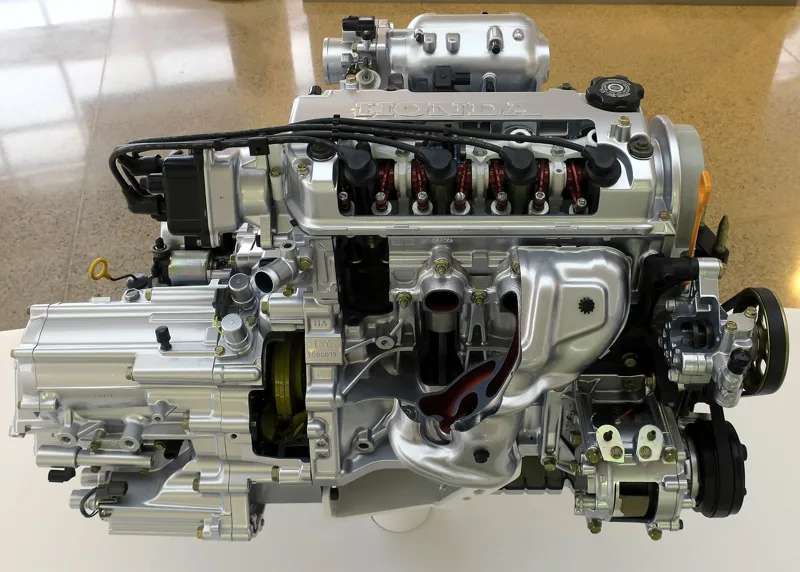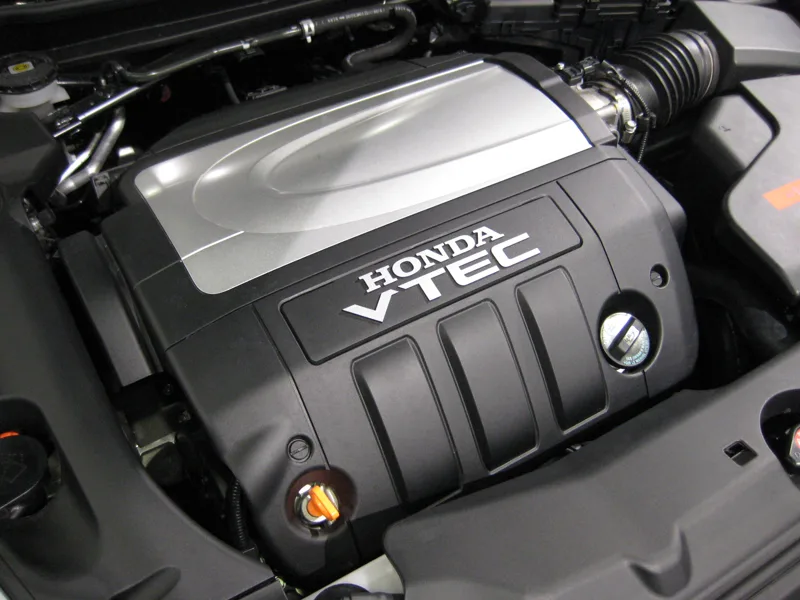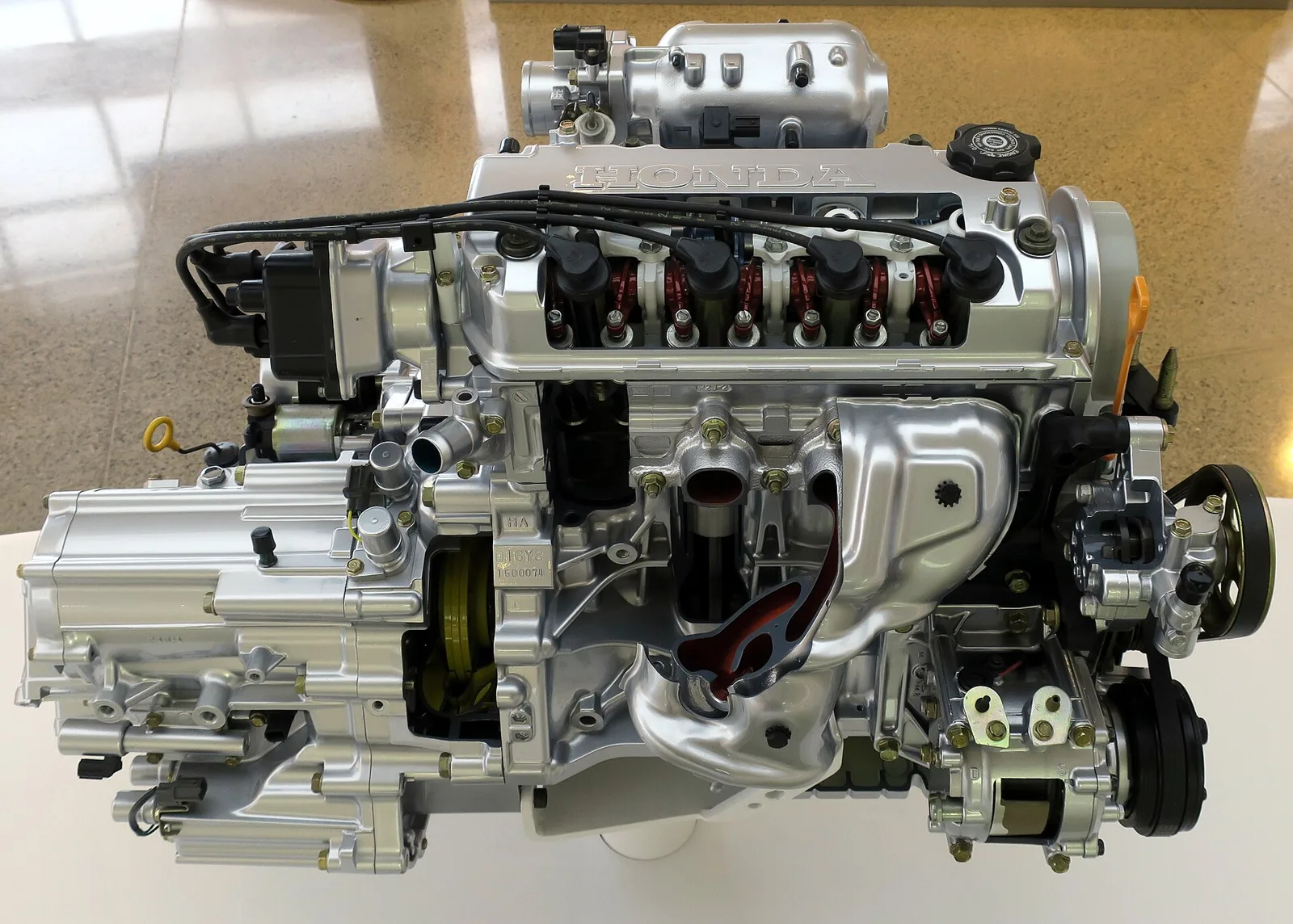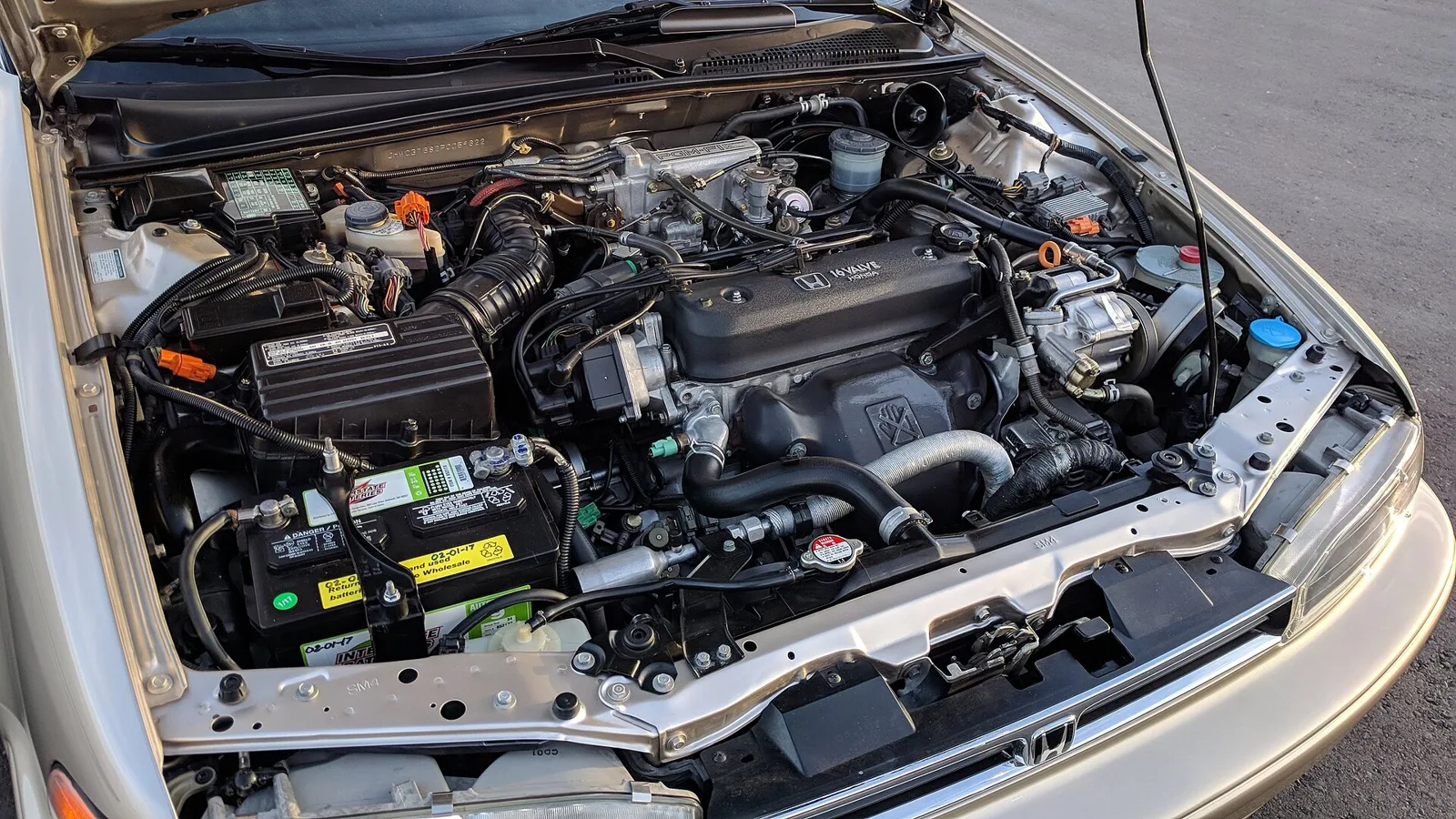
A family of iron-block inline fours that ran from Rover economy cars to the 240 bhp DOHC F20C in the Honda S2000.
The Honda F engine was an inline four-cylinder family with SOHC and DOHC versions, ranging from 1.8 L economy units to the 2.2 L F22C1. The F22B1 brought VTEC to the family in 1994, and the 240 bhp F20C powered the Honda S2000.
The Honda F-series was a family of inline four-cylinder engines that Honda built as its large-block four. It began as a single-overhead-camshaft unit and later produced double-overhead-camshaft versions that reached far higher speeds. Across more than a decade the range powered Accords, Preludes, Rover cars and the Honda S2000.
What is the Honda F engine family?
The F-series was Honda's bigger four-cylinder design, and most of its engines were single-overhead-camshaft units. Lower-production double-overhead-camshaft versions were also built, giving the family a second, more performance-minded line. Together the two sets covered engines from economy-minded 1.8-litre units up to a 2.2-litre high-revving performance engine. Several members also went into Rover cars, and the F18A3 was assembled at Honda's Swindon facility.
Construction followed a common plan. The block was an open deck design in cast iron, with sleeves for the cylinders, although some blocks used aluminium. The cylinder head was made from an aluminium or magnesium alloy.
An iron-block inline four that gave Honda VTEC in the mid-1990s and reached 240 bhp in the S2000.
How did the F-series block and head work?
The sleeved iron block and light alloy head were the two main construction choices, and they set the pattern for the rest of the family.
The F23A1 carried a second-order balance system, with two shafts running at twice engine speed to cancel the inertial forces of a large four-cylinder.
Which early SOHC F engines came first?
The F18A3 opens the list of SOHC engines, used in the Rover 618i and assembled at Honda's Swindon plant. Its 85 mm x 81.5 mm dimensions gave a displacement of 1.8 L (1,849 cc) and 16 valves. Output was 115 hp (86 kW) up to 1997, and its fuel economy was listed at 13 km/L (37 mpg-imp; 31 mpg-US).
The F18B2 stands out for its awards. It powered the Accord in European CG8 and CH6 form from 1998 to 2002, and the Japanese F18B variant appeared in the CD3 and CF3 1.8 VTS and VTE from 1993 to 2002. It took the 1.8-litre class prize at the International Engine of the Year awards for 2000.
The F18B2 had a compression ratio of 9.3:1 and used VTEC with an IAB induction system. VTEC became active at 2,500 rpm and the IAB came into play at 4,000 rpm. Peak output reached 136 hp (101 kW) at 6,100 rpm; 168 Nm (124 lbf ft) of torque came at 5,000 rpm.
What did the 2.0 and 2.2 SOHC engines offer?
The F20A was the original 2.0-litre member of the family, using 85 mm x 88 mm dimensions that gave a displacement of 2.0 L (1,997 cc). Japanese and European Accords, the Ascot Innova and the Prelude all used it, with compression of 9.6:1. Output varied widely by variant, from 89 hp on a carburetted version to 143 hp on a fuel-injected one.
The F20A family included carburetted and injected forms. The F20A2 and F20A3 were carburetted units rated at 110 hp at 5,700 rpm. The F20A4 and F20A5 reached 133 hp at 6,000 and 5,300 rpm respectively, the F20A6 was a carburetted engine at 89 hp, and the F20A7 and F20A8 used injection for 133 hp and 143 hp at 5,600 rpm.
The F20A8 offered the top of that range, with 143 hp (107 kW) at 5,600 rpm and 138 lbf ft (187 Nm) of torque at 4,800 rpm. Its fuel economy was rated at 25 mpg-US in urban use and 34 mpg-US on the highway. The Japanese combined cycle rating for the PGM-FI engine was 9.6 km/L.
The F22A made the 2.2 L (2,156 cc) step, using 85 mm x 95 mm dimensions and a compression ratio of 8.8:1. Its variants spanned several markets. The F22A1 produced 125 hp (93 kW) at 5,200 rpm in the Accord, while the Prelude S of 1992 to 1996 used a more aggressively tuned ECU that lifted output to 135 hp (101 kW).
Regional variants showed how differently the F22A was specified. The F22A2 was built for Gulf-market Accords and Preludes, the F22A3 was a 150 hp European engine tuned for less strict emissions, and the F22A6 added a more aggressive camshaft to reach 140 hp (104 kW) at 5,600 rpm. The F22A9 was the Australian version, with slightly larger valves and a similar character to the F22A6.
When did VTEC reach the F-series?
The F22B1 was the first F-series engine to feature VTEC. It was used in the 1994 to 1997 Accord EX, along with the 1993 JDM Accord models and the 1997 Acura CL. Output stood at 145 hp (108 kW) at 5,500 rpm, and 199 Nm (147 lb ft) of torque arrived at 4,500 rpm.
VTEC switched over between 2300 and 3200 rpm, depending on manifold pressure, and the redline sat at 6,500 rpm with fuel cut-off. The F22B1 was fitted with OBD-I PGM-FI in 1994 and 1995 and OBD-II PGM-FI from 1996 to 1998.
The F22B5 used in the European Accord Aerodeck offered 150 hp (112 kW) at 5,600 to 5,900 rpm, with a compression ratio of 9.8:1 and a redline of 6,200 rpm. A family of F22B engines, including the F22B2, F22B3, F22B6 and F22B8, used differing exhaust headers and produced 130 hp (97 kW) at 5,300 rpm.
How did the F23A1 meet emissions rules?
The F23A1 served the 1998 to 2002 Accord range in LX, EX and SE LEV trim, plus the Acura 2.3CL in North America. Its acceleration to 60 mph was in the mid-9-second range. For automatic LX and EX models, city fuel use was 10 L/100 km (23 mpg-US; 28 mpg-imp), and highway use was 7.8 L/100 km (30 mpg-US; 36 mpg-imp).
Emissions were the main focus of the design. The LX and EX engines qualified for California LEV status, and the EX with an automatic transmission reached ULEV status, which made it the first gasoline car to reach that level. The engine used stratified-charge VTEC, electronically controlled exhaust gas recirculation and a 32-bit control unit that managed each cylinder's air-fuel ratio separately.
The block was high-pressure die-cast from aluminium alloy, with walls extended below the crankshaft centreline to stiffen the bottom end. Honda used finite element analysis to set the rib and wall thicknesses, and an aluminium stiffener tied the block to the transmission case. Rod weight fell to 475 g from 578 g, which helped reduce vibration.
Peak power was 152 PS (150 hp; 112 kW) at 5,700 rpm, with 206 Nm (152 lb ft) reached at 4,900 rpm. Compression rose to 9.3:1 from 8.8:1, made possible by a knock control system that optimised ignition timing.
What were the F23 variants for the Accord?
The F23 family spread across several Accord versions. The F23A4 was the ULEV variant, with 148 hp (110 kW) and 204 Nm (150 lb ft) of torque, while the F23A5 served the 1998 to 2002 Accord DX, the LXi in New Zealand and the 2002 LX value package, with 135 hp (101 kW; 137 PS) at 5,500 rpm.
Compared with the F23A1, the F23A4 used different exhaust plumbing, a tighter intake manifold and an oxygen sensor reading the air-fuel ratio, all managed by a 32-bit control unit.
The F23A7 went into the 1998 Honda Odyssey and the 1998 and 1999 Isuzu Oasis, as well as the Honda Shuttle. It used the same 86 mm x 97 mm bore and stroke as the F23A1, with a 9.3:1 compression ratio. The F23Z5 powered the European Accord CL3 from 2001 to 2003, rated at 154 hp (115 kW; 156 PS) at 5,700 rpm.
| Engine | Years and typical models | Displacement | Peak output |
|---|---|---|---|
| F18B2 | 1998-2002 Accord (CG8, CH6) | 1.8 L (1,849 cc) | 136 hp (101 kW) at 6,100 rpm |
| F20A8 | Accord and Prelude, SOHC | 2.0 L (1,997 cc) | 143 hp (107 kW) at 5,600 rpm |
| F22B1 | 1994-1997 Accord EX, first VTEC | 2.2 L (2,156 cc) | 145 hp (108 kW) at 5,500 rpm |
| F23A1 | 1998-2002 Accord LEV | 2.3 L (2,254 cc) | 152 PS (150 hp; 112 kW) at 5,700 rpm |
| F20C | Honda S2000 | 2.0 L (1,998 cc) | 240 bhp (179 kW) at 8,300 rpm |
| F22C1 | 2004-2009 long-stroke DOHC | 2.2 L (2,157 cc) | 240 bhp (179 kW) at 7,800 rpm |
What were the DOHC F engines?
The DOHC versions were built in smaller numbers, but they gave the family its performance credentials. The F20A DOHC powered the 1990 to 1993 CB3 and CB4 Accord 2.0Si and the Prelude Si. Output came to 152 PS (150 hp; 112 kW) at 6,100 rpm, while torque was 186 Nm (137 lb ft) at 5,000 rpm.
The F20B served Japanese Accords and the Torneo from 1997 to 2001. Its DOHC VTEC cylinder head resembled the H22A used in the Prelude, yet the engine was built to fit under the sub-2.0 litre tax limit that several countries applied. Manual versions produced 200 PS (197 hp; 147 kW) at 7,200 rpm, while automatic versions made 180 PS (178 hp; 132 kW) at 7,000 rpm.
The F20B also had a VTEC engagement point of 5,600 rpm, a redline of 7,400 rpm and a rev limit of 7,800 rpm, with compression of 11.0:1. Its manual models used larger cams, intake and throttle body from the H22 Type S, which set them apart from the automatics.
Why was the F20C so different?
The F20C was a radical departure from earlier F engines, sharing only basic dimensions such as bore spacing with its predecessors. It was designed specifically for the Honda S2000 and shares some engineering with the K engine. Its 87 mm x 84 mm bore and stroke gave a displacement of 2.0 L (1,998 cc).
The F20C reached 240 bhp (179 kW) at 8,300 rpm, and its torque peaked at 206 Nm (152 lb ft) at 7,000 rpm. Its redline was 9,000 rpm and VTEC engaged at 6,000 rpm. The Japanese-specification engine ran a higher compression ratio of 11.7:1 than the 11.0:1 used elsewhere.
A long-stroke variant, the F22C1, was built from 2004 to 2009. It used a reworked rod and stroke ratio, with 87 mm x 90.7 mm dimensions and a displacement of 2.2 L (2,157 cc). Peak torque rose by 6% while power stayed the same, and the redline fell to 8,200 rpm.