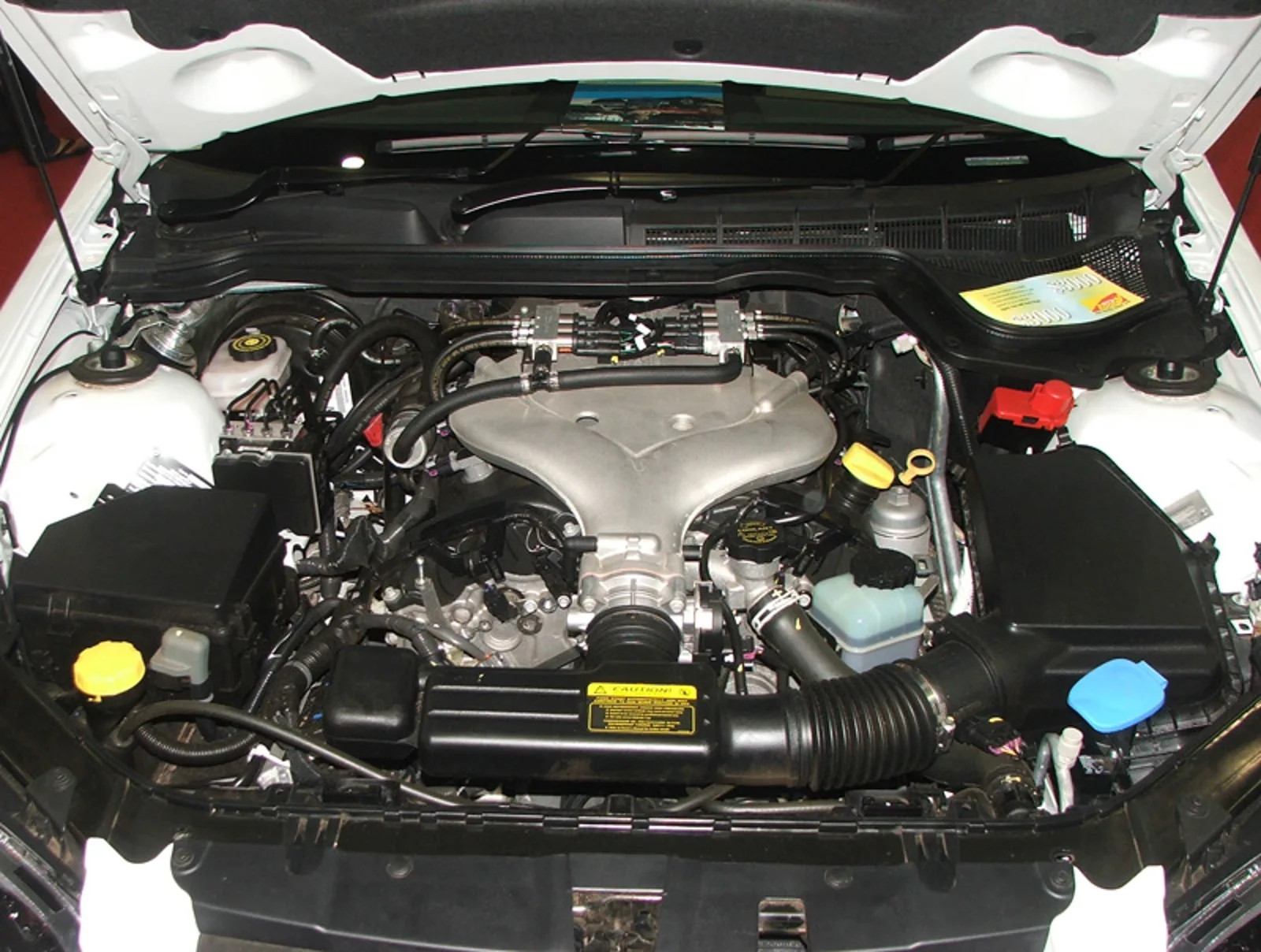
Holden and Cadillac's 24-valve aluminium V6 family, from its 2004 debut to the turbocharged LF3 and LF4 and the 2016 fourth generation.
The GM High Feature V6 is a 60 degree, 24-valve aluminium V6 family that Holden and Cadillac developed together. It arrived in 2004 and spanned displacements from 2.8 to 3.6 litres, with turbocharged, LPG, flex-fuel and hybrid versions along the way.
GM's High Feature V6 is a family of 60 degree, 24-valve V6 engines with an aluminium block and heads, first introduced in 2004. Holden and Cadillac developed it together, and the family went on to power sedans, crossovers, turbocharged performance cars and LPG-fuelled models.
What is the GM High Feature V6?
The High Feature V6, also called the HFV6, is a family of double overhead cam engines with sequential multi-port fuel injection and electronic throttle control. Most versions use continuously variable cam phasing on both the intake and exhaust valves. The first cars to use it were the 2004 Cadillac CTS and the Holden VZ Commodore.
Engineers built the family around forged internals, sinter forged connecting rods and coil-on-plug ignition. The design team was drawn from the same international group behind the Ecotec engines, and it included Opel engineers who had worked on GM's 54 degree V6.
Ricardo plc contributed to the design and development engineering. Holden sold its own version under the Alloytec name, and it reserved the High Feature label for its high-output version with twin cam phasing.
One aluminium V6 family, stretched from 2.8 litres to 3.6, then turbocharged, LPG-fuelled and hybrid.
Where was the High Feature engine developed?
Holden and Cadillac ran a joint programme to design, test and build the family. Most of the alloy construction, transmission pairing and first production work took place in Detroit, while the engines were manufactured at St. Catharines in Ontario. Holden took on the smaller engines and its own 3.6 L and 3.0 L versions.
Both companies tested variations of the engines in the United States and Australia. Most of the design work happened in Flint, Michigan, and the first versions went into the Cadillac range before Holden's versions followed. Holden also built the 3.2 L and the turbocharged LP9 at its own plants.
The Holden range used the Alloytec V6 name for its 3.6 L and 3.0 L engines. Holden's 3.2 L also became the basis of the Alfa Romeo JTS V6, so an Australian-built block ended up in Alfa Romeo's own engine family.
How big were the early 2.8 and 3.2 litre engines?
The LP1 was a naturally aspirated 2.8 L (2,792 cc) engine. Its 89 mm x 74.8 mm cylinders come with a 10.0:1 compression ratio. It was built in St. Catharines and launched in the 2005 Cadillac CTS. Holden's 3.2 L (3,195 cc) followed between 2005 and 2010, peaking at 6600 rpm with 227 hp (169 kW; 230 PS).
The LP9 is the turbocharged version of the 2.8 L. It keeps the LP1 dimensions but drops compression to 9.5:1 to cope with boost. Saab used it in the 9-3 and 9-5, and Holden's Fishermans Bend plant at Port Melbourne built it, with GM Powertrain Sweden handling the turbocharging.
GM later gave the LP9 turbo the code LAU. It first appeared in the 2010 Cadillac SRX, and production of that model with the engine ended in 2011. The Saab 9-4X kept the LAU in use until 2012.
The Holden 3.2 L was sold in Chevrolet Captiva and Opel Antara models from 2006 to 2010, and in the Suzuki Grand Vitara from 2008 to 2012. Its city fuel use was 4-6 km/L (9.4-14.1 mpg-US; 11-17 mpg-imp), and on the highway it managed 7-9 km/L (16-21 mpg-US; 20-25 mpg-imp).
What were the 3.0 and 3.6 litre versions?
The LF1 displaces 3.0 L (2,994 cc) and runs an 11.7:1 compression ratio, with 89 mm x 80.3 mm cylinders. It used spark ignition direct injection and was built from 2010 to 2014. The LFW flex-fuel sibling ran on E85, petrol or any mix, with identical output.
The 3.6 L LY7 was the mainstay of the early years, and its 94 mm x 85.6 mm cylinders give a 10.2:1 compression ratio. It arrived in the 2004 Holden VZ Commodore and the 2004 Cadillac CTS sedan, and lower-powered versions had variable cam phasing on the inlet camshaft only. The complete engine weighed 370 lb (170 kg) as installed, and it was made in several countries, including Mexico and Japan.
Between 2005 and 2012 Holden also sold the LW2, a dual-fuel 3.6 L rated 235 hp (175 kW; 238 PS). It ran on petrol or autogas, used a dual-fuel system developed by IMPCO and had hardened titanium valve seats. Holden vehicles were the only home for it.
The direct-injected LLT arrived in May 2006 and claimed 15% more power, 8% more torque and 3% better fuel economy than the port-injected version. With an 11.3:1 compression ratio it peaked at 6300 rpm with 302 hp (225 kW; 306 PS), and its 272 lb ft (369 Nm) of torque arrived at 5200 rpm on regular 87 octane petrol.
The LFX followed in 2012 as an enhanced LLT developed jointly by Holden and Cadillac. It appeared in the Holden VE Commodore SV6 and the Chevrolet Camaro LS and LT, weighed 20.5 lb (9.3 kg) less than its predecessor and ran an 11.5:1 compression ratio with E85 flex-fuel capability.
The LWR was a dedicated LPG version of the 3.6 L LY7, introduced for the MY 2012 Holden VE Commodore. It used vapour injection rather than liquid injection, with a 12.2:1 compression ratio, and on the combined ADR 81/02 cycle the Commodore Omega returned 11.8 L/100 km, which was 1.6 L/100 km better than the dual-fuel LW2 it replaced (19.9 mpg-US; 24 mpg-imp).
Were there hybrid or bi-fuel versions?
Yes, although the hybrid never reached showrooms. The LCS was a two-mode hybrid version of the LLT, built for the cancelled Saturn Vue Hybrid, and the LFR was a bi-fuel LFX that ran on gasoline and CNG. Both show how the design was adapted for different fuel and drivetrain plans.
The LCS grew out of the direct-injected LLT and used a two-mode layout. Its compression was 11.3:1, and it was due to peak at 6100 rpm with 262 hp (195 kW; 266 PS), with 250 lb ft (339 Nm) of torque arriving at 4800 rpm. Plans for the Saturn Vue Hybrid were dropped, so the LCS never went on sale.
The LFR used multi-point fuel injection for both gasoline and CNG instead of direct injection. The LFY builds on the LFX, adding stop-start operation and revised airflow.
Which High Feature engines were turbocharged?
The turbocharged members include the 2.8 L LP9, the 3.0 L LGW and LGY, and the 3.6 L twin-turbo LF3 for the 2014 Cadillac CTS and XTS. At 5750 rpm the LF3 produces 420 hp (313 kW; 426 PS), and its torque of 430 lb ft (583 Nm) arrives between 3500 and 4500 rpm.
The LF3 arrived with a new cylinder block, new heads, strengthened connecting rods and a forged steel crankshaft. Its intake valves measure 38.3 mm (1.51 in) and its exhaust valves 30.6 mm (1.20 in), and the exhaust valves are sodium-filled. Cadillac quoted a 0-60 mph time of 4.6 seconds with the eight-speed automatic.
The LF4 is the higher-performance variant for the Cadillac ATS-V and CT4-V Blackwing. It uses titanium-aluminide turbines and raises peak boost to 18 psi (1.2 bar), up from 12 psi (0.83 bar), with higher-flow fuel injectors. Titanium connecting rods went into the ATS-V and manual CT4-V models, while the 10-speed automatic kept steel rods.
How did the fourth generation differ?
The fourth generation arrived on the 2016 Cadillac CT6 with a redesigned block whose bore centres grew from 103 mm (4.055 in) to 106 mm (4.173 in). It added cylinder deactivation, start-stop technology and two-stage oil pumps, along with updated variable valve timing.
The 3.0 L LGW and LGY use an 86 mm x 85.8 mm bore and stroke, a 9.8:1 compression ratio, titanium-aluminide turbine wheels and a 6500 rpm limit. They need premium unleaded fuel. The LGZ is a variant of the 3.6 L LGX built for the Chevrolet Colorado and GMC Canyon.
The 3.6 L LGX has a bore of 95 mm (3.740 in), up from 94 mm (3.701 in), and it keeps the 85.8 mm (3.378 in) stroke of the 3.0 L, giving 3,649 cc. Its compression ratio is 11.5:1 and its maximum engine speed is 7200 rpm. Ward's named it one of its 10 Best Engines for 2016, and it was measured against the 3.7 L VQ37VHR fitted to the 2015 Infiniti Q40.
Did the family ever get a V12?
Yes, on paper. AutoWeek reported on 21 March 2007 that GM planned a 60 degree V12 built from two 3.6 L V6s joined crankshaft to crankshaft. It would have displaced 7.2 litres and it was expected to make around 600 hp (447 kW; 608 PS), with torque reaching 540 lb ft (732 Nm).
Holden was to carry out the development in Australia, with a possible HSV or Statesman application. GM announced in August 2008 that the V12 had been cancelled, so the engine never reached production.
What problems affected the timing chains?
Earlier engines with the three-chain design suffered premature timing chain failures. The main causes were a faulty PCV breather and oil changes spaced too far apart, and most of the problems occurred before the LFX arrived. Those engines included the 2.8 L and 3.0 L units, as well as the 3.6 L and 3.2 L engines built with that layout.
Because the failures traced back to a breather system and to service intervals, the story of this period is as much about maintenance as about engine design. That is why the LFX is usually treated as the dividing line in the family's reputation.
What were the main High Feature specifications?
| Specification | Detail |
|---|---|
| Layout | 60 degree V6, 24 valves, DOHC |
| Early displacement range | 2.8 L (2,792 cc) to 3.6 L (3,564 cc) |
| Holden 3.2 L output | 6600 rpm peak, 227 hp (169 kW; 230 PS) |
| LLT output | 6300 rpm peak, 302 hp (225 kW; 306 PS) |
| LFX compression ratio | 11.5:1 |
| LWR combined economy | 11.8 L/100 km, equal to 24 mpg-imp or 19.9 mpg-US |
| LF3 output | 5750 rpm peak, 420 hp (313 kW; 426 PS) |
| LF3 torque | 430 lb ft (583 Nm), 3500-4500 rpm |
| Fourth generation bore centres | 106 mm (4.173 in) |
| LGX displacement | 3.6 L (3,649 cc) |
| LGX maximum speed | 7200 rpm |