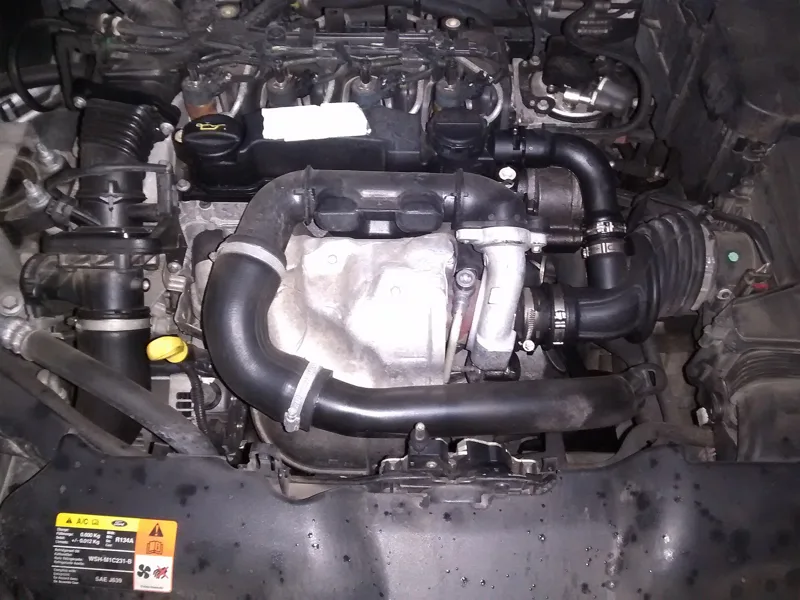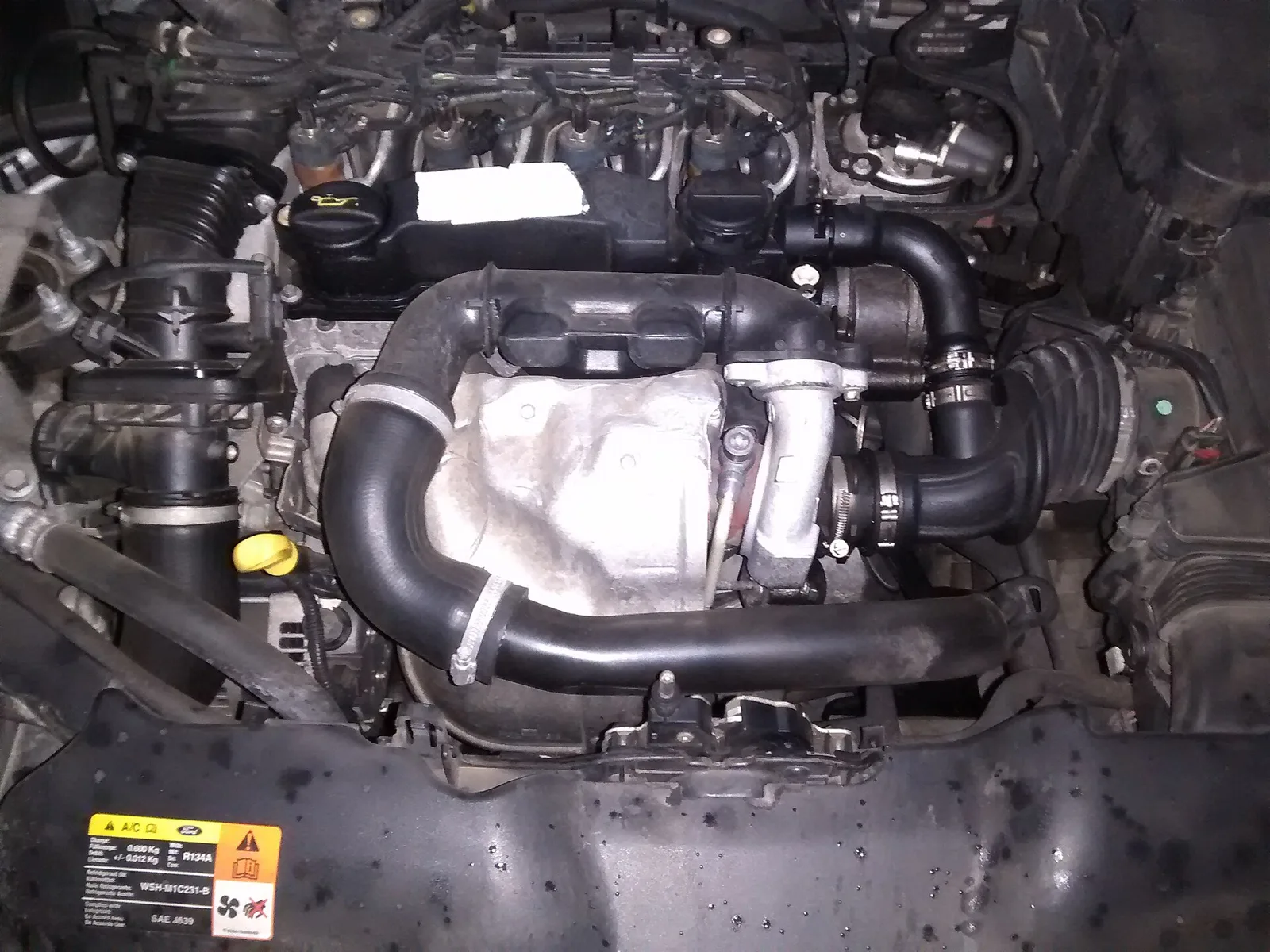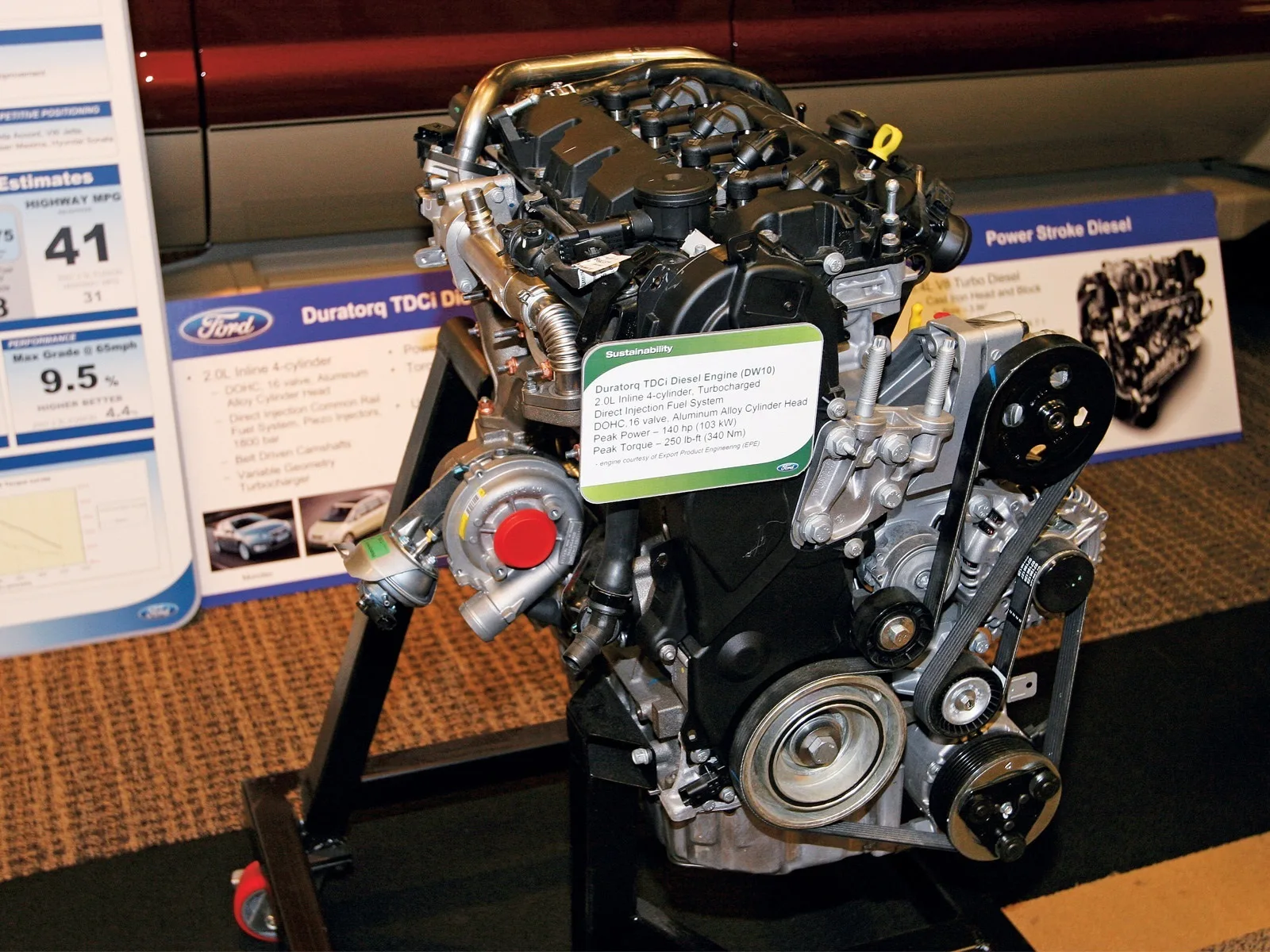
Ford's Duratorq diesels began as a 2.0 litre Puma four in 2000 and grew into a range that ran from small commercial vans to a twin-turbo 3.6 litre V8.
Duratorq is Ford's marketing name for a range of diesel engines introduced in 2000. The family spans inline-fours, a five-cylinder unit and V6 and V8 engines, and was progressively replaced from 2016 by the EcoBlue range. Its engines powered vans, cars and several Land Rover and Jaguar models.
Ford's Duratorq diesels began in 2000 with a 2.0 litre engine developed under the Puma codename. Over the following years the range grew from small commercial vans to a twin-turbo 3.6 litre V8. Several later units came out of a joint venture with PSA Peugeot Citroen, and the EcoBlue family began replacing them in 2016.
What is the Ford Duratorq engine?
Ford applies the Duratorq name to diesel engines first introduced in 2000. Its engines powered vans, family cars and several models from Jaguar, Land Rover, Volvo and Mazda, which also used the TDCi badge. The larger five-cylinder units carry the Power Stroke name when fitted to North American vehicles.
The name covers three broad groups. The DLD inline-fours came from a joint venture with PSA and ran from 1.4 to 1.8 litres. The Puma engines were 2.0, 2.2 and 2.4 litre units built at Dagenham, while the V6 and V8 engines were larger additions made later in the range.
One diesel family spanned vans, family cars and a twin-turbo V8 before EcoBlue took over in 2016.
Where did the Duratorq family come from?
The first design was codenamed Puma during development. It replaced the older Endura-D unit, which had been in production since 1984, and its commercial versions took over from the 2.5Di engine that powered the Transit. The Puma engines were built at Dagenham in east London.
The Endura-D was not simply dropped. It was heavily revised with a variable-vane turbocharger and Delphi high-pressure common rail injection, then relaunched in 2001 as the Duratorq TDCi. The unrevised engine was renamed the TDDi so that the two could be told apart.
Some Duratorq units found their way into specialist vehicles. The London Taxi and the Land Rover Defender both used the engine, which gave the family a presence in British commercial and utility work that lasted well beyond its launch years.
How did the DLD engines fit into the range?
The DLD engines came from a Ford and PSA joint venture announced in September 1998. Ford sells them as TDCi, while Citroen and Peugeot badge them HDi. The inline-fours fall into 1.4 and 1.6 litre families, and Ford later added the unrelated 1.8 litre DLD-418 to the group.
The 1.4 litre DLD-414 was rated at 50 kW (68 PS; 67 hp) at 4,500 rpm, with 160 N m (118 lb ft) of torque at 2,000 rpm. It came in two forms: an early 8-valve design with no intercooler, and a 16-valve design that used Delphi DCR1400 common-rail injection.
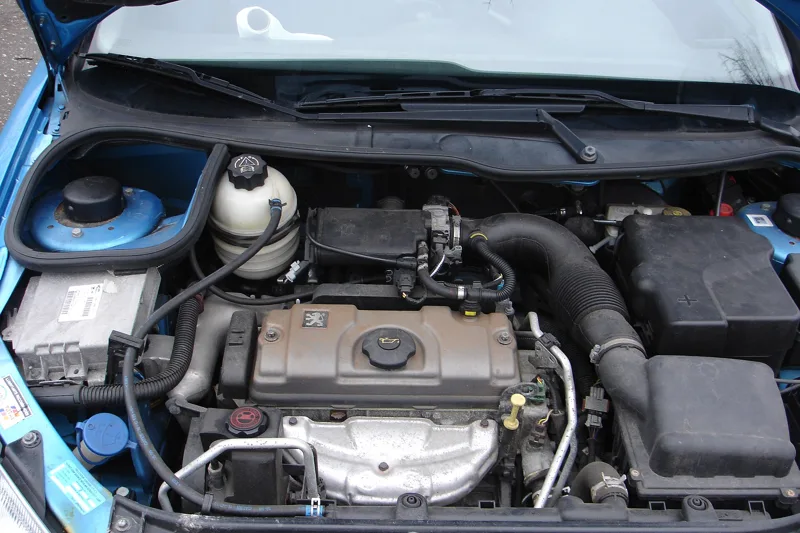
The 1.6 litre DLD-416 displaced 1,560 cc and produced 90 or 110 hp. Ford, Mazda, Volvo, Mini, Peugeot and Citroen all used it, and Peugeot engineers designed it on behalf of PSA and Ford. A 1.5 litre version arrived in 2012, derived from the 1.6 with its bore cut from 75 to 73.5 mm.
The 1.8 litre DLD-418, at 1,753 cc, was an intercooled common-rail diesel and a development of the older 1.8 Endura-D. It is unrelated to the 1.4 and 1.6 units, yet Ford lists it in the DLD group because of its official name.
Because the DLD family was shared with Peugeot and Citroen, the same basic engine could appear in cars wearing very different badges. That shared heritage explains why Ford, Mazda and Volvo could each offer a version without developing a separate unit.
How much power did the early Puma 2.0 make?
The first 2.0 litre ZSD-420 launched in 2000 alongside the Mk3 Mondeo, producing 115 PS (85 kW; 113 hp) plus 280 N m (207 lb ft) of torque. Adding common-rail injection in late 2001 lifted output to 130 PS (96 kW; 128 hp), and torque rose to 330 N m (243 lb ft).
The engine was a 16-valve design with twin chain-driven camshafts and a variable-geometry turbocharger with an overboost function. Its 1,998 cc capacity made it the mainstream choice for the Mondeo and related models of the period.
A detuned version using a fixed-geometry turbocharger followed, and a lower-output fleet variant was added to the range later in the decade. That version was aimed at buyers who valued running costs over performance, and it sold in large numbers to businesses.
Owners and fleet managers judged the early engines on torque as much as power. The 330 N m (243 lb ft) of the common-rail unit gave strong pulling force at low revs, which suited loaded vans and estates and kept the 2.0 central to the commercial side of the range.
What changed with the 2005 TDCi engines?
The 2005 TDCi engines were developed with PSA from the DW10 and DW12 engines. They used third-generation common-rail injection with pressures raised to 1,800 bar (26,000 psi), and their piezo injectors have seven apertures rather than five, which allows more precise injection events.
Common-rail systems of this generation were valued for smoother running and cleaner combustion, which mattered as European emissions rules tightened. Splitting each injection into several precisely timed events gave engineers a finer grip on noise, emissions and power.
The 2.0 unit first appeared in the 2005 Focus with 136 PS, and later versions reached 163 PS (120 kW; 161 hp) with 340 N m (251 lb ft). A later Mondeo offered 210 PS (154 kW; 207 hp), which showed how far the design had been pushed.
The 2.2 litre followed in 2008 in the Mondeo, producing 175 PS (129 kW; 173 hp) and peaking at 400 N m (295 lb ft). A 200 PS (147 kW; 197 hp) version with 420 N m arrived from 2010, and the engine was also used in the Land Rover Freelander 2 and the Range Rover Evoque.
How big did the Duratorq engines get?
The largest Duratorq units were the 3.2 litre five-cylinder, which powered the Transit and the Ranger from 2012 to 2022, and the twin-turbo 3.6 litre V8 that entered production in April 2006. The 2.7 litre V6 sat between them, built at Dagenham by Ford and Jaguar.
In its North American Power Stroke form, the 3.2 is rated at 187 PS (138 kW; 184 hp), and its torque is 470 N m (347 lb ft). The Duratorq TDCi version sold in Asia and Europe makes 200 PS (147 kW; 197 hp) at 3,000 rpm, with the same 470 N m torque figure. The Vivarail D-Train also uses this engine.
The 2.7 litre V6 made 204 PS (150 kW; 201 hp) and torque reached 440 N m (325 lb ft), and it was fitted to Jaguar, Land Rover and Citroen models. The 3.6 litre V8 was twin-turbocharged and rated at 270 PS (199 kW; 266 hp) with torque of 640 N m (472 lb ft) from its start of production.
Torque mattered more than revs in the heavy-duty and premium uses the V6 and V8 were built for. Twin turbochargers on a diesel of that size were an unusual choice, and they helped the V8 deliver its torque across a broad band of engine speeds.
A 4.4 litre version built in Mexico made 250 kW (340 PS; 335 hp), and torque peaked at 700 N m (516 lb ft). It powered Range Rover and Range Rover Sport models, and it gave the Duratorq family its most powerful output of all.
What were the main Duratorq specifications?
| Engine | Displacement | Peak output | Notes |
|---|---|---|---|
| DLD-414 | 1,399 cc | 50 kW (68 PS; 67 hp) at 4,500 rpm | 1.4 litre DLD family |
| DLD-416 | 1,560 cc | 90 or 110 hp | 1.6 litre DLD family |
| DLD-418 | 1,753 cc | Intercooled common rail | Development of the Endura-D |
| ZSD-420 | 1,998 cc | 115 PS (85 kW; 113 hp) at launch, 130 PS (96 kW; 128 hp) with common rail | Launched in 2000 |
| ZSD-422 | 2,198 cc | 155 PS (114 kW; 153 hp) | Introduced in 2004 |
| ZSD-424 | 2,402 cc | Turbocharged and intercooled | Used in the Transit |
| Five-cylinder | 3.2 L | 200 PS (147 kW; 197 hp) at 3,000 rpm | Transit and Ranger, 2012 to 2022 |
| AJD-V8 | 3.6 L | 270 PS (199 kW; 266 hp) | Production from April 2006 |
Why did the Duratorq range last so long?
The range ran from 2000 until EcoBlue began replacing it in 2016, and during that time the Puma and DLD designs were revised several times. Each revision added common-rail refinements, new turbo layouts and higher outputs, so later engines were noticeably stronger than the first ones.
Shared development with PSA also spread the work across two companies. That arrangement let Ford offer small and large diesels without building every unit from scratch, which helps explain how many models ended up using them.
Which vehicles used the Duratorq family?
The engine appeared across Ford's own range, its commercial vehicles and a number of Jaguar and Land Rover models. The most widely recognised applications are listed below.
- Ford Mondeo, S-Max and Galaxy with the 2.0 and 2.2 TDCi
- Ford Transit vans with the 2.0, 2.4 and 3.2 units
- Ford Ranger and Everest with the 2.2 and 3.2 engines
- Jaguar X-Type and XF with the 2.0, 2.2 and 2.7 units
- Land Rover Defender, Freelander 2 and Discovery Sport
- London Taxi, and Peugeot and Citroen models using the HDi versions
What is the Duratorq range's successor?
The EcoBlue diesel range, originally codenamed Panther, progressively replaced the Duratorq engines from 2016. It was planned in 2.0 and 1.5 litre variants, which meant the change came model by model rather than all at once.
Each family in the range had its own timetable for the switch, so the Duratorq name lingered in some vehicles after EcoBlue arrived elsewhere. The earlier engines remain a common sight on older Transit and Ranger models.
For a buyer, the badge mattered less than the output. The TDCi, HDi and Power Stroke names described closely related families, so the choice came down to which size and tune suited the job at hand.