A family of racing and road engines named after Enzo Ferrari's son, from a 65-degree V6 to the 3.6-litre V8 of the 360 Modena.
The Ferrari Dino engine was a family of V6 and V8 units built for roughly four decades, starting in the late 1950s. It powered racing cars, road cars such as the 308 and 328, and the turbocharged F40, until the F136 replaced the V8 in 2004.
Ferrari's Dino engines were V6 and V8 designs produced for around four decades, starting in the late 1950s and ending in the early 2000s. The family began as a small racing V6 for Formula Two and finished as the 3.6-litre V8 used in the 360 Modena. Along the way it produced an unusual 65-degree V6 and a long run of turbocharged road and race cars.
Who was Dino Ferrari?
Alfredo Ferrari, known as Dino, was Enzo Ferrari's son, and the engine carries his nickname. In late 1955 he suggested a V6 for Formula Two. He fell gravely ill with muscular dystrophy and died on 30 June 1956, aged 24, before he could see the engine run.
Dino never saw the project through. While he was in hospital he talked through the engine's technical details with Vittorio Jano, an engineer who had worked for Alfa Romeo and Lancia before joining Ferrari. The first Ferrari V6 came out of those discussions and was running by the end of 1956.
An engine family named after a son who never saw it run, and one that shaped Ferrari's road and race cars for four decades.
What was the 65-degree V6?
The 65-degree V6 was a 1.5-litre racing engine of 1,489 cc (90.9 cu in). Its debut came at the Naples Grand Prix in April 1957, a third-place finish behind two Lancia-Ferrari V8 Formula One cars. It was the only 65-degree V6 engine ever built.
The extra five degrees between the cylinder banks gave Ferrari the straight intake runners it wanted. Each connecting rod had its own crankpin, and the pins were set 55 degrees apart for each cylinder pair. That kept the firing order even and let the designers build harmonically balanced exhaust manifolds, so the engine ran as smoothly as a conventional 60-degree V6 while offering more performance.
The 65-degree angle did not die with the V6, because it reappeared in the 1992 456 V12.
How much power did the 60-degree V6 make?
Jano's conventional 60-degree V6 drew on ideas from the Lancia Aurelia and first appeared in 1958. The 196 S used a 1,984 cc unit with a 77 mm x 71 mm bore and stroke, producing 200 bhp (149 kW; 203 PS). A larger 2,417 cc version gave 245 bhp (183 kW; 248 PS) in the Dino 246 S.
Grand Prix, Formula One and Formula Two machines of 1959 onward carried this 60-degree unit into the early 1960s. The 286 SP of 1962 enlarged the bore and stroke to 90 mm x 75 mm, reaching 2,863 cc (2.9 L). Its output was 260 PS (191 kW; 256 hp). Development of the 60-degree unit stopped after the SP series, and the 65-degree V6 carried on alone.
Why did Ferrari build the Fiat Dino?
Ferrari needed 500 production vehicles to homologate the 65-degree V6 for racing, so it turned to Fiat. Together they developed a front-engined, rear-wheel-drive sports car, and the result was the Fiat Dino. Fiat Dino production ran from 1966 to 1973 with two engine sizes: 2.0 L first, then 2.4 L.
The 1965 Dino 166 P used a 1,593 cc version of the 65-degree unit, with a 77 mm bore and a 57 mm stroke. Output was 175 PS (129 kW; 173 bhp). That same year the Dino 206 SP appeared with a 1,987 cc engine rated at 218 PS (215 bhp; 160 kW), and the 1966 Dino 206 S used the same capacity.
How did the Dino 206 GT differ from the racer?
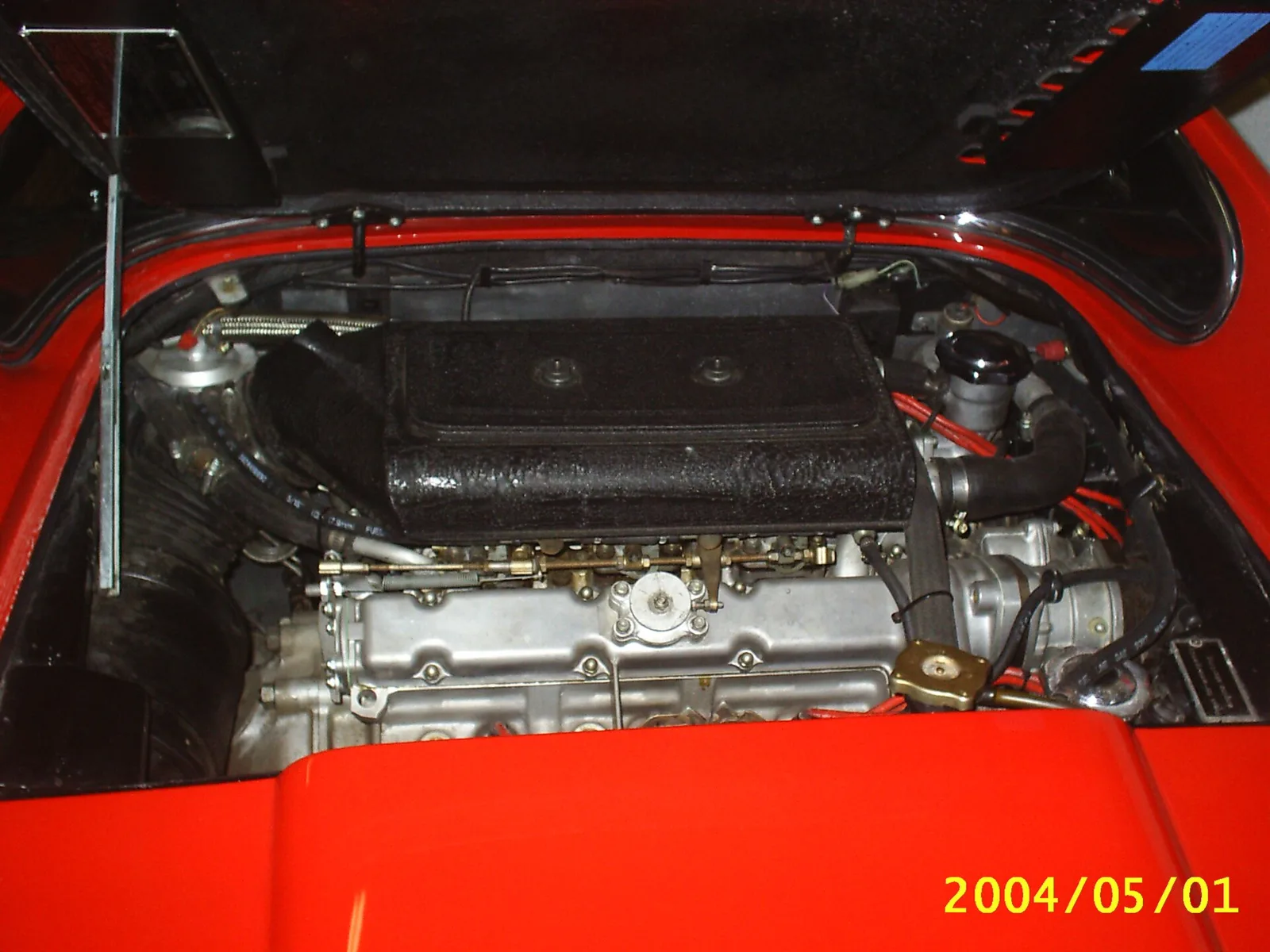
In 1968 Ferrari launched the Dino 206 GT, a first for the company as a mid-engined road car. The 2.0-litre V6 came from the 206 S and sat transversely between the rear wheels, but the road version was detuned to 180 PS, or 132 kW (178 bhp). Only 152 cars were built before Ferrari enlarged the engine.
Enlarging the bore to 92.5 mm and the stroke to 60 mm gave 2,419 cc (2.4 L; 147.6 cu in). It produced 195 PS (192 bhp; 143 kW) at 7,600 rpm and 226 Nm (166 lbf ft) at 5,500 rpm. The block also changed, moving from aluminium to cast iron.
The same V6 went to Lancia for the Stratos rally car in the early 1970s. Ferrari's road Dinos had moved on to eight cylinders by then, and a brief return to Formula Two in the late 1970s, after rules allowed six-cylinder engines, brought no notable success.
Which road cars used the Dino V6?
The 2.0-litre V6 served in the 1966 to 1969 Fiat Dino and the 1967 to 1969 Dino 206 GT. The 2.4-litre version powered the 1969 to 1973 Fiat Dino and the 1969 to 1974 Dino 246 GT and GTS, and the Lancia Stratos from 1973 to 1975.
The Dino V8 arrives in the 308
The Dino V8 replaced the V6 in the 1973 GT4 and the 1975 GTB 308. The bore grew to 81 mm while the stroke stayed at 71 mm, giving 2,927 cc (2.9 L). Despite the 308 name, the engine was not a 3.0-litre unit. It kept a double overhead camshaft layout with two valves per cylinder.
What changed with fuel injection and the Quattrovalvole?
Fuel injection arrived with the 1980 i models, which added it to the Mondial 8 and the 308 GTBi and GTSi. In 1982 four valves per cylinder appeared in the 308 and Mondial Quattrovalvole, lifting power to 245 PS (180 kW; 242 bhp). That matched the pre-injection peak of the engine.
The Quattrovalvole also powered the Lancia Thema from 1986 to 1991. Ducati built that engine, which used a cross-plane crankshaft instead of the flat-plane design Ferrari favoured.
Why was there a 2.0-litre Dino V8?
The smaller V8 variants were aimed mainly at the domestic market, where engines above two litres attracted a 38% value added tax. In 1975 the 208 GT4 reduced the bore from 81 mm to 66.8 mm and kept the 71 mm stroke. Power fell from 255 PS to 170 PS, or 125 kW (168 bhp).
The 208 Turbo arrived in 1982 with 220 PS (162 kW; 217 bhp). That beat the fuel-injected 308 of the year before. Nicola Materazzi designed the turbocharged Formula One and road units built between 1980 and 1989, apart from the non-intercooled 208 Turbo, drawing on his work with Mobil, Lancia and Osella.
How powerful was the 288 GTO's engine?
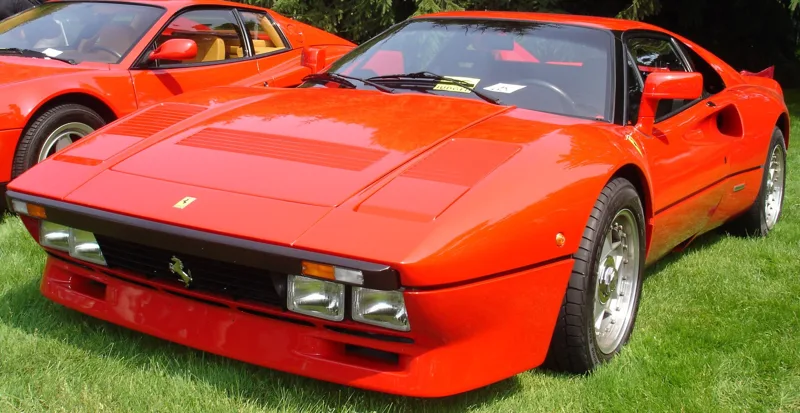
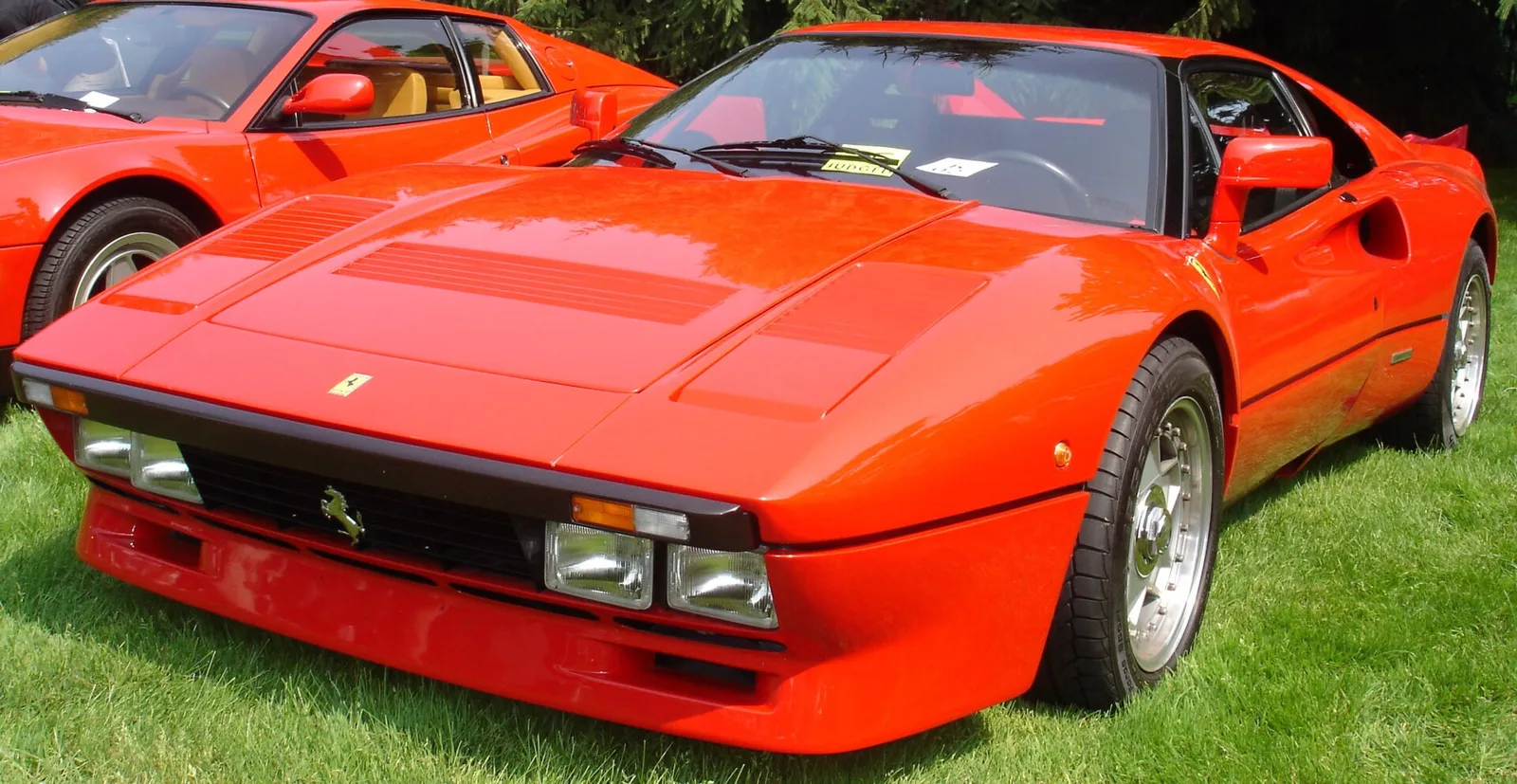
The 288 GTO used a 2,855 cc (2.9 L) variant of the 308 engine, with the bore reduced by 1 mm (0.04 in) to meet Group B rules. Twin IHI turbos, a Behr intercooler and Weber-Marelli injection gave the car 400 PS (294 kW; 395 bhp). The 208 Turbo had earlier served as a development platform for the car.
How did the F40 use the Dino engine?
The 1987 F40 used the Tipo F120A, a 2,936.25 cc (2.9 L) engine with an 82 mm x 69.5 mm bore and stroke. With 16 psi (1.1 bar) of boost it made 351.5 kW (478 PS; 471 hp) at 7,000 rpm. The US-specification F120D was rated at 356 kW (484 PS; 477 hp).
The F40 produced 577 Nm (426 lbf ft) of torque at 4,000 rpm. The Tipo F120B, used in the F40 LM, kept the same displacement but ran 2.6 bar (38 psi) of boost and an 8.0:1 compression ratio. It made 720 hp (540 kW; 730 PS) at 7,500 rpm.
The F117 prototypes and the Dino V8 for larger cars
Two prototype Ferrari 408 4RM cars from 1987 and 1988 used a longitudinally mounted 4.0-litre V8 of 3,999.7 cc. It had a compression ratio of 9.8:1, dry sump lubrication and four valves per cylinder, and produced 300 PS, or 221 kW (296 hp), at 6,250 rpm. A transverse version, the F117A, was tested as a possible option for the 348 but was rejected, because Ferrari preferred smaller, high-revving engines.
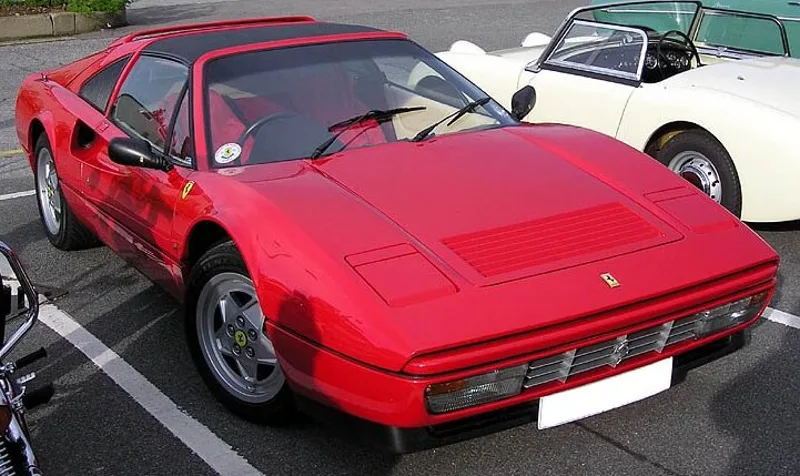
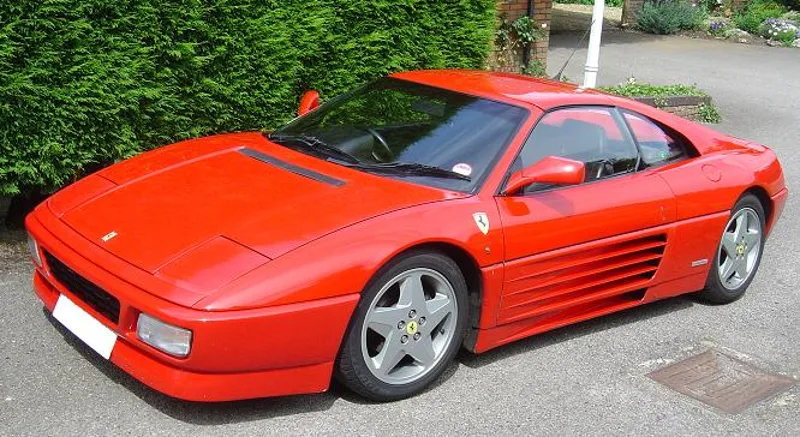
The 328 and 3.2 Mondial of 1985 ran a naturally aspirated 3,186 cc (3.2 L) engine with 270 PS (199 kW; 266 bhp). The 1989 348 and Mondial t moved to 3,405 cc (3.4 L), an 85 mm x 75 mm engine rated at 300 PS (296 bhp; 221 kW), later revised to 320 PS (316 bhp; 235 kW).
The 1994 F355 introduced Ferrari's first production five-valve engine. Its stroke was 2 mm longer, giving 3,496 cc (3.5 L) and 380 PS (375 bhp; 279 kW). The 1999 360 Modena kept the 85 mm bore and five valves per cylinder, with a 79 mm stroke, for 3,586 cc (3.6 L) and 400 PS (395 bhp; 294 kW). The 2003 Challenge Stradale, with an 11.2:1 compression ratio, reached 425 PS (419 bhp; 313 kW).
Dino engine specifications at a glance
| Model | Displacement | Output | Notes |
|---|---|---|---|
| 196 S (60-degree V6) | 1,984 cc (2.0 L) | 200 bhp (149 kW; 203 PS) | Racing V6, 1958 |
| 246 S (60-degree V6) | 2,417 cc (2.4 L) | 245 bhp (183 kW; 248 PS) | Formula One, F2 and Grand Prix cars |
| 246 S (65-degree V6) | 2,417 cc (2.4 L) | 280 PS (276 bhp; 206 kW) | Dual overhead camshafts |
| 206 GT (road) | 1,987 cc (2.0 L) | 180 PS (178 bhp; 132 kW) | First mid-engined Ferrari road car |
| 246 GT | 2,419 cc (2.4 L) | 195 PS (192 bhp; 143 kW) | Cast-iron block |
| 308 Quattrovalvole | 2,927 cc (2.9 L) | 245 PS (180 kW; 242 bhp) | Four valves per cylinder |
| 288 GTO | 2,855 cc (2.9 L) | 400 PS (294 kW; 395 bhp) | Twin turbochargers, Group B |
| F40 | 2,936.25 cc (2.9 L) | 478 PS (351.5 kW; 471 hp) | Turbo, 16 psi boost |
| F40 LM | 2,936.25 cc (2.9 L) | 720 hp (540 kW; 730 PS) | 2.6 bar boost |
| 328 | 3,186 cc (3.2 L) | 270 PS (199 kW; 266 bhp) | Naturally aspirated |
| 348 | 3,405 cc (3.4 L) | 320 PS (316 bhp; 235 kW) | Later Tipo F119H |
| F355 | 3,496 cc (3.5 L) | 380 PS (375 bhp; 279 kW) | Five valves per cylinder |
| 360 Modena | 3,586 cc (3.6 L) | 400 PS (395 bhp; 294 kW) | 85 mm bore |
| 360 Challenge Stradale | 3,586 cc (3.6 L) | 425 PS (419 bhp; 313 kW) | 11.2:1 compression |
When did the Dino V8 end, and what replaced it?
The Dino V8 was retired in 2004, when the new Ferrari-Maserati F136 engine arrived in the Ferrari F430. The 360 Modena family, built from 1999 to 2004, was the last of the Dino V8s and the largest of the line in road-going form.
The V12 that followed
The V12 first appeared in the 1992 456, designated Tipo F116. It kept the 65-degree V angle, used an 88 mm bore and shared the 348's 75 mm stroke. It was later revised as the Tipo F133 for the 550 (5.5 litre), the 575M Maranello and the 612 Scaglietti (5.75 litre).
Which Dino-based engine had the most power?
Among the engines covered here, the most powerful was the 3.0-litre twin-turbo unit fitted to Lancia LC2 racers, rated at 828 PS (609 kW; 817 bhp) in its final form. It was derived from the Quattrovalvole and built for the World Sportscar Championship.
The LC2 started with a 2.65-litre engine, and in qualifying trim the earlier version made 720 PS (530 kW; 710 bhp).