From American hot rod roots to Japanese VIP sedans, the custom car is a culture built on paint, engines and show-floor rivalry.
Customising means reworking a road car for better handling, distinct looks or both. The culture grew from American hot rodding and spread to Japan, Britain and New Zealand. Its centre of gravity is styles, paint, engine swaps and show awards such as the AMBR and the Ridler.
A custom car is a road car reworked for sharper performance, a new look, or both. The idea grew out of American hot rodding, and it has since become a worldwide culture with its own styles, paint techniques, awards and famous machines. Today the word covers everything from a lowered lowrider to a show roadster with candy paint and a rebuilt engine.
What makes a car a custom?
A custom car is a passenger vehicle altered from its factory form to improve performance, change its looks, or both. Many enthusiasts treat the aim as going well beyond what a showroom car offers. In British usage the phrase can also describe a car built to the buyer's own specification from the outset.
The range of changes is wide. Some builders alter paintwork and body panels, while others rebuild the engine, suspension or interior. A modified car can end up looking very different from its stock counterpart, and many owners borrow the visual or performance traits of an established style, sometimes without meaning to.
A custom car is the owner's own statement, written in paint, metal and the engine bay.
How are custom cars different from coachbuilt cars?
Custom cars should not be confused with coachbuilt automobiles. Coachbuilt cars were historically rolling chassis that specialist body builders fitted with luxury bodywork. A custom starts with a finished car and changes it, while coachbuilding supplies the whole body. The two trades still share history, because early coachbuilders shaped bodies that inspired later customizers.
Where did hot rods come from?
Hot rods were among the first defined customization movements, and they were popularised in the United States. Their roots lie in early race cars built for dirt tracks and dry lake beds, often from stripped down Ford Model Ts and Model As. Modified cars used by Prohibition-era bootleggers to evade revenue agents are also counted as a predecessor.
Early builders hopped up their cars with extra carburettors, high compression heads and dual exhausts. The so-called gow job evolved into the hot rod in the 1940s and 1950s, and engine swaps aimed to put the most powerful unit into the lightest frame and body they could find.
After the Second World War the movement took off, particularly in California. Many returning servicemen had received technical training, and that knowledge helped the scene grow quickly across the state.
How did custom culture spread beyond the United States?
Customizing spread through Japan, Britain and New Zealand, and each place developed its own vocabulary. Japan's industry grew after the Second World War until the country became the world's largest vehicle producer. British South London builders favoured lowered 1950s to 1970s Fords, while New Zealand's siren kings used loudspeakers.
In Japan, the late 1970s and 1980s produced Kaido Racers, cars with homemade parts styled after the racing machines of the day. The 1990s brought drifting builds, VIP style luxury sedans and continued highway racing. Japanese builders also imported American muscle cars and lowriders, and decorated Dekotora trucks became a tradition of their own.
What styles of custom car are there?
Custom styles range from period-correct hot rods to modern restomods. Each style has its own visual rules, which can cover wheels, stance, paint or the era the car reproduces. The table below summarises some of the most recognised styles and their defining features.
| Style | Defining features |
|---|---|
| Hot rod | Period-specific parts and finishes that copy early 1930s and 1940s drag cars |
| Kustom | American cars from the 1930s to the 1960s, reworked in that era's fashion |
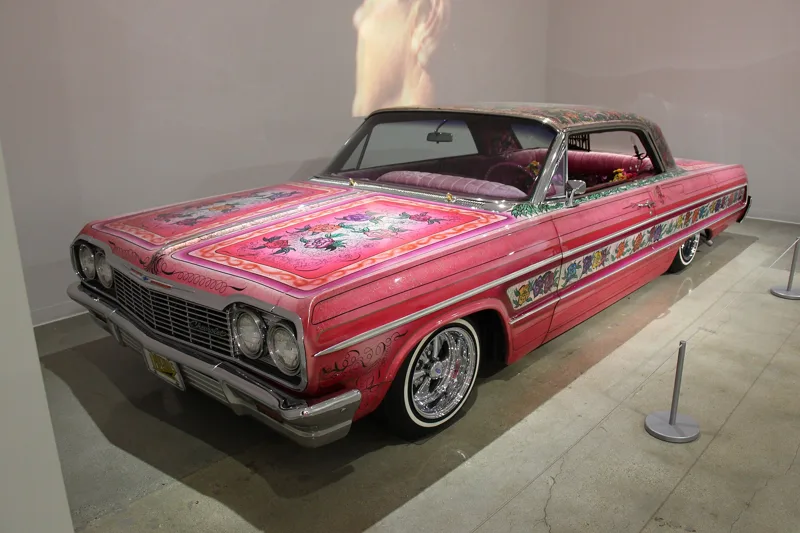
| Lowrider | Hydraulic or airbag suspension, custom paint, pinstriping and small wire wheels |
| Slab | Full-size American luxury car with custom elbows, neon and a peanut butter interior |
| Outlaw | Porsches 356 and 911 and Karmann Ghias with stronger engines, brakes and a harder look |
| Restomod | Classic exterior styling with modern suspension, wheels, transmission or interior |
| Rat rod | Deliberately unfinished look that imitates 1940s to 1960s hot rods |
| VIP style | Japanese customizing of luxury cars |
Why does custom paint matter so much?
Paint is one of the most prized parts of custom culture. Builders use candy, metalflake and colour-shifting finishes, along with pinstriping, airbrushing and hand-painted designs. In many competitions, paint awards carry as much prestige as the awards for whole cars.
Candy-apple paint, a transparent colour laid over a metallic undercoat, appeared in the 1960s. Joe Bailon, a customizer from Northern California, is credited with inventing the style. Candy and flake finishes needed many coats to reach their brilliance, and in hot climates they could flake off.
What are engine swaps and suspension changes?
An engine swap moves a motor from one car into another, often into a car that did not originally have it. Completing one usually needs fabrication to fit the engine and link it to the transmission, electrics and body. Suspension changes lift a car for off-road clearance or lower it for better handling, and some builders fit height-adjustable systems.
Popular donor engines include the Chevy LS, Ford Coyote, Toyota JZ, Honda K and Volkswagen VR6, among many others. Many suppliers sell kits with adapter plates, engine mounts and front subframes for common swaps. Lowriders use hydraulic or air suspension so the car can rise and fall at the press of a switch. A solid axle swap replaces the independent front suspension with a solid axle.
Which awards do customizers want most?
The AMBR, short for America's Most Beautiful Roadster, is among the most coveted prizes in American custom building. It has been handed out at the Grand National Roadster Show each year since 1948. The Ridler Award has been handed out at the Detroit Autorama since 1964, honouring the most outstanding first-time entries.
The AMBR was known as the Oakland Roadster Show until the event moved to Southern California in 2003. The Ridler's entry rule is unusual, because a car must be shown for the first time at the Autorama. Many builders of high-end roadsters therefore enter Detroit first and then the Grand National show, hoping to win at both. The Ridler honours show promoter Don Ridler.
Which custom cars became famous?
Some custom cars became famous for their looks, others for appearing in film or television. Silhouette and Ed Roth's Mysterion won show attention, while the Red Baron became a Hot Wheels model. Film and television gave fame to Ala Kart, the yellow deuce from American Graffiti, the Monkeemobile and KITT.
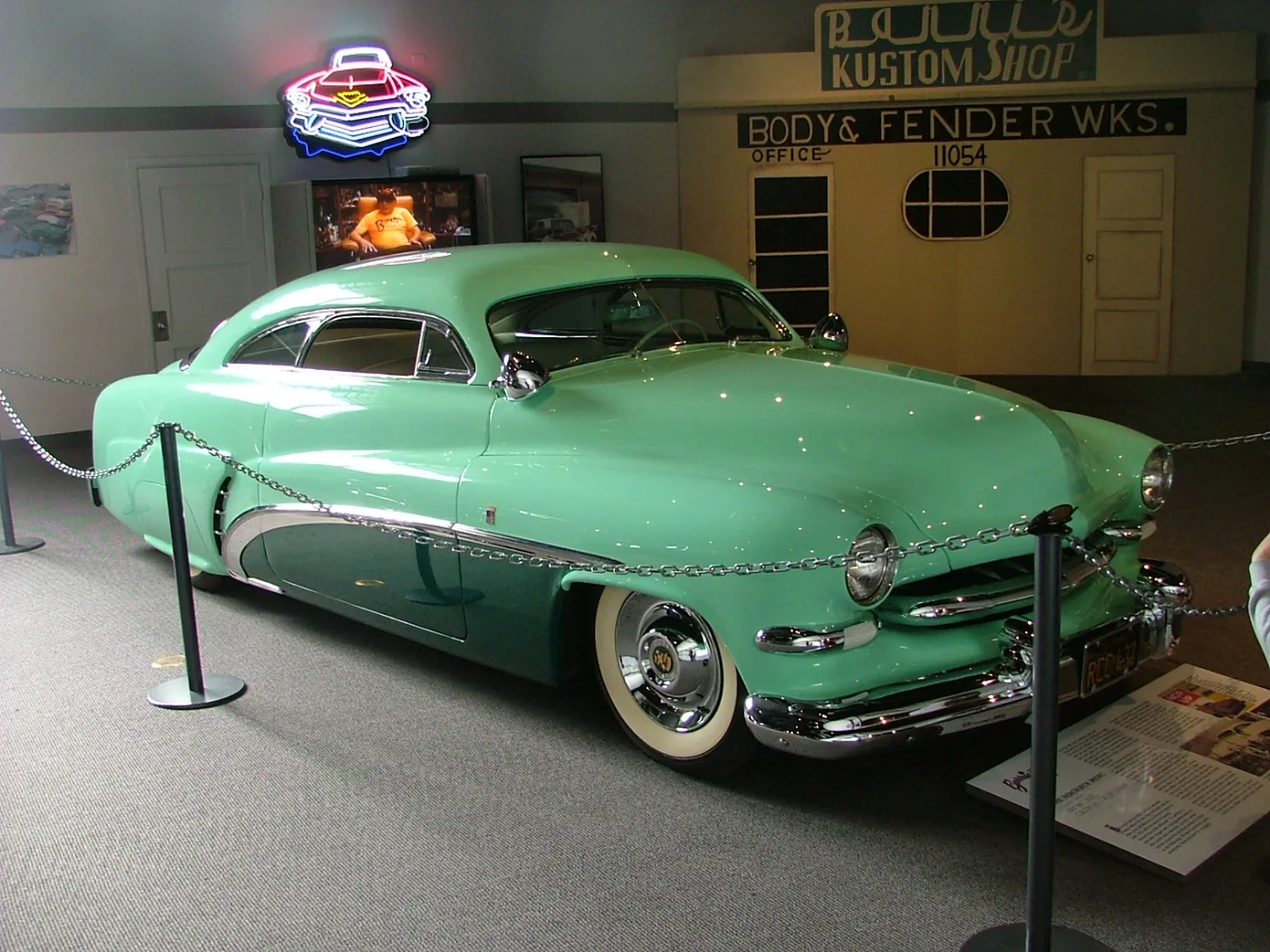
The Hirohata Merc is a notable example of a trend. The Barris brothers built the 1951 Mercury for Bob Hirohata in 1953, and it is counted among the most iconic customs of the 1950s even though it was not used in the film Runnin' Wild. That same year, Valley Custom Shop, through Neil Emory and Clayton Jensen, turned a 1950 Holiday 88 sedan into Polynesian for Jack Stewart. Hot Rod put the car on its cover that August, and the 1954 Motor Trend Custom Car Annual gave its build 54 pages.
What is stance and why do builders chase it?
Stance describes how a car sits on its wheels, and it is the defining concern of the stanced style. Stanced cars use lowered suspension, custom wheels and low-profile tyres, with aggressive sizes, offsets and camber. The look is built around the wheel and tyre package more than the engine.
The Euro style takes a related approach. Its cars carry one-off paint and small wheels, and builders shave features to sharpen the body lines. The German look is another variant, built on a Volkswagen Type 1, a Type 3 or a Karmann Ghia that has been lowered, with recent Porsche mag wheels and touring car styling. Heavily modified suspension and drivetrains in these builds put handling and cornering ahead of show appeal.
Stance is also where the culture meets practicality. Lowered cars can be hard to drive on rough roads, while lifted off-road builds trade road manners for ground clearance. Each approach shows what a builder values, whether that is the look of a car at a standstill or how it behaves in a corner.