General Motors' aluminium flat-six, built for the rear-engined Corvair, grew from 80 hp in 1960 to a 180 hp turbo and later found a following among homebuilt aircraft and custom car builders.
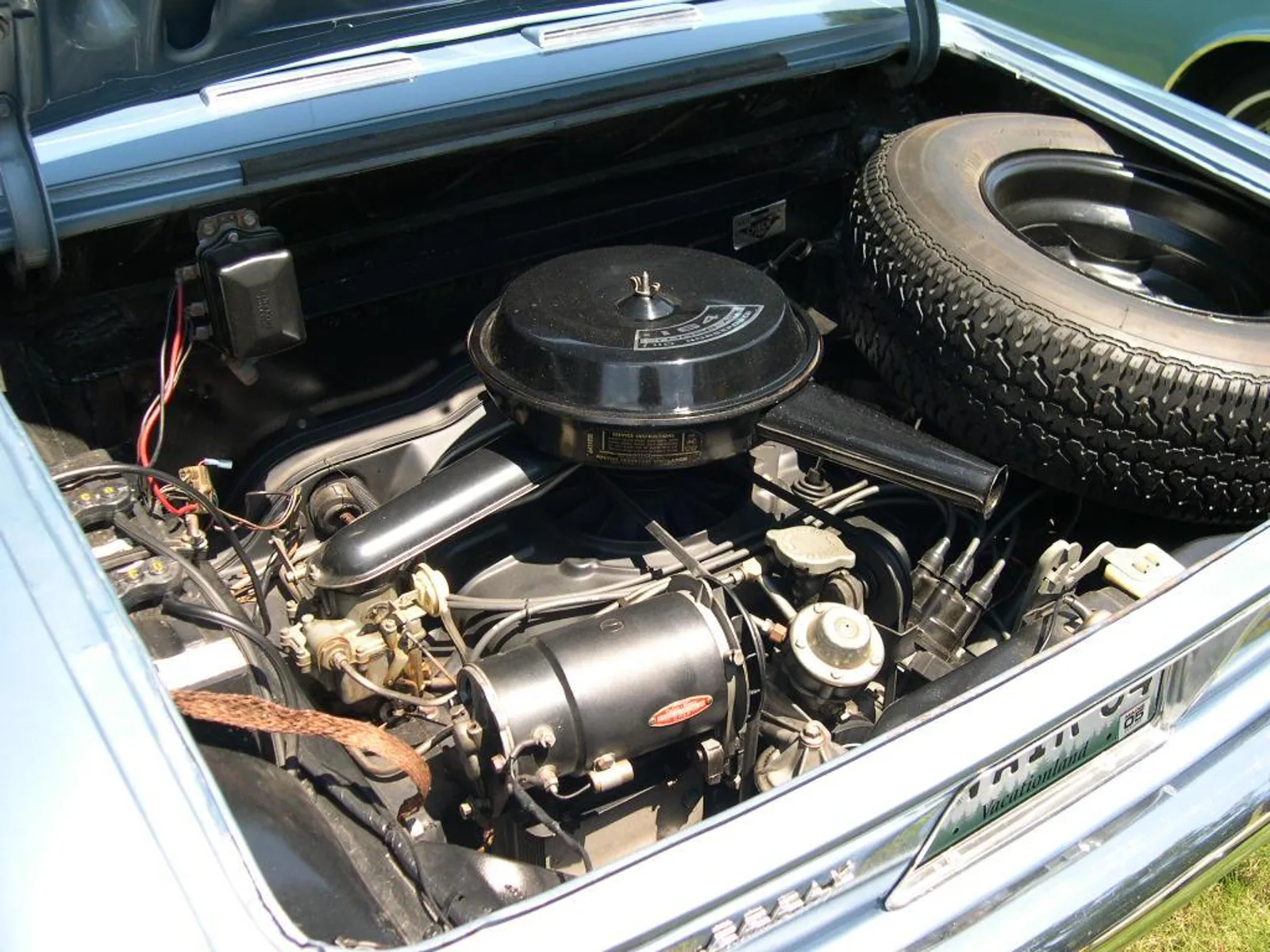
The Turbo-Air 6 was Chevrolet's air-cooled aluminium flat-six, first sold in the 1960 Corvair. It ran from 80 hp to a 180 hp turbo in 1965, and it was used across the whole Corvair line, with Corvair production ending after 1969 and taking the engine with it.
Developed by General Motors in the late 1950s for the rear-engined Chevrolet Corvair, this air-cooled flat-six powered the entire Corvair line through the 1960s. Its aluminium construction and air cooling made it a favourite of amateur aircraft builders, and a small cottage industry grew up around modifying Corvair engines for flight. Production ended when the Corvair itself was discontinued after 1969.
What was the Chevrolet Turbo-Air 6?
The Turbo-Air 6 was a flat-six engine that was primarily air-cooled. Its main components were an aluminium crankcase, a pair of aluminium heads that each served three cylinders and carried the intake passages, and six separate iron barrels. It was used in a wide range of cars, including the 500, 700 and 900 Monza, Corsa, Spyder, Corvair and Lakewood models, as well as vans and pickups.
The engine was not just a Corvair part. Its air cooling, lack of antifreeze and aluminium components gave it a distinct identity that set it apart from the water-cooled engines that dominated the American market at the time.
An aluminium, air-cooled flat-six that began as a rear-engined car's power unit and became the favourite of aircraft builders for decades.
Why did Chevrolet choose an air-cooled engine?
Ed Cole, Chevrolet's chief engineer from 1952 to 1956 and its general manager until 1961, was the driving force behind the Corvair and its engine reaching showrooms. Cole had designed powertrains for light tanks at Cadillac during the Second World War, and after the war he experimented with rear-engined prototypes nicknamed Cadibacks.
Cole also oversaw the production of the M41 Walker Bulldog tank in 1950, which used a six-cylinder, air-cooled, supercharged boxer engine of 895 cu in (14.7 L). He logged over 300 hours piloting a Beechcraft Bonanza with a smaller engine of the same basic layout, so air cooling was familiar territory for him. When he asked Maurice Olley to find something different, Olley's team concluded that a rear-engined, rear-wheel-drive car would need an aluminium, air-cooled engine.
Who developed the Turbo-Air 6?
Robert P. Benzinger was the senior project engineer, and Adelbert Kolbe was the engine designer. The first unit ran in December 1957, and an early prototype was fitted to a Porsche 356 for road testing. Later development cars carried the LaSalle II name or were badged as Holdens.
The programme needed new foundry and machining techniques. A new casting foundry was built at Massena, New York, and General Motors persuaded Reynolds Aluminum to build a reduction plant nearby to supply the metal. Each engine used 92 lb (41.7 kg) of aluminium, which went into the pistons, cylinder heads, block, crankcase cover, clutch housing and flywheel housing. The aluminium parts were cast with machines from Karl Schmidt GmbH of Neckarsulm, and every engine was assembled at GM's Tonawanda Engine plant.
When did the Corvair engine go on sale?
The car and engine launched on 29 September 1959, and they reached showrooms three days later. The advertising agency, Campbell-Ewald, gave the engine its name, the Turbo-Air 6, and promoted the fact that it did not need anti-freeze. It also emphasised the aircraft-type aluminium content of the engine.
How was the Turbo-Air 6 built?
The crankcase was cast as two box-section halves and held four main bearings. Twelve head studs on each side clamped the cylinder heads, and the crankshaft had six throws but no counterweights. That saved 25 lb (11.3 kg), and the early crankshafts were forged alloy steel.
Each cylinder head carried two overhead valves per cylinder, operated by stamped-steel rockers and hydraulic tappets through pushrods that ran inside tubes below each barrel. The tubes were a weak point: oil seeped past the pushrod tube seals until Viton seals cured it. The crankshaft rotated counter-clockwise when viewed from the rear, the opposite of most engines, which let the car use a conventional transmission and pinion arrangement.
Cooling was provided by a shrouded fan mounted horizontally on top of the engine. Early fans were steel and later ones magnesium, and a bellows thermostat controlled either a ring valve or a set of damper doors. Engine oil was also used as a coolant, and a variety of oil coolers were fitted over the production run. The single cast-iron camshaft had only nine lobes, with three double-width lobes operating all six exhaust valves.
What were the early Turbo-Air versions?
The 1960 engine displaced 140 cu in (2.3 L), with a bore of 3.375 in (85.7 mm) and a stroke of 2.6 in (66.0 mm). It had a compression ratio of 8.0:1 and produced 80 hp (59.7 kW) at 4400 rpm, with peak torque of 125 lb-ft (169 N-m) at 2400 rpm. A Special Camshaft package raised output to 95 hp (70.8 kW) with a different carburettor and a larger exhaust system.
In 1961 the bore grew to 3.4375 in (87.31 mm), giving 144.7 cu in (2,372 cc). The high-performance Super Turbo-Air raised the compression to 9.0:1 and produced 98 hp (73.1 kW) at 4600 rpm. Its development was reportedly carried out by Zora Arkus-Duntov.
How did the turbocharged Corvair engine work?
Chevrolet announced a turbocharged version on 27 March 1962. It was not marketed under the Turbo-Air name at first, and it was listed as the Super Charged Spyder engine. Development was carried out by James Brafford and Robert Thoreson, under the supervision of Benzinger, the Corvair's chief engine designer since 1959. The turbo engine produced 150 hp (111.9 kW) at 4400 rpm, a 47% increase over the naturally aspirated 102 hp, and its torque of 210 lb-ft (285 N-m) was 58% higher.
The Thompson Valve Division, part of Thompson-Ramo-Wooldridge until it became TRW in 1965, supplied the turbocharger. It weighed 13.5 lb (6.1 kg), had a 3 in (76 mm) impeller and could spin to 70,000 rpm. The engine had no wastegate. Instead, boost was limited by a back-pressure exhaust layout, and a metering rod and jet gave a rich mixture at full throttle to prevent it running too lean. The distributor used a pressure retard that cut timing by up to 9 degrees above 2.0 psi, and boost was capped at 10 psi (0.69 bar).
The turbo engine had heavy-duty rods and main bearings, chromed upper piston rings and nickel and chromium exhaust valves. Its crankshaft was forged 5140 chrome steel, and its compression ratio was reduced to 8.0:1. A single side-draft carburettor replaced the multiple-carburettor intake of the naturally aspirated versions.
How did the output change through the 1960s?
In 1963 crankcase ventilation became standard, and the oil cooler was changed to a three-plate design on most cars. In 1964 the stroke increased to 2.94 in (75 mm), taking displacement to 163.7 cu in (2,683 cc). The base engine produced 95 hp (70.8 kW) at 3600 rpm, the Super Turbo-Air produced 110 hp (82.0 kW) at 4400 rpm, and a harmonic balancer was added to every engine except the base model.
The 1965 model year brought a naturally aspirated engine with 140 hp (104.4 kW) at 5200 rpm. It had larger valves, a dual exhaust and four carburettors, and it used the same forged crankshaft as the turbo engine. The turbo was also revised, with a larger impeller that lifted output to 180 hp (134.2 kW) at 4000 rpm. The turbo was dropped in 1967, and by 1968 every US car carried an air injection reactor system to meet emission rules.
Why did the modular and SOHC projects fail?
In 1960 Frank Winchell took over Chevrolet's research and development group, and he began work on a successor. An early attempt at 176 cu in (2.9 L) only aggravated the head-gasket trouble. He then proposed casting the cylinder barrels and heads as a single piece, which removed the gasket altogether. The design team, led by Al Kolbe, produced what became the modular engine, which kept the boxer layout and air cooling.
The modular concept could be built with two, four, six, eight, ten or twelve cylinders, and versions with two, four, six and ten cylinders were actually built. The six produced about 120 hp (89.5 kW), and the ten-cylinder, known as the P-10, went into a 1962 Impala converted to front-wheel drive and produced 200 hp (149.1 kW). The Firebird IV concept grew out of the related XP-790 project, while the XP-787 project was cancelled.
A separate single overhead camshaft prototype was built between 1964 and 1966. It had a bore of 3.56 in (90.4 mm) and a compression ratio of 10.5:1, and its claimed output of 240 hp (179.0 kW) at 7200 rpm was never achieved. The best prototype made 190 hp (141.7 kW) at 5700 rpm, and fan losses rose to 26 hp (19.4 kW) at 6000 rpm. Cooling losses were a major concern in the final report, and the prototypes are believed to have been destroyed.
Did fuel injection work on the Corvair engine?
General Motors began investigating fuel injection on 11 August 1962, using a mechanical system from Marvel-Schebler. A 164 cu in (2.7 L) test engine produced 133 hp (99.2 kW), and after a further programme the Rochester system delivered 180 hp gross and 147 hp net by early 1965. Even so, the 30-month programme decided that the expense of injection was not warranted by the modest power gain.
Which Corvairs were tuned by specialists?
Several companies modified stock Corvairs for better performance or a more individual look. Don Yenko built 100 Yenko Stingers with the rear seats removed to qualify for SCCA racing in Class D. They were offered in four stages of tune, with 160, 190, 220 and 240 hp, and production ran from 1966 to 1969. Claims of 240 to 250 hp were made for the top Stage IV and racing Stingers.
The Fitch Sprint, sold directly by John Fitch's works in Connecticut or as a dealer-fitted kit, raised power to a peak of 155 hp (115.6 kW) with a four-carburettor intake. Solar Automotive later continued the Sprint and launched the Cavalier, keeping Fitch's carburettor modifications and offering a Weber conversion.
What other vehicles used the Turbo-Air 6?
The engine found work in motorhomes, military vehicles, boats and aircraft. The Travalon and UltraVan motorhomes used a 110 hp or later 140 hp version, and the Canadair CL-91 and DynaTrac XM-571 amphibious track vehicle used an industrial Turbo-Air. The Gama Goat prototypes used the engine, and the XM-808 Twister used two Corvair engines, one at each end.
Aircraft were a major field. The air-cooled engine suited homebuilt designs such as the Pietenpol Air Camper, the Zenith CH 601 and the Pro-Composites Personal Cruiser, which was designed around the Corvair. Specialist propeller maker Hegy in Marfa, Texas, made propellers for the engines. Some builders also experimented with inline-three configurations based on half of a Turbo-Air six.
How did the engine find its way into hot rods?
Private hot rodders and small companies built one-off cars around the Turbo-Air 6. Gene Winfield's Reactor used a turbocharged Corvair engine in the front, driving the front wheels, and it appeared on television programmes including Bewitched, Star Trek and Batman. Ed Roth's Road Agent placed the engine ahead of the rear wheels in a custom tubular chassis. The Stiletto debuted at the 1966 Detroit Autorama, and the Hannibal Twin-8 built for the film The Great Race had a Corvair engine in one of its two drivable cars.
How did the Turbo-Air 6 come to an end?
Corvair production stopped after 1969, and the engine went with it. The engine had been a central part of GM's experiment with rear-engined, air-cooled cars, and its later life in aircraft, custom cars and specialist vehicles has kept it visible for decades. Neither the modular nor the SOHC successor reached production.
Specifications at a glance
| Version | Year | Displacement | Output | Torque |
|---|---|---|---|---|
| Standard | 1960 | 140 cu in (2.3 L) | 80 hp (59.7 kW) at 4400 rpm | 125 lb-ft (169 N-m) at 2400 rpm |
| Super Turbo-Air | 1961 | 2,372 cc | 98 hp (73.1 kW) at 4600 rpm | 132 lb-ft (179 N-m) |
| Turbo | 1962 | 2,372 cc | 150 hp (111.9 kW) at 4400 rpm | 210 lb-ft (285 N-m) |
| Base | 1964 | 163.7 cu in (2.7 L) | 95 hp (70.8 kW) at 3600 rpm | 154 lb-ft (209 N-m) at 2400 rpm |
| Four-carburettor | 1965 | 163.7 cu in (2.7 L) | 140 hp (104.4 kW) at 5200 rpm | 160 lb-ft (217 N-m) at 3600 rpm |
| Turbo | 1965 | 163.7 cu in (2.7 L) | 180 hp (134.2 kW) at 4000 rpm | 232 lb-ft (315 N-m) at 3200 rpm |