A cast-iron V6 that began life as half of a Buick V8 became the most-built GM six, surviving a sale, a buy-back and decades of turbo, supercharged and fuel-injected versions.
The Buick V6 is an overhead-valve V6 that General Motors introduced in 1962 as the Fireball. Its later 3800 form, at 3.8 litres, was built in over 25 million examples and went through a sale to AMC and a buy-back by GM.
Buick's overhead-valve V6, first offered by General Motors in 1962, is best remembered in its later form as the 3800. It was derived from Buick's aluminium V8 but was cast in iron, and over 25 million of the family were built. The engine went through a sale to AMC, a buy-back by GM and a long series of revisions, and it became one of the most-produced engines in automotive history.
What is the Buick V6 engine?
Built with a cast-iron block and two valves per cylinder, this overhead-valve V6 was a durable and cheap-to-make design. Its later form, the 3800, displaced 231 cu in (3.8 L) and became the most common GM V6. Ward's counted the family among the best engines of the 20th century, and it appeared in the magazine's yearly top ten on many occasions.
The engine was the first six-cylinder designed exclusively for Buick since the Buick straight-six was discontinued in 1930. Production was based at the Flint North plant in Flint, Michigan, with its blocks and heads cast at the Grey Iron plant in Saginaw, Michigan.
A V6 that began as half a V8 and went on to become the most-built engine in General Motors history.
Where did the Buick V6 begin?
The first engine in the family, with RPO code 6I, arrived in 1961 for the 1962 model year Buick Special. It used a 198 cu in (3.2 L) displacement and was known as the Fireball V6. It was the first V6 in an American car, although the GMC V6 had already been used in trucks.
Buick had derived the V6 from its 215 cu in (3.5 L) aluminium V8, which was later sold on as the Rover V8. Buick's engineers wanted a cheaper cast-iron alternative with the same tooling, so they settled on a 90-degree V6 that was essentially the V8 with two cylinders removed. The first version measured 3.625 in by 3.1875 in (92.08 mm by 80.96 mm) and weighed about 35 lb (16 kg) more than the aluminium V8.
Why did the early V6 have an uneven firing pattern?
The crankshaft had only three crank pins, set 120 degrees apart, and each pair of opposing cylinders shared one. The result was an uneven firing pattern, which many drivers perceived as roughness. A former American Motors executive once compared the feel to a rough cob, which gives some idea of the reputation the design carried.
The off-centre design continued until the 1988 LN3 version, when the left-hand bank was moved forward relative to the right. The bore spacing then became centred, although the bores were still 4.24 in (108 mm) apart on each bank. The change was one of the important steps that made the later engines smoother.
How did the 225 V6 grow from the Fireball?
The 225 grew to a 3.75 in (95.25 mm) bore and a 3.4 in (86.4 mm) stroke, giving 225.3 cu in (3.7 L). The 225 was similar to the small-block Buick V8 and used much of the same tooling. It carried the RPO codes KH for 1964, LH for 1965, MH for 1966 and NH for 1967, and in 1966 it was renamed the Wildcat V-6.
The first 225s in 1964 and 1965 used a single-barrel Rochester MonoJet and made 155 hp (116 kW). In 1966 and 1967 a two-barrel Rochester 2GV gave a 5 hp increase to 160 hp (119 kW). After the 1967 model year Chevrolet's 250 cu in (4.1 L) inline six took its place, and the V6 tooling went to Kaiser-Jeep.
Kaiser-Jeep had already begun using the 225 in its CJ Jeeps in 1965 as the Dauntless V6, with a much heavier flywheel to damp the firing vibrations. When American Motors bought Jeep, the V6 was replaced by AMC straight-six engines, although AMC kept ownership of the V6 tooling.
How did GM bring the V6 back in 1974?
After the 1973 oil crisis GM needed fuel-efficient engines to replace its large V8s. The only small GM engines then available were the Chevrolet four and straight-six, so the company looked back at the V6. Buick engineers fitted an old Fireball V6 from a junkyard into a 1974 Buick Apollo, and the test worked so well that GM wanted to restart production.
AMC's cost per unit was judged too high, so GM repurchased the tooling and production line in April 1974 and began building the engines on 12 August. Because the old machinery was still in place at Buick's engine plant in Flint, production returned in some 1975 models, at least two years earlier than new tooling would have allowed. The bore grew to 97 mm (3.8 in), giving 231.4 cu in (3.8 L; 3,791 cc), and 78,349 units went into Buicks for 1975.
Tighter fuel economy and emissions rules kept the output down, and the 1975 unit was rated at 78 or 82 kW (105 or 110 hp) according to fitment. The 231 was to become the platform on which the later 3800 was built.
What did the 231 change in 1977 and 1979?
In 1977 Buick redesigned the crankshaft with a split-pin layout to create an even-firing version. The crank pins serving opposing cylinders were staggered by 30 degrees, and a 3 mm flange between them stopped the connecting rods from walking off the journal. The rods were redesigned with their big ends offset from the piston pin, and this new layout became known for its off-centre bore spacing.
In 1978 GM began to market the engine as the 3.8 litre, following the move to metric sizes, with the code LD5 in most markets and LC6 for California. From 1979 it was used in the front-wheel-drive Buick Riviera, still mounted longitudinally. Larger valves and better intake and exhaust flow lifted output for 1979, and the new engine became the basis for the turbocharged versions that followed.
How did the turbocharged 3.8 become the GNX engine?
The turbo 3.8 was the pace car at the 1976 Indianapolis 500, and production versions came two years later. In 1984 the turbo engine gained sequential injection and wasted-spark ignition without a distributor. In 1986 an air-to-air Garrett intercooler arrived, and the code became LC2, with a bore of 3.8 in (96.5 mm) and a stroke of 3.4 in (86.4 mm).
The LC2 was rated at 235 hp in 1986 and 245 hp in 1987. The limited-production GNX benefited from a ceramic turbocharger, a more efficient intercooler, a low-restriction exhaust and revised programming, which together gave a factory rating of 300 hp (304 PS; 224 kW).
What were the smaller and larger versions of the V6?
A smaller 196.3 cu in (3.2 L; 3,216 cc) version, with a 3.5 in bore, went to Century, Regal and Monza buyers in 1978 and 1979. It started at 90 hp and rose to 105 hp (78 kW) in 1979 after the head improvements. The LC4 went the other way, with a 3.965 in (100.7 mm) bore, giving 4,128 cc (251.9 cu in) from 1980 to 1984.
The LC4 produced 125 hp (93 kW), and torque stood at 205 lb-ft (278 N-m); it went into many large rear-drive Buicks and into models from several other GM divisions. It also served as standard power for the Riviera and Toronado front-drivers between 1981 and 1984. It was the first naturally aspirated GM V6 to use a four-barrel carburettor, and its only real weakness was the intake valve seals.
A 3.0 litre unit measuring 181.0 cu in (2,966 cc) arrived in 1982 for transverse front-drive cars like the Century and Cutlass Ciera. It kept the 3.8's bore but used a 2.66 in (68 mm) stroke. The LN7 was a multiport fuel-injected version for 1985, which was replaced in 1989 by the 3.3 litre engine.
How did the 3.8 go transverse in the 1980s?
In mid-1984 the 3.8 was modified for transverse mounting in smaller front-wheel-drive cars, with multipoint fuel injection. The LG2 version had flat lifters and produced 140 hp (104 kW) at 4,400 rpm and 200 lb-ft (271 N-m) at 2,000 rpm. The LG3 had roller lifters, producing 125 hp in 1984 and 1985 and 150 hp in 1986 to 1988 with sequential fuel injection.
From 1986 the engine received a crankshaft-driven oil pump, which removed a long-standing problem with pump housing wear and loss of prime. That kind of detail mattered because the 3.8 was becoming the most common GM V6, and dependability was becoming as important as performance.
What was the LN3 and the 3300?
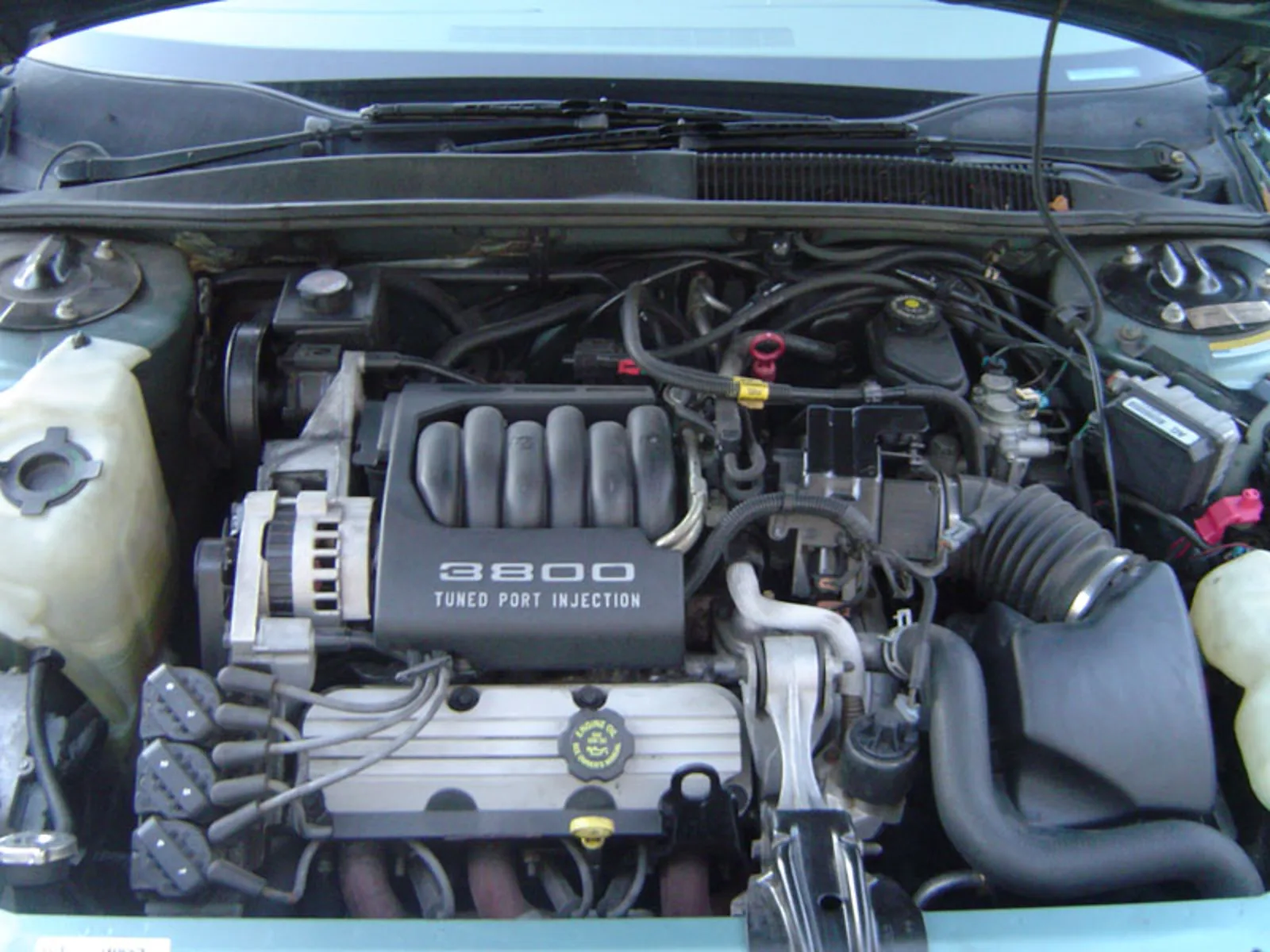
The 3800 LN3 arrived in 1988 rated at 165 hp (123 kW); its torque was 210 lb-ft (285 N-m). It was a major redesign with on-centre bore spacing, a balance shaft, a crank-trigger system and multiport fuel injection. The LN3 stayed in service in several GM models until the early 1990s.
The 3300 was a 3.3 litre engine built from 1989 to 1993, based on a lower deck with a smaller bore of 3.7 in (94.0 mm) and a 3.16 in (80.3 mm) stroke, giving 3,341 cc. It had batch-fire injection and no balance shaft, and it produced 160 hp (119 kW) at 5,200 rpm with 185 lb-ft (251 N-m) at 2,000 rpm.
How did the Series I 3800 and the supercharged L67 perform?
The L27 replaced the LN3 in mid-1990 and produced 170 hp (127 kW), with more mid-range torque from a new two-piece intake manifold with longer runners. It was known as the Series I 3800 or 3800 TPI, and Holden used it in Australia in the 1991 VN Commodore. The VR Commodore of 1993 raised the output to 130 kW (177 PS).
The supercharged Series I, the L67, used an Eaton M62 supercharger and went through two revisions. Output was 205 hp for 1991 to 1993 with the Gen2 unit and 225 hp for 1994 and 1995 with the Gen3. The Gen3 used epoxy-coated rotors rather than the Teflon coating often assumed, a larger inlet and a 72 mm pulley, and its redline was 6000 rpm.
What changed with the Series II in 1995?
The Series II arrived in 1995 and became the most popular 3800, known for its power, smoothness and reliability. The shorter deck and redesigned crankshaft cut weight, and a new intake manifold, larger valves and a higher compression ratio raised output to 205 hp (153 kW), and torque rose to 230 lb-ft (312 N-m). It weighed 392 lb (178 kg), 26 lb lighter overall, and it was on Ward's 10 Best Engines list for 1995 to 1997.
On 14 April 2009 GM recalled 1.5 million vehicles fitted with this engine, because oil leaking under the valve cover gaskets could reach hot exhaust manifolds and start a fire. Earlier units also suffered from a plastic upper manifold that cracked around the EGR passage, which could let the engine hydrolock. The revised intake gaskets and manifolds corrected these issues.
How did the supercharged Series II and Series III differ?
The L67 Series II supercharged engine appeared in 1996, a year after the naturally aspirated L36. It used an Eaton Generation III M90 supercharger, a larger throttle body and a different lower intake, and its compression fell from 9.4:1 (L36) to 8.5:1. GM rated the output at 240 hp (179 kW), with 280 lb-ft (380 N-m) of torque. It was built in Flint and certified LEV in 2001.
The Series III engines from 2003 introduced an aluminium intake, larger intake valves and electronic throttle control. Powdered metal connecting rods came into use in 2004 for supercharged engines and 2005 for naturally aspirated ones. The supercharged L32 used the Generation 5 M90, and in Grand Prix GTP trim it reached 194 kW (260 hp), and it required premium fuel of 91 octane or higher.
Specifications at a glance
| Version | Years | Displacement | Output | Typical application |
|---|---|---|---|---|
| Fireball | 1962 | 198 cu in (3.2 L) | Original 198 cu in unit | Buick Special |
| 225 | 1964 to 1967 | 225.3 cu in (3.7 L) | 155 hp (116 kW) to 160 hp (119 kW) | Buick Special and Skylark |
| 231 (LD5) | From 1975 | 231.4 cu in (3.8 L) | 105 or 110 hp at launch | Buick Riviera and Regal |
| LC2 turbo | 1986 to 1987 | 231 cu in (3.8 L) | 235 hp (1986); 245 hp (1987) | Turbo models |
| LN3 3800 | 1988 to 1990 | 3.8 L | 165 hp (123 kW) | Several GM products |
| L27 Series I | From 1990 | 3,791 cc | 170 hp (127 kW) | Buick and Holden |
| L36 Series II | 1995 onwards | 3.8 L | 205 hp (153 kW) | Most 3800 models |
| L67 supercharged | 1996 onwards | 3.8 L | 240 hp (179 kW) | Supercharged models |
| L32 supercharged | 2004 onwards | 3.8 L | Up to 260 hp (194 kW) | Grand Prix GTP |