American Motors wanted a mid-engined rival to the De Tomaso Pantera in 1970. Italian specialists built the chassis, six cars were made, and the design still shapes AMC lines today.
Presented in Italy in March 1970 as a rival to the De Tomaso Pantera, the AMC AMX/3 was a mid-engined American coupe. Italian specialists built much of its chassis, only a handful of cars were made, and AMC dropped the project that summer.
The AMC AMX/3, also written AMX III, was a mid-engined sports car that American Motors Corporation unveiled in Italy in March 1970. It was styled in Detroit, but Italian specialists built its chassis and most of the prototypes, and AMC planned to make it in Germany. The company dropped the project that summer, after building only a handful of cars.
Why did AMC want a mid-engined sports car?
AMC wanted a sporty image to match its struggling sales. It was the smallest of the four major American carmakers and had lost money in the early 1960s, and its models were widely seen as staid. A mid-engined coupe would give the brand a halo car that could prove its engineering.
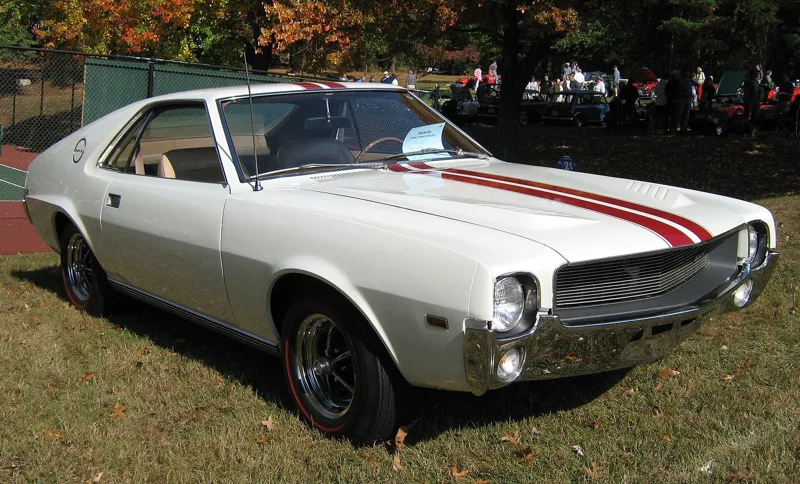
The Javelin pony car arrived in 1968, three years after the Ford Mustang had created the category. The two-seat AMX built on the Javelin sold less than expected, and the Chevrolet Corvette remained the only other two-seat car with an established reputation in America.
Ford's racing success with the GT40 had shown how much a mid-engined car could help a brand, and AMC began planning a high-performance mid-engined model in 1968. The first show car, the AMX/2, was stylistically influenced by the De Tomaso Mangusta. Its design was then developed into the AMX/3, which was already near production in the spring of 1968.
In the autumn of 1968 AMC decided to put the AMX/3 into series production. Its primary rival was the De Tomaso Pantera, which Ford would sell through its dealers in the United States. Building the car in Europe was a financial decision, because management hoped to keep production and sales prices low.
A mid-engined American coupe whose chassis came from Italy and whose design still shows in later AMC hatchbacks and coupes.
Who designed the AMX/3?
The body was credited to AMC's own studio, led by Richard "Dick" Teague, with detailed work by Vince Geraci, Jack Kenitz, Chuck Mashigan and Robert "Bob" Nixon. A clay model was made in a studio that AMC leased at its East Outer Drive facility, and a full-size glass-fibre model known as the Pushmobile followed in the autumn of 1968.
The Pushmobile was not roadworthy and had no engine, steering or interior. It was judged against a proposal from Giorgio Giugiaro's Italdesign studio, which had been produced in parallel with the Bizzarrini Manta show car. The AMC design won, and Italdesign's involvement was not made public at the time.
AMC had only front-engined, rear-drive cars in its 1960s range, so the mid-engined layout could not build on existing production technology. The company brought in the engineer Giotto Bizzarrini, who had worked on racing and sports cars for several Italian makers. Bizzarrini had lost his own company to bankruptcy a month before he joined AMC.
Teague later suggested that some work had been outsourced to a specialist firm in Detroit, but he did not name the tasks.
Bizzarrini's role was narrower than AMC's publicity suggested. He produced the first chassis drawings in December 1968, and only the suspension has been proven to be his design. The frame was largely the work of Italdesign, which saw itself as a design studio and a construction service provider.
Coachbuilder Coggiola began the first prototype in late 1968 but did not finish it. The work passed to Autocostruzioni S.D., run by Salvatore Diomante, who had been plant manager at Automobili Bizzarrini. Diomante's workshop was based in Livorno before it moved to Moncalieri near Turin, where the remaining AMX/3s were built.
How was the AMX/3 built?
The car used a semi-monocoque chassis with a central beam and box sills, which set it apart from Bizzarrini's earlier tube-frame designs. Every wheel had independent suspension on double wishbones, with coil springs and telescopic dampers. The rear lower wishbones were trapezoidal, and the wheel carriers were cast from aluminium.
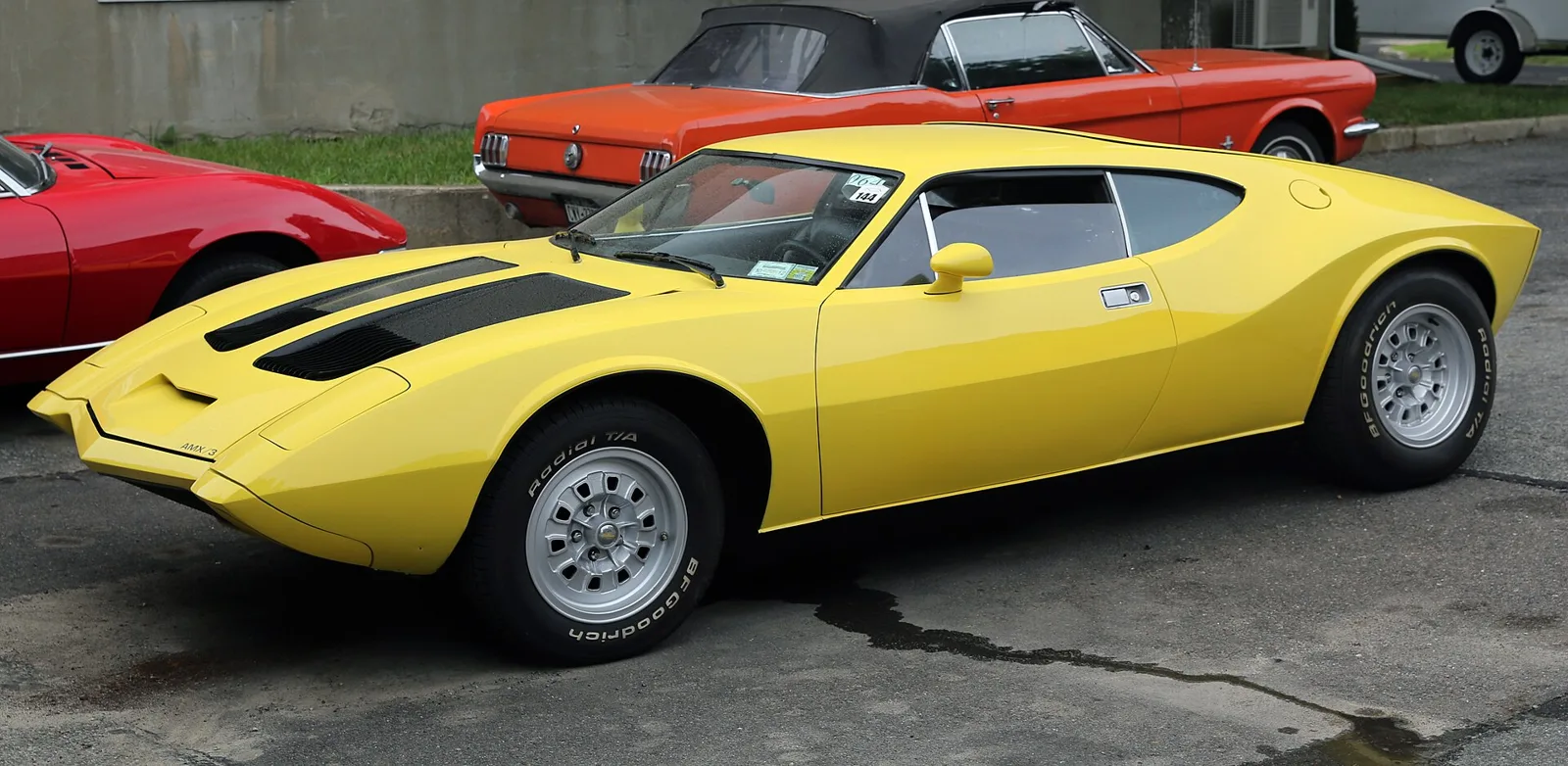
During 1969 AMC revised the design in several areas, lengthening the rear overhang, redesigning the bonnet to cover the wipers and fitting one-piece side windows. The tailgate, which included the engine cover and rear window, was hinged at the back and held open by two gas struts.
The body was handcrafted in sheet steel and joined to the floor pan to form a self-supporting unit. It was very flat, at 1.10 m high, but wide at 1.92 metres (6.3 ft). The profiled fenders and the sweep over the rear wheels were the most striking features, and the design drew on the Studio GT prototype that Neri e Bonacini had shown in 1966.
The first prototype was tested by BMW from June 1969 under the code E18. The testers found the chassis too weak and the cooling inadequate, so Bizzarrini revised both. The brakes were changed from Girling units to a system from Alfred Teves after those tests, and BMW's involvement ended in January 1970 when AMC stopped paying for the test programme.
| Feature | Detail |
|---|---|
| Layout | Mid-engined, rear-wheel drive, coupe with a hatchback tailgate |
| Engine | AMC V8, 390 cu in (6.4 L), 10:1 compression |
| Output | 340 hp (254 kW) at 5,100 rpm; about 295 hp (217 kW) DIN |
| Torque | 430 lb-ft (583 N m) at 3,600 rpm |
| Gearbox | Four-speed by Oto Melara; one car with a five-speed ZF |
| Weight distribution | 43:57 front to rear |
| Tyres | 205/70 VR 15 front, 225/70 VR 15 rear |
| Body height and width | 1.10 m high, 1.92 m wide |
How fast was the AMX/3?
The V8 was mounted longitudinally between the seats and the rear axle. It was an AMC unit with a 390 cu in (6.4 L) capacity, a four-barrel Carter carburettor and a 10:1 compression ratio. It made 340 hp (254 kW) at 5,100 rpm under the SAE test standard, and 430 lb-ft (583 N m) of torque at 3,600 rpm.
Management set the bar at 160 mph (260 km/h) or more. The first prototype fell short, because the original shape generated too much lift at high speed, and it topped out at 145 mph (233 km/h). Bizzarrini and the racing driver Antonio Nieri then tested different front spoilers on the second prototype.
With the spoilers fitted, the second prototype reached 170 mph (270 km/h) at the Autodromo Nazionale Monza. Nieri's fastest lap there was 1:56 minutes, which matched the figures achieved a few years earlier by a Bizzarrini GT 5300.
How many AMX/3s were built?
Diomante began building the cars in February 1969, and the exact number is still disputed. Most sources count six original AMX/3s, with several later cars built on the same chassis. Bizzarrini later spoke of three completed cars and two almost finished at the time of AMC's withdrawal.
The first prototype was built in spring 1969 and carries no chassis number. It eventually returned to the United States after years in storage. The second, the Red Monza Car, was sold in 1971 for US$6,000 and was restored in California in 1990. In January 2017 it sold for $891,000 at a classic car auction, the highest price ever paid for an AMC-branded car.
The fifth car was restored in 2006 and received a black-painted front spoiler, and it has been shown at irregular intervals in the United States and Europe since then.
The sixth car was finished in early 1971 and is recognised as an original. It was shown at the 1976 Turin Motor Show as the Bizzarrini Sciabola. Richard Teague later called it a real gem, and it is the only example fitted with the Oto Melara gearbox.
Why did AMC walk away from the project?
AMC withdrew from the project in July 1970 without giving any reason. It had invested about $2 million, equivalent to $15,691,517 in 2023, in the programme by then. That sum was enough to build a serious sports car, but the company chose to stop funding the work.
Diomante destroyed the nine cars made from the summer of 1970 onwards, although he kept the original prototypes built up to 1970.
Before that decision, AMC had been prepared to let Bizzarrini build 30 cars in the summer of 1970, 20 of them for sale in Europe under his own name. Giotto Bizzarrini later said he had not accepted the offer himself, and at the start of 1971 AMC refused the promised technical components and demanded that the models be scrapped.
How has the car been received?
Most commentators regard the AMX/3 as a milestone rather than a failure, even though it never reached mass production. Many consider it the best design Richard Teague produced at AMC, and some have argued that mass production could have won the company new customers.
In 2017 Thomas Glatch of SportsCarMarket described the car as a milestone that grew out of an unusual collaboration between designers and engineers on two continents. The car's story is one of ambition rather than of a failed design.
What happened to the AMX/3 after AMC left?
Several attempts were made to revive the design as the Bizzarrini AMX/3 or the Bizzarrini Sciabola. The Sciabola exhibit at the 1976 Turin show was mainly financed by Oto Melara, which wanted the car to advertise its gearboxes. Bizzarrini announced a hand-built price of $23,800, but production never began.
Bizzarrini also built the Iso Varedo show car, which used an AMX/3 chassis. The Varedo used a Ford Cleveland V8 and debuted at the 1972 Turin Motor Show. The California company Sciabola Inc. has tried to develop replica bodies since 2007, with no recorded sales.
How did the AMX/3 influence later AMC cars?
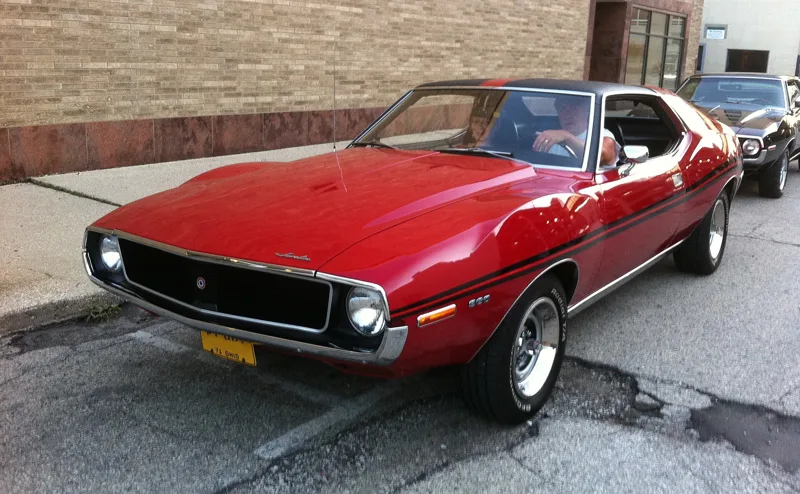
The AMX/3's most recognisable feature, its hip sweep over the rear wheels, reappeared on later AMC models. The 1973 Hornet hatchback quoted it in a toned-down form, and the Matador coupe carried AMX/3-inspired rear wings. Car and Driver named the Matador coupe its Best Styled Car of 1974.
Richard Teague, who led the design, regarded the AMX/3 as the best design he produced at AMC. Giotto Bizzarrini also considers it his best design. Teague's son Jeff, who has worked for Ford, designed the AMX/4 concept and the AMX/5 of 2010 as homages to the original.