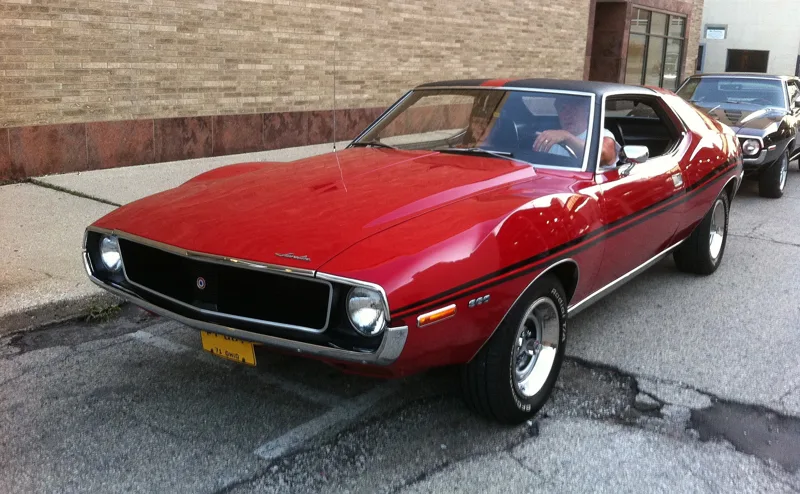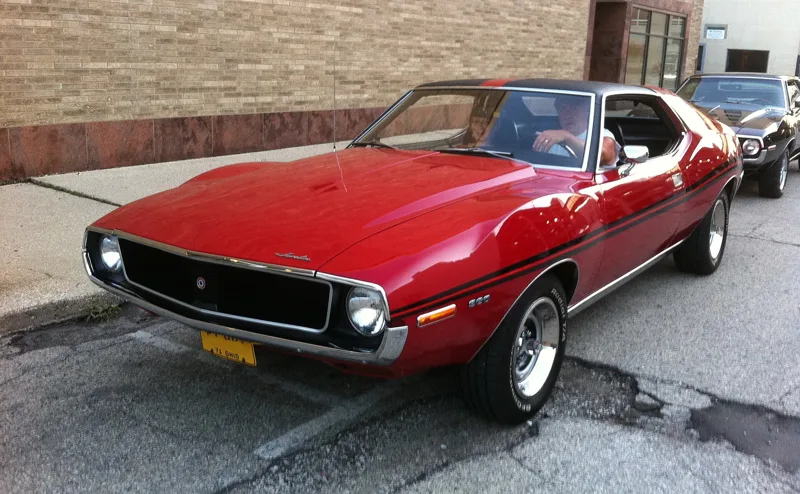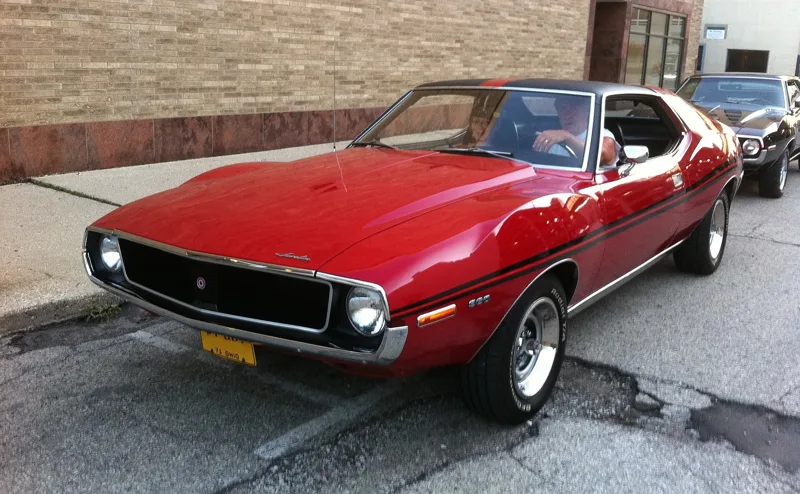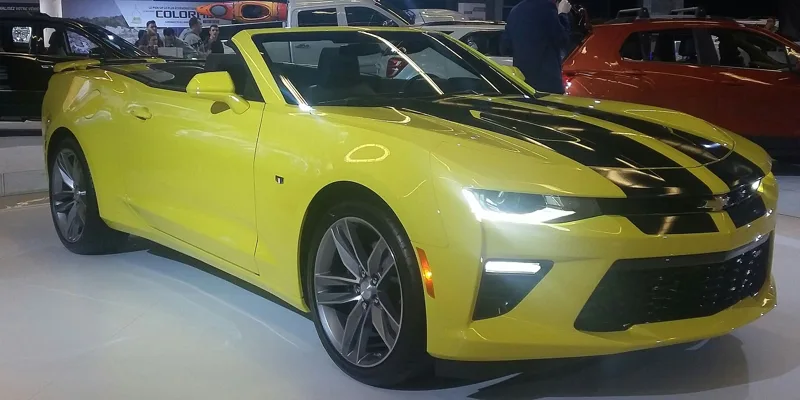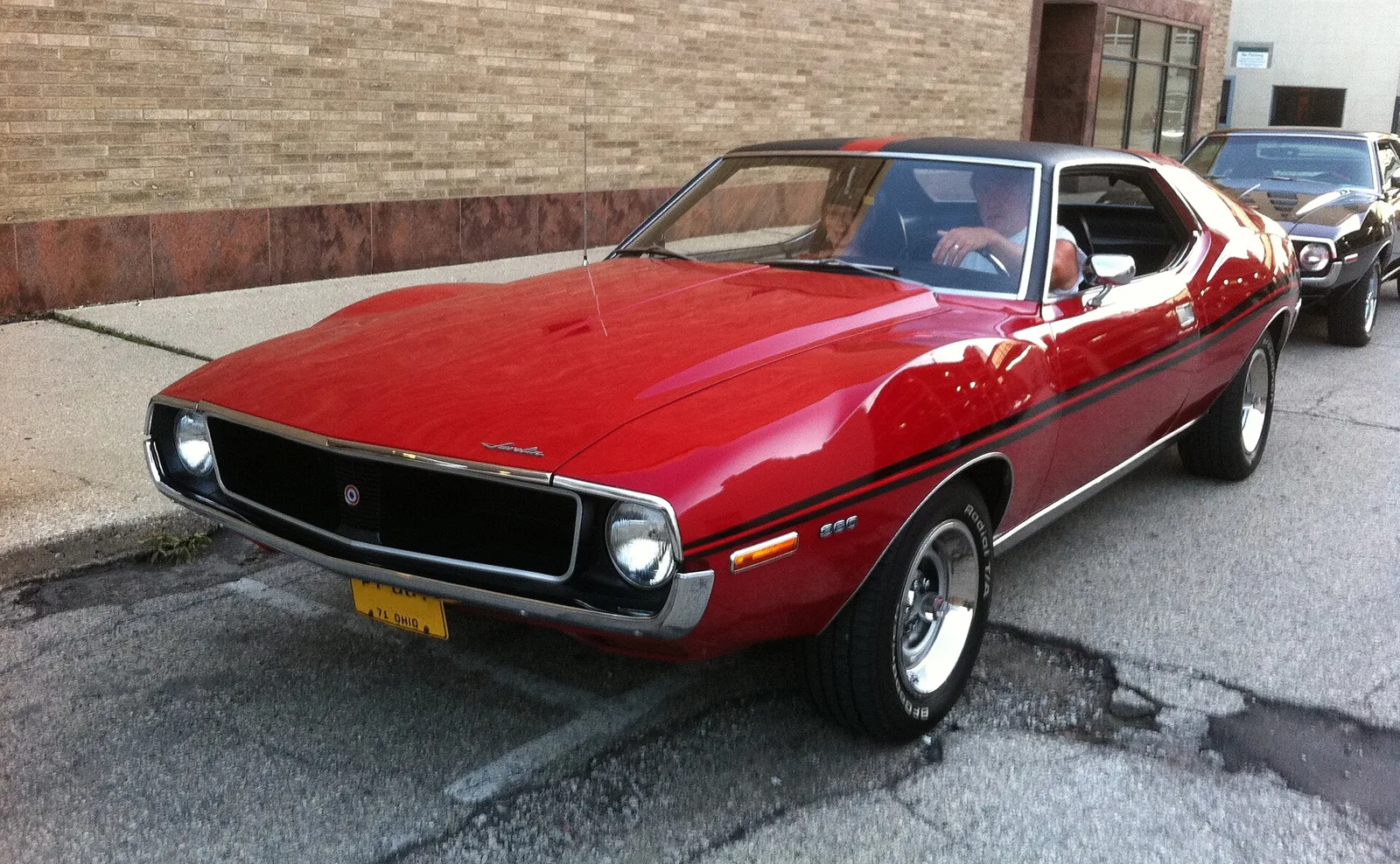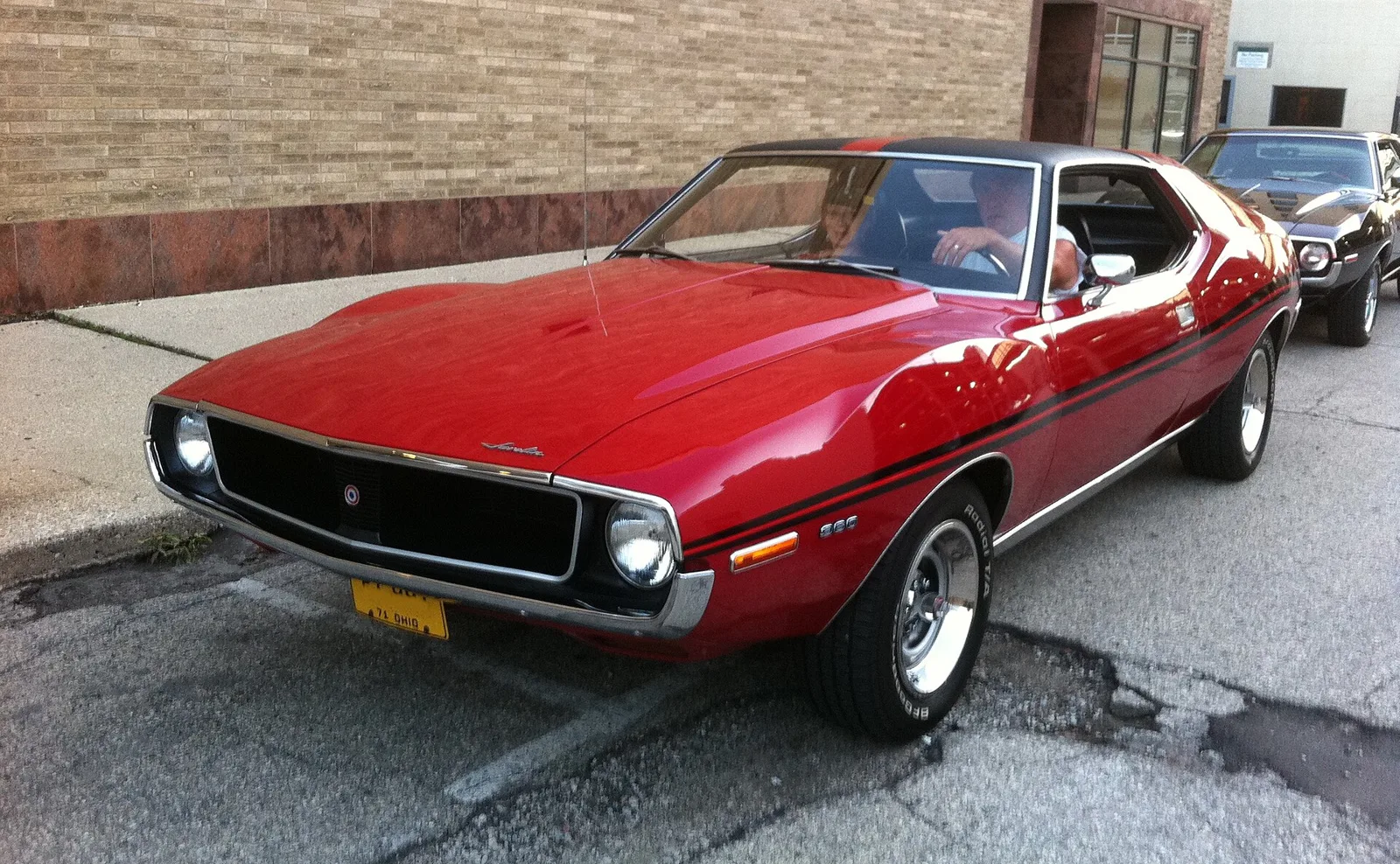
A 1968 American Motors pony car set against the sixth-generation Camaro, built from 2015 to 2023 on a platform it shared with Cadillac.
The AMC Javelin ran from 1968 to 1974, while the Chevrolet Camaro in this comparison is the sixth generation, built from 2015 to 2023. Both were pony cars, but they never shared a model year, so the pairing is about how two eras approached the same idea.
The AMC Javelin and the Chevrolet Camaro share a pony car heritage and very little else. The Javelin came out of American Motors in 1968 with a straight-six and a choice of V8s, while the sixth-generation Camaro arrived in 2015 on General Motors' Alpha platform with turbocharged fours, a 455 hp V8 and a supercharged 650 hp flagship.
Size is the one measure that links the two cars directly. The Javelin was longer and roomier than the Camaro of its own time, and the newer Camaro shrank in several dimensions, so the comparison runs as much on engineering philosophy as on horsepower.
Were the Javelin and Camaro ever direct rivals?
They were rivals in the same class, as pony cars built for buyers who wanted a sporty two-door with some performance. The two never met in the same model years, though, because the Javelin ended in 1974 and the sixth-generation Camaro did not appear until 2015.
What links them is the class itself. Each car was built to give buyers a sporty two-door at a modest price, and each grew a range of trims and performance versions to keep that promise over its life.
Two pony cars from different decades, each judged by its size, its speed and the trims it offered.
How did the Javelin and Camaro compare on size?
The Javelin was described as longer and roomier than the Mustang and the Camaro of its day, though it fell short of the larger Plymouth Barracuda. Its 288.83 litres (10.2 cubic feet) of trunk space is the one interior figure available for it.
The sixth-generation Camaro was 58 mm (2.3 in) shorter, 20 mm (0.8 in) narrower and 28 mm (1.1 in) lower than the car it replaced. It was also more than 91 kg (200 lb) lighter, despite similar equipment and engines.
Specifications side by side
| Specification | AMC Javelin | Chevrolet Camaro (sixth generation) |
|---|---|---|
| Production | 1968 to 1970 and 1971 to 1974 model years | 2015 to 2023, introduced 16 May 2015 |
| Body | Two-door hardtop | Coupe and convertible |
| Base engine | 232 cu in (3.8 L) straight-six | 2.0 L turbocharged four-cylinder (LS trim) |
| Performance engine | 390 cu in (6.4 L) V8, 315 hp (235 kW; 319 PS) | 6.2 L LT1 V8 in the SS, 455 hp (339 kW; 461 PS) |
| Flagship output | No figure given | ZL1: 650 hp (485 kW; 659 PS) |
| Torque | 576 Nm (425 lb ft) with the 390 | 617 Nm (455 lb ft) in the SS; 881 Nm (650 lb ft) in the ZL1 |
| 0-60 mph | 97 km/h (60 mph) in 8 seconds (343 Go Pac) | 97 km/h (60 mph) in 4.0 seconds (SS); 3.5 seconds (ZL1) |
| Quarter mile | 15.4 seconds (343 Go Pac) | 11.4 seconds at 204 km/h (127 mph) (ZL1) |
| Top speed | Approaching 193 km/h (120 mph) (343 Go Pac) | 319 km/h (198 mph) (ZL1) |
| Transmission | Three-speed Shift-Command automatic or manual | 6-speed manual, 8-speed or 10-speed automatic |
| Weight | No figure given | More than 91 kg (200 lb) lighter than the previous generation |
| Size | Longer and roomier than the Mustang and Camaro of its day | 58 mm (2.3 in) shorter than the previous generation |
| Launch price | From $2,743 (1968 model year) | No figure given |
| Production | 55,125 (1968); 40,675 (1969) | No figure given |
| Motorsport | Trans-Am series wins in 1971, 1972 and 1976 | ZL1 1LE: 7 minutes, 16.04 seconds at the Nurburgring (2017) |
What did the Javelin's engine range offer?
The standard engine was a 3.8 L (232 cu in) straight-six, with optional 290 cu in (4.8 L) and 343 cu in (5.6 L) V8s. The Go Package added a four-barrel 343 with power front disc brakes and heavy-duty suspension, and the 390 cu in (6.4 L) V8 followed in mid-1968.
The 390 produced 315 hp (235 kW; 319 PS) and 576 Nm (425 lb ft) of torque, and buyers could choose a three-speed Shift-Command automatic. The straight-six cruised at 129 km/h (80 mph) with an automatic gearbox.
How quick was the Camaro SS and ZL1?
The Camaro SS relied on a 6.2L LT1 V8 that made 455 hp (339 kW; 461 PS), with 617 Nm (455 lb ft) of twisting force, and it reached 97 km/h (60 mph) in 4.0 seconds. The ZL1 went further with a supercharged 6.2 L LT4 V8 rated at 650 hp (485 kW; 659 PS).
The ZL1 covered 97 km/h (60 mph) in 3.5 seconds and the quarter mile in 11.4 seconds at 204 km/h (127 mph). Its official top speed was 319 km/h (198 mph).
The 343 Go Pac of 1968 managed 97 km/h (60 mph) in 8 seconds, which puts the gap between the two eras in plain figures.
What did the sixth-generation Camaro's platform change?
The sixth-generation Camaro sat on General Motors' Alpha platform, which it shared with the Cadillac ATS and CTS. The car used MacPherson struts at the front, replacing the previous multi-link setup, and General Motors said 70 percent of its architectural components were unique to the Camaro.
Production returned to the United States, after the fourth and fifth generations had been assembled in Canada. Coupe and convertible body styles carried over, and the new car was also lighter than its predecessor with similar equipment and engines.
What trims did the sixth-generation Camaro offer?
At launch the Camaro came in LT, with 1LT and 2LT trims, and SS, with 1SS and 2SS. Chevrolet added a base LS trim with a 2.0 L turbocharged inline-four and a 6-speed manual for 2017, and standard equipment on every trim included automatic air conditioning, cruise control, Apple CarPlay and seven airbags.
Later additions included the 3LT and the LT1 trim for 2020, which paired the LT styling with the SS's 6.2 L V8. The 1LE track package returned in 2017 for the V6 and V8 manual coupes, and it was later offered with the four-cylinder turbo as well.
The 3LT trim arrived in 2020 and bundled every option the mid-level 2LT could take. The 2LT itself was de-contented in the same change. The 2LT lost its larger touchscreen and its Bose premium audio, both of which became options.
What did the Camaro SS add over the base car?
The SS came with the 6.2L LT1 V8 as its standard engine, offered with a six-speed manual or an eight-speed automatic. Chevrolet quoted 4.0 seconds to 97 km/h (60 mph) for the SS. The engine made 455 hp (339 kW; 461 PS), and the SS sat just below the ZL1 as the Camaro's performance heart.
The 1SS and 2SS shared the same power, but the 2SS added leather seats that were heated and ventilated, interior spectrum lighting, a steering wheel that heats, blind-spot alerts, Bose audio and wireless charging. From 2019 the 2SS also gained a rearview camera to improve visibility behind the car.
The 1LE package could be added to either SS trim, bringing Magnetic Ride Control, an electronic limited-slip differential, 20-inch forged wheels and Brembo brakes.
How did the Camaro's track cars perform?
The ZL1 1LE was the track-focused version of the ZL1, with aerodynamic parts that Chevrolet developed in a wind tunnel to produce 136 kg (300 lb) of downforce at 241 km/h (150 mph). It ran 19-inch wheels instead of the standard 20-inch set, and the car weighed 27 kg (60 lb) less than a standard ZL1.
In 2017 Chevrolet put a ZL1 1LE around the Nurburgring Nordschleife in an official test driven by Bill Wise, and the car recorded 7 minutes and 16.04 seconds. That lap was 13.6 seconds quicker than the regular ZL1, and it remains the car's headline figure.
The four-cylinder 1LE copied most of the V6 car's hardware, including the FE3 suspension, Brembo brakes and mechanical limited-slip differential. Car and Driver found it only 1.6 seconds slower than the V6 around VIR.
The 1LE package also carried adjustable Multimatic spool-valve shocks, paired with adjustable top mounts for camber and springs much stiffer than the standard ZL1. The rubber subframe bushings were swapped for solid aluminium parts to sharpen the car's response.
Which special editions did the Camaro get?
The 50th Anniversary Special Edition arrived in 2017 on 2LT and 2SS models, with Nightfall Gray Metallic paint, 20-inch wheels and orange 50th Anniversary decals. The Hot Wheels Special Edition followed at the SEMA Show in October 2017, with Crush Orange paint and a Hot Wheels 50th Anniversary fender emblem.
The Hot Wheels car used a unique Crush Orange paint, a Jet Black leather interior with orange stitching, and illuminated front door sill plates with the Hot Wheels insignia.
The Redline Edition came for the 2018 model year with black 20-inch wheels and red accent stripes. The ZL1 Garage 56 Edition, limited to 56 units, marked the modified NASCAR Cup car that ran at the 2023 24 Hours of Le Mans, and the Collector's Edition closed out the final model year in 2024.
How did the Camaro's production end?
The sixth-generation Camaro's last cars left the line on 14 December 2023. Before that, GM cut back the 2024 run, building fewer cars, ending fleet and government orders and removing employee discounts, as it prepared to stop making the car. The final model year was 2024.
Several options also disappeared for 2024, among them the four-cylinder turbo engine, two metallic paint shades, the lowered-suspension package, a set of 20-inch wheels and the entry 1LS trim. The Collector's Edition was the send-off for the final model year.
How did the Camaro's engine line-up change?
The Camaro's engines ran from a 2.0 L turbocharged four in the LS to the supercharged 6.2 L LT4 V8 in the ZL1, with the LT1 V8 of the SS in between. The 10-speed automatic reached the SS in 2019, and the ZL1 used a 10-speed that Chevrolet developed in collaboration with Ford.
The ZL1's 10-speed was built by General Motors in its own factory in Romulus, Michigan. The ZL1 used 11 heat exchangers to keep the powertrain cool, with a lower grille opening, front splitter and carbon hood insert that help clear hot air from the engine bay.
Were the SS and ZL1 sold in every state?
They were not. The SS and ZL1 could not be sold in California or Washington, because their brake pads contained toxic metals and asbestos. Brake pads with more than 5% copper have been prohibited since January 2021. That restriction matters most to buyers in those two states, who could not buy either car new.
How did the two cars perform in racing?
The Javelin raced in Trans-Am from 1968, and it went on to win the series in 1971, 1972 and 1976. AMC's team placed third in the over-2-litre class that first season, with cars developed by Kaplan Engineering. The Camaro's record here is in road-going and track form rather than in a championship.
Kaplan's engineers worked on the Javelin's handling and oiling through 1968, adding a Watt's linkage rear suspension and a dual-carburetor cross-ram manifold. A run of 50 engine blocks was cast in Windsor, Ontario, and painted bright orange before reaching AMC's parts system.
Which buyer suits each car?
The Javelin suits a buyer who wants a late-1960s pony car with a straight-six, a V8 or the 390 Go package. The Camaro suits a buyer who wants a modern pony car, from the LS turbo four to the 650 hp ZL1.
Practicality can only be partly compared. The Javelin's trunk is known at 288.83 litres (10.2 cubic feet), but no rear seat or boot figures are given for the Camaro, and no running costs are covered for either car.