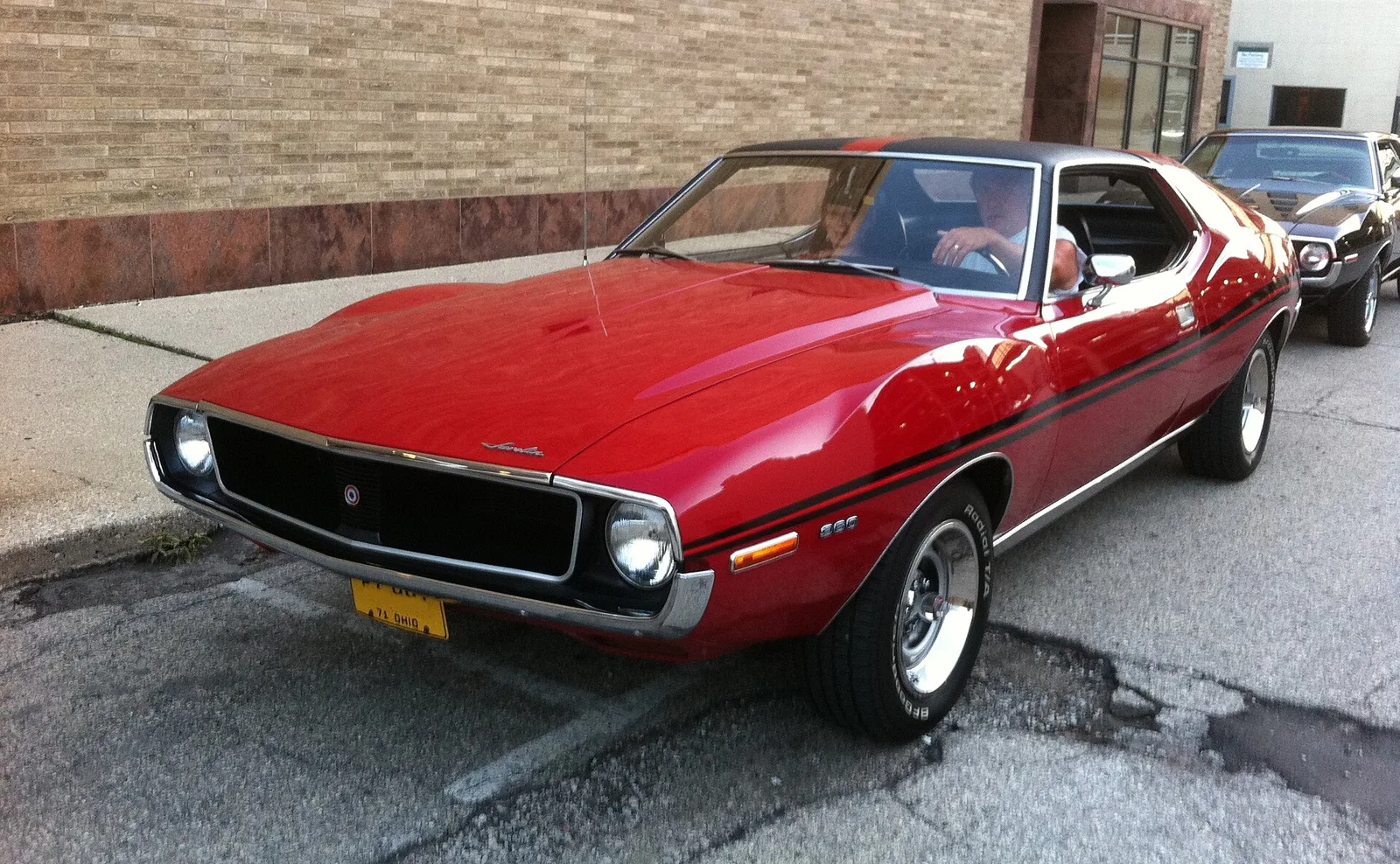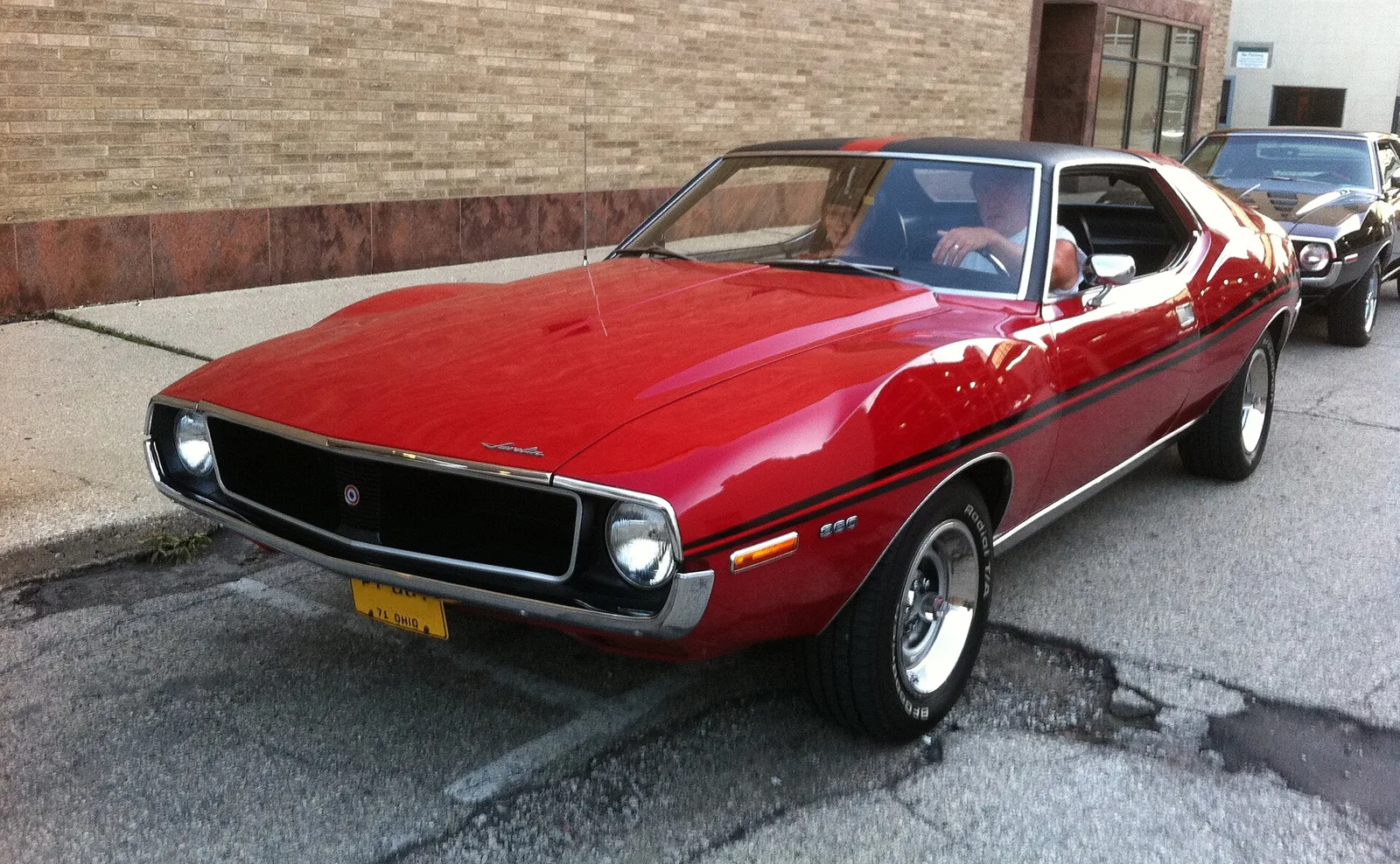
American Motors built the Javelin to take on the car that created the pony car market, and its advertising went after the Mustang by name.
The AMC Javelin and Ford Mustang are linked by the pony car market, which the Mustang created. The Javelin ran from 1968 to 1974 and the fifth-generation Mustang from 2005 to 2014, so the two never shared a model year.
American Motors built the Javelin to take on the car that had created the pony car market, and the Javelin's advertising named its target outright. The Javelin arrived in 1968 as the company's answer to younger, performance-minded buyers, and it went after the Mustang directly, which was unusual for the time.
The two cars are hard to pair head to head, because the Mustang in this comparison is the fifth generation, built for the 2005 to 2014 model years, while the Javelin ran from 1968 to 1974. The comparison is about how each car answered the pony car brief in its own era.
Why were the Javelin and Mustang seen as rivals?
Ford's Mustang had created the pony car segment, although it was not the first entry. American Motors built the Javelin to compete in that segment, and the Javelin's advertising compared it side by side with the Mustang, showing the rival being beaten to pieces with sledgehammers.
That confrontational approach broke with the convention of not attacking the competition. The campaign came from Mary Wells Lawrence and her Wells, Rich, Greene agency, and it made the Mustang the obvious point of reference for every Javelin buyer.
The Javelin's advertising went after the Mustang directly, and that was unusual for its time.
Were the two cars built in the same years?
They never shared a model year. The Javelin was sold in two generations across the 1968 to 1974 model years, while the fifth-generation Mustang was built for the 2005 to 2014 model years, so each car sat in its own decade.
Javelin production was 55,125 for the 1968 model year and 40,675 for 1969. No Mustang sales total is available for this comparison, so volume can only be set against the Javelin's own figures.
What made the Javelin a pony car?
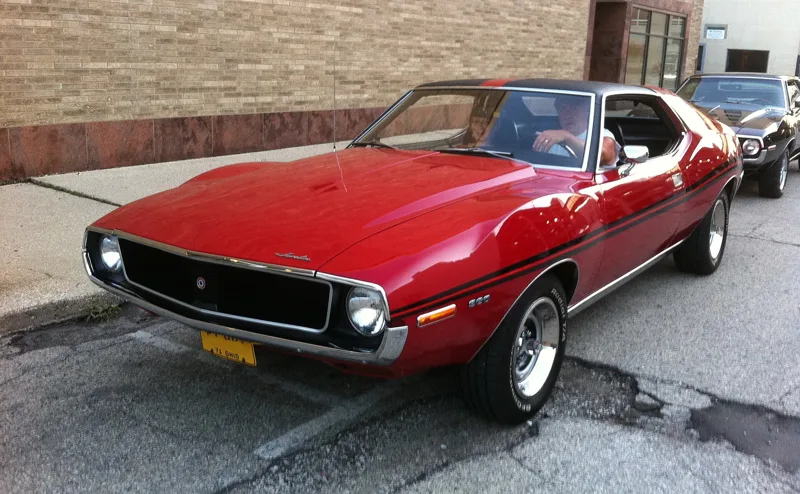
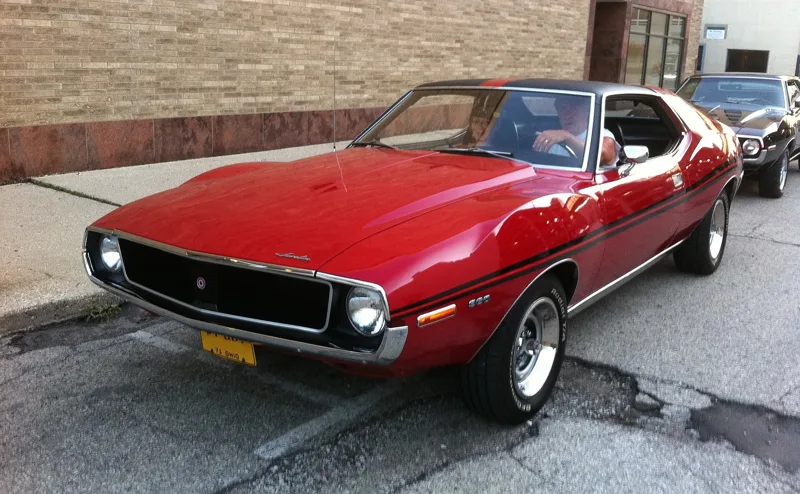
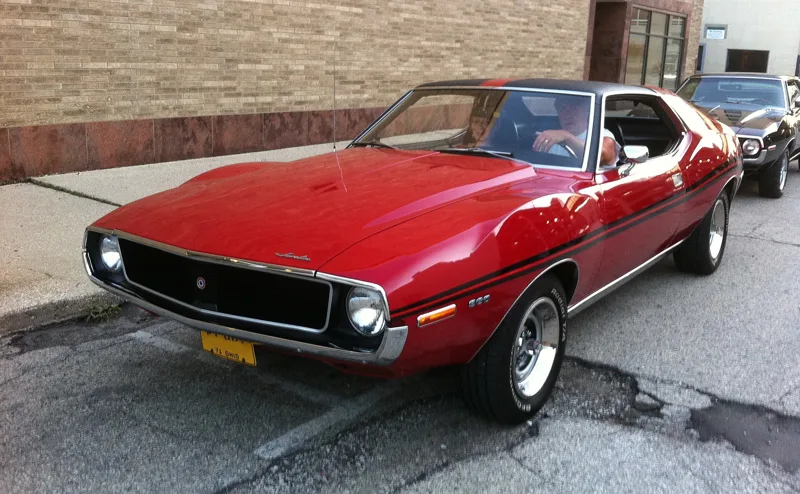
The Javelin was a two-door hardtop with a front engine and rear-wheel drive, built on AMC's compact Rambler American platform. It was aimed at buyers who wanted something cheaper and sportier than a full-size car, and it came in base and SST trims with a straight-six or a V8 under the bonnet.
Styling was led by Dick Teague, who worked to a tight brief. AMC lacked the money to design separate fastback and notchback hardtops, so the Javelin got one semi-fastback roofline, which set it apart from Ford's Mustang and Plymouth's Barracuda.
Management had asked for good trunk space and rear-seat room, and the Javelin's trunk held 288.83 litres (10.2 cubic feet). The car's glamour came from its curves and its front end, with a recessed honeycomb grille that gave it a face of its own.
How fast was the Javelin's Go Package?
The Go Package paired a four-barrel 343 cu in (5.6 L) V8 with power front disc brakes, heavy-duty suspension and dual exhausts with chromed outlets. The 343 Go Pac reached 97 km/h (60 mph) in 8 seconds, ran the quarter mile in 15.4 seconds and approached 193 km/h (120 mph).
Later in 1968 the 390 cu in (6.4 L) engine arrived as part of the Go package. It made 315 hp (235 kW; 319 PS) with 576 Nm (425 lb ft) of torque, and it reached 97 km/h (60 mph) in the seven-second range.
The earlier engines were more modest. The straight-six cruised at 129 km/h (80 mph) with an automatic gearbox, while the 290 cu in (4.8 L) V8 managed 161 km/h (100 mph) at most.
Which Mustang engines did buyers get?
The fifth-generation Mustang's base engine was a 4.0 L Cologne V6 that made 210 hp (157 kW), peaking at 5,300 rpm, with 240 lb ft (325 Nm) of torque at 3,500 rpm. The GT's 4.6 L Modular V8 made 300 hp (224 kW), reaching it at 5,750 rpm, and it could reach 97 km/h (60 mph) in 4.9 seconds.
The GT's torque was 434 Nm (320 lb ft) at 4,500 rpm. The car covered the quarter mile in 13.7 seconds at 166 km/h (103 mph), and its limited-slip differential used carbon-fibre clutch discs.
Gearing changed in 2007, when a 3.31:1 final drive became standard with a 3.55:1 ratio available as an option. Automatic models of every year came with the 3.31:1 ratio.
How did the Javelin race in Trans-Am?
AMC entered the Javelin in Trans-Am racing in 1968, with Kaplan Engineering running two cars for Ron Kaplan and Jim Jeffords. The team placed third in the over-2-litre class and was the only factory entry to finish every race it started, with a single engine-related retirement during the season.
Kaplan's group developed a Watt's linkage rear suspension and front anti-dive geometry, and worked with Vic Edelbrock on a dual-carburetor cross-ram manifold. A run of 50 engine blocks was cast in Windsor, Ontario, and the finished blocks were painted bright orange.
The Javelin went on to win the Trans-Am series in 1971, 1972 and 1976. That record gave the car a racing identity to match the sharp tone of its advertising.
What did the Mustang's Shelby and GT/CS versions add?
Carroll Shelby Automobiles modified the GT into the Shelby GT-H and later the Shelby GT, lifting output to 319 hp (238 kW) with a Ford Racing air intake and performance tune. The GT-H was a Hertz fleet car, with 500 units ordered for the 2006 model year.
The GT California Special revived a 1968 name. It added 18-inch polished aluminium wheels and non-functional side scoops, and its front fascia sat 38 mm (1.5 in) lower than the standard GT. Inside, it had Mustang floor mats and leather in CS-only colours.
How did the fifth-generation Mustang take shape?
Sid Ramnarace designed the fifth-generation Mustang through late 2001, and its design was frozen in July 2002. Development had begun in 1999, with Hau Thai-Tang as chief engineer, on Ford's D2C platform. The car drew its inspiration from the 1964 to 1970 original.
Two pre-production concepts, a convertible and a coupe, were unveiled in January 2003. The convertible had 20-inch wheels and a billet-aluminium showbar, while the coupe had a glass roof and functional hood scoops.
The concepts later went under the hammer in 2009 at Barrett-Jackson's Palm Beach sale, fetching $175,000 each before buyer's premium. Production started in September 2004, with US deliveries from late October that year.
How did the Mustang's options change in its early years?
Ford introduced a Pony Package for the V6 in 2006, with an upgraded suspension, 17-inch wheels and a rear deck spoiler. A glass roof option followed for 2009 at US$1,995, a full-length sunroof that sat between the coupe and the convertible in purpose and price.
The V6 Appearance Package was offered from 2008 at $2,398. Only 152 had been built by 2008, and 96 by 2009. The cheaper V6 Standard arrived for 2006 at US$19,115 for a coupe and US$23,940 for a convertible, each US$100 below the V6 Deluxe.
How did the 1968 Javelin handle safety and comfort?
The Javelin came with several safety touches for its time, including fiberglass padding on the windshield posts, flush paddle-style door handles and exterior side marker lights. Front seats had three-point belts and headrests, and the interior was kept free of bright trim to cut down on glare.
American Motors marketed the car on its packaging, claiming it offered more interior and luggage room than most competitors, with enough space in the back. There were no side vent windows, so air moved through flow-through ventilation controlled by flap valves at the bottom of the door armrests.
The SST trim brought reclining front seats with richer upholstery, faux wood-grained door panels and a sporty steering wheel. The instruments sat in a padded panel facing the driver, and the rest of the dashboard was pushed well forward and away from the passenger seat.
What changed on the Javelin in 1969?
The 1969 model year brought revised side striping, a bull's-eye grille emblem and a stainless trim ring for the Magnum 500 wheels. The interior got new door panels and carpeting, and the tachometer, which ran from 0 to 8,000 rpm, was styled to match the speedometer.
The Mod Javelin package arrived mid-year with a roof-mounted spoiler, simulated air scoops and Big Bad paint in neon brilliant blue, orange or green. From January 1969 the four-speed manuals also took a Hurst floor shifter, which gave shorter throws between gears.
Production fell to 40,675 for the 1969 model year, from 55,125 the year before.
Who bought the Javelin?
The first 1,000 Javelin buyers averaged 29 years of age, ten years younger than AMC's typical customer. The car pulled younger buyers into dealerships, which was the point of the company's move away from its economy car image. Buyers of that age were exactly the group AMC wanted in its showrooms.
The Javelin's styling and performance versions gave it a broad appeal. Mod Javelin trim with a roof spoiler and simulated scoops arrived in 1969, and the Javelin's later styling options kept that appeal going.
What did critics say about each car?
Car and Driver found the Javelin's appearance clean and understated when it compared 1968 pony cars. Road and Track praised the big engine as an asset in a small car, and Motor Trend placed the Javelin top of the sports-personal category.
The fifth-generation Mustang drew heavy criticism for its live rear axle. Ford said that independent rear suspension would have raised the price by $5,000, a point that made the car's cost-cutting visible to reviewers.
Which buyer suits each car?
The Javelin suits a buyer who wants a late-1960s pony car with a straight-six, a V8 or the 390 Go package, and who enjoys cars styled for impact. The Mustang suits a buyer who wants a modern pony car with a V6 or GT V8, a choice of coupe or convertible, and the Shelby or GT/CS trims for extra character.
Practicality is only partly covered. The Javelin's 288.83 litres (10.2 cubic feet) of trunk space is known, but no boot or rear seat dimensions are given for the Mustang, and running costs are not covered for either car.
Specifications side by side
| Specification | AMC Javelin | Ford Mustang (fifth generation) |
|---|---|---|
| Production | 1968 to 1970 and 1971 to 1974 model years | 2005 to 2014 model years |
| Body | Two-door hardtop | Coupe and convertible |
| Base engine | 232 cu in (3.8 L) straight-six | 4.0 L V6, 210 hp (157 kW) |
| Performance engine | 390 cu in (6.4 L) V8, 315 hp (235 kW; 319 PS) | 4.6 L V8 in the GT, 300 hp (224 kW) |
| Torque | 576 Nm (425 lb ft) with the 390 | 434 Nm (320 lb ft) at 4,500 rpm in the GT |
| 0-60 mph | 97 km/h (60 mph) in 8 seconds (343 Go Pac) | 97 km/h (60 mph) in 4.9 seconds (GT) |
| Quarter mile | 15.4 seconds (343 Go Pac) | 13.7 seconds at 166 km/h (103 mph) (GT) |
| Top speed | Approaching 193 km/h (120 mph) (343 Go Pac) | No figure given |
| Trunk | 288.83 litres (10.2 cubic feet) | No figure given |
| Suspension | Heavy-duty suspension in the Go package | MacPherson struts at the front, live axle at the rear |
| Launch price | From $2,743 (1968 model year) | US$19,115 coupe (V6 Standard, 2006) |
| Production | 55,125 (1968); 40,675 (1969) | No figure given |
| Motorsport | Trans-Am series wins in 1971, 1972 and 1976 | No record given |