From a 1976 Philippine pickup to a 2007 finale, the Kijang carried families and fleets across Asia, Africa and India under more than a dozen regional names.
The Toyota Kijang was a pickup, wagon and light commercial series built from 1976 to 2007 across Southeast Asia, Taiwan, India and South Africa. It was sold under many regional names, and Toyota replaced it with the Avanza and Innova.
The Toyota Kijang was a series of pickup trucks, station wagons and light commercial vehicles that Toyota produced from 1976 to 2007. It was built mainly in Southeast Asia, Taiwan, India and South Africa, and it was sold under many names, from Tamaraw and Revo to Qualis and Zace. Its core appeal was simple: a rugged, practical, high-seating vehicle that a family or a fleet operator could afford.
Why did the Kijang sell so well?
The Kijang was relatively affordable in the markets where it was sold, particularly next to four-wheel-drive vehicles. Most versions were predominantly rear-wheel drive, but they offered high seating capacity, high ground clearance and a rugged suspension, all useful on the poor roads and in the large extended families common across the region.
It was also designed with ease of manufacture in mind. In 1986, assembling the Kijang cost only 42 percent of the cost of assembling the smaller E80 Corolla. The vehicle was built as a CKD (complete knock-down) kit in almost every country where it was sold, and many of its parts came from the local markets themselves.
The name itself means muntjac or deer in Indonesian. Inside Toyota the vehicle was known as the TUV, short for Toyota Utility Vehicle, which reflected its role across so many markets.
A rugged, cheap, high-seating pickup-based family car that outlived most of its rivals under a dozen names.
Where did the first-generation Kijang come from?
The Kijang prototype was first displayed at the 1975 Jakarta Fair, and development was led by Osamu Ohta, with Ohyama as chief engineer in 1972. The first generation, designated F10 and KF10, was a compact, light pickup. It used a carburetted 1.2-litre 3K four-cylinder OHV petrol engine, the same unit that appeared in the 1972 Corolla, matched to a four-speed manual.
The vehicle first went on sale in the Philippines on 2 December 1976, and it entered the Indonesian market on 9 June 1977. It had a boxy design with externally hinged half doors and plastic and canvas windows. Its bonnet opened to a shape that looked like a crocodile's jaws, which earned it the nickname Kijang Buaya, or Crocodile Kijang. The KF10 sold 26,806 units over its four years of production.
A pickup with a rear body and roof was also produced, and local companies built the Kijang Minibus, a van and wagon version. Toyota did not make those body styles itself in the first two generations, so local third-party firms converted the basic pickup.
What was the Philippine Tamaraw?
In the Philippines the Kijang was sold as the Tamaraw, named after one of the country's national animals. It launched in December 1976 as a small three-quarter-ton high-side pickup with the 1.2-litre 3K engine, rated at 41 kW (55 hp; 56 PS). It was built by Delta Motors, the company that assembled Toyota vehicles in the Philippines at the time.
Toyota called the Tamaraw a Basic Utility Vehicle, or BUV. Some early models had no driver-side or passenger-side doors, but the design was simple, rugged and easy to maintain. Rivals took note: General Motors, through Francisco Motors, along with Ford and Chrysler with Mitsubishi, each built its own version of the BUV concept.
The Tamaraw was also exported to Papua New Guinea in 1980 by Ela Motors, a division of the Burns Philip Group, where it was renamed the Traka. It could carry a payload of 750 kg (1,653 lb) and produced more than 60 hp.
How did the second-generation Kijang grow?
The second-generation Kijang, designated KF20, launched in June 1981 with the same boxy style but different body panels. Locals called it the Kijang Doyok. The 1.3-litre 4K sat beneath the slimmer bonnet until December 1985, when a 1.5-litre 5K took its place. The only transmission option was a four-speed manual.
The 5K raised power from 44 kW (59 hp; 60 PS) to 53 kW (71 hp; 72 PS), both at 5,600 rpm. The 1986 model could be spotted by its rectangular headlamps and redesigned grille. The Kijang began selling strongly in 1983 and 1984, catching up with leaders such as the Suzuki Super Carry and the Daihatsu Hijet.
Its engine placement made it safer than the cheaper kei truck competitors. The more powerful Kijang also offered more carrying capacity, and the factory passed its hundred-thousandth Kijang in February 1985.
In the Philippines the Tamaraw was offered as the long-wheelbase F30 series, promoted as an alternative to the jeepney. In South Africa production began in 1982, marketed as the TUV with a two-door pickup called the TUV Bakkie and a ten-seat cab called the TUV Stallion, both powered by the 4K.
What changed with the third generation?
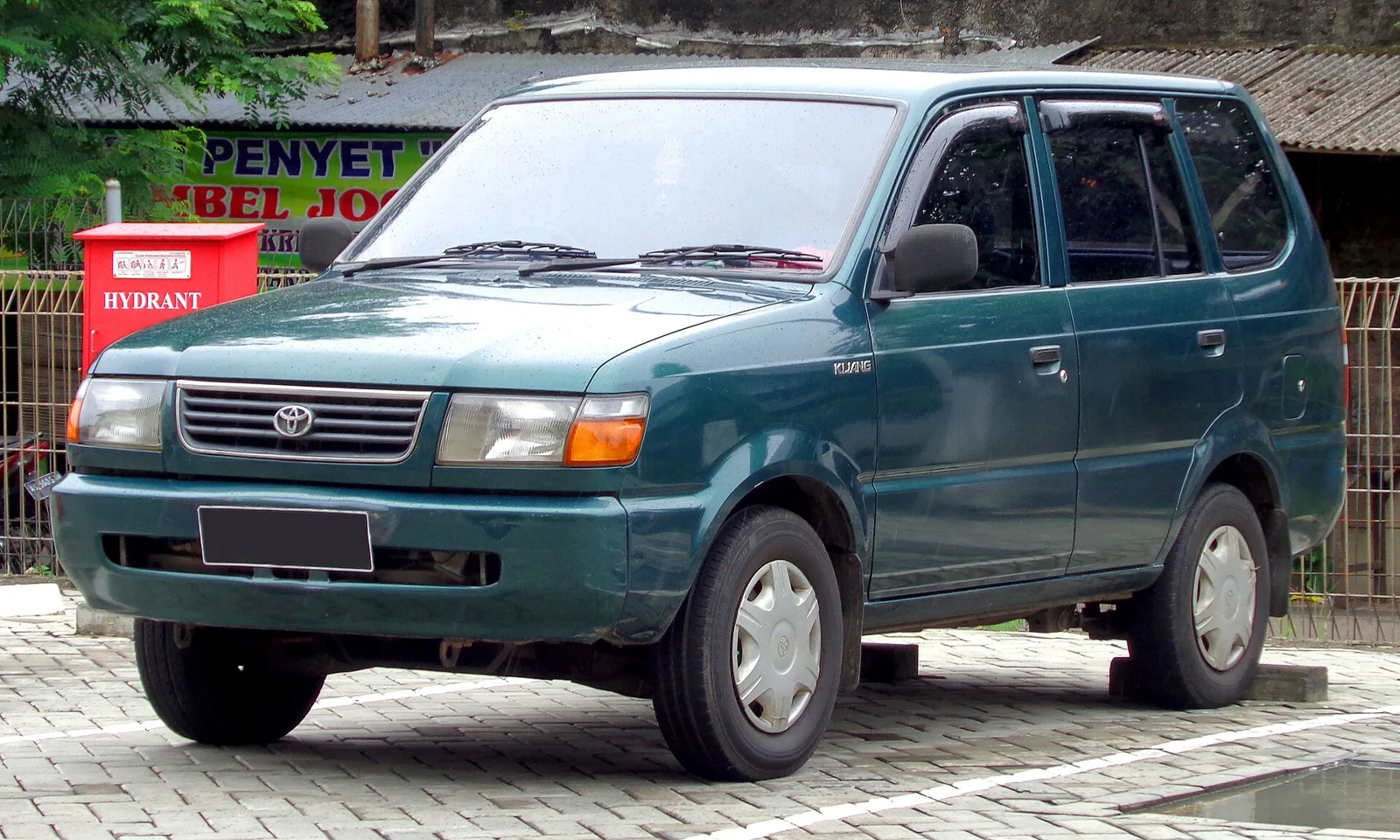
The third-generation Kijang arrived in November 1986 in short-wheelbase (F40) and long-wheelbase (F50) versions. It was larger and heavier than before and was no longer treated as a pickup-based model first. The Standard trim had a four-speed manual, while the Super had a five-speed and a better interior.
Toyota introduced a Full Pressed Body wagon, built by appointed companies. The technique cut the amount of body filler used by 2 to 5 kg (4 to 11 lb) per car. The first facelift in August 1992 changed the steering from recirculating ball to rack and pinion, and the wagon's name changed to Toyota Original Body.
The wagon range was split into trims such as Standard, Deluxe, Super G and Grand Extra, which offered double-blower air conditioning, Enkei 14-inch alloys, suede door trim and a four-speaker audio system. Coachbuilt variants included the Rover, a restyled body resembling the 70-series Land Cruiser, the Jantan, the Kencana and the two-door Perkasa with a removable fibreglass canopy.
The Rover was later renamed RoverAce after objections from the British carmaker Rover. In April 1995 the Kijang received a second facelift with a vertically barred grille and the larger 1.8-litre 7K engine, and production of the 5K stopped as a result.
What did the fourth generation bring?
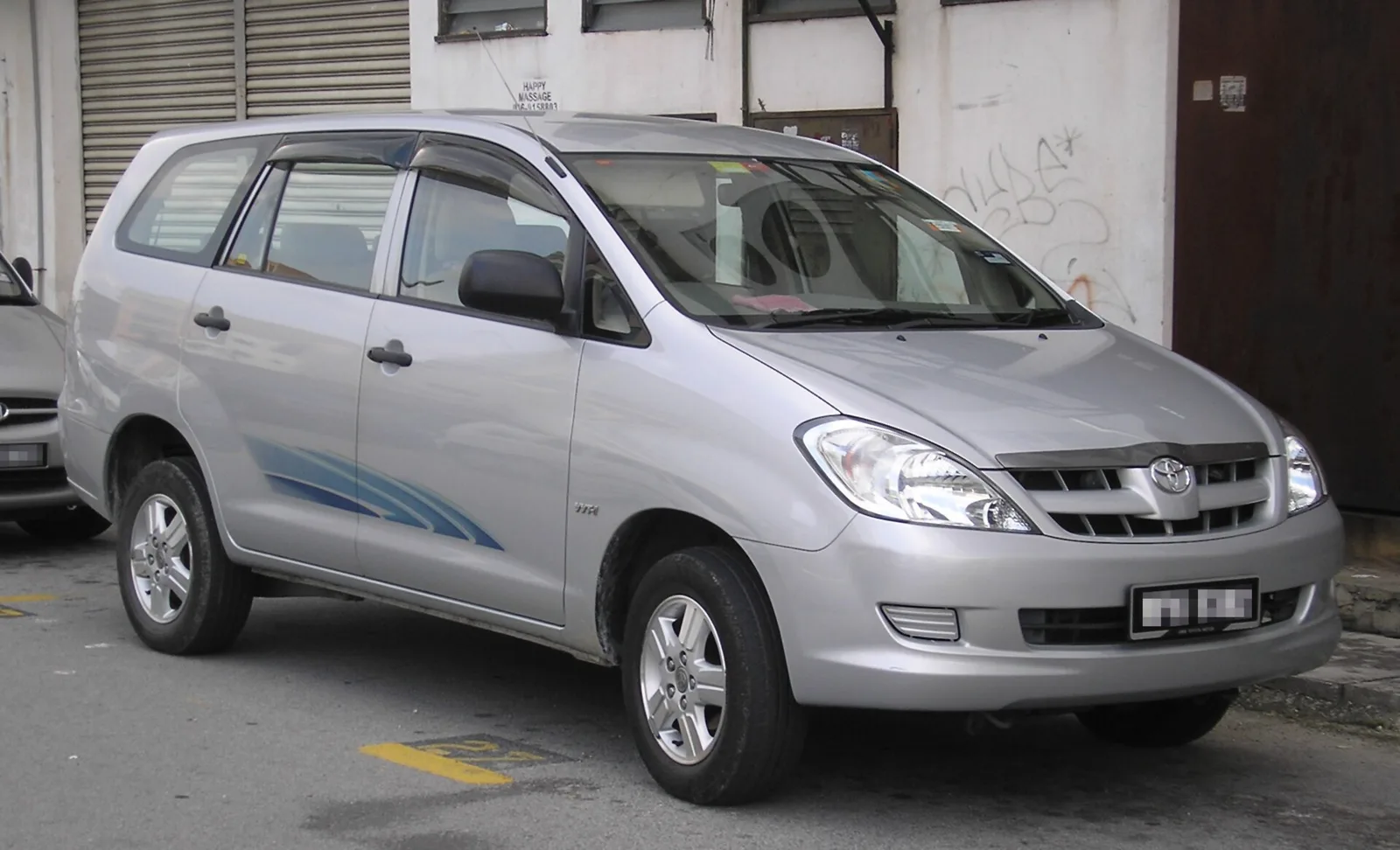
The fourth-generation Kijang, designated F60, F70 and F80, launched in Indonesia on 15 January 1997 with a more rounded, aerodynamic shape. Toyota had planned the launch for 2000, but Mitsubishi intended to introduce the Kuda in 1998, so the Kijang came out three years early. It was built on the same platform as the sixth-generation Hilux.
The wagon was called the Kijang Kapsul, or Capsule Kijang. It had a rear liftgate instead of the side-opening door of earlier models, and the short wheelbase version was F70 while the long wheelbase was F80. For the first time a 2.4-litre 2L diesel was offered. The carburetted 7K was the most popular engine because of its low running costs, even though it was underpowered compared with the 2.0-litre 1RZ-E.
The fourth generation brought the first automatic Kijang, a four-speed option on the SGX and LGX. Trims included SX and LX, SSX and LSX, SGX and LGX, the Rangga SUV-inspired model and the Krista, which had a body kit and a refined interior. The wagon's production ended on 19 June 2004 at 452,017 units, and the pickup continued until February 2005.
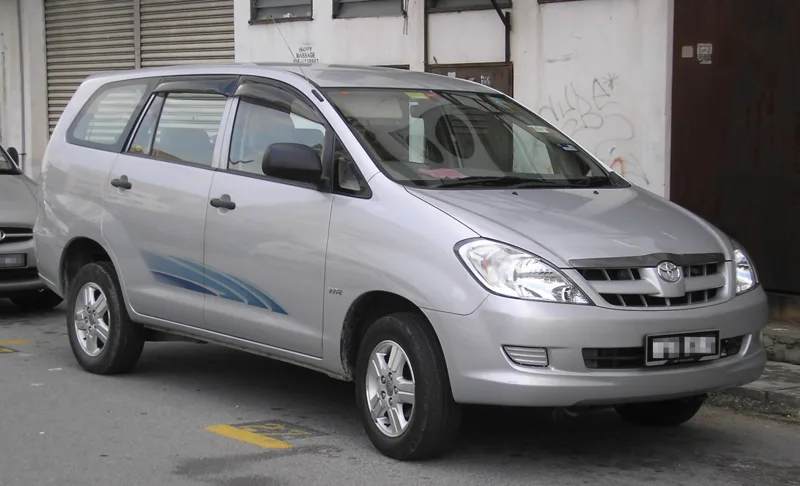
The fourth generation went through two facelifts, on 1 February 2000 and 23 August 2002. The first brought a 2.0-litre petrol option and altered trim equipment, while the second added a redesigned grille with vertical slats and beige interiors on the upper trims.
Why did the Kijang have so many names?
Each market gave the Kijang its own identity, and the list is long. It was known as the Qualis in India and Nepal for the third generation, the Zace in Vietnam and Taiwan, the Unser in Malaysia for the fourth generation, the Stallion in Africa and the Venture in South Africa for the third generation, and the Condor in South Africa for the fourth.
The Philippines produced its own variants too. The fourth-generation car sold there as the Tamaraw FX Revo from 1998, replacing the older Tamaraw FX while the two sold alongside each other for a time. Toyota applied the Revo nameplate to the Philippine fourth generation specifically, and the Tamaraw FX itself was introduced in 1991 as a high-side pickup and in 1993 as a wagon.
What were the regional versions like?
India came late to the Kijang story. Toyota entered India through a joint venture with the Kirloskar Group formed in 1997, and the third-generation car launched there in January 2000 as the Qualis. Critics expected it to struggle, but taxi operators, fleet firms and large families welcomed it over rivals such as Tata's Sumo and Mahindra's Bolero.
The Qualis started with a 2.4-litre 2L-II SOHC diesel, and a 2.0-litre 1RZ-E petrol later arrived in the top GST Super. The line was revamped in 2002, and the Qualis was discontinued in January 2005, being replaced by the Innova without a fourth-generation model in between.
In Taiwan the Zace Surf was sold from 1988 onwards in five- and eight-seat configurations. In Vietnam the Zace arrived in 1999 with a 1.8-litre EFI engine, and its engine grew to 2.0 litres in 2000. The Vietnamese Zace was the best-selling Toyota Motor Vietnam model in 2005 with 5,634 units, and the total for the Zace reached 17,268 units by the end of its production.
In South Africa the Kijang was built in three body styles. The high-roof Venture wagon came with a 1.8-litre 2Y, a 2.2-litre 4Y or a 2.4-litre 2L diesel. The Stallion was a commercial model available as a panel van or pickup, and its advertising starred the local comedian Tolla van der Merwe, which is why many called it the Tolla bakkie.
Did the Kijang compete in motorsport?
Yes, in South African off-road racing. Toyota South Africa's research and development team in Prospecton, Durban, prepared the Team Castrol Toyota Condor 2.4 RV 4x4 for the National Off-Road Championship. It debuted in the 2001 season, driven by Kassie Coetzee with co-driver Ockie Fourie.
The car competed in the four-cylinder production class and was upgraded to 155 PS (114 kW; 153 hp), later raised to 170 PS (125 kW; 168 hp). Modifications included a rear limited-slip differential, a 260-litre fuel tank, strengthened suspension and a roll cage. The team replaced it with a Hilux 3.0TD 4x4 in 2003.
The Condor was competitive from its first season, but its racing record was limited. Its only class win came in the opening race of the 2002 season, the Barberspan 500, where it finished seventh overall, before multiple mishaps that season, including a rock-throwing incident, ended its run of results.
What replaced the Kijang?
The Avanza, smaller, arrived across Southeast Asia in 2003 to take over from the wagon, and the bigger Innova followed in 2004. In Indonesia the Innova was sold as the Kijang Innova to keep the link with the original car. Toyota's own numbering makes the Innova's three generations the fifth, sixth and seventh Kijang.
The pickup kept going until early 2007, when the Hilux took over to satisfy Euro 2 emissions rules. In the Philippines, the Innova succeeded the Revo in 2005, while the Hilux FX and LiteAce FX took over the commercial duties of the Tamaraw FX.
What are the Kijang specifications?
| Specification | Detail |
|---|---|
| Production span | 1976 to 2007 under various names |
| First generation engine | 1.2-litre 3K four-cylinder OHV petrol, carburetted |
| First generation gearbox | 4-speed manual |
| Tamaraw output | 41 kW (55 hp; 56 PS) from the 3K |
| Second generation engines | 1.3-litre 4K, then 1.5-litre 5K from December 1985 |
| 5K output | 53 kW (71 hp; 72 PS) at 5,600 rpm, up from 44 kW (59 hp; 60 PS) |
| Third generation facelift | 1.8-litre 7K engine from April 1995 |
| Fourth generation engines | 1.8-litre 7K, 2.4-litre 2L diesel, 2.0-litre 1RZ-E |
| Fourth generation launch | 15 January 1997 in Indonesia |
| Fourth generation wagon output | 452,017 units, ended 19 June 2004 |
| Traka payload | 750 kg (1,653 lb), more than 60 hp |
| Zace Vietnam sales | 5,634 units in 2005; 17,268 units in total |
| Racing Condor power | 155 PS (114 kW; 153 hp), later 170 PS (125 kW; 168 hp) |