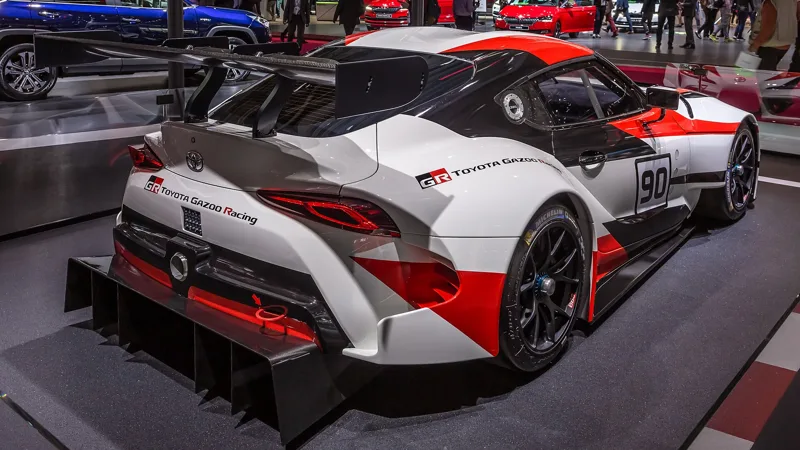
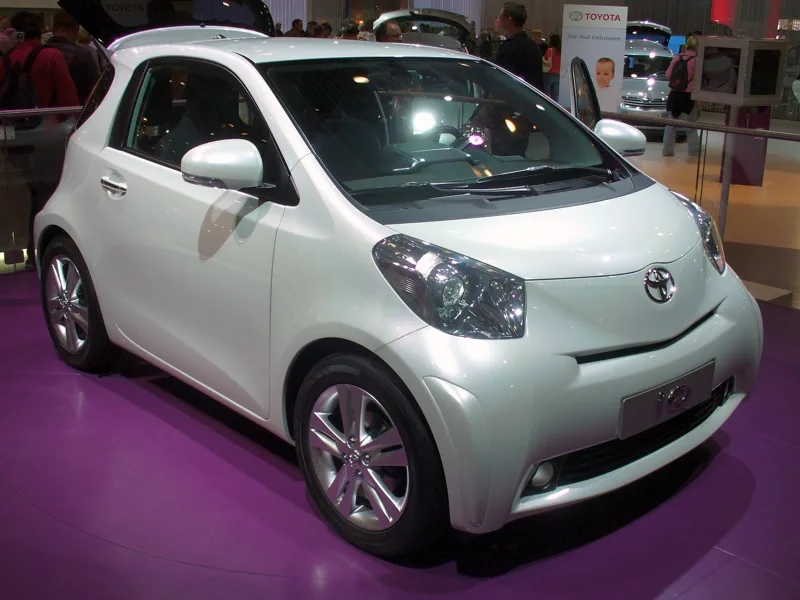
Gas turbines, electric runabouts, a glass hatchback and a V8 luxury coupe: the concepts Toyota showed through a decade of Tokyo shows.
Toyota's concepts from 1980 to 1989 ran from the DV-1 mobility car to the 4500GT V8 coupe. Several, including the SV-3, AXV-II and RAV-Four, reached production, while the GTV gas turbine stayed an experiment and the EV-30 remained a low-speed electric prototype for malls and hospitals.
Toyota's concept vehicles from 1980 to 1989 covered a wide span, from a mobility car for drivers with severe upper body disabilities to a V8 luxury coupe. Many were shown first at the Tokyo Motor Show, and several fed directly into production cars such as the MR2, the RAV4 and the Sera.
Which Toyota concepts appeared in the early 1980s?
The HiLux RV-3 was a 1980 concept that entered production as the third-generation Hilux. The DV-1 followed in 1981, a Welcab-style car shown at the Tokyo Motor Show, and the EX-11 and SV-2 also appeared at that year's show.
The RV-5 was shown at the January 1982 Tokyo Auto Salon and then at the March 1983 Geneva Motor Show. The CQ-1 of 1983 was based on the TownAce and was a concept in automobile communications technology, with advanced equipment for the 1980s.
From a glass hatchback to a 295 bhp V8 coupe, Toyota's 1980s concepts tested ideas that later reached showrooms.
How did the DV-1 help disabled drivers?
The DV-1 was designed for people with severe upper extremity disabilities. Based on the Toyota Corolla 1500SE, it moved operations normally done by the hands onto other parts of the body, so the doors could be opened and closed with the feet.
The car was steered with the left leg, while the shift lever, switches and parking brake were worked with the right leg and right shoulder. The turn signal was operated with the head, and the air conditioner and radio responded to spoken commands. Toyota also fitted remote door lock and unlock, speed-responsive door locks, automatic headlights and run-flat tyres.
Which concepts became production cars?
Several concepts reached showrooms with little change. The SV-3 of 1983 became the MR2 with minor alterations, while the AXV-II of 1987 went into production as the Toyota Sera in March 1990. The RAV-Four, shown at the 1989 Tokyo Motor Show, entered production as the RAV4.
Other concepts left their marks in less direct ways. The Palette Y-2 of 1987 was renamed the AXV-II, the Palette Y-3 of 1990 became the Sera, and the 4500GT of 1989 led to the third-generation Soarer, which Lexus later sold as the SC.
What did the AXV and FXV aim to prove?
The AXV, or Advanced Experimental Vehicle, was first shown at the October 1985 Tokyo Motor Show. Its goal was ultra-low fuel consumption, a weight under 650 kg and the interior volume of a small sedan, while still seating four people.
Its body was aerodynamically shaped with a drag coefficient of Cd=0.26. The bonnet, rear suspension arms and wheel rims were made from Sheet Moulding Compound, and the windows used polycarbonate resin. The engine was a 1.1 litre three-cylinder diesel that used turbocharging and direct injection.
The FXV, or Future eXperimental Vehicle, was also shown at the 1985 Tokyo show. It combined four-wheel steering and four-wheel drive with Electronic Skid Control, and its mid-mounted 2.0 litre engine carried both a supercharger and a turbocharger.
How did the GTV gas turbine work?
The GTV, or Gas Turbine Vehicle, made its debut at the October 1987 Tokyo show. It was based on the Toyota Carina and was a proof-of-concept vehicle that was initially slated for small-scale production.
The car used the Gas Turbine II engine, with one stage driving the compressor and a second turbine connected to the drive shaft. That second stage also replaced the fluid flywheel, and a regenerator recovered waste heat to warm the incoming air. Output reached 148 hp (110 kW) at 5300 rpm and 245.9 lb-ft (333 Nm) of torque.
Car Magazine drove the vehicle in 1986 and judged its overall performance favourably, although turbine lag hurt the impression. The continuously variable transmission impressed testers, and it later became the basis of the gearboxes used in Toyota's Prius.
What did the October 1987 show bring?
The October 1987 Tokyo show included four concepts that stood out. The AXV-II had butterfly doors and a hatchback made almost entirely of glass, and its mechanical parts were the same as those of the Starlet.
The FXV-II was a four-wheel drive concept with an all-alloy 3.8 litre V8 of 32 valves. It used a prototype of the 1UZ-FE, a later engine used in the Lexus LS400, and its maximum speed was 260 km/h (160 mph). The Pegasus suspension was a prototype for the TEMS suspension used on later Cressidas, Soarers and Supras.
The EV-30 was a two-seat electric concept with a resin body, shown with and without a roof but with no doors. It was built as a low-speed vehicle for use inside shopping malls and hospitals, and its zinc-bromide batteries of 106 V drove an AC induction motor.
The EV-30 topped out at 43 km/h (27 mph), and at 30 km/h (19 mph) it could cover 165 km (103 mi). Owners could plug the batteries into an ordinary Japanese 100 V wall socket.
Why is the 4500GT important?
The 4500GT debuted at the 1989 Frankfurt Motor Show as a two-door, 2+2 coupe that marked Toyota's move into the upper-level luxury coupe class. Its styling was widely disliked by the show-goers, but its mechanical parts carried over closely to the production car.
The power plant was a derivative of the new 1UZ-FE V8 with an extra 500 cc of displacement, twin overhead camshafts per bank and five valves per cylinder. Peak output was 220 kW (295 bhp) at 6600 rpm, with 390 N m (288 lb-ft) at 4800 rpm, sent through a six-speed manual mounted at the rear.
Toyota claimed the car could carry four people and their luggage at 300 km/h (186 mph), and its drag coefficient was Cd=0.29. No acceleration test was ever done, but with a curb weight of 1,450 kg (3,197 lb) and 220 kW (295 bhp), it could reasonably be expected to reach 0 to 97 km/h in under seven seconds.
The 4500GT never reached a showroom directly. It paved the way for the third-generation Toyota Soarer, which Lexus knew as the first-generation SC, and that car used a milder 4.0 litre V8 with 250 hp (186 kW).
What were the late-1980s leisure concepts?
The Camp Mate of 1989 was a recreational vehicle based on the LiteAce, or TownAce. Its expandable side added 0.9 m (3 ft) of living space, and it could take up to 10 people with two beds, a small kitchen, a living room and a bathroom. It used the 2C 2.0 litre diesel with four-wheel drive.
The Soarer Aero Cabin of 1989 was a Japan-only sports car based on the Soarer. Toyota built 500 examples with an electric folding roof, leather seats, keyless entry and a digital dash, and about 490 of them were estimated to remain in good condition.
How do the main concepts compare?
| Concept | Year | Base or platform | Notable feature |
|---|---|---|---|
| DV-1 | 1981 | Corolla 1500SE | Controls operated by feet, legs, shoulder and head |
| RV-5 | 1982 | 4WD Tercel L20 | Cross-country camera platform |
| AXV | 1985 | Not recorded | Cd=0.26, 1.1 litre three-cylinder diesel |
| FXV | 1985 | Not recorded | Four-wheel steering and four-wheel drive |
| GTV | 1987 | Carina | Gas Turbine II, 148 hp (110 kW) |
| AXV-II | 1987 | Starlet mechanicals | Butterfly doors and glass hatchback |
| FXV-II | 1987 | Not recorded | 3.8 litre V8, 260 km/h (160 mph) |
| EV-30 | 1987 | Not recorded | Zinc-bromide batteries, 165 km (103 mi) range |
| 4500GT | 1989 | 1UZ-FE derivative V8 | 220 kW (295 bhp), Cd=0.29 |
| Camp Mate | 1989 | LiteAce, TownAce | Expandable side, 10 occupants |
What were the concepts' lasting legacies?
The decade's concepts left a clear legacy in production. The MR2, RAV4, Sera and Soarer all trace their lineage to concepts from this period, and the Lexus SC carried the 4500GT's mechanical story into the luxury market.
Some ideas were more experimental. The gas turbine GTV and the electric EV-30 did not become mass-market cars, but they showed the range of technologies Toyota was testing in the 1980s.