The first Twingo grew out of two decades of Renault searching for an R4 successor, and its design was frozen in 1988.
The Renault Twingo I was the first generation of the Twingo people carrier, built from 1993 to 2007. Its search for an R4 successor began in the early 1970s. It launched with the 1,239 cc C3G engine, later gained the 1,149 cc D7F and D4F, and left European price lists in 2007.
Renault began looking for an R4 replacement around 1973, yet the Twingo that entered production in 1993 needed two decades and several rejected designs to reach the market. The result was a cheerful people carrier whose cabin squeezed a surprising amount of room out of a short body.
Where did the Twingo idea come from?
The Twingo idea dates back to 1973, when the VBG programme began looking at small cars with large interiors. Designer Robert Opron, who had worked at Citroen, joined once the work was under way. Renault's hesitation repeatedly slowed the programme, which was suspended and resumed some years later.
VBG stood for budget car in French, and its first concepts were 1:1 scale models meant to test styling ideas. Opron and Gaston Juchet unveiled two such models on 29 July 1975. A year later Opron showed another design, while Juchet and the designer Jacques Nocher each added one more.
Outside Renault, a decisive push came from Poland. In 1983 the Polish manufacturer FSM built the Beskid 106 prototype, a small people carrier intended to replace the 126p. Renault revived its own programme, but its leadership stayed undecided, so in 1984 it asked outside designers for proposals. Marcello Gandini, the Italian designer behind the Lamborghini Countach and earlier work for Renault on the Supercinque, presented two 1:1 models with very angular bodies. Neither convinced the board, which feared that the assembly lines would need too deep a revision and that costs would push up the final price.
In 1985 the VBG programme was renamed the W60 project, and things finally moved. Jean-Pierre Ploue, a young designer fresh from his studies and newly arrived at Renault, produced in 1986 a people carrier with softer shapes that closely foreshadowed the definitive car. Ploue later became design director at the PSA Group.
In 1987 Patrick LeQuement arrived as design director, and the W60 project became X06 during a change of leadership. Georges Besse, who had been the victim of an attack, was succeeded by Raymond Levy. LeQuement backed Ploue's idea, aware of the success the Renault Espace had meanwhile enjoyed. He gave the interior to Gerard Gauvbry, while Ploue and LeQuement kept working on the exterior. Overall responsibility for X06 went to Yves Dubreuil.
In 1988 the lines were frozen, so no further changes could be made. LeQuement's design still met resistance from some board members, but Levy and the design director answered the criticism directly. In spring 1990, after investing 3.7 billion francs in the project, the president approved the assembly of the bodywork, interior, engine and running gear so that the first road-test prototypes could be built.
Two decades and several rejected designs stood between Renault's idea and the cheerful Twingo.
Who designed the Twingo?
Several designers shaped the Twingo. Jean-Pierre Ploue set out the softer people-carrier form in 1986, design director Patrick LeQuement backed it, Gerard Gauvbry was given the interior, and the design director and the president together answered board objections to an unconventional line.
The name combined twist, swing and tango, three dance words that suited a car meant to look lively and friendly. The definitive model was shown at the Paris Motor Show in October 1992, where visitors split into supporters and detractors, as they usually did with unusual cars.
What did the Twingo's exterior look like?
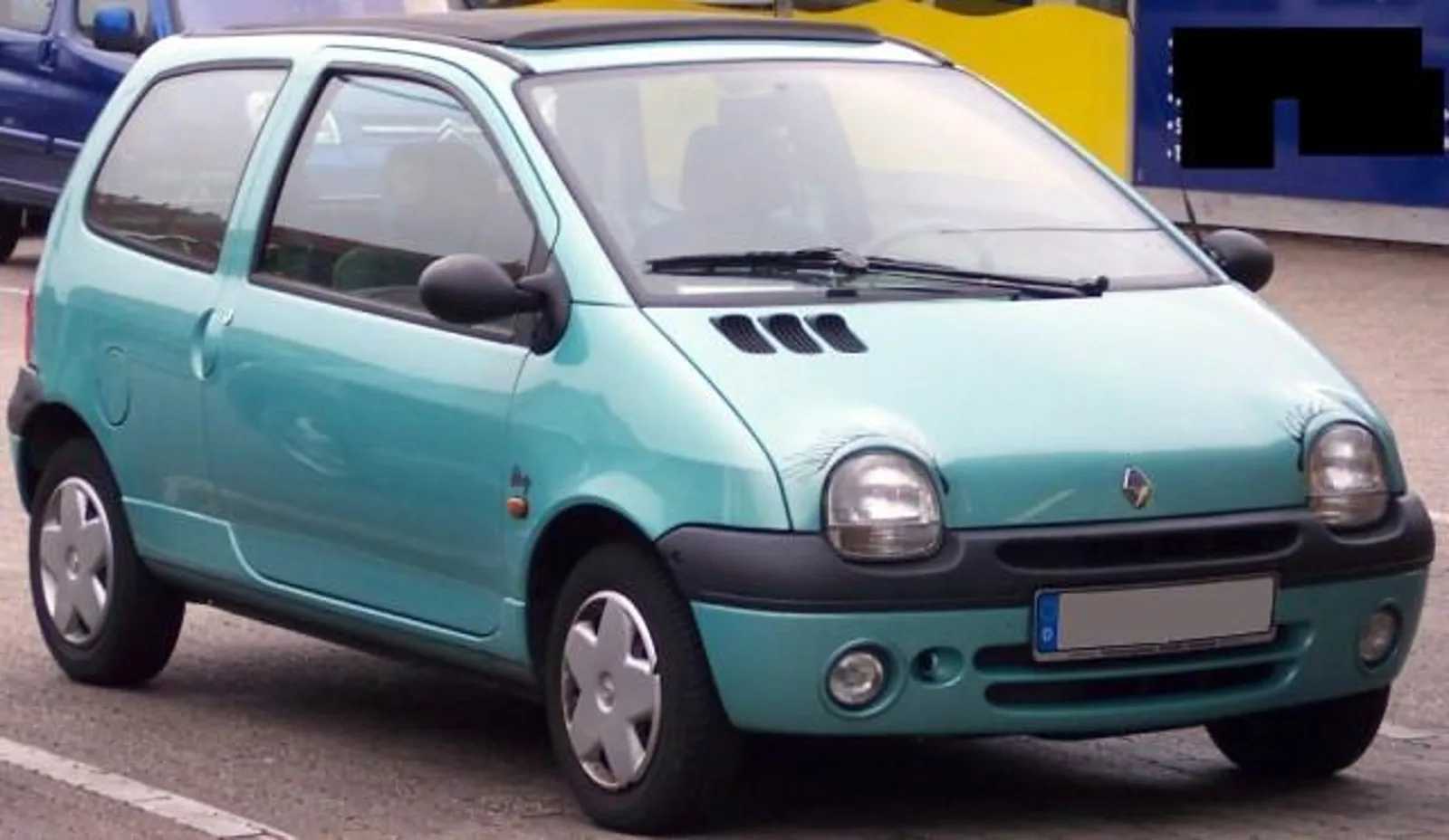
The Twingo's exterior was a compact people carrier body with a sloping front that followed the wide windscreen. The Twingo was the first car to adopt this body style in segment A in Europe, although the Honda Today had done so in Japan. Its generous wheelbase of 2.347 metres pushed the wheels almost to the four corners of the body.
Compared with its rivals the Twingo was smaller overall than its predecessor, the R4, and shorter than some contemporaries. The Citroen AX was 7 cm longer, and the Peugeot 106 was 13 cm longer. Renault made the Twingo wider, so that occupants had more room.
The headlamps were rounded light clusters that stood slightly proud of the bodywork, which led people to call them frog-like. Patrick LeQuement came up with that idea late in the design process, along with the indicators. Set beneath the lamps, the indicators suggested lower eyelids, so the front looked like a smiling face. The bumpers were unpainted plastic, front and rear.
The flank had very simple lines, with just two large glazed areas per side and a single door on each side. The windscreen ran into the bonnet without a break. At the rear, a tailgate covered the full width of the car, with a large rear window and rounded light clusters. Buyers could choose seven-spoke alloy wheels, a folding canvas roof running the full length of the car, roof bars, side protection strips, quarter windows, a radio, and a steering wheel in black and green.
How roomy was the Twingo's interior?
The cabin was designed to give the greatest possible room in a very compact package. The car was approved for four occupants, and because it was wider than its rivals, those four could find a decent amount of space. Rounded shapes ran through the whole cabin, from the round air vents and centre-console controls to the door panels, seat bases, backrests and headrests.
Equipment was sparse. The instrument panel offered little more than a speedometer and a fuel gauge, placed in the centre of the dashboard rather than in front of the driver. The seats came in cheerful fabric patterns and could be moved or folded in many combinations. The car had no storage compartments to speak of.
Owners could turn the interior into a double bed by arranging the front and rear seats, a trick that featured in a well-known advertisement showing two boys sunbathing lying down in a Twingo with its canvas roof open.
Luggage space was excellent for the car's size, though it did not reach the level of the R4. With the rear bench removed, the R4 could take nearly 1.5 cubic metres, while the Twingo managed nearly 1.1 cubic metres because it was lower and shorter. With the bench in place, the Twingo I offered 168 litres up to the parcel shelf, and 261 litres once the shelf was removed.
Which engines and mechanics did the Twingo I use?
At launch the Twingo I had one engine, the C3G, a 1,239 cc (75.6 cu in) unit with pushrod valve gear that delivered 54 PS (53 hp). It was paired with a five-speed manual gearbox. The body was a unitary structure, with a lower frame carrying a subframe for the front suspension.
The Twingo's structure was a unitary body, with a lower frame that carried an auxiliary subframe to which the front suspension was fixed. Anti-intrusion bars strengthened the doors and the base of the tailgate. The R4 it replaced was by then decidedly old, so the Twingo's engineering was a clear step forward.
At the front the car used an independent MacPherson-type suspension with coil springs. The rear axle had interconnected wheels, also with coil springs, and on both axles the springs sat coaxially with the shock absorbers. The steering was rack and pinion, and the servo-assisted brakes combined front discs with rear drums.
The C3G still used a pushrod and rocker valve layout, and it was the only engine offered at launch.
Twingo I specifications at a glance
| Item | Detail |
|---|---|
| Engine at launch | C3G, pushrod valve gear, 1,239 cc (75.6 cu in), 54 PS (53 hp) |
| Gearbox at launch | Five-speed manual |
| Engine from 1996 | D7F, 1,149 cc (70.1 cu in), single overhead camshaft, two valves per cylinder, 60 PS (59 hp) |
| Engine from 2001 | D4F, 1,149 cc (70.1 cu in), twin overhead camshafts, four valves per cylinder, 75 PS (74 hp) |
| Front suspension | Independent, MacPherson type, coil springs |
| Rear suspension | Interconnected wheels, coil springs |
| Steering | Rack and pinion |
| Brakes | Servo-assisted; discs at the front, drums at the rear |
| Wheelbase | 2.347 metres |
| Luggage | 168 litres to the parcel shelf; 261 litres with the shelf removed |
How did the Twingo change during its life?
The first generation changed mostly through special series and a handful of engine and trim updates. The Twingo Easy arrived in 1994 with an electronically operated clutch, which removed the need for a clutch pedal. In 1996 the C3G gave way to the 1,149 cc D7F, and a 1998 facelift, a 1999 Initiale trim and a 2001 twin-cam engine followed.
Special series such as Kenzo, Spring, Summer with its canvas roof, United Colors of Benetton, Elite, Velvet and Ice varied the seat patterns and body colours. Production passed 260,000 units by mid-1994 and more than 800,000 by late summer 1996.
The 1996 update was perhaps the most substantial. The D7F had a single overhead camshaft and two valves per cylinder, and it stayed available until 2007. The interior was refreshed with new upholstery, and a third brake light appeared at the rear. The Twingo Matic followed in 1997, with a three-speed automatic gearbox.
The 1998 facelift showed most clearly at the front, where the indicators were built into the main lamps and became light-coloured. New fog lamps were integrated into the bumpers, the front tow hook moved to the passenger side, and a passenger airbag was added. Inside, the dashboard was redesigned with boomerang-shaped air controls and a three-spoke steering wheel. Mechanically nothing changed.
The Initiale trim arrived in 1999 with leather seats, door panels and gear lever gaiter, its own alloy wheels and an "Initiale Paris" badge. It could also be ordered with a glass sunroof, and from 2000 it carried 14-inch eight-spoke alloy wheels. That same year a sporty RS prototype was unveiled with the 1.6 16v engine of 110 PS (108 hp), that had only just been used in the Clio II. It never went beyond the prototype stage.
The 2000 update was mainly mechanical. The rear anti-roll bar was enlarged, a front anti-roll bar was added, the front brakes gained ventilated discs and the rear drums were enlarged, and the wheels grew to 14 inches. ABS and electronic brake force distribution finally appeared on the options list, and the bumpers were redesigned again. By May 2000 output had gone well past 1.6 million.
In January 2001 the D4F engine arrived. It was the same 1,149 cc unit, but with twin overhead camshafts and four valves per cylinder, and it produced 75 PS (74 hp). Those cars carry a "16V" badge above the side indicators. The Quickshift version, with a five-speed sequential gearbox, appeared the same year.
The Diabolika trim was sold only in Italy from 2003 to 2005. It added ABS, power steering, air conditioning and electric mirrors as standard, and a three-dimensional sticker on the tailgate made it instantly recognisable. Its upholstery and door trim were blue fabric stitched in red. A small update in 2004 changed only the tailgate button, which now carried the Renault logo, and the side impact strips became standard.
How did visitors and buyers react?
Reaction was mixed. Visitors to the 1992 Paris show divided into supporters and detractors, yet by the end of that show the newborn car had collected 2,240 orders. Until then the R4, which was meant to be replaced in the early seventies, had stayed on Renault's price list.
Renault first built the car at Flins. Production later spread to the old FASA works at Valladolid in Spain and to two plants in South America, and the first generation sold steadily until the second arrived.
The Twingo I left European price lists in 2007, when the second generation was launched. South American sales ran until 2012.