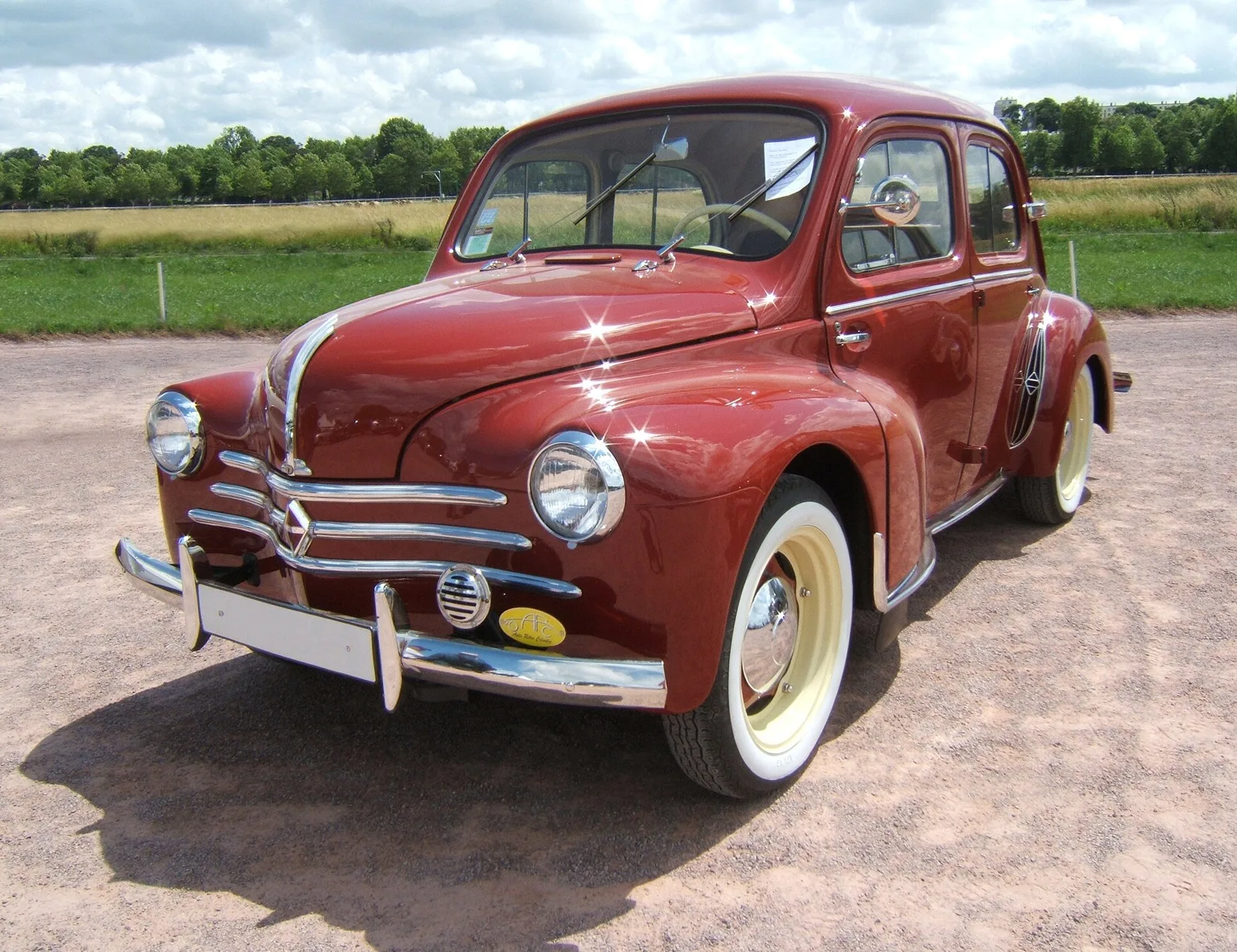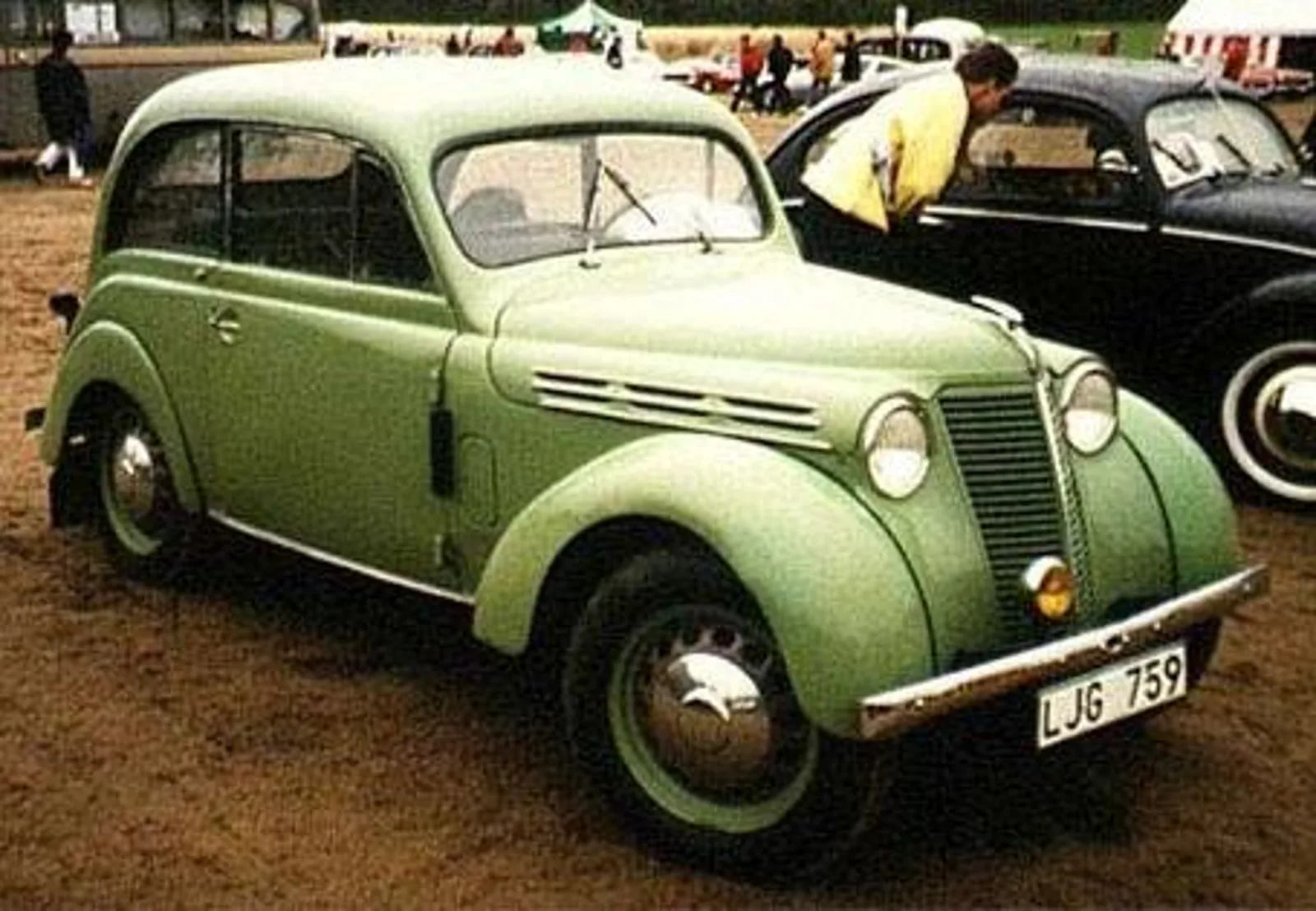
A side-valve family car inspired by the Opel Olympia, built from 1937 to 1960 in saloon, van, station wagon and rare coupe bodies.
The Juvaquatre was a Renault family car built from 1937 to 1960. It was inspired by the Opel Olympia, used a 1,003 cc side-valve engine at launch, and later became the Dauphinoise estate.
The Renault Juvaquatre was a small family car that Renault built from 1937 to 1960. It began life as a two-door saloon with an engine of just over a litre, and it later became a four-door saloon, a van and a station wagon that stayed in production far longer than the saloon did.
What was the Renault Juvaquatre?
The Juvaquatre was a compact car that Renault designed to fall in the 6CV tax class. It was produced as a saloon until 1948, when the Billancourt plant turned its full attention to the new 4CV. A station wagon continued in production until 1960.
Its name placed it in Renault's range below the existing Primaquatre and Celtaquatre models. Those larger cars were the upmarket offering, and the Juvaquatre was the entry point for the brand.
A pre-war Renault that started as an Opel Olympia-inspired saloon and ended its days as a practical estate.
Why did Louis Renault create the Juvaquatre?
Louis Renault conceived the car in 1936 as a small, affordable model. The company wanted customers who would not otherwise buy a Renault, including the new class of lower-income buyers that had emerged in France during the 1930s.
The design was heavily inspired by the German Opel Olympia, which Louis had admired on a visit to Berlin in 1935. Early models bore a strong resemblance to it, and that was an open acknowledgement of where the idea had come from.
How did the Juvaquatre launch?
The car was shown at the 1937 Paris Motor Show, and on the opening day Louis Renault was photographed showing a Juvaquatre to President Lebrun. The show was part of a wider plan to prepare for volume production the following year.
The first production prototype, known as the AEB1, was homologated in February 1937. In early summer that year Louis ordered a batch of at least twenty preproduction AEB2 prototypes, most of which went to major Renault distributors for technical and customer appraisals. Engineers at Billancourt then made changes before volume production of the AEB2 began in April 1938.
How far did a Juvaquatre run in 1938?
In late March 1938 Renault staged a non-stop endurance run at the Montlhery circuit, a short distance west of Paris. A Juvaquatre was driven round and round by a team of four drivers, who covered 5,391 km (3,350 miles) in 50 hours.
The average speed was computed at slightly under 109 km/h (68 mph). The run was staged as publicity for the car.
What did the early bodies look like?
The first production cars were all two-door saloons, which the French called coach bodies. The steel body was welded to the chassis platform to create what was, for most purposes, a monocoque shell. The headlights were built into the body instead of sitting on the front wings.
The integrated headlights were a tribute to the Olympia, although the idea had appeared earlier on the American Hupmobile Type 518 of 1934.
When did a four-door Juvaquatre arrive?
Public demand for four-door cars grew, and rival makers Peugeot and Simca offered affordable four-door models. Renault answered with a four-door Juvaquatre, known in French as a berline, from April 1939.
After the war all Juvaquatres had four doors, and the two-door coach body was not revived. From the back, the postwar cars had an opening boot lid, which removed the need to climb over two sets of seats to reach the luggage space.
How many two-seater coupes were made?
Perhaps 80 two-seater coupe bodies were built between 1939 and 1946, most of them based on the prewar model and produced in 1939 and 1940. A final batch of 30 coupes was made between December 1945 and January 1946, according to one source.
Renault seems to have intended to resume coupe production after the war, but the tooling for heavy steel body panels was never commissioned. One coupe was still on show at the Brussels Motor Show in January 1948, which suggests the idea had not been dropped at that stage.
Where did the van and station wagon come from?
A camionnette van was developed soon after the launch for commercial use, and La Poste used it extensively. When the van returned in 1948 after the war, its name changed to fourgonnette.
A station wagon based on the van was launched in 1950 as the Renault Break 300 Kg. It was renamed the Renault Dauphinoise in 1956, and it stayed in production for nearly a decade after the saloon was withdrawn. The front-engined layout suited an estate body far better than the rear-engined 4CV or Dauphine.
What engine did the Juvaquatre use?
The four-cylinder water-cooled engine shared its 95 mm stroke with the unit that had powered the Celtaquatre since 1934. The Juvaquatre's bore was reduced to 58 mm, which gave a capacity of 1,003 cc. It was a side-valve engine, and at launch it was rated at 23 hp (17 kW).
The car spent more than ten years in direct competition with the Peugeot 202, which came with a more efficient overhead-valve engine and more power. That gap left the Renault at the cheap end of the class.
How did the engine change in later years?
The old side-valve unit was retired in 1952. The Juvaquatre Break, by then the only surviving version, received the smaller 747 cc engine from the 4CV. The overhead-valve unit produced slightly less power, but the car was valued for dependability and low cost rather than speed.
The 747 cc engine brought a lower annual car tax, and in 1956 the car moved up a band with a bored-out version of the same engine, as fitted to the Dauphine. Rebranded as the Dauphinoise, it had an 845 cc engine rated at up to 26 hp SAE (19 kW).
What running gear did the Juvaquatre have?
Power went from the front-mounted engine to the rear wheels through a three-speed manual gearbox, with synchromesh on the upper two ratios. The car had independent front suspension, although Renault was the last of the big three French makers to offer it on a passenger car in 1937.
Peugeot had claimed a first for independent front suspension in volume cars with its 1931 upgrade of the 201, and Citroen had begun work on it in 1934. The Juvaquatre's front assemblies had just three joints each, with a transverse leaf spring acting as the fourth flexible element. The rear used a rigid axle on transverse leaf springs.
Early cars had mechanically operated brakes, but Lockheed hydraulic brakes were introduced in 1939.
How did the Juvaquatre compare on price?
In the late 1930s the 6CV class had three major rivals. At the 1937 Paris show the Juvaquatre two-door was advertised at 16,500 Francs, the cheapest of the group, reflecting its side-valve engine. The Peugeot 202 reached showrooms in early 1938 at 21,300 Francs for a four-door car with a more modern engine.
The Simca 8, essentially a locally assembled Fiat, was already offered in 1937 with hydraulic brakes, a four-speed gearbox and independent front suspension, at 23,900 francs for the four-door Normale. Half a class up, the front-drive Amilcar Compound was advertised at 21,700 Francs, but the Amilcar firm lost its independence in 1937 and the name disappeared in 1940.
Ten years later the prices had changed sharply after currency depreciation, but the order stayed the same. At the 1947 Paris show the Juvaquatre, now a four-door with independent front suspension as standard, was priced at 260,000 Francs, against 303,600 Francs for the Peugeot 202 and 330,000 Francs for the Simca 8.
How did the war affect production?
Production fell sharply after France was taken over by Nazi Germany, although it stayed high compared with other European makers that had switched almost entirely to military equipment. Only a few hundred cars were built in 1941.
A very small series continued until 1942, and in 1943, 1944 and 1945 an occasional car was assembled for the occupation forces or for French government use.
How did the Juvaquatre return after the war?
Production formally restarted in 1946, with Renault now owned and controlled by the French government. The postwar cars were built in years of acute economic stringency, and almost all of them were earmarked for export.
Billancourt was focused on tooling for the new 4CV, and Juvaquatre production there stopped at the end of 1948. A small batch of saloons was built at the new Flins plant in 1951, where the Juvaquatre was the first model assembled, and saloon production ended in November 1951.
What happened to the Dauphinoise?
The Break Juva 4 station wagon stayed in production between 1950 and 1953 with the prewar dashboard and the 1,003 cc side-valve engine, now with an air filter added. From 1956 it carried the Dauphine's engine and became the Dauphinoise.
With no obvious direct rivals, the Dauphinoise still sold steadily, with 13,262 built in 1958 and 9,489 in 1959. It remained listed until 1960, a few months before the Renault 4 arrived.
How was the Juvaquatre taxed?
The car was classified as 6 CV from launch until 1953 because of its 1,003 cc displacement. From 1953 only the 747 cc engine was offered, which rated it at 4 CV. From 1956 the Dauphinoise, with its 845 cc engine, was rated at 5 CV.
What are the key engine figures?
| Years | Engine | Output | Application |
|---|---|---|---|
| 1937 to 1952 | 1,003 cc side-valve four | 23 hp (17 kW) | Saloon, van and early Break |
| 1952 to 1956 | 747 cc overhead-valve four | Slightly less than the side-valve | Juvaquatre Break |
| 1956 to 1960 | 845 cc overhead-valve four | Up to 26 hp SAE (19 kW) | Dauphinoise |
How is the Juvaquatre remembered?
The Juvaquatre spanned a turbulent period, from its pre-war launch through occupation to the postwar 4CV era, and it ended as a practical estate. It helped Renault reach buyers who had never considered the brand before the war.
Its longest life was in the Dauphinoise form, which kept the body style in use until the Renault 4 replaced it.