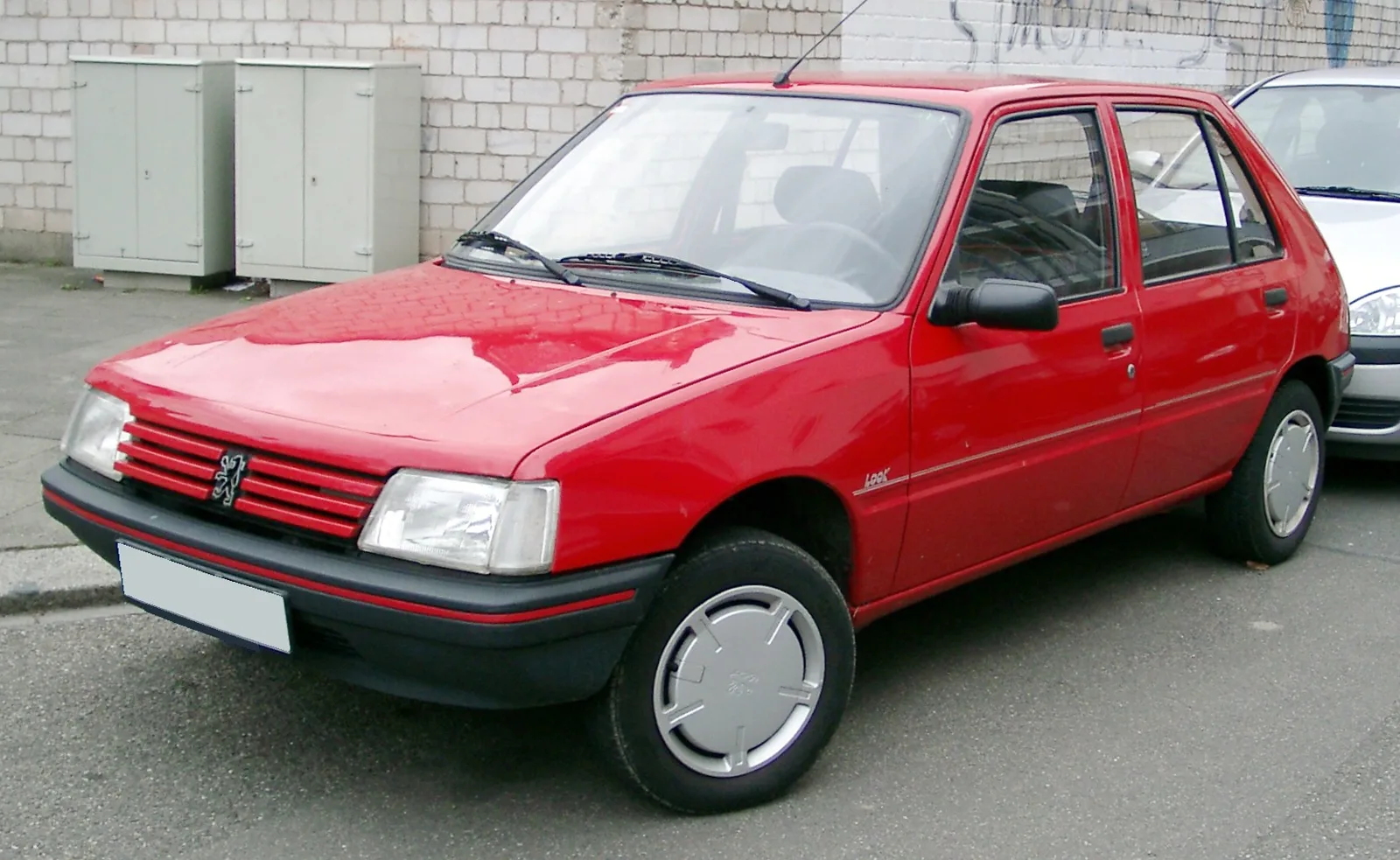
Long-travel suspension, plastic panels and a record-breaking diesel in a French supermini that Citroen sold for twelve years.
The Citroen AX was a supermini built from 1986 to 1998. It was designed around light weight, a drag coefficient of 0.31 and plastic panels, and 2,561,432 were produced. The car was launched at the 1986 Paris Motor Show, and electric and performance versions followed.
The Citroen AX was a French supermini built from 1986 to 1998, and it became the company's smallest car once the 2CV ended in 1990. It replaced the Visa and LNA with a lighter, cheaper-to-run package that used plastic panels, long-travel suspension and a range of frugal engines.
Where did the Citroen AX come from?
Development of the AX started in 1983 with a possible Talbot Samba replacement in mind. Falling Talbot sales and the success of the Peugeot 205 led to that version being dropped, and the Citroen version reached the 1986 Paris Motor Show. It launched on 2 October 1986 as a three-door hatchback.
The car reached the left-hand drive continental markets first. Five-door versions arrived in 1987, and the UK right-hand drive version followed in August 1987 as a three-door. A five-door joined the British range a year later, and it replaced the five-door Visa, which was discontinued that year.
The launch advertising was memorable. Filmed in China, the campaign starred the actress Janet Mas alongside an elderly gentleman known as Mr. Wong. Early cars had a gear shifter problem, where the lever could fall off, but Citroen fixed it before the AX reached export markets.
With the classic 2CV finally gone in 1990, the AX took over as the smallest model in the Citroen range. Its design owed something to the ECO 2000 research programme, which was shared by PSA Peugeot-Citroen, Renault and the French government.
Lightness and long-travel suspension in a supermini that Citroen sold for twelve years.
How was the AX engineered to be so light?
The AX reached a basic weight of 640 kg (1,411 lb) by using plastic panels in non-structural areas and thinning the steel body to the minimum the loads allowed. Its drag coefficient of 0.31 and friction-cutting engine work supported an economy-focused design.
The aerodynamics were strong for the class, and the body shape did much of the work behind the car's fuel economy. Engineers also targeted lower friction inside the engines, so that the lightweight structure was matched by efficient power units.
The AX could be specified with self-coloured plastic bumpers. That technology was taken from the ECO 2000 work, and the production car was much more conservative than the original one-box prototype. The prototype had been pushed closer to ECO 2000 styling, but it drew negative reactions from focus groups.
Suspension was fully independent at all four corners, with unusually long wheel travel for a small car. That was unusual for a car of its size.
Which engines and performance versions did the AX offer?
The launch line-up used 1.0, 1.1 and 1.4 litre TU-series engines with belt-driven overhead camshafts. The AX Sport of 1987 carried a 1.3 engine with twin carburettors and 95 PS (70 kW; 94 bhp), and the GTi arrived in 1992 with 100 PS (74 kW; 99 bhp).
The AX Sport used Solex ADDHE 40 carburettors until late 1988, then switched to Weber DCOM 40s, as the Peugeot 205 Rallye did. Its inlet manifold was shorter than the 205's, a compromise to fit the smaller engine bay. Phase 2 cars offered more colours and optional GT wheels with a rear spoiler.
The AX 14 GT used a single double-barrel carburettor on a 1.4 litre engine producing 85 PS (63 kW; 84 bhp). From 1991 that model gained fuel injection, which came with a revamp of the whole range and met the tougher 1992 EU emission rules for catalytic converters.
Economy had its headline moment in 1989, when a naturally aspirated diesel AX returned 2.7 litres per 100 km (100 mpg-imp; 87 mpg-US). It covered more than 1,000 miles (1,609 km) from Dover to Barcelona on 10 imp gal (45.5 L; 12.0 US gal) of fuel, a feat that earned it a place in the Guinness Book of Records.
What changed in the AX's facelift and later years?
Late 1991 brought a heavy facelift to the tailgate and interior. The front indicators became clear, the Citroen logo moved to the centre of the bonnet, and the much-criticised dashboard was replaced with a more conservative design.
The 1992 GTi became the most powerful AX. The GT sold alongside it for a few months before being phased out, while limited editions such as the Forte, Spree, Elation and Dimension kept the range fresh for buyers.
In January 1995 the Echo arrived, with a top speed of 110 mph (177 km/h). Its closest rival, the Peugeot 106 Ski, shared components with the AX but was outsold by the Echo.
From June 1996, after the Saxo was introduced, the AX range was slimmed down. Production at Vigo in Spain ended in May 1997 after 812,000 vehicles, and assembly continued at Mangualde in Portugal for some months. The model finally ended in December 1998 after a 12-year production run.
How did the AX Electrique work?
The AX Electrique used 20 nickel-cadmium batteries and a 20 kW motor to deliver an estimated 75 km (47 mi) of range and a 90 km/h (56 mph) top speed. Citroen and Heuliez built 374 examples between December 1993 and 1996, with most sold to administrations.
Pre-production cars had been on the road since December 1993, notably in La Rochelle. The production AX Electrique was introduced in November 1995 as a 1996 model. A four-seat passenger car was offered, but most were sold to administrations as a two-seat panel van.
The batteries were 6V SAFT units with liquid cooling, which allowed fast charging for the era. A proprietary charging system used the same input pins as home charging, and a network of stations around France could add 20 km in 10 minutes, according to Citroen's brochure.
Citroen estimated the electric car's time from 0 to 50 km/h at 8.3 seconds. The car weighed 995 kg (980 kg for the commercial versions, stripped of their rear seats), and it was succeeded by the Saxo Electrique.
A modified AX Electrique set a record in 2011. CEA-Liten, a French state-funded research body, fitted a lithium-iron-phosphate battery in place of the nickel-cadmium pack and covered 1,280 km in 24 hours by alternating driving with fast charging. The 14 kWh battery gave between 105 and 115 km per leg, and each fast charge took 38 minutes.
What derivatives did the AX spawn?
Several variants came from the AX platform. Citroen offered a five-door 4x4 that sold with limited success against the Fiat Panda 4x4, and it was never sold in the UK. Between 1992 and 1994 the Pistes Rouges 4WD 1400 used a bespoke four-wheel-drive system built by the French firm Dangel.
Heuliez presented an estate version, the AX Evasion, at the 1988 Mondial de l'Automobile. Citroen also built the Xanthia concept car on the AX, and in 1996 the company MDI fitted its EV3 air engine to a regular AX.
Aixam produced the Mega Club and Mega Ranch, AX derivatives with plastic bodywork that drew some inspiration from the Mehari. Nearly 1,000 were built before the line was discontinued in 1998. A tubeframe competition version raced in the Andros Trophy in the early 1990s.
Malaysian maker Proton built a version called the Tiara from 1996 to 2000. In Portugal, the Benjamin Barral dealership created an unofficial convertible, the BB AX Cabrio, which ran through the 1980s until about 1996. A planned Talbot Samba replacement based on the AX was cancelled when the Talbot marque was axed.
What are the Citroen AX specifications?
The AX ran from 1.0 litre to 1.5 litre petrol and diesel engines and weighed 640 kg (1,411 lb) in basic form, with a drag coefficient of 0.31. The table lists the launch figures, the sporting variants and the AX Electrique.
| Specification | Detail |
|---|---|
| Production | 1986 to 1998, 2,561,432 built |
| Launch engines | 1.0, 1.1 and 1.4 L TU-series belt-driven OHC |
| Basic weight | 640 kg (1,411 lb) |
| Drag coefficient | 0.31 |
| AX Sport (1987) | 1.3 engine, 95 PS (70 kW; 94 bhp), twin carburettors |
| AX 14 GT | 1.4 L, 85 PS (63 kW; 84 bhp) |
| GTi (1992) | 100 PS (74 kW; 99 bhp) |
| Diesel economy (1989) | 2.7 litres per 100 km (100 mpg-imp; 87 mpg-US) |
| AX Echo (1995) | Top speed 110 mph (177 km/h) |
| AX Electrique range | 75 km (47 mi) estimated; top speed 90 km/h (56 mph) |
| AX Electrique motor | 20 kW (26 hp) peak, 11 kW (15 hp) nominal |
| Electric 0-50 km/h | 8.3 seconds |
How did the AX fare in the UK?
The right-hand drive AX reached British showrooms in August 1987 as a three-door hatchback, with a five-door joining a year later. It was withdrawn from the UK market in the first half of 1997, once right-hand drive production ended. The British run was short compared with the car's life on the continent.
Citroen's British customers therefore saw the AX for only a decade at most. The four-wheel-drive five-door 4x4 was never offered in the United Kingdom, so the UK range stayed with the two-wheel-drive hatchbacks throughout.
What did the AX mean for the Citroen range?
The AX took over as the smallest Citroen after the 2CV was finally retired in 1990, and it had replaced the Visa and LNA when it launched. Its approach was a less-is-more philosophy, which combined light weight with more conventional styling than earlier Citroens had used.
The AX's engineering also fed two later models. The Peugeot 106, launched in 1991, and the Citroen Saxo were both developments of the AX. They followed a 1990s trend toward heavier, more solid cars that were seen as safer, so the lightweight thinking of the AX gave way to a different approach.
Economy stayed a theme through the range's life. The 1989 diesel record and its 2.7 litres per 100 km figure were the most visible proof of that focus, and the same priorities shaped the 1.5 litre diesel that replaced the 1.4 in September 1994. Each change kept the AX's frugal character intact.
What is the Citroen AX's legacy?
The AX's legacy rests on its lightweight engineering and its economy record, which made it a benchmark for frugal small cars. Its 1989 diesel run and the production total of 2,561,432 both show how far that formula carried it in the market.
The electric version outlived the petrol car's production run in a different sense. Its successor was the Saxo Electrique, and the AX Electrique's battery work was later reused in a 2011 record attempt, when a modified car covered 1,280 km in 24 hours.
Few small cars have had such a varied afterlife. Derivatives ranged from the Mega Club kit car to the Tiara built in Malaysia, and the platform's ideas carried on through the Peugeot 106 and the Saxo. That breadth is why the AX still gets discussed by enthusiasts of practical small cars.
Frequently asked questions
When did production of the Citroen AX end?
Production finished in December 1998. The range had been slimmed down from June 1996, when the Saxo arrived, and the Vigo factory in Spain closed its AX line in May 1997.
How many Citroen AX cars were built?
Citroen produced a total of 2,561,432 AX cars across a production run that stretched from 1986 to 1998.
Was there a four-wheel-drive AX?
Yes. The five-door 4x4 was sold in limited numbers and was not offered in the UK. The Pistes Rouges 4WD 1400 used a separate four-wheel-drive system built by Dangel between 1992 and 1994.
How far could an AX Electrique travel on one charge?
Citroen estimated a range of 75 km (47 mi). The 2011 record car, with its lithium-iron-phosphate battery, managed between 105 and 115 km per leg before a 38 minute fast charge.