From a 1967 rival to the Mustang to the 2002 WS6, the Trans Am went through four generations, a turbo V6 and a long run of special editions.
The Pontiac Firebird Trans Am was a performance package and model line of Pontiac's Firebird pony car, built from 1967 to 2002. It began in 1969 as a handling and appearance upgrade, and it became the top trim across four generations and many special editions.
Pontiac's Firebird pony car ran from 1967 to 2002, and its Trans Am version became the performance flagship across four generations. It started as a challenger to the Ford Mustang and finished with a 310 hp WS6 model in its final year.
What did the Trans Am badge mean?
The Trans Am began as an option group that sharpened handling, firmed up the suspension and added power. Buyers also got distinctive hoods, spoilers, fog lamps and wheels, and the package carried on from its 1969 debut until the end of the line.
The name nodded to the Trans Am racing series, yet the smallest engine offered at first was too large for that competition. The SCCA raised objections about the name, and General Motors resolved the matter by paying the association $5 for each car sold.
A pony car built to take on the Mustang that became a performance flagship across four generations.
How did the first Firebird arrive?
Pontiac launched the Firebird on February 23, 1967, about five months after Chevrolet's Camaro, which shared its platform. The aim was to take on the Mustang, and Ford's Mercury Cougar also appeared that year as a more upmarket Mustang.
The Firebird was never meant to be the first choice. Pontiac had wanted a two-seat roadster derived from its Banshee concept, but General Motors worried that such a car would eat into Corvette sales. Pontiac received the F-body platform instead, which it shared with Chevrolet.
The 1967 coupe was listed at $2,666, roughly $25,742 in 2025 money, and the convertible at $2,903, or about $30,136 today. The Trans Am option followed in March 1969 at US$1,083, which equals about $9,508 in 2025 money.
Which engines did the 1967 to 1969 cars have?
The entry engine was a 230 cu in (3.8 L) overhead-cam inline six with a one-barrel carburettor that yielded 165 hp (123 kW). The Sprint version of that six, with a four-barrel carburettor, reached 215 hp (160 kW), but most customers chose one of the V8s.
The V8 line-up ran from a 326 cu in (5.3 L) unit breathing through a two-barrel carburettor, at 250 hp (186 kW), through a four-barrel high-output 326 at 285 hp (213 kW), to a 400 cu in (6.6 L) taken from the GTO and producing 325 hp. Early 400s used throttle restrictors on their secondary barrels.
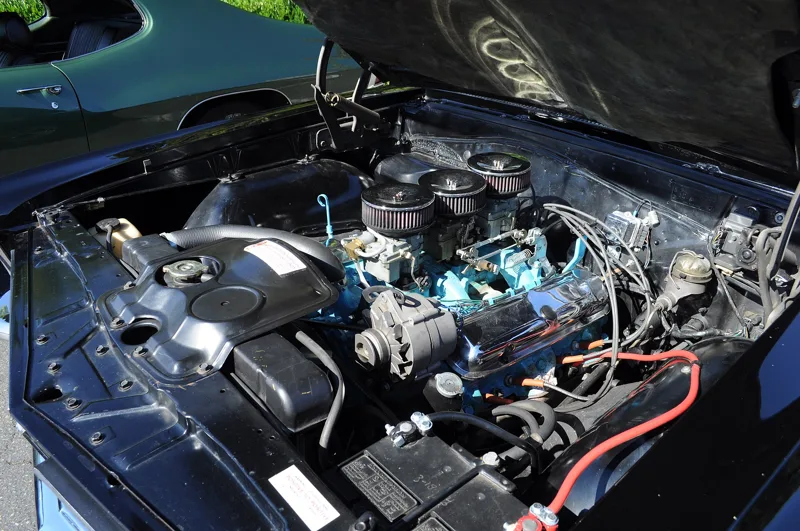
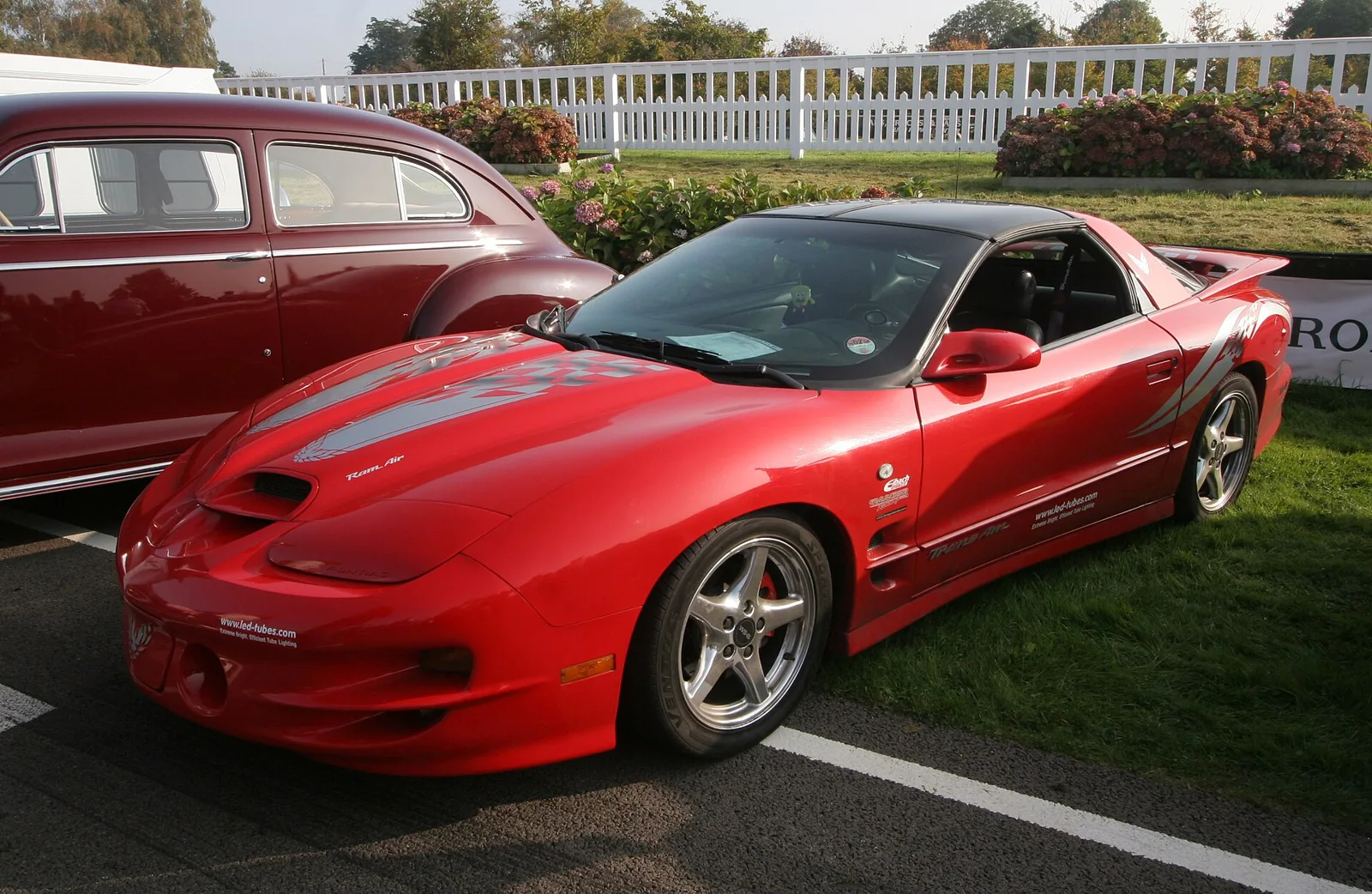
The Ram Air package added functional hood scoops, freer-flowing heads and a hotter camshaft. The 1969 Ram Air IV made 257 kW (345 hp; 350 PS) at 5000 rpm, with 430 lb ft of torque reached at 3400 rpm.
In 1968 the six grew to 250 cu in (4.1 L) and gained 175 hp, while the 326 made way for a 350 cu in (5.7 L) V8 with 265 hp. A high-output 350 with a revised cam added 320 hp. A 303 cu in (5.0 L) racing engine was also developed for the SCCA, though it was not sold to the public.
What changed with the second generation in 1970?
The second generation appeared on February 26, 1970, later than intended because of tooling and engineering troubles, and it was coupe-only. Convertibles did not return until 1989.
The Coke bottle curves gave way to a smoother body with a rear window line that dropped almost straight to the boot lid. A flat rear window remained until the 1975 redesign, and the look it created defined the F-body for longer than any other design.
The 1970 range added the Esprit and the Formula beside the Trans Am. The base car used a 250 cu in (4.1 L) six rated at 155 hp, while the Esprit and Formula came with a 350 cu in (5.7 L) producing 255 hp.
Trans Am buyers could choose the 335 hp Ram Air III or the 345 hp Ram Air IV. Only the Trans Am could be ordered with the Ram Air IV, whose carburettor linkage held back the rear barrels, a limit a simple change could remove.
How did the big-block cars perform in the early 1970s?
In 1971 Pontiac offered its largest V8, a 455 cu in (7.5 L) engine in a 325 hp L75 guise and a 335 hp LS5 high-output form. The 455 HO became standard on the Trans Am that year.
The 1973 Trans Am could be fitted with a base L75 455 rated at 250 hp, or with the Super Duty LS2 455, rated at 290 hp (216 kW) and hand-assembled. The Super Duty's shaker scoop read SD-455.
A 1974 SD455 weighed 3,850 lb (1,746 kg). In a magazine test a stock car with a 4,010 lb test weight ran 14.25 seconds at 101 mph, and while the factory quoted 290 SAE net horsepower, a chassis dyno recorded 253 hp.
Catalytic converters forced changes for 1975. The Super Duty LS2 and the TH400 automatic were dropped, and the TH350 took over. The L78 400 became standard on the Trans Am, and a 455 HO returned mid-year with a four-speed manual, rated at 200 hp.
What were the Y82 and Y88 editions?
Pontiac marked its 50th anniversary in 1976 with the Y82, a black Trans Am with gold accents. It was the first anniversary Trans Am and the first black and gold special edition, and a Hurst removable roof was planned for it.
Installation and quality problems meant most Y82s left the factory without the Hurst roof. T-tops became a regular option in 1977, and the Y82 became well known after appearing in Smokey and the Bandit, which helped lift Firebird sales.
The gold Y88 of 1978 followed, with gold mirrored T-tops and snowflake wheels. Problems with its Solar Gold paint led Pontiac to end the package, and the plain black edition replaced it for the rest of the year.
What did the 1979 restyle change?
The 1979 Firebird was completely reshaped, with a new aerodynamic nose, a revised spoiler, wider flares on the Trans Am and a single connected taillight that stayed for the rest of the design. The grille moved low in the bumper to feed cooler air to the radiator.
The Oldsmobile L80 403 became the standard Trans Am engine, while the W72 400 was a brief last hurrah for the big Pontiac V8s. The W72 demanded the WS6 handling package and a four-speed manual.
The TATA, a 10th anniversary Trans Am coded Y89, was built in a run of 7,500 cars, with 1,817 fitted with the W72 and a manual. Car and Driver named the WS6 car the best handling car of 1979, and Trans Am sales peaked at 116,535 that year.
What happened to engines in 1980 and 1981?
Stricter emissions rules made Pontiac drop its big V8s in 1980. The 301 became the Trans Am's base engine, and a turbocharged 301 with a Garrett TB305 turbo was offered. A hood-mounted boost gauge and a bulge to clear the carburettor marked the turbo cars.
The 1980 Y85 Turbo Trans Am was the Indianapolis 500 pace car, and 5,700 were built. It came with mirrored T-tops, a hood and roof decal, 15x8-inch wheels, the turbo 301 and the WS6 package, though many options remained extra.
The 1981 model year closed out the second generation. A four-speed manual returned, paired only with the Chevrolet 305, and the 301 gained electronic spark control. The 1981 Daytona 500 pace car was a black and white Y85 limited to 2,000 units, with Recaro seats.
What did the third generation of 1982 bring?
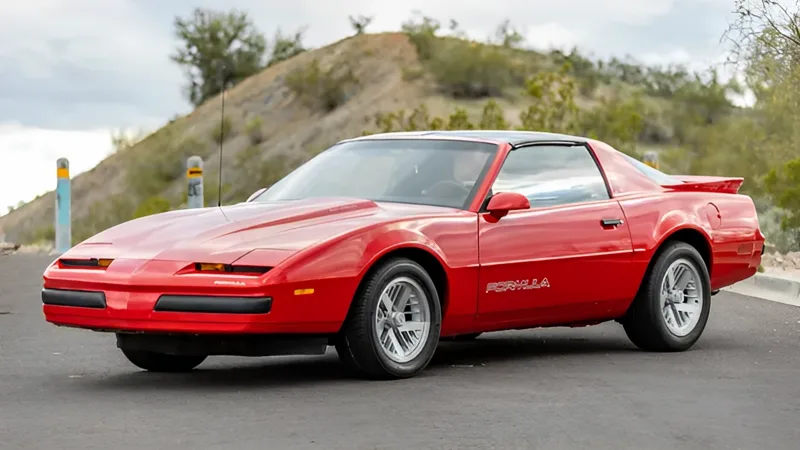
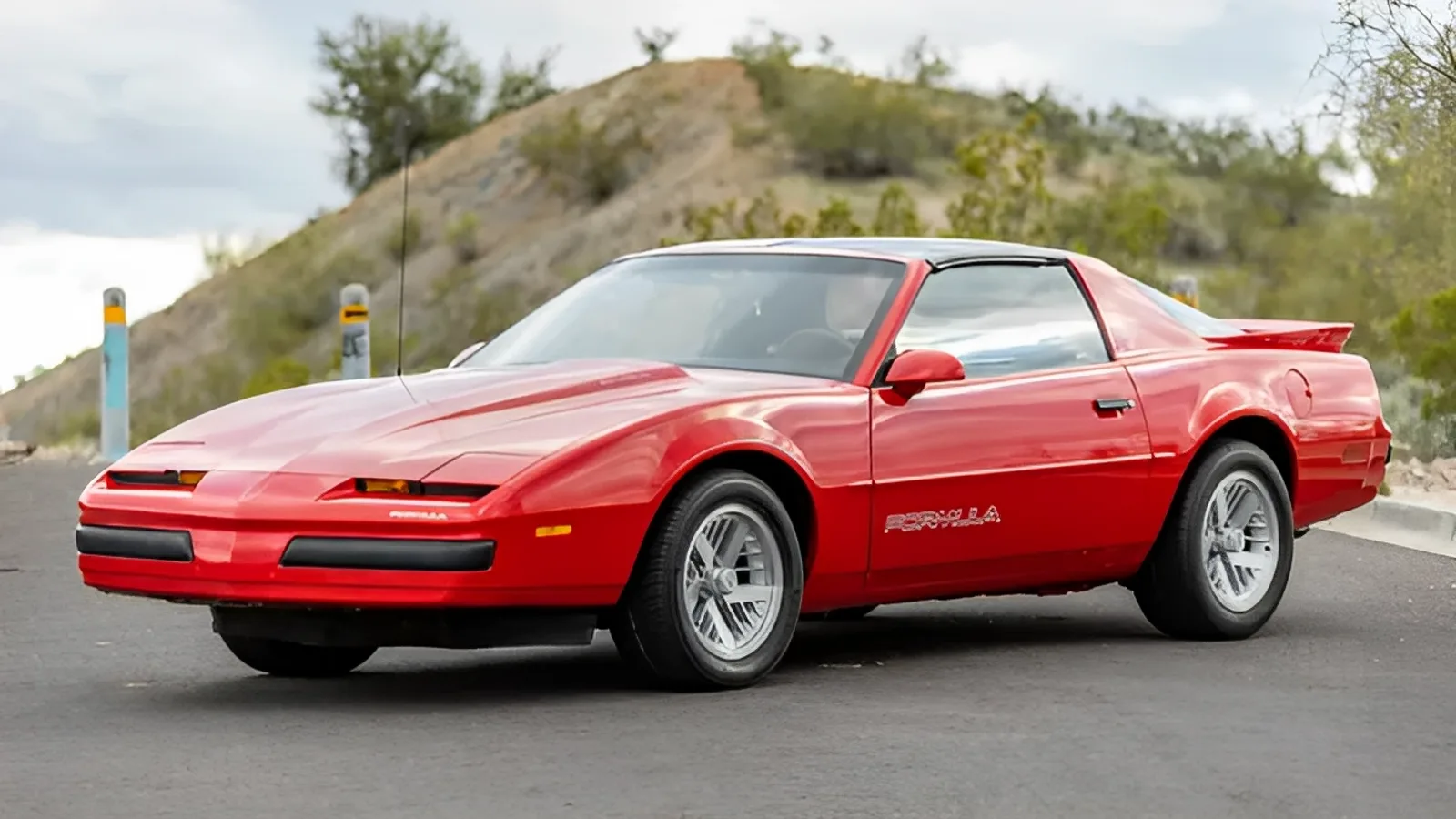
The Firebird and Camaro were redesigned for 1982. The windscreen was raked at 62 degrees, and a large glass hatchback needed no metal support. Two concealed pop-up headlamps set the car apart from its Camaro sibling.
Fuel economy was a priority during two oil crises. The new car was about 500 pounds (230 kg) lighter than its predecessor, and a four-cylinder model managed 6.9 L/100 km, or 34 miles per US gallon. Wind-tunnel work shaped the body.
The Trans Am GTA, sold from 1987 to 1992, was the most expensive Firebird and was meant to be the ultimate Trans Am. A notchback rear deck was offered for 1988, but fibreglass and paint problems led to its cancellation for 1989.
What was the 1989 Turbo Trans Am?
Pontiac built a 20th anniversary Turbo Trans Am in 1989, and it served as that year's Indianapolis 500 pace car. It used a 3.8-litre turbocharged V6 from the Buick GNX, reworked to 8:1 compression and boosted to 16 psi against the GNX's 14 psi.
Official ratings listed 186 kW (250 hp) and 340 lb ft, but dyno tests often recorded more than 300 hp. The car also carried a longer warranty than the GNX, and 1,555 Turbo Trans Ams were built.
How did the fourth generation perform?
The fourth-generation Firebird, sold from 1993 to 2002, kept the live rear axle and floor aft of the front seats, but about ninety percent of its parts were new. Standard equipment now included dual airbags, anti-lock brakes on all four wheels, 16-inch wheels and rack-and-pinion steering.
A 3.4-litre V6 rated at 160 hp (119 kW) was the base engine until 1995, when a 3.8-litre V6 with 200 hp (149 kW) took over. From 1993 to 1997 the Formula and Trans Am relied on the 5.7-litre LT1 V8, essentially the Corvette's engine with more restrictive intake and exhaust.
The 1996 LT1 was rated at 285 hp, and the WS6 pack pushed it to 305 hp with 17x9-inch wheels. In 1997 an LT4 Firehawk arrived with 330 hp (246 kW), and 29 of those cars were built.
What changed in the 1998 refresh and after?
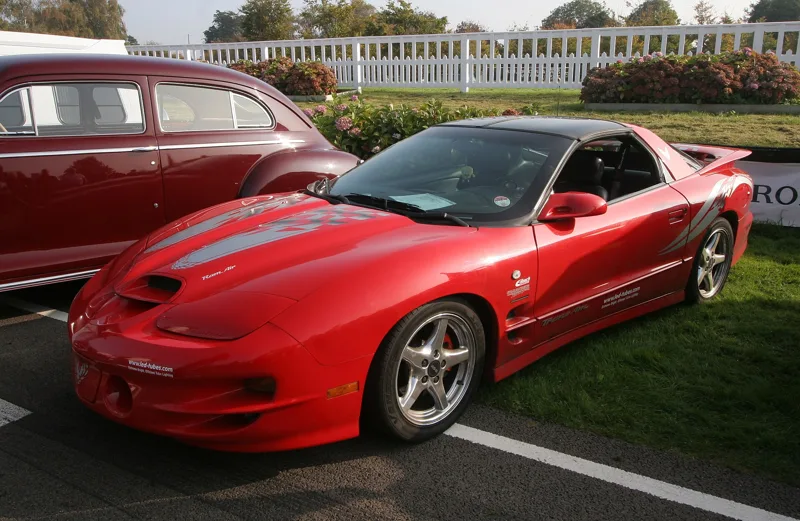
The 1998 refresh brought a new hood and front fascia, retracting quad halogen headlamps and a honeycomb rear light panel. The LS1 V8 from the C5 Corvette replaced the LT1, and every trim gained four-wheel disc brakes.
The 1999 Firebird made 327 hp (244 kW) with the LS1, and the figure climbed through 330 hp in 2000 and 335 hp in 2001 before reaching 345 hp in late 2002 with the Blackwing intake. In 2002 the WS6 Trans Am delivered 231 kW (310 hp) at 5,200 rpm, with 340 lb ft at 4,000 rpm.
Which special editions stood out?
The Firehawk began as a 1992 model built by SLP Engineering, using modified Formula 350s with over 350 hp and 390 lb ft of torque. Only 25 regular cars and two race models were sold that year, which makes the 1992 Firehawk very rare.
A Firehawk package returned in 1993 and 201 were built that year. The 1994 25th anniversary Trans Am was white with a dark blue centre stripe, and the 75th anniversary package of 2001 counted 472 cars.
How did the Trans Am perform in racing?
Firebirds took part in Trans Am series racing in the sixties and seventies, though the 400 cu in engine was too big for the series. Between 1996 and 2006 the International Race of Champions ran cars built on WS6 Trans Am coupe bodies.
John Force used a Firebird body in NHRA funny car racing across 1995, 1996 and 1997, after using Oldsmobile and Chevrolet bodies since 1988. He won the championship in all three seasons, while Jim Yates won in pro stock in his second year with the Firebird body.
What happened to Burt Reynolds' Firebirds?
In April 2018 the actor Burt Reynolds, a keen Firebird collector after the Smokey and the Bandit films, saw three Trans Ams from his personal collection sold at Barrett-Jackson in Palm Beach. He died about five months later.
A red 1977 Trans Am sold for $57,200, about $70,168 in 2024 money. A 1974 Trans Am 455 Super Duty and a 1980 Indianapolis pace car each brought $100,000 before the buyer's commission.
Later, Trans Am Depot revived the name under a licence from General Motors, and in 2017 a Bandit Edition appeared, with a 455 cu in supercharged engine and a signature from Reynolds on each of 77 cars.
Pontiac Firebird Trans Am specifications at a glance
| Specification | Detail |
|---|---|
| Production years | 1967 to 2002 |
| Introduced | February 23, 1967 |
| 1967 entry six | 230 cu in (3.8 L), 165 hp (123 kW) |
| 1969 Ram Air IV | 257 kW (345 hp; 350 PS) at 5000 rpm |
| 1973 Super Duty | 290 hp (216 kW) at 4000 rpm |
| 1979 Trans Am sales | 116,535 cars |
| 1989 Turbo Trans Am | 250 hp (186 kW) official rating; 1,555 built |
| 1997 LT4 Firehawk | 330 hp (246 kW) |
| 2002 WS6 | 231 kW (310 hp) at 5,200 rpm; 340 lb ft at 4,000 rpm |