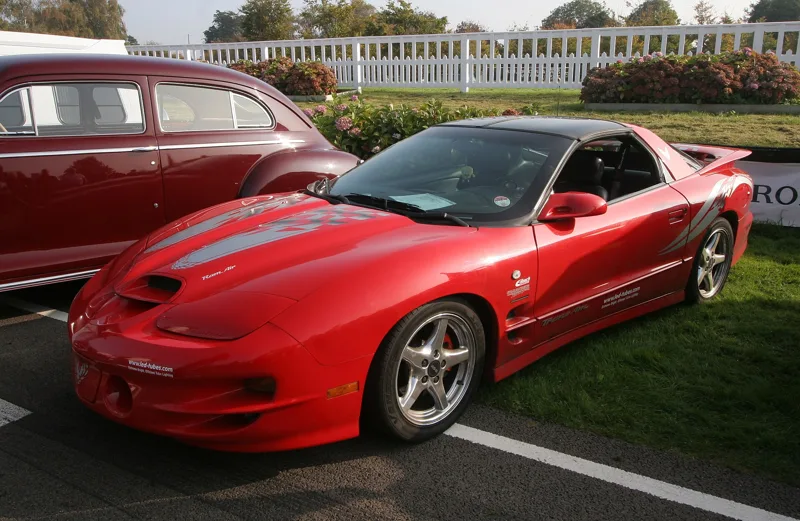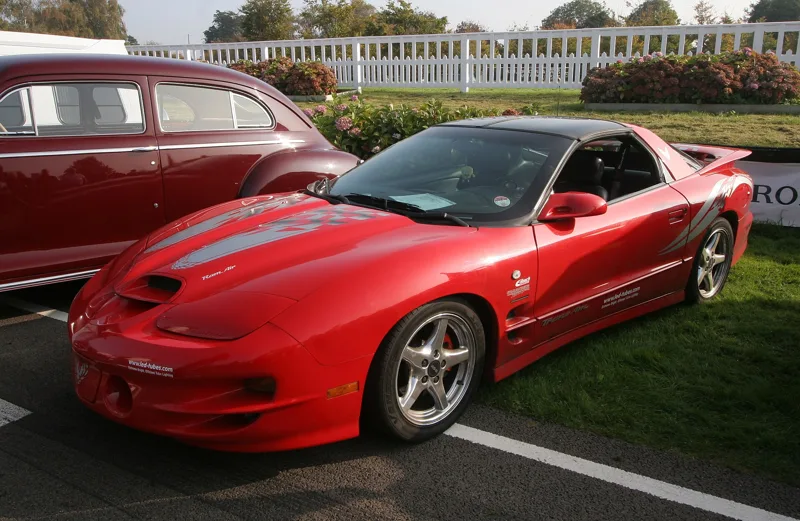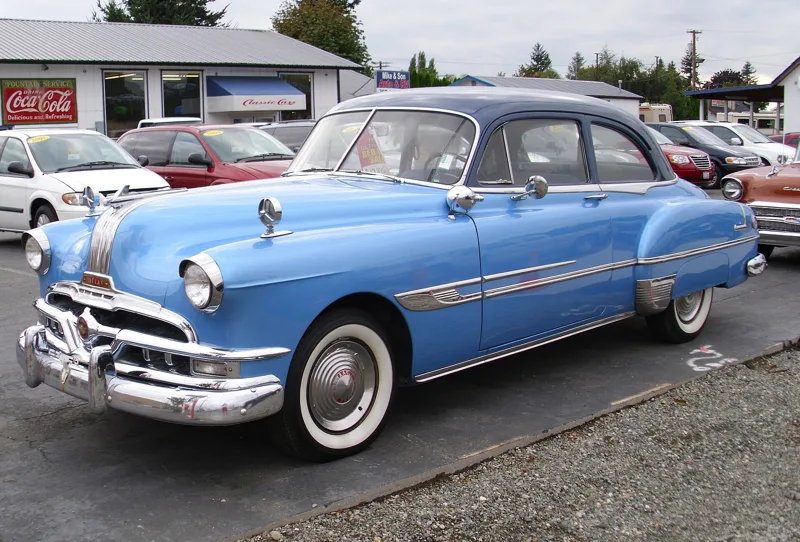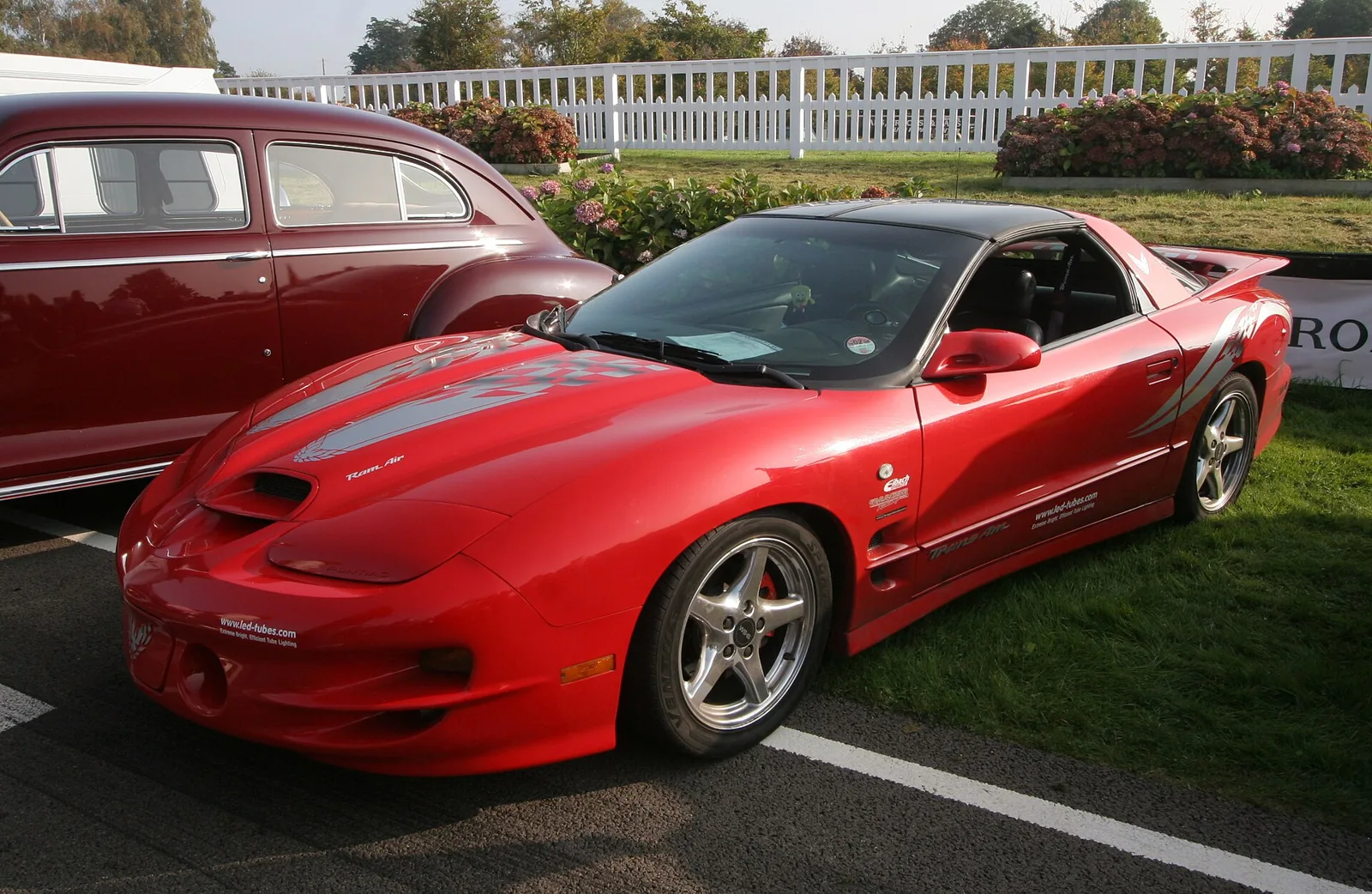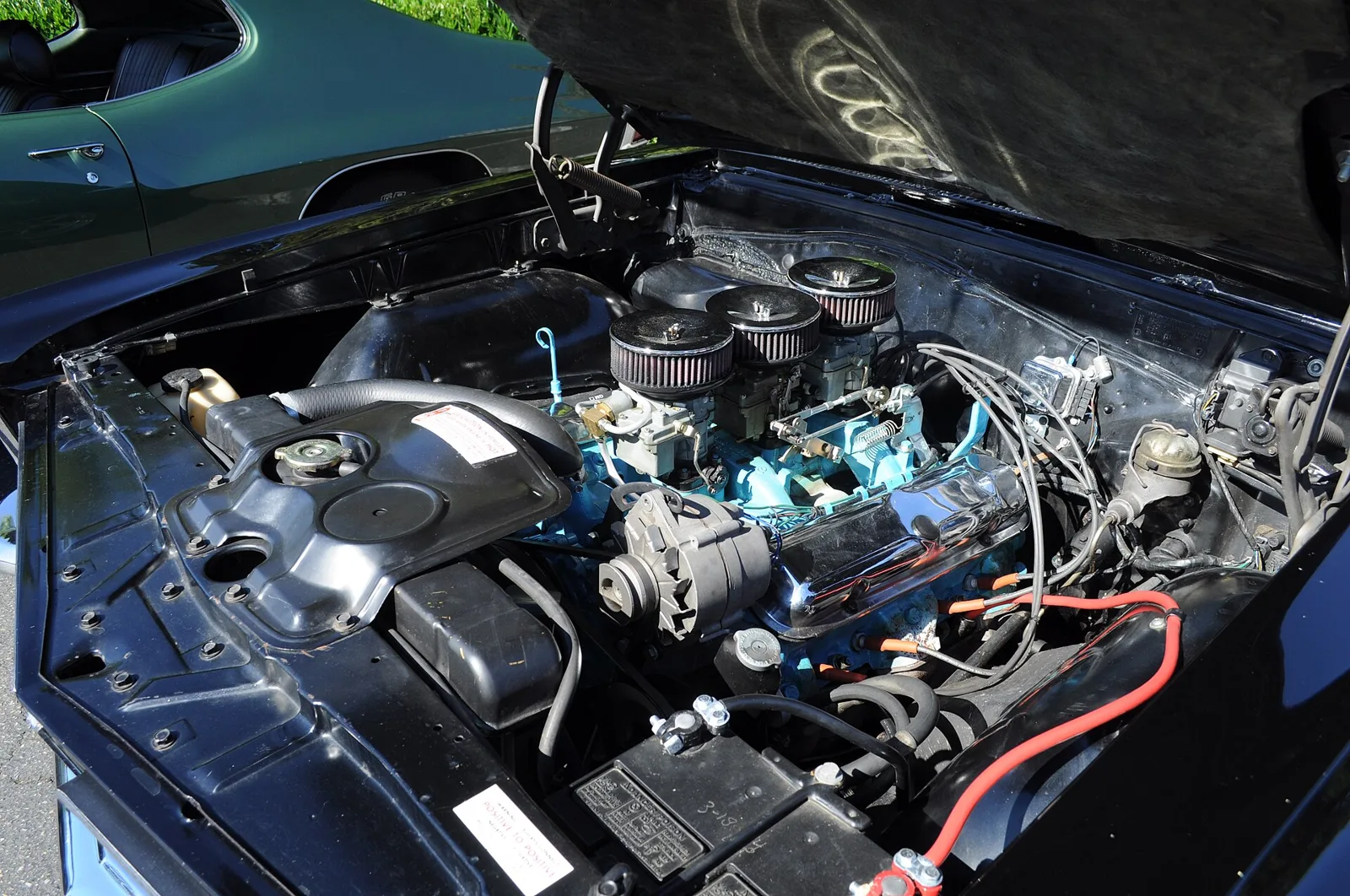
Pontiac's cast-iron V8 ran from the 1955 Strato Streak to the end of production in 1981, through Tri-Power, the Ram Air engines, the 455 and the turbocharged 301.
The Pontiac V8 was a cast-iron overhead valve family built from 1955 to 1981. It began as the 287 Strato Streak, grew to 455 cu in, and included the Ram Air engines and the 301 Turbo, the last true Pontiac V8.
The Pontiac V8 was an overhead valve, 90-degree engine with a cast-iron block and cast-iron heads and two valves per cylinder. Pontiac built it from 1955 until 1981, in displacements that ran from 265 cu in (4.3 L) up to 455 cu in (7.5 L). Most were carbureted, though one fuel-injected version and a turbocharged 301 were also offered, and the family carried Pontiac's performance name through the Trophy and Ram Air years.
Why did Pontiac wait until 1955 for a V8?
Pontiac had been a companion make to Oakland since 1926, and it used an inline six and then a straight eight for decades. When Robert Critchfield became general manager in 1952, he set out to move Pontiac up into the mid-range market held by Oldsmobile, and that plan demanded V8 power. He fast-tracked the programme and finished the new engine in 18 months, which was a remarkably short timeline for a new engine of the period.
Pontiac had planned to introduce the V8 in 1953, but Buick and Chevrolet persuaded GM management to grant a two-year delay. Buick wanted to be the only division with a new V8 for 1953, and Chevrolet did not want to be the only one without a V8 in 1954. The 1954 Strato-Streak concept car introduced the engine, and the production version followed in 1955, after nine years of design and development work.
Pontiac's cast-iron V8 started as a 287 Strato Streak and finished as a 301 with a turbocharger, with the Ram Air name in between.
How was the original Pontiac V8 designed?
The first Pontiac V8 used reverse-flow cooling, which earned the nickname gusher cooling, and its stamped rocker-arm system had been devised by engineer Clayton Leach in 1948. The rockers sat on ball pivots set on studs in the head. That arrangement was simpler and cheaper to build than conventional shafts, and it gave more consistent valve action. Chevrolet used the same layout in its own 1955 V8 at the request of Ed Cole.
The engine shared a common 4.62 in bore pitch across the whole family, which gave a mid-size block with the same external dimensions for almost every displacement. Most engines measured 28.25 in (718 mm) long, 27 in (690 mm) wide and 31 in (790 mm) high, and dry weight ran from 590 to 650 lb (270 to 290 kg). The deck height was 10.24 in for most versions, with three short-deck exceptions.
How did the crankshafts change over the years?
Early cranks from 1955 to 1958 were forged. From 1959 to 1966 they were cast in Armasteel, a pearlitic malleable iron, and from 1967 until production ended in 1982 they were nodular iron. Main journal diameters grew with displacement, from 2.5 in on the earliest engines to 3.00 in on engines of 400 cu in and smaller from 1959, and to 3.25 in on the 421 and larger.
What were the 287, 317 and 347 engines?
The first engine, the 287 cu in (4.7 L), arrived for 1955 as the Strato Streak. It had a 3.75 in x 3.25 in (95.3 mm x 82.6 mm) bore and stroke and an 8.00:1 compression ratio. The four-barrel version made 200 hp (149 kW) at 4600 rpm, and the two-barrel made 180 hp (134 kW) at the same speed. Pontiac had based its decision on more than a million test miles, which was unusual for the time.
For 1956 the bore grew to 3.9375 in, giving 316.6 cu in (5.2 L). A factory 285 hp version was built for NASCAR, and dual four-barrel carburettors were offered on the road cars. In 1957 the stroke rose to 3.5625 in (90.49 mm) for 347 cu in (5.7 L), and Pontiac offered its first Tri-Power, three two-barrel carburettors with a sequential linkage. The top Tri-Power produced 290 hp (216 kW) at 5000 rpm.
The 1957 Bonneville also introduced Pontiac's first fuel injection, a mechanical system built by Rochester. Only 630 Bonnevilles were made that year, all of them with injection, and contemporary road tests suggested the set-up was slightly inferior to Tri-Power although it returned better fuel economy.
How did the 370 and 389 Tempest and Trophy engines work?
For 1958 the bore grew again to 4 1/16 in (103.2 mm), and the displacement became 369.4 cu in (6.1 L). The engine was called the Tempest V-8 until the end of 1960. A fuel-injected option carried a price of $500, almost 15% of the base price of the car, and it was rated at 310 hp (231 kW) at 4800 rpm with 10.5:1 compression. Only about 400 were made before the injection system was dropped.
The 389 arrived in 1959 with a 3.75 in (95.3 mm) stroke and a 3.00 in main journal. Its crankshaft was an Armasteel casting, the first cast crank used by any Detroit automaker. The name Trophy V-8 was adopted in 1961, reflecting the engine's many racing victories. The 389 stayed the standard engine through 1966, in outputs from 215 to 368 hp (160 to 274 kW), and it powered the Grand Prix, Bonneville and GTO.
| Engine | Years | Displacement | Bore | Stroke | Peak output |
|---|---|---|---|---|---|
| 287 | 1955 to 1956 | 287.2 cu in (4.7 L) | 3.75 in (95.3 mm) | 3.25 in (82.6 mm) | 200 hp (149 kW), four-barrel |
| 400 | 1967 to 1978 | 400 cu in (6.6 L) | 4.12 in (104.6 mm) | 3.75 in (95.3 mm) | 360 hp in the 1968 GTO |
| 428 | 1967 to 1969 | 426.61 cu in (7.0 L) | 4.12 in (104.6 mm) | 4 in (101.6 mm) | 390 hp (291 kW) in 1968 and 1969 |
| 455 | 1970 to 1976 | 456.12 cu in (7.5 L) | 4.1525 in (105.47 mm) | 4.21 in (106.9 mm) | 360 hp (268 kW) in 1970 |
| 301 | 1977 to 1981 | 301.6 cu in (4.9 L) | 4 in (101.6 mm) | 3 in (76.2 mm) | 170 hp (127 kW) in the W72 version |
What was the Ram Air family?
The Ram Air story began in 1965, when Royal Pontiac developed a prototype hood scoop on its GTO drag car. Pontiac picked up the idea and offered dealers a Fresh Air package in August 1965. In January 1966 the factory offered the XS-code engine, with a new camshaft and valve springs. Pontiac's own description rated the XS 389 at 360 bhp at 5200 rpm.
The 1967 Ram Air 400 was the most powerful and advanced engine available in the GTO and Firebird. Its cast 670 heads had a closed combustion chamber with a 14-degree valve angle, and the engine carried the 744 camshaft. It was underrated at 360 hp. The 1968 Ram Air II followed, with 366 hp at 5400 rpm in the GTO and 340 hp at 5300 rpm in the Firebird. It was the first engine to use Pontiac's round-port head design in a production car.
The Ram Air IV ran from 1969 to 1970, and it had a higher-lift cam with 1.65:1 rockers and aluminium intake manifolds. Production totalled 1,808 cars over the two years, of which 1,563 were A-bodies and 245 were F-bodies. The Ram Air V was a racing engine with tunnel-port heads, and only about 25 of the 303 short-deck engines were made, with others in 366, 400 and 428 forms.
How did the 455 and the SD-455 respond to the 1970s?
The 455 cu in engine arrived in 1970 with 360 hp (268 kW) and 500 lb ft (678 N m) of torque. For 1971 the 455 HO carried a four-bolt block, round-port heads and a special Quadrajet, and its rating was 335 hp (250 kW) gross or 310 hp (231 kW) net. The 1972 455 HO was rated 300 hp (224 kW) under the new net method, although performance figures suggested little change.
The Super Duty 455 was planned for 1973, and it was based on the racing RA IV with four-bolt mains and forged rods. Emissions testing forced a milder camshaft, and the production SD-455 was rated at 290 hp (216 kW) SAE net. Only 295 Firebirds were built in 1973, and 1,001 followed in 1974, with 943 of them Trans Am models. The 455 was used through 1976 when it was dropped as manufacturers moved to smaller engines.
What were the W72 and the 301 Turbo?
The 400 W72, badged T/A 6.6, appeared in 1977 to fill the performance gap left by the 455. It used 6x4 heads with hardened valve seats, a higher-duration cam, a larger oil pump and an 800 cfm Quadrajet. Its rating was 200 hp (149 kW) at 3600 rpm, against 180 hp (134 kW) for the standard L78. For 1978 it was rated 220 hp (164 kW) at 4000 rpm, and the 1979 W72 was measured at 260 to 280 net horsepower by the NHRA.
The 301 Turbo was offered only in the Firebird Trans Am and Formula from 1980 to 1981. It used a Garrett turbocharger wastegate-limited to 9 psi of boost, and it made 210 hp (157 kW) at 4400 rpm in 1980. The 1981 version was rated 205 hp (153 kW). The 301 W72 of 1980 and 1981 added Electronic Spark Control and was rated 170 hp (127 kW) against 150 hp for the standard engine.
Why did the Pontiac V8 end in 1981?
Federal regulations and GM's push for a corporate engine family brought the Pontiac V8 to an end. Pontiac had downsized the engine in 1977 with the thin-wall 301, and the 1981 production cut-off came when the division's last true V8 was built. Its replacements were GM corporate engines such as the Chevrolet 305 and the Oldsmobile 307, and eventually the LS V8 introduced in 1997.
The engine's legacy lies in its performance versions. From the Trophy 389 to the Ram Air IV and the W72 cars, the family gave Pontiac a reputation that outlived its production run, and the 301 remains the last true Pontiac V8 in the sense that the division built it.