From the 1940 Custom Torpedo and fastback Streamliner to the Chieftain's first V8 in 1955, how Pontiac's everyday cars changed from 1940 to 1958.
The Pontiac Torpedo, Streamliner and Chieftain were Pontiac's mainstream cars from 1940 to 1958. The Torpedo and fastback Streamliner led the 1940s, and the Chieftain replaced the Torpedo in 1949 and gained Pontiac's first V8 since 1932 in 1955 before the Catalina took over in 1959.
Pontiac had a modern overhead-valve V8 ready for its 1953 and 1954 cars, and did not get to use it. Managers at Buick, who wanted nothing to upstage their own "Nailhead" V8, succeeded in delaying the Pontiac engine until 1955. In the meantime, Pontiac was the last General Motors division still building its prewar inline eight, and its sales fell by 30% in 1954. The cars caught in that gap were the Pontiac Chieftain, and behind it the Streamliner and Torpedo, the mainstream models that carried the brand through the 1940s and 1950s.
What was the Pontiac Torpedo?
The Torpedo was a full-sized Pontiac sold from the 1940 model year. When it appeared it was the largest Pontiac, it had an eight-cylinder engine and it came with more standard equipment than any other. In 1940 the name belonged only to the top line. A year later it covered the whole range.
The 1940 Custom Torpedo
The Custom Torpedo of 1940 rode on the GM C-body. Pontiac, like Oldsmobile, had all three of General Motors' mainstream platforms that year, a distinction that lasted just one more season. Cadillac's Series 62, Buick's Roadmaster and Super and Oldsmobile's Series 90 shared the same body, and it brought a cutting-edge torpedo shape. Shoulder and hip room grew by more than 5 in (127 mm). Running boards disappeared, and the cars sat 2-3 in (51-76 mm) lower. With a column-mounted shift lever, six passengers could sit in genuine comfort.
Larger windows and wider seats set it apart from other Pontiacs, and so did extra-wide doors on concealed hinges, long streamlined rear decks and a plastic Indian head on the hood ornament. Four-door sedans had front and rear ventiplanes, the small pivoting vent windows. The only engine was the inline eight, and buyers could choose a four-passenger two-door sedan or a five-passenger four-door. Extras included a heater, a cigarette lighter, a six-tube radio, a clock and a boot light.
1941: the name goes on everything
For 1941 the A-body and B-body were redesigned too, lower and wider and without running boards, although those could still be ordered as an extra. Pontiac renamed its whole range Torpedo. At the bottom sat the A-bodied Deluxe Torpedo on a 119-inch wheelbase, the middle line was the B-bodied Streamliner Torpedo on a 122-inch wheelbase, and the Custom Torpedo kept the C-body and the same 122 inches. Every model could have a six or an eight.
The Deluxe had notchback styling, a wide grille with horizontal bars and recessed headlights, with five body styles at first, including a convertible with a power top. The Streamliner Torpedo was the sleek one: its fastback roofline swept from windscreen to rear bumper in a single curve. A Super Streamliner Torpedo subseries added two-tone worsted wool upholstery, sponge rubber seat cushions, electric clocks and folding centre armrests. The Custom Torpedo gained an eight-passenger, wood-bodied station wagon, built by Hercules and Ionia, with genuine leather cushions in Deluxe trim. It was the last Pontiac on the C-body until the big clamshell-tailgate Safari and Grand Safari wagons of 1971-76.
The war and after
For 1942 the Torpedo name moved to the A-bodied Pontiac, and the Streamliner became the B-bodied model. Civilian production ended on 2 February 1942 as manufacturers switched to the war effort; cars very like the prewar Pontiacs restarted in 1945, but Torpedoes only reappeared in June 1946. From 1942 to 1948 the name marked only the base models. The postwar cars looked much like those before the war, with full round-gauge instrumentation and the same engines. In 1947 came a new Chief Pontiac hood ornament and an optional eight-tube radio, and 1948, the last Torpedo year, brought a new grille, optional Hydramatic automatic transmission and a base price of $1,500. The Chieftain replaced it for 1949.
Pontiac was the last General Motors division still building its prewar inline eight.
The Pontiac Streamliner and its fastback body
Pontiac's Streamliner was a full-size, mid-priced car in the upper part of the range, built from 1942 to the 1951 model year and sold through the years straight after the war. Streamliners used the larger B-body, with fastback styling on everything except the station wagons.
The Chieftain name actually began as a Streamliner trim, the 1941 Super Streamliner with folding centre armrest being sold as a Chieftain in 1942. After 1946 that trim level became Deluxe. For 1942 all Pontiacs looked lower, heavier and wider, with the hood running back to the front doors so the cowl disappeared. After 15 December 1941 wartime blackout trim meant that chrome parts were finished in Duco Gun Metal Grey.
The wagon
When the Custom Torpedo ended, station wagon production moved to the Streamliner line, with bodies still finished by Hercules Body Company or Ionia Manufacturing. A 1942 Streamliner wagon started at $1,265 as a base six and reached $1,340 as a Chieftain eight, the dearest Pontiac of all. At 215.8 in (5,481 mm) it was also the longest Pontiac ever built until the 1959 Star Chief and Bonneville. Streamliner wagons stayed the most expensive Pontiac through 1946, 1947 and 1948.
Postwar sales
The first postwar Pontiac to be had, on 13 September 1945, was the Streamliner coupe, and it was the sole product for a time. By 1946 the cars had wraparound bumpers and a massive 14-blade grille, and Pontiac sold 92,731 Streamliners, over two-thirds of all its cars. The 1947 model added five chrome bands on the hood and four broad bowed grille bars, and 128,660 were sold, nearly 56% of Pontiacs. For 1948 came triple Silver Streaks, round taillights and a horizontal grille with a vertical shaft. Streamliners sold 160,857 that year, nearly 66% of all Pontiacs.
Deluxe versions in 1948 had spear moldings along the front fender, shiny gravel guards, chrome wheel discs, two-tone trim and pillow-and-tuft seatbacks, with quarter-sawn mahogany on the dash and electric clocks in the glovebox door. Wagon prices ran from $2,364 for a standard six up to $2,490 for a Deluxe eight. As of 1948 only General Motors sold fully automatic cars, and apart from Pontiac the only way into one was a pricier Cadillac, Buick or Oldsmobile. A 1948 Pontiac buyer could therefore ask for Hydramatic, an option most rivals could not match.
Straight eights before the war
The Streamliner's story starts in the 1930s with Pontiac's straight-eight. For 1933 the Economy Eight Series 601 used a 223.4 cu in (3.7 L) Silver Streak engine after Pontiac dropped the flathead V8 of 1932. That year all GM cars could be ordered with vent windows. The 1936 Series 8BA grew to 232.2 cu in (3.8 L) with independent "Knee-Action" front suspension, and Pontiac sold 176,270 cars, sixth in the US. By 1937 the Deluxe Eight on the B platform had 248.9 cu in (4.1 L) and 100 bhp at 3,800 rpm. In 1939 production totalled 170,726, and a column-mounted gearshift, called the Safety Gearshift, let a third passenger sit on the front bench.
Pontiac Chieftain: 1949 to 1958
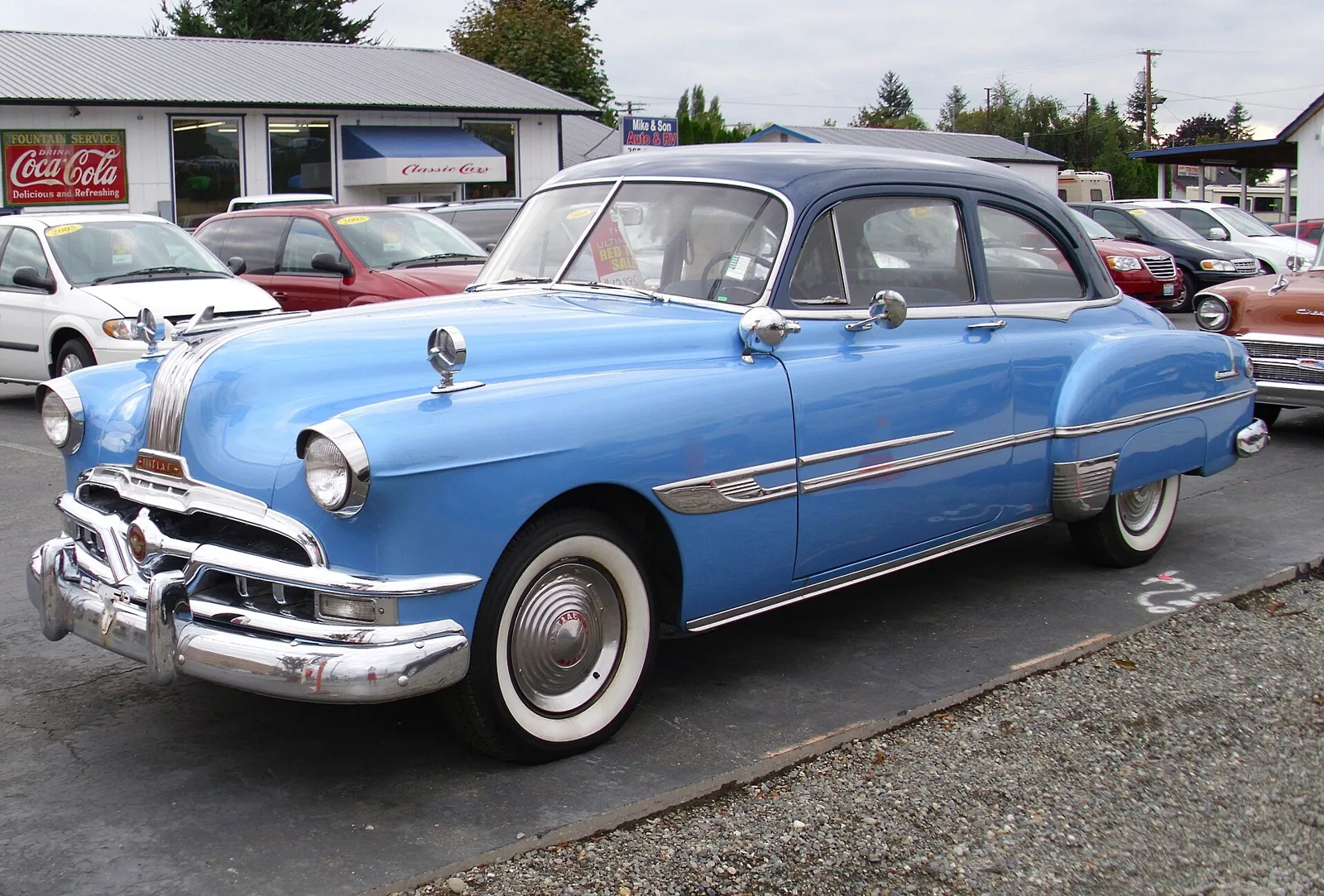
The Pontiac Chieftain ran from 1949 to 1958. The 1949 Chieftain and Streamliner were the first all-new Pontiac designs since the war, since earlier cars had been 1942 models with minor revisions. The A-body Chieftain took over from the Torpedo as the smaller, cheaper model, but the newly redesigned B-bodied Streamliner was very close to it in dimensions, engines, trim levels and options. For the first time since 1934 all Pontiacs shared one wheelbase, and they had automatic interior lighting as standard.
First generation, 1949 to 1954
Four body styles launched the range: a sedan, a sedan coupe, a business coupe and a deluxe convertible coupe. A Catalina Coupe was added in 1950, and a station wagon in 1952 when the Streamliner wagon, the range-topper, was dropped. Pontiac discontinued the Streamliner for the 1952 model year, which left the Chieftain as the only Pontiac line, still on a 120-inch wheelbase. The 1949 car came with four engine choices, two sixes and two eights, the differences within each pair coming down to compression ratios. Some of the stranger options were a tissue dispenser, under-seat heaters, a seven-tube radio and a Remington Auto-Home shaver.
The instruments covered fuel, charging, oil pressure and temperature, with temperature marks at 160, 180 and 220 degrees Fahrenheit. In 1951 the eight reached 116 hp. A red parking-brake reminder light arrived in 1952, and Popular Mechanics rated a Chieftain at 14.9 seconds for 0-60 mph that May. Head room measured 36 inches in front and 35.75 inches at the rear.
A new body came in 1953, on a 122 in (3,099 mm) wheelbase, with sleeker lines, a one-piece windscreen and a panoramic rear window as standard. For the first time the rear fenders had bubbled-up fins. The range split into a Chieftain Special, a Chieftain Deluxe and the Custom Catalina two-door hardtop, and a plastic Chief Pontiac on the bonnet lit up with the headlights. In 1954 the Star Chief joined, built on the same shell with 11 in (279 mm) added to the frame, and the Chieftain slipped to entry level. Carburettor changes lifted the eight by about nine horsepower: 122 hp (91 kW) with the manual gearbox, 127 hp (95 kW) with the Hydra-Matic.
That 1954 sales drop of 30% was blamed partly on Chevrolet, Oldsmobile and Buick, and partly on the missing V8. Oldsmobile and Cadillac had moved to modern overhead-valve V8s in 1949 and Buick in 1953, while Chevrolet never built an inline eight. Yet the 1954 Pontiac still introduced power brakes, power windows on the front doors only and air conditioning as paid extras for the first time. The 1954 Pontiac is credited as the first production car in the US with a modern air conditioning system, controlled from the dashboard. The front seat became fully adjustable and far more responsive.
Second generation, 1955 to 1957
The 1955 Chieftain had a completely new chassis, body and engine, and the engine was the headline: Pontiac's first V8 since a 1932 Oakland flathead was renamed Pontiac. This Strato Streak displaced 287.2 cu in (4.7 L) and made 173 or 180 horsepower (130 kW) at 4400 rpm, with a 200-horsepower four-barrel version following later. The 1955 line was V8-only. A six had been considered, but it was dropped because sixes had accounted for only about 10-15% of volume since 1951. The Silver Streak chrome strips on the hood and boot were updated to a twin-stripe design.
For 1956 the V8 was enlarged to 316.6 cu in (5.2 L), with 192 and 205 horsepower, and a padded safety dashboard became optional. Sales dropped by as much as 20% from record-setting 1955, partly because of tighter credit rules from American banks. In 1957 Star Flight styling arrived: side trim shaped like a missile, longer rear fenders ending in a V, lower bonnets and enormous bumpers. A Super Chief sub-series took 58.02% of Pontiac sales. The first Tri-Power engines arrived, the V8 grew to 347 cu in (5.7 L) and Chieftain models made 290 horsepower. Even though the cars resembled them, they never matched the popularity of the Chevrolet Tri-Five. In Australia, Holden assembled the 1957 Pontiac under the Super Chief name.
Third generation, 1958
The last Chieftain, in 1958, wore a honeycomb grille, quad head and tail lamps and concave rear fenders. The Super Chief rose to full model status, leaving the plain Chieftains as the entry-level Pontiac. Options included a removable transistor radio called the Sportable, air suspension and a limited slip differential. The V8 grew to 370 cu in (6.1 L), making 240 or 270 horsepower (180 or 200 kW). The all-new Catalina replaced the Chieftain in 1959.
How did Pontiac's engines grow?
| Model year | Engine | Output |
|---|---|---|
| 1949 (six) | 239.2 cu in L-head | 90 or 93 horsepower (67 or 69 kW) at 3400 rpm |
| 1949 (eight) | 248.9 cu in L-head | 103 or 106 horsepower (77 or 79 kW) at 3800 rpm |
| 1954 (eight) | L-head eight | 122 hp (91 kW) manual; 127 hp (95 kW) Hydra-Matic |
| 1955 | 287.2 cu in (4.7 L) V8 | 173 or 180 horsepower (130 kW) at 4400 rpm |
| 1956 | 316.6 cu in (5.2 L) V8 | 192 or 205 horsepower |
| 1957 | 347 cu in (5.7 L) V8 | 290 horsepower |
| 1958 | 370 cu in (6.1 L) V8 | 240 or 270 horsepower (180 or 200 kW) |