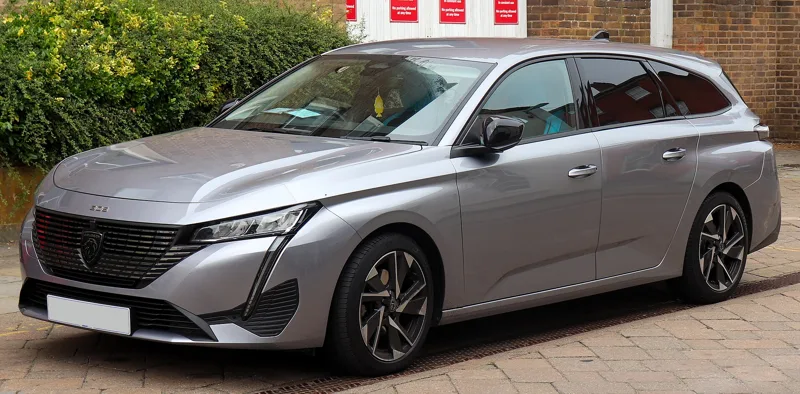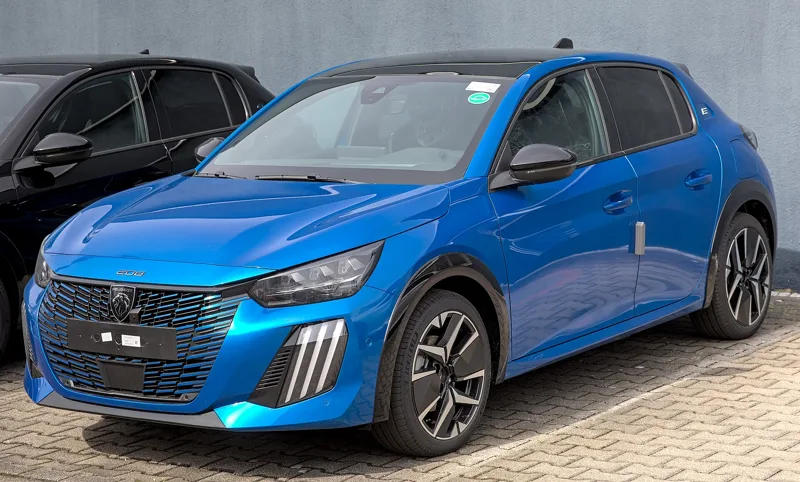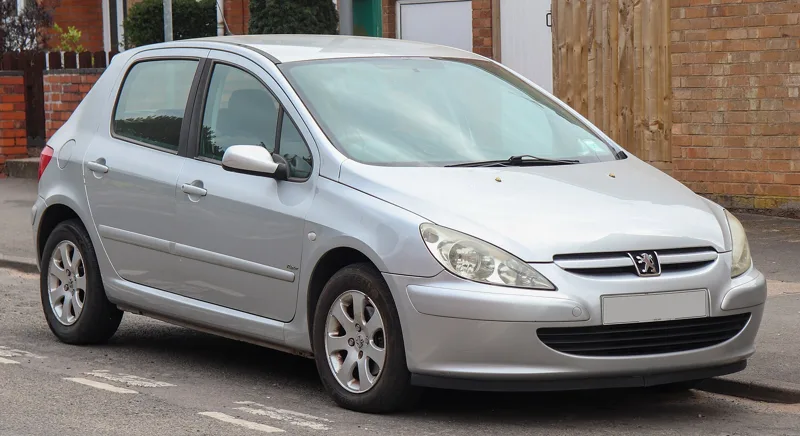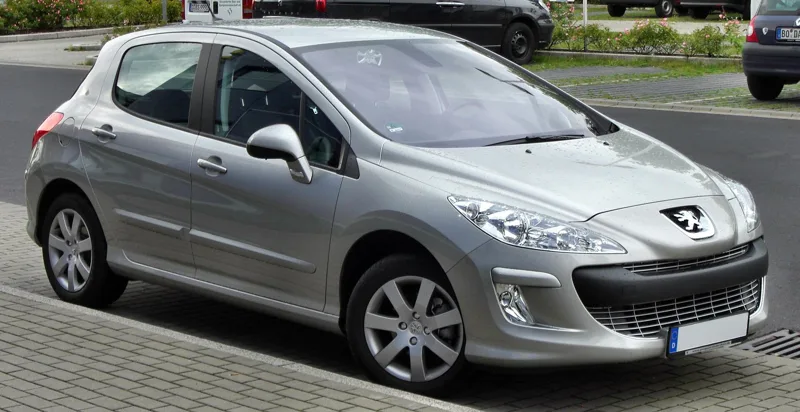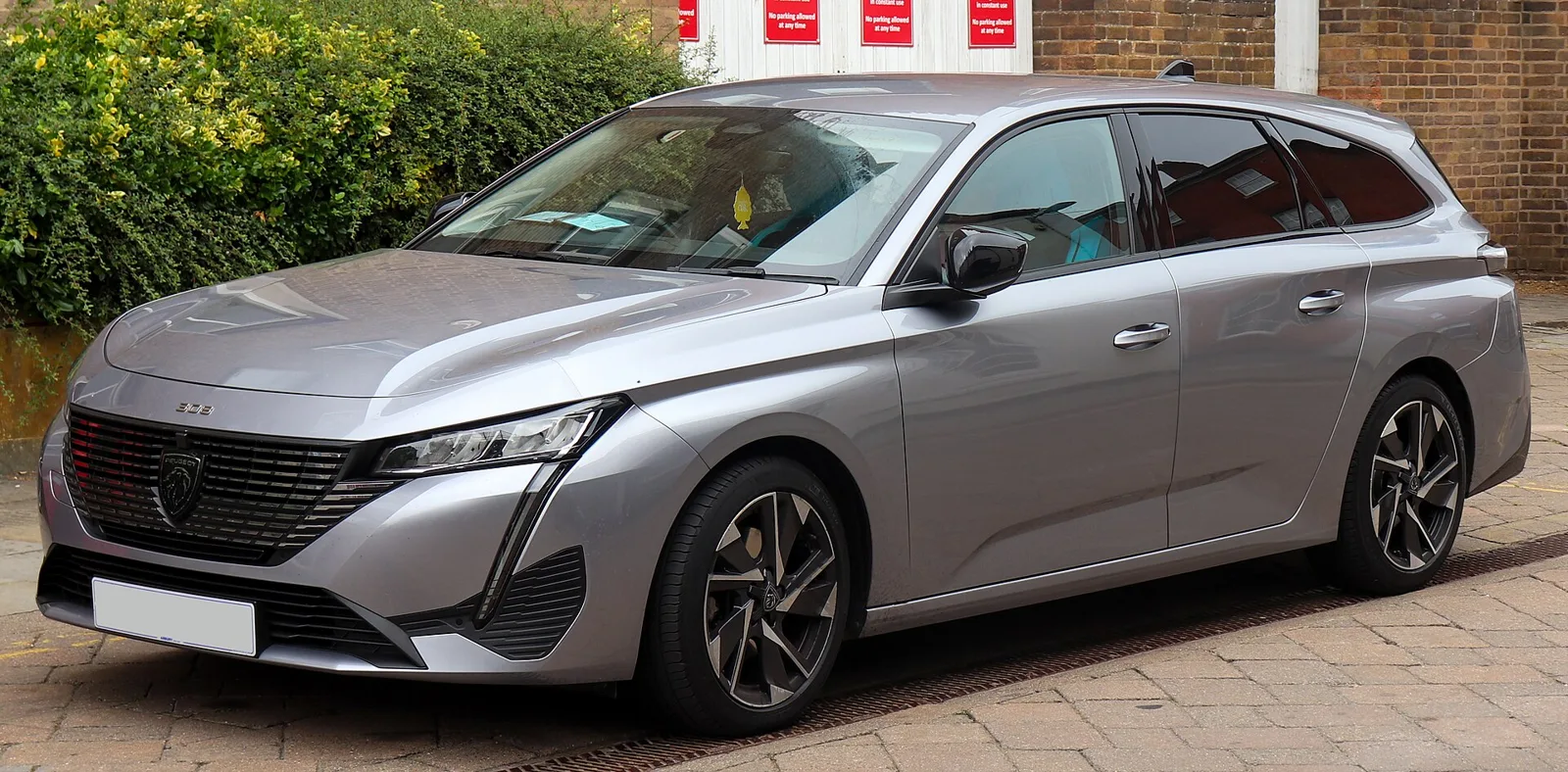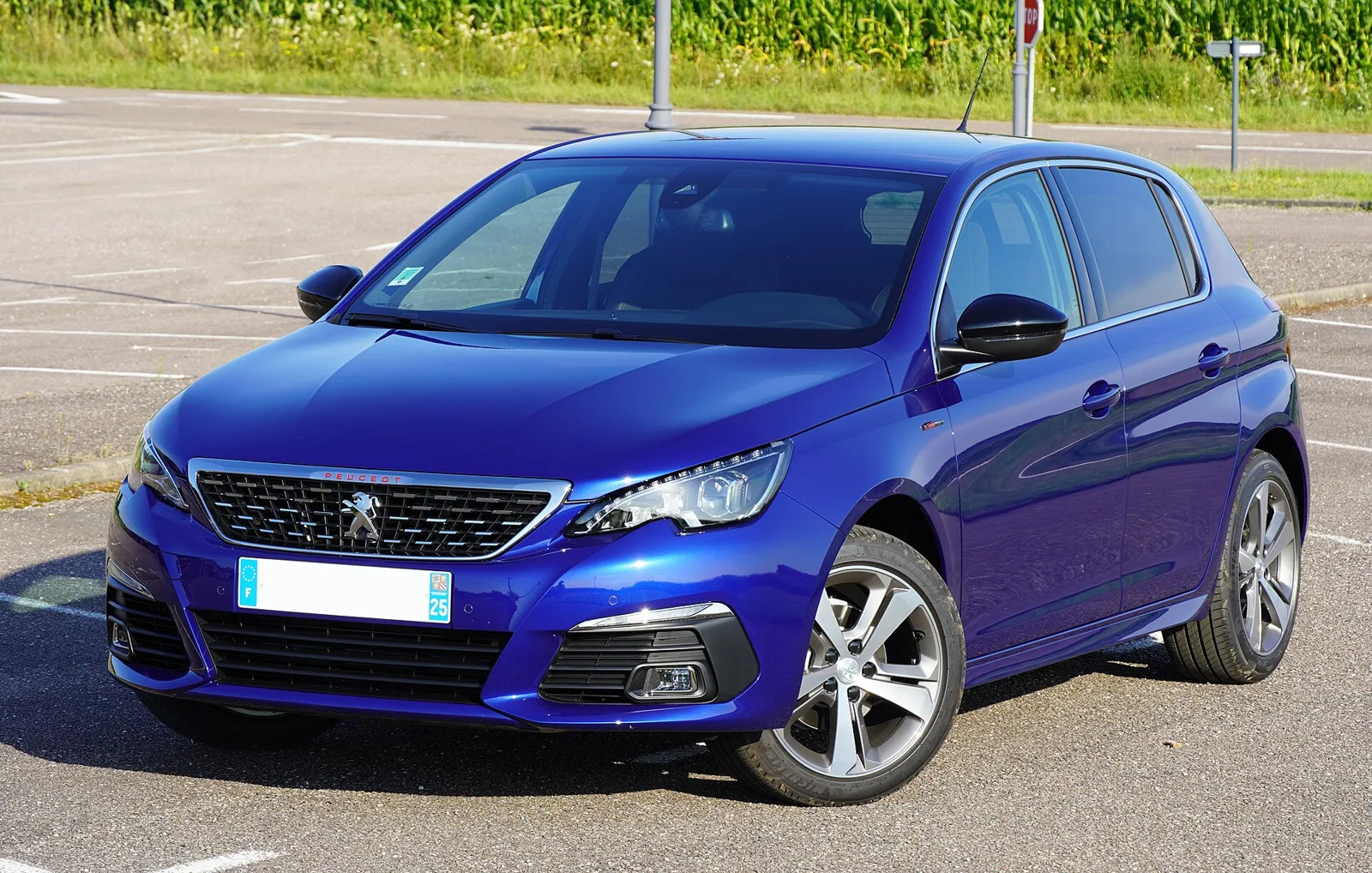
A compact from Sochaux with full LED lights, a sharp new look and an engine line-up that changed nearly every year until production ended in 2021.
The Peugeot 308 II was the second generation of the compact 308, built from 2013 to 2021. It won the European Car of the Year title for 2014, and its engines and trims changed nearly every year. Its GTi reached 270 PS, and its last example left Sochaux in September 2021.
Shown in Frankfurt in September 2013, the 308 in its second generation was elected European Car of the Year for 2014. Its engine line-up changed almost every year before the last example left the Sochaux factory in 2021.
Why did Peugeot keep the 308 name?
The 308 II was the first Peugeot to keep the same name for two successive models. The 309 name had already been used from 1985 to 1993, so Peugeot faced a choice for its three-segment car. It fixed the whole range with the suffix 8, while emerging markets received a range with the suffix 1.
That was a habit of Renault, Citroen and several foreign brands, which had got used to keeping a name from one generation to the next. The internal code of the 308 II was T9, with T91 for the five-door and T92 for the SW estate.
The car belonged to Peugeot's 300 lineage, which began with the 301 in 1932 and went on through the 302 (1936), 304 (1969), 305 (1977), 309 (1985), 306 (1993) and 307 (2001) before the 308.
A compact that kept its name, gained full LED lights and changed its engine line-up almost every year.
How was the 308 II designed?
The design was the work of the stylist Thomas Rohm, and it gave Peugeot a sharp, sporting line with a feline look in the purest Peugeot tradition. The aggressive front end and the rear lights shaped like claws defined the car, and the new look marked a renewal for the brand.
Inside, the car brought in the i-Cockpit already seen on the 208. The steering wheel was smaller, so the instruments could be read over the top of it, and a touchscreen grouped the radio and air-conditioning functions. From the Allure trim the car also had full LED front lights, which changed the front end, lights and bumper.
The 308 was one of the first cars from a mainstream brand to fit full LED lights, alongside the Seat Leon.
What was the 308 II built on?
The 308 II was the first Peugeot built on the modular EMP2 platform, and it took up the versatile architecture first used by the Citroen C4 Picasso II. Its lower weight and wind resistance came from a body 1.5 cm narrower, 4 cm lower and 2.3 cm shorter than before.
Thanks to that, the entry-level petrol version had 13 PS less than the car it replaced. The range started with a new naturally aspirated engine of 82 PS (60 kW; 81 hp), known as the EB, which disappeared at the 2017 facelift.
| Engine | Introduced | Notes |
|---|---|---|
| 1.2 VTi 82, renamed 1.2 PureTech 82 in 2014 | 2013 | Removed from the catalogue at the 2017 facelift |
| 1.6 HDi 92 | 2013 | Replaced by the 1.6 BlueHDi 100 in 2015 |
| 1.6 e-HDi 115 | 2013 | Removed in 2015 |
| 1.2 PureTech 130 | 2014 | Paired with the EAT6 automatic, later the EAT8 |
| 1.6 THP 205 (GT) | 2014 | Manual gearbox with six speeds |
| 2.0 BlueHDi 180 (GT) | 2014 | Paired with the EAT8 after the 2017 facelift |
| 1.6 THP 250 and 270 (GTi) | 2015 | The 270 was sold in France as the GTi by Peugeot Sport |
Peugeot's product director, Laurent Blanchet, said the target was a perceived quality that stayed as new after three years of use. Tests by international journalists placed the 308 as the first Peugeot to approach the Volkswagen Golf VII, the class benchmark: the Golf scored 97 for aspect quality against a base of 100, but led on functional quality, scoring 100 to the 308's 97.
What changed in the 2017 facelift?
The 2017 facelift widened the front end of the GT across the whole range and redrew it slightly. The engine range was also updated. The 1.2 PureTech 82 petrol was dropped to anticipate the Euro 6.c standard, while new diesels arrived in the form of the 1.5 BlueHDi engines of 100 and 130 PS (74 and 96 kW; 99 and 128 hp).
Buyers could specify the EAT8, an 8-speed automatic, on the 2.0 BlueHDi 180, the 1.5 BlueHDi 130 or the 1.2 PureTech 130. The equipment was enriched as well, with a capacitive touchscreen and the Mirror Screen system that mirrors a smartphone onto the display. Options such as lane departure warning, adaptive cruise control and a 180-degree reversing camera were added.
How did the engine range change in 2014 and 2015?
In 2014 the 1.2 VTi 82 was renamed the 1.2 PureTech 82 and the 1.2 PureTech 110 appeared. The 1.2 PureTech 130 replaced the 1.6 THP 125 and brought an EAT6 automatic gearbox, supplied by a Japanese maker. The GT arrived with the 1.6 THP 205 and, in diesel form, the 2.0 BlueHDi 180 with the same automatic.
On the diesel side, the 1.6 BlueHDi 120 eventually replaced the 1.6 e-HDi 115, and the 2.0 BlueHDi 150 was added. In 2015 the 1.6 THP 155 disappeared at the start of the year without replacement, and the 1.6 THP 250 and 270 PS arrived in GTi trim. The 1.6 BlueHDi 100 replaced the 1.6 HDi 92, and the BlueHDi 150 was re-homologated with lower CO2 emissions.
The engines of 2016 were kept without real changes. The 1.2 PureTech 82, 110 and 130 stayed, as did the 1.6 THP 205, 250 and 270, the 1.6 BlueHDi 100 and 120, and the 2.0 BlueHDi 150 and 180.
What were the GT and GTi versions like?
The GT, unveiled at the 2014 Mondial de l'Automobile, gave the range a livelier look while the GTi was still to come. It came with a 2.0 HDi diesel producing 180 PS with the EAT6 automatic, or a 1.6 THP petrol of 205 PS with a six-speed manual. After the 2017 facelift the 180 PS diesel was paired with the EAT8.
The GTi answered Renault's Megane RS, which made 250 to 275 PS, and the Volkswagen Golf GTi, with 220 or 230 PS in Performance form. Depending on the country the GTi had a 1.6 THP tuned to 250 or 270 PS. It offered a rigid and precise chassis, efficient braking and strong traction, while keeping four genuine seats and a usable boot.
In France the 270 PS car carried the 308 GTi by Peugeot Sport badge, since the brand's racing department had helped engineer it. The 250 PS version, sold elsewhere, lacked the Torsen differential, and its front discs measured 330 mm against 380 mm on the 270. Its bucket seats were optional and its wheels were 18 inches.
Why did the petrol GT and GTi end?
The petrol versions of the GT were halted during 2019 because of new standards. The GTi was revised for the Euro 6.c standard. Its power fell by 7 PS (5 kW; 7 hp) with a particulate filter fitted, although torque rose by 10 Nm (7 lb ft).
The brand's director, Jean-Philippe Imparato, said the 308 GTi would mark the end of GTi versions for the brand. The reason given was the environmental malus of 10,000 euros that the model faced. Production stopped on 2 December 2020, and in total about 38,000 examples of the 308 II GTi left the Sochaux factories between 2015 and 2020.
Did the 308 R concepts reach production?
The 308 R Concept, shown at the 2013 Frankfurt motor show, used the 1.6 THP 270 from the RCZ R and foreshadowed the 308 GTi. It was built to rival its direct competitor, the Golf R.
The 308 R HYbrid concept was shown at the 2015 Shanghai motor show. Developed with Peugeot Sport, it was built so that small-series production was feasible, according to its director Bruno Famin. It combined the 1.6 THP 270 with two electric motors of 115 PS (85 kW; 113 hp) each, for a theoretical maximum close to 500 PS (368 kW; 493 hp) and 730 Nm (538 lb ft) of torque.
The prototype was shown in public demonstrations, including at the Castellet circuit during the 2015 GT Tour. The maker claimed a 0 to 100 km/h time of 4 seconds and an all-electric range approaching 15 km (9 mi). Commercialisation was briefly considered and then abandoned.
What was the 308 Racing Cup?
The 308 Racing Cup was a race car built to replace the Peugeot RCZ Racing Cup. It used the 1.6 THP of the 308 GTi by Peugeot Sport, though with the turbo of the Peugeot 208 T16, and it was meant to compete in Peugeot's promotional series as well as in official races.
On 21 April 2016 Peugeot said that two 308 Racing Cups would go to the Sebastien Loeb Racing team. Its May programme was Spa from 5 to 7 for the TCR, two days at the Nurburgring for the VLN on the 13th and 14th, and the ETCC on the same circuit from 26 to 28. The brand gave 9 July 2016 as the planned date for commercial sale.
How did the SW estate and the Chinese models differ?
The SW estate was shown in January 2014 and made its debut at the Geneva motor show in early March. The new estate dropped the seven-seat layout of the earlier 308 SW, as well as its individual rear seats, which were left to the Peugeot 5008. The new estate returned to conventional proportions, standing 1.47 m (4.8 ft) high.
With a lengthening of 33 cm compared with the saloon, of which 11 cm was on the wheelbase, the SW measured 4.58 m (15.0 ft) long. It used the new 1.6 BlueHDi 120 and 2.0 BlueHDi 150 diesels and the 1.2 THP 110 and 130 petrols. It kept the 1.6 e-HDi 115, the 1.6 HDi 92 and the 1.6 THP 155 from the Euro 5 generation.
In China the five-door car was sold as the Peugeot 308S, a name that set it apart from the four-door 308. On 25 May 2016 the 308S scored five stars from China NCAP, the Chinese equivalent of Euro NCAP, with an overall score of 55.1 out of 61 under a protocol introduced on 1 July 2015. It was the first PSA group model to reach five stars under that version of the test.
A three-box version, called the 308 Sedan, was presented at the Beijing motor show on 25 April 2016. Reserved for China, it went on sale in the second half of 2016 with a rear that recalled the Exalt concept car.
When did production of the 308 II end?
The 308 II was given one final update, known as phase 3, from July 2020. It changed the touchscreen, which gained a glossy black surround, and replaced the needle dials with a digital instrument cluster. After the semiconductor shortage, the needle dial returned in April 2021, and only the new three-layer pearl colour Vertigo Blue was added outside.
The car ended its European career at the end of May 2021, after which it was sold only from stock. On 10 September 2021 the last example left the Sochaux factory, and the same year the 308 III replaced it.
How many awards did the 308 II win?
On 3 March 2014 the 308 II was named European Car of the Year, a trophy the 307 had taken a dozen years earlier. The following year it was elected the favourite compact of French drivers, after a survey by a French motoring magazine among 10,000 readers.
A separate interior design prize came from the International Automotive Festival in 2013. Thirteen journalists from a business magazine picked the Blue HDi 120 for the Business Car of the Year trophy on 26 January 2016, in the Compact Business 2016 category. In February of the same year a reader jury gave it the Best Cars prize for best compact.
Which films and public services used the 308 II?
A 308 II phase 1 in the Feline trim was the car of Sandrine Kiberlain in the film Floride, released in 2015. A phase 1 car also featured as product placement in the science-fiction film Lucy, directed by Luc Besson and released in 2014, in which Scarlett Johansson takes the wheel during a chase through Paris.
In the 2019 film Les Miserables, a phase 1 308 II SW serves the BAC unit. The car also served public bodies: in France as a liaison vehicle for the Gendarmerie, in Switzerland as a liaison vehicle, and in Italy where the Carabinieri in Rome were lent a 308 GTi by Peugeot.